ほしい vs たい: wanting a thing, wanting to do, and wanting someone else toほしい と たい: ものがほしい、したい、してほしい
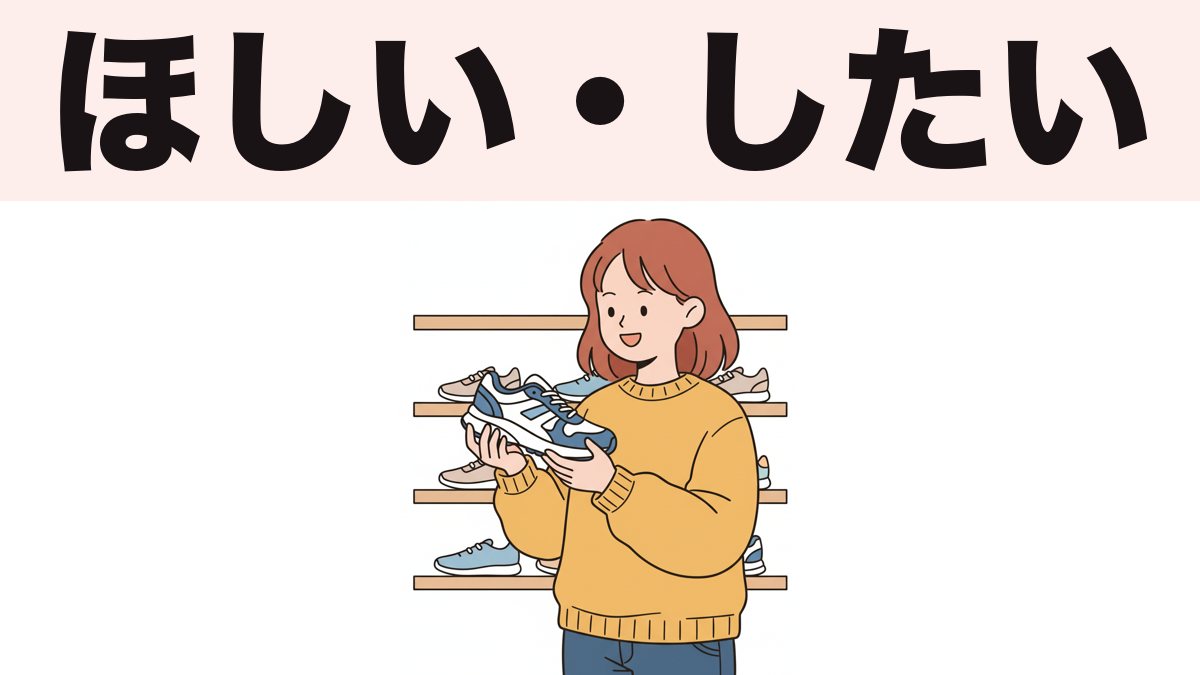
ほしい means you want a *thing*; 〜たい means you want to *do* something. Both are い-adjectives, both take が, and — the part nobody warns you about — neither can be used about another person. 彼は行きたいです is wrong; it has to be 行きたがっています.
「欲しい(ほしい)」は**もの**がほしい。「〜たい」は**すること**がしたい。どちらも い形容詞で、どちらも「が」をとります。そして、だれも教えてくれないこと——**どちらも他の人には使えません**。「彼は行きたいです」は間違いで、「行きたがっています」になります。
Between them these two cover most of what a beginner needs to say, and the third piece, 〜てほしい ("I want you to…"), turns them into a way of asking for things.
The basics
The split
| Want what | Pattern | Example |
|---|---|---|
| A thing | noun + が + ほしい | 水がほしいです |
| To do something | verb ます-stem + たい | 水が飲みたいです |
| Someone else to do something | te-form + ほしい | 手伝ってほしいです |
新しい靴がほしいです。 — I want new shoes. (polite — a thing) 日本に行きたいです。 — I want to go to Japan. (polite — an action)
たい attaches to the ます-stem, exactly like 〜やすい and 〜にくい: 飲みます → 飲みたい, 食べます → 食べたい, します → したい.
Both are い-adjectives
Once attached, ほしい and たい conjugate like 高い:
| ほしい | 行きたい | |
|---|---|---|
| Present | ほしい | 行きたい |
| Negative | ほしくない | 行きたくない |
| Past | ほしかった | 行きたかった |
| Past negative | ほしくなかった | 行きたくなかった |
昨日は何も食べたくなかったです。 — I didn't want to eat anything yesterday. (polite past negative)
So ほしいでした and 行きたいでした do not exist, for the same reason 高いでした does not — see い-adjectives vs な-adjectives.
The particle: が, and sometimes を
With ほしい it is always が. With たい, both が and を appear:
水が飲みたいです。 — I want to drink water. (polite — が, the classic form) この本を読みたいです。 — I want to read this book. (polite — を, also natural)
The rough tendency: が emphasises the thing you want, を keeps the focus on the action. Both are correct, and long sentences with other が in them tend to prefer を to avoid pile-ups. What is not correct is 水をほしい — ほしい never takes を.
Beyond the basics
You cannot use these about other people
This is the rule that surprises everyone. In Japanese, another person's desires are not something you can state as fact. For a third person, use 〜たがる / ほしがる:
弟は新しい自転車をほしがっています。 — My brother wants a new bike. (polite — ほしがる, and note it takes を) 彼は日本に行きたがっています。 — He wants to go to Japan. (polite — たがる)
Note two things: the がる forms normally appear in the teiru form, and ほしがる switches the particle to を, because がる makes it a verb ("shows signs of wanting").
The alternative is to hedge instead: 行きたいみたいです, 行きたいそうです, 行きたいと思っています. All of these mark the thought as reported rather than known — the same instinct behind 〜と思っています for other people's thoughts.
〜てほしい: asking without asking
ちょっと手伝ってほしいんですけど。 — I'd like you to help me a bit… (polite, trailing — a soft request)
てほしい states your wish rather than issuing an instruction, which makes it gentler than 〜てください. The person marked with に is the one you want to act: 田中さんに来てほしい.
The negative is ないでほしい: 言わないでほしい ("I'd rather you didn't say that").
〜たいですか can be too direct
Asking a superior 何が食べたいですか is grammatically fine and socially blunt — it puts their desires on the table for inspection. Softer options:
何になさいますか。 — What will you have? (very polite — honorific なさる) お茶でもいかがですか。 — Would you like some tea? (polite offer)
Among friends, 何食べたい? is completely normal. The problem is only upwards.
〜たいと思っています
Attaching 思っています softens a stated desire into a considered intention, which is why it dominates job interviews and formal self-introductions:
将来、日本で働きたいと思っています。 — I'm hoping to work in Japan in the future. (polite — measured, not blurted)
ほしい also means "desirable" in the abstract
もう少し時間がほしいですね。 — We could do with a bit more time. (polite — a shared wish, not a personal demand)
Used this way it is closer to English "it'd be good to have," and it can include the listener rather than only the speaker.
Common mistakes
- 水をほしいです. ほしい takes が: 水がほしいです.
- 彼は行きたいです. Other people need 行きたがっています, or a hedge like 行きたいみたいです.
- ほしいでした / 行きたいでした. These are い-adjectives: ほしかったです, 行きたかったです.
- 飲むたい. たい attaches to the ます-stem: 飲みたい.
- Using 〜たいですか with a boss. Grammatically fine, socially blunt. Use いかがですか or なさいますか.
- Confusing ほしがる's particle. ほしい takes が, but ほしがる takes を.
Practice
Answers are hidden — build yours first, then open. Questions 1 and 2 are a pair: same water, and only the kind of wanting changes.
1. Say "I want water."
Show answer
水がほしいです — a thing, so noun + が + ほしい. を is never correct with ほしい.
2. Say "I want to drink water."
Show answer
水が飲みたいです — an action, so ます-stem + たい. This is the pair to question 1.
3. Something is wrong here: 昨日は行きたいでした。
Show answer
行きたかったです — たい is an い-adjective, so the past is かった.
4. Something is wrong here: 彼は日本に行きたいです。
Show answer
行きたがっています — you cannot state another person's desire as fact. がる, usually in the teiru form.
5. Say "my brother wants a new bike."
Show answer
弟は新しい自転車をほしがっています — ほしがる is a verb, so the particle switches from が to を.
6. Ask someone to help you, softly, using ほしい.
Show answer
ちょっと手伝ってほしいんですけど — てほしい states a wish rather than giving an instruction, which is gentler than てください.
7. Say "I'd rather you didn't say that."
Show answer
言わないでほしいです — the negative of てほしい is ないでほしい.
8. Your boss is choosing lunch. Is 何が食べたいですか a good question?
Show answer
Grammatical but blunt — 何になさいますか or お茶でもいかがですか are the upward-facing versions. With friends, 何食べたい? is fine.
9. Say "I'm hoping to work in Japan in the future," in a job-interview register.
Show answer
将来、日本で働きたいと思っています — 思っています turns a blurted wish into a considered intention.
10. Make 食べる into the たい form, and say what it attaches to.
Show answer
食べたい — the ます-stem — 食べます minus ます, plus たい. Not the dictionary form.
FAQ
Is たい ever used with ください? No. たいてください does not exist. For requests, use てほしい or てください.
What about ほしがっている vs ほしがる? The plain ほしがる is generic ("children want toys"); the teiru form describes a specific person right now, which is what you usually mean.
Can I use たい in the negative to refuse? Yes, and it is common: 行きたくないです. It is direct, though — a softer refusal trails off instead: ちょっと…
Is 欲しい written in kanji? Both appear. 欲しい is standard in writing; kana is common in casual text.
What is 〜たがっている for objects? Nothing — がる is for people. For a machine "wanting" something, Japanese rephrases entirely.
Does 〜たい work with する verbs? Yes: 勉強したい, 電話したい. The stem of します is し.
Vocabulary from this article
Tap the block to select all of it, then copy. In Anki: File → Import, note type Basic, separator Tab — the first column becomes the front, the second the back.
欲しい	ほしい — to want (a thing)
水	みず — water
飲む	のむ — to drink
新しい	あたらしい — new
靴	くつ — shoes
日本	にほん — Japan
行く	いく — to go
本	ほん — book
読む	よむ — to read
昨日	きのう — yesterday
食べる	たべる — to eat
弟	おとうと — younger brother
自転車	じてんしゃ — bicycle
手伝う	てつだう — to help
言う	いう — to say
将来	しょうらい — the future
働く	はたらく — to work
時間	じかん — time
お茶	おちゃ — tea
勉強	べんきょう — study
電話	でんわ — telephone
高い	たかい — expensive, high
I'm Yuuki, a Japanese teacher based in Tokyo. I've taught on italki as a Top 1% teacher and watched over 1,500 anime. The rule that stops learners cold is not the particle — it is being told they cannot say what someone else wants. It is worth sitting with, because the same logic runs through 思う, 感じる and every other verb about the inside of a head.
Sources: the author's own lessons and standard reference grammars.
この2つで、初級で言いたいことのほとんどがカバーできます。3つ目の「〜てほしい」(人にしてほしい)を足すと、おねがいもできるようになります。
基本
分け方
| 何がほしいか | 形 | れい |
|---|---|---|
| もの | 名詞+が+ほしい | 水がほしいです |
| すること | 動詞のます形+たい | 水が飲みたいです |
| 人にしてほしい | て形+ほしい | 手伝ってほしいです |
新しい靴がほしいです。 — I want new shoes. 日本に行きたいです。 — I want to go to Japan.
「たい」はます形につきます。「飲みます→飲みたい」「食べます→食べたい」「します→したい」。
どちらも い形容詞
| ほしい | 行きたい | |
|---|---|---|
| 今 | ほしい | 行きたい |
| うちけし | ほしくない | 行きたくない |
| かこ | ほしかった | 行きたかった |
| かこ・うちけし | ほしくなかった | 行きたくなかった |
昨日は何も食べたくなかったです。 — I didn't want to eat anything yesterday.
「ほしいでした」「行きたいでした」はありません。「高いでした」がないのと同じです。
助詞は「が」、時々「を」
「ほしい」はいつも「が」です。「たい」は「が」も「を」も出ます。
水が飲みたいです。 — I want to drink water. この本を読みたいです。 — I want to read this book.
「が」はほしいものを強く、「を」は動作に目を向けます。どちらも正しいです。「水をほしい」だけは間違いです。
もう少しくわしく
他の人には使えません
日本語では、他の人の気もちを「そうだ」とは言えません。3人目には「〜たがる」「ほしがる」を使います。
弟は新しい自転車をほしがっています。 — My brother wants a new bike. 彼は日本に行きたがっています。 — He wants to go to Japan.
2つ気をつけてください。「がる」はふつう「ています」の形で使います。そして「ほしがる」は助詞が「を」に変わります(動詞になるからです)。
もう1つのやり方は、ぼかすことです。「行きたいみたいです」「行きたいそうです」「行きたいと思っています」。
「〜てほしい」= おねがい
ちょっと手伝ってほしいんですけど。 — I'd like you to help me a bit…
「してください」より、やわらかいです。めいれいではなく、自分の気もちを言っているからです。してほしい相手は「に」でしめします(田中さんに来てほしい)。
うちけしは「ないでほしい」です。「言わないでほしい」。
「〜たいですか」は直せつすぎることがある
目上の人に「何が食べたいですか」は、文法は正しくても少しぶしつけです。
何になさいますか。 — What will you have? お茶でもいかがですか。 — Would you like some tea?
友だちには「何食べたい?」でぜんぜんかまいません。問題になるのは上に向かう時だけです。
「〜たいと思っています」
「思っています」をつけると、思いつきではなく、考えた上での気もちになります。面接(めんせつ)や自こしょうかいでよく使います。
将来、日本で働きたいと思っています。 — I'm hoping to work in Japan in the future.
「ほしい」=「あるといい」
もう少し時間がほしいですね。 — We could do with a bit more time.
この使い方は、自分だけでなく、聞いている人もふくみます。
よくある間違い
- 水をほしいです。 「ほしい」は「が」です。
- 彼は行きたいです。 他の人は「行きたがっています」です。
- ほしいでした/行きたいでした。 い形容詞なので「ほしかったです」「行きたかったです」です。
- 飲むたい。 「ます形」につきます。「飲みたい」です。
- 目上の人に「〜たいですか」。 「いかがですか」「なさいますか」を使います。
- 「ほしがる」の助詞。 「ほしい」は「が」、「ほしがる」は「を」です。
練習
答えはかくれています。まず自分で作ってから開いてください。1番と2番が対です。同じ水で、ほしがり方だけが変わります。
1. 「水がほしいです」— どうして「が」ですか。
答えを見る
「ほしい」は名詞+が だから — 「を」は使えません。
2. 「水を飲みたい」を言ってください。前の形は?
答えを見る
水が飲みたいです(ます形+たい) — 1番と対で、ものではなく動作です。
3. 直してください: 昨日は行きたいでした。
答えを見る
行きたかったです — 「たい」は い形容詞です。
4. 直してください: 彼は日本に行きたいです。
答えを見る
行きたがっています — 他の人の気もちは、そうだと言えません。
5. 「弟が新しい自転車をほしがっています」— どうして「を」ですか。
答えを見る
「ほしがる」は動詞だから — 「ほしい」は形容詞で「が」、「ほしがる」は動詞で「を」です。
6. やわらかく手つだいをおねがいしてください。
答えを見る
ちょっと手伝ってほしいんですけど — めいれいではなく、自分の気もちを言っています。
7. 「それは言わないでください」をやわらかく言ってください。
答えを見る
言わないでほしいです — 「てほしい」のうちけしは「ないでほしい」です。
8. 目上の人に「何が食べたいですか」と聞くのはどうですか。
答えを見る
文法は正しいですが、少しぶしつけです — 「何になさいますか」「いかがですか」を使います。友だちにはOKです。
9. 面せつで「将来日本で働きたい」と言ってください。
答えを見る
将来、日本で働きたいと思っています — 考えた上での気もちになります。
10. 「食べる」を「たい」の形にしてください。何につきますか。
答えを見る
食べたい — ます形につきます — じしょ形ではありません。
この記事に出た単語
ブロックをタップすると全部選べます。そのままコピーしてください。Anki では ファイル → 読み込み、ノートタイプ 基本、区切り タブ。1列目が表、2列目が裏になります。
欲しい	ほしい — to want (a thing)
水	みず — water
飲む	のむ — to drink
新しい	あたらしい — new
靴	くつ — shoes
日本	にほん — Japan
行く	いく — to go
本	ほん — book
読む	よむ — to read
昨日	きのう — yesterday
食べる	たべる — to eat
弟	おとうと — younger brother
自転車	じてんしゃ — bicycle
手伝う	てつだう — to help
言う	いう — to say
将来	しょうらい — the future
働く	はたらく — to work
時間	じかん — time
お茶	おちゃ — tea
高い	たかい — expensive, high
面接	めんせつ — job interview
私はユウキです。東京で日本語を教えています。 italki の Top 1% の先生で、アニメは1,500本以上見ました。人が止まるのは助詞ではありません。「他の人の気もちは言えません」と聞いた時です。ここはゆっくり考える価値があります。同じ考え方が「思う」「感じる」など、人の頭の中の話ぜんぶを通っているからです。
More drills like the ones above, plus a timed JLPT-style mock test: Practice · N5上のような練習問題と、時間つきのJLPT形式のもぎ試験: 練習ページ · N5
Want to try this in a real conversation?
本当の会話で、ためしてみませんか?
30-minute trial lesson, $13. Times shown in your own timezone.
30分の体験レッスン、$13。時間はあなたのタイムゾーンで表示されます。
Book a trial lesson · $13