ただ: "free," "merely," and "but" — three words sharing one sound「ただ」は3つのことば: 無料・〜だけ・でも
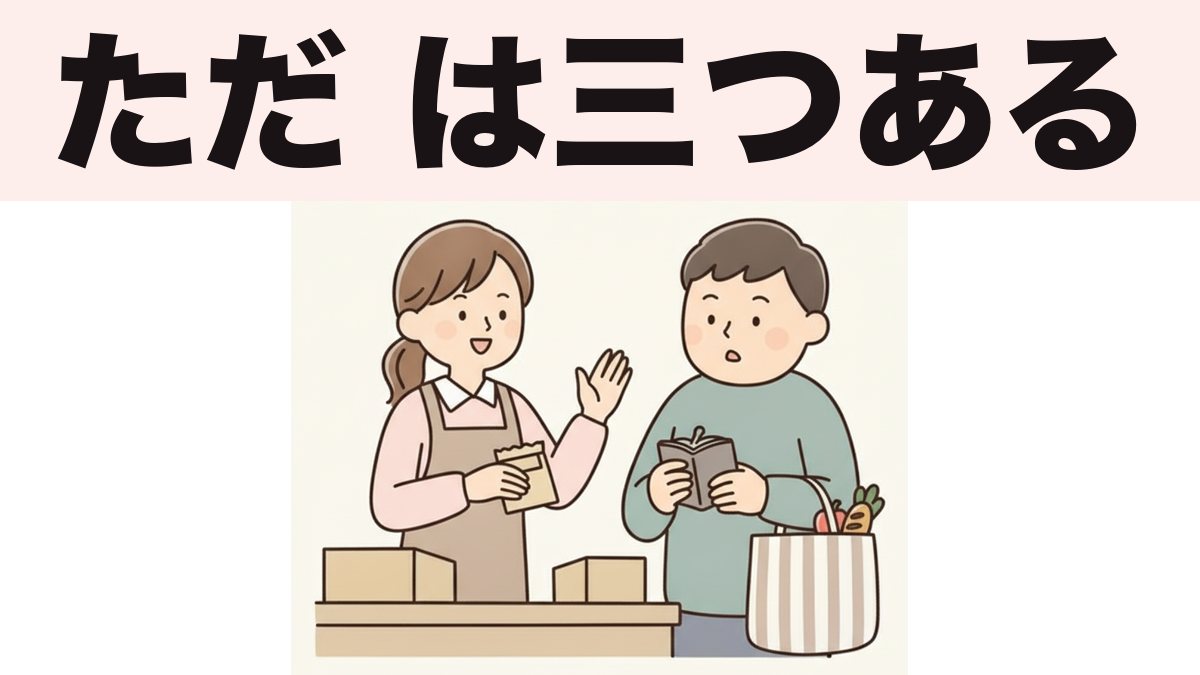
ただ is three different words. At the front of a sentence it means "but." In front of a noun it means "merely, nothing more than." On its own after です it means "free of charge." Position tells you which one you are hearing.
「ただ」は3つの別のことばです。文の先頭なら「でも」。名詞の前なら「〜にすぎない」。「です」の前なら「お金がいらない」。どこにあるかで決まります。
Learners usually meet the "free" one first, from a sign or a game, and then spend months confused when characters start sentences with ただ. They are not the same word, and no amount of thinking about "free" will get you to "however."
The basics
ただ = free of charge
This is the one everybody learns first. In this meaning it is often written in katakana — タダ — precisely to separate it from the other two.
このアプリはただです。 — This app is free. (polite) 入場はタダだった。 — Entry was free. (casual)
The neutral word is 無料 (むりょう), and that is what appears on signs, websites and anything official. ただ is the spoken, slightly blunter version.
| Word | Register | Where you see it |
|---|---|---|
| 無料 | Neutral, written | Signs, websites, forms, announcements |
| ただ / タダ | Casual speech | Conversation, manga, adverts aimed at you |
| 無償 (むしょう) | Formal, written | Contracts, "free of charge" in a legal sense |
| サービス | Casual, in shops | "On the house" — a Japanese use of the English word |
That last one is worth knowing: a restaurant saying これはサービスです means "this one's on us," not "this is our service."
ただ = merely, nothing more than
Put it in front of a noun with の, and it means the thing is ordinary — and usually the speaker is pushing back on someone who thinks otherwise.
ただの風邪です。 — It's just a cold. (polite) ただの友達だよ。 — We're just friends. (casual)
The tone is always mild denial. ただの〜 is the word you reach for when someone has read too much into something.
Without の it attaches to numbers and counters for emphasis:
ただ一人だけ残った。 — Only one person remained. (written/literary)
This second meaning is close to だけ and しか, but ただ is heavier and more dramatic. だけ is how you say "only" in conversation; ただ一人 is how a narrator says it.
ただ = but, however
At the start of a sentence, ただ is a soft "but." It adds a caveat to something you have just agreed with.
いいと思います。ただ、時間がかかりますね。 — I think it's good. It's just that it'll take time. (polite) 行きたい。ただ、お金がない。 — I want to go. Only, I have no money. (casual)
The feel is closer to English "only," "just," or "the thing is" than to a hard "but." It softens rather than contradicts, which is why it turns up so much in polite disagreement.
Beyond the basics
ただし is the rule-book version
ただし (只し) is the formal relative of the third meaning, and it means "provided that." It appears in rules, terms and signs — essentially anywhere conditions are attached.
入場無料。ただし、小学生以下は保護者同伴。 — Admission free. However, children of primary school age and under must be accompanied by a guardian. (written)
If you ever read the small print on a Japanese poster, ただし is the word introducing the catch.
ただいま is a different word wearing the same clothes
ただいま is 只今 — "just now, at this moment." The homecoming greeting is a shortening of ただいま帰りました ("I have returned just now"), which is why it means "I'm home" without containing any word for "home."
You also hear the full version constantly in shops and on the phone:
ただいま準備中です。 — We are preparing right now. (polite) ただいま席を外しております。 — They are away from their desk at the moment. (humble)
So if you hear ただいま from a member of staff, nobody has come home. This is the same kind of split covered in Japanese homophones, except here the words are genuinely related and drifted apart.
The compounds that mean "for free"
- ただ働き (ただばたらき) — working without pay
- ただ乗り (ただのり) — riding without paying; also "free-riding" in the social sense
- ただ見 (ただみ) — watching without paying
All three carry a faint disapproval. They are not neutral descriptions of a free service — they describe getting something you should have paid for.
タダより高いものはない
A proverb you will meet: タダより高いものはない — "there is nothing more expensive than something free." It is the Japanese "there's no such thing as a free lunch," and it turns up in conversation whenever someone is offered a suspiciously good deal. The 高い here is the price meaning, which the 高い article untangles from the height meaning.
ただでさえ
ただでさえ means "even as it is, even without that." It sets up a complaint about something being made worse.
ただでさえ忙しいのに、仕事が増えた。 — I was already busy as it is, and now there's more work. (casual)
The のに at the end is doing its usual job of carrying the grievance.
How it sounds in anime
Three things worth listening for.
First, ただの〜じゃない — "this isn't just a ___" — is a stock line before a reveal. ただの人間じゃない. It is almost a genre marker.
Second, characters use sentence-initial ただ constantly to half-agree, and subtitles usually render it as "but," which flattens it. What is actually happening is a softer hedge: the speaker is conceding the point and adding a problem.
Third, ただ一人 and ただ一つ in narration are register markers. When a narrator says ただ一人生き残った, the ただ is doing emotional work that だけ would not do.
Common mistakes
- Saying ただですか? to a shop assistant. It reads as blunt, close to "is this a freebie?" Ask 無料ですか. Use ただ for things, not to people's faces.
- Using ただ to mean "but" in writing. In formal writing you want しかし or ただし. Sentence-initial ただ is conversational.
- ただの before a verb. ただの attaches to nouns only — ただの学生. In front of a verb you want ただ〜だけ.
- Reading ただいま as only the greeting. In a shop or on the phone it means "right now," and the sentence continues.
- Assuming タダ in katakana is slang. The katakana is just visual separation from the other two meanings. It is not youth language.
- Confusing ただ with たた・だだ. Both syllables are short. Lengthening either makes a different word or no word at all.
FAQ
Is ただ rude? The word itself is not. Using it about a price, to the person selling you the thing, is what sounds blunt. 無料 is the safe choice in any exchange with staff.
Why is ただ sometimes written タダ? To disambiguate. Japanese has no spaces and few capital letters, so katakana is often used to signal "this one, the free one." You will see the same trick with ダメ and スゴい.
Is ただし the same word as ただ? Historically yes, in the "but" sense. In practice treat them as separate: ただ is conversational, ただし is the written form used in rules and conditions.
What is the difference between ただの and 単なる (たんなる)? They overlap. 単なる is stiffer and more written; ただの is what you say out loud. 単なるミス and ただのミス both mean "just a mistake."
Does ただ ever mean "always"? No. You may be thinking of いつも. The confusion usually comes from ただただ, a reduplicated adverb meaning "simply, utterly" — ただただ驚いた, "I was simply astonished."
Practice
Questions 1 and 2 are a pair: the same word, two completely different meanings, told apart only by position.
1. Say "This app is free," politely.
Show answer
このアプリはただです。 — or 無料です. After は〜です, ただ is the price meaning. 無料 is the safer choice when talking to staff.
2. Say "I think it's good. It's just that it'll take time," politely.
Show answer
いいと思います。ただ、時間がかかりますね。 — at the front of a sentence, ただ is the soft "but." Position is the only thing distinguishing it from question 1.
3. Someone assumes your cough is serious. Tell them it's just a cold, politely.
Show answer
ただの風邪です。 — ただの+noun means "nothing more than." The tone is mild denial, which fits exactly here.
4. Fix this: ただ学生です。 (intended: "I'm just a student")
Show answer
ただの学生です。 — the の is required when ただ attaches to a noun. Without it the sentence reads as an unfinished "but."
5. A sign says 入場無料。ただし、小学生以下は保護者同伴。 What is ただし doing?
Show answer
Introducing a condition — "provided that." ただし is the written, rule-book form. Entry is free, but only with a guardian for younger children.
6. A shop assistant says ただいま準備中です。 Has someone come home?
Show answer
No. ただいま here means "right now." 只今 is "at this moment." The homecoming greeting is a shortening of ただいま帰りました.
7. What does ただ働き mean, and what is the feeling attached to it?
Show answer
Working without pay — and it is a complaint. ただ働き・ただ乗り・ただ見 all imply getting something you should have paid for.
8. Translate the proverb タダより高いものはない.
Show answer
"There is nothing more expensive than something free." The Japanese equivalent of "there's no such thing as a free lunch." 高い here is price, not height.
9. Say "I was already busy as it is, and now there's more work," casually.
Show answer
ただでさえ忙しいのに、仕事が増えた。 — ただでさえ sets up "even without this," and のに carries the grievance.
10. You want to write "but" at the start of a sentence in a formal report. Is ただ the right choice?
Show answer
No — use しかし, or ただし if you are attaching a condition. Sentence-initial ただ is conversational and looks light in formal writing.
Vocabulary from this article
Tap the block to select all of it, then copy. In Anki: File → Import, note type Basic, separator Tab — the first column becomes the front, the second the back.
ただ	ただ — free; merely; but
無料	むりょう — free of charge (neutral, written)
無償	むしょう — free of charge (formal, legal)
ただし	ただし — however, provided that
只今	ただいま — right now; I'm home
ただ働き	ただばたらき — working without pay
ただ乗り	ただのり — riding without paying, free-riding
単なる	たんなる — mere, simple (written)
風邪	かぜ — a cold
入場	にゅうじょう — entry, admission
保護者	ほごしゃ — guardian
同伴	どうはん — accompaniment
準備中	じゅんびちゅう — preparing, not yet open
席を外す	せきをはずす — to be away from one's desk
増える	ふえる — to increase
驚く	おどろく — to be surprised
I'm Yuuki, a Japanese teacher based in Tokyo. I've taught on italki as a Top 1% teacher and watched over 1,500 anime. Students almost always arrive with only the "free" meaning, and the sentence-initial ただ is what trips them up in real conversation — so that is the one worth drilling.
Sources: the author's own lessons and standard reference grammars.
多くの人は「無料」の意味をさきに覚えます。そのあと、話の先頭に出てくる「ただ」でこんがらがります。別のことばなので、「無料」から考えても分かりません。
基本
ただただお金がいらない
いちばん有名な意味です。この意味の時は「タダ」とカタカナで書くことが多いです。ほかの意味と分けるためです。
このアプリはただです。 — This app is free. (polite) 入場はタダだった。 — Entry was free. (casual)
書くときや、お店の案内では「無料(むりょう)」を使います。
| ことば | 感じ | 使う場所 |
|---|---|---|
| 無料 | ふつう・書きことば | 案内・サイト・申込書 |
| ただ / タダ | 話しことば | 会話・マンガ・広告 |
| 無償(むしょう) | かたい・書きことば | 契約書 |
| サービス | お店の話しことば | 「お店からのおまけ」 |
お店で「これはサービスです」と言われたら、「おまけです」という意味です。
ただ=〜にすぎない
名詞の前に「ただの」を置くと、「ふつうのものだ」という意味になります。相手が大きく考えすぎている時に使います。
ただの風邪です。 — It's just a cold. (polite) ただの友達だよ。 — We're just friends. (casual)
「の」がない形は、数のことばにつきます。
ただ一人だけ残った。 — Only one person remained. (written)
「だけ」と近いですが、「ただ一人」のほうが重く、物語の言い方です。
ただ=でも
文の先頭に置くと、やわらかい「でも」になります。いったん相手に合わせてから、気になる点を足します。
いいと思います。ただ、時間がかかりますね。 — I think it's good. It's just that it'll take time. (polite) 行きたい。ただ、お金がない。 — I want to go. Only, I have no money. (casual)
強く打ち消す「でも」ではなく、やわらげる言い方です。
もう少し先へ
「ただし」は決まりのことば
「ただし」は書きことばで、「でも、条件があります」という意味です。案内や規則に出ます。
入場無料。ただし、小学生以下は保護者同伴。 — Admission free. However, children of primary school age and under must be accompanied by a guardian. (written)
「ただいま」は別のことば
「ただいま」は「只今」で、「今」という意味です。家に帰った時のあいさつは「ただいま帰りました」を短くしたものです。だから「家」ということばが入っていません。
ただいま準備中です。 — We are preparing right now. (polite) ただいま席を外しております。 — They are away from their desk at the moment. (humble)
お店で「ただいま」と聞いても、だれも帰ってきていません。
「ただ〜」のことば
- ただ働き(ただばたらき) — お金をもらわずに働く
- ただ乗り(ただのり) — お金をはらわずに乗る
- ただ見(ただみ) — お金をはらわずに見る
どれも少しよくない感じがあります。
タダより高いものはない
ことわざです。タダより高いものはない。ただでもらった物は、あとで高くつく、という意味です。
ただでさえ
「ただでさえ」は「それがなくても、もう」という意味です。
ただでさえ忙しいのに、仕事が増えた。 — I was already busy as it is, and now there's more work. (casual)
アニメでの聞こえ方
3つあります。
1つめ。「ただの〜じゃない」は、正体が分かる場面の決まった言い方です。「ただの人間じゃない」。
2つめ。話の先頭の「ただ」はとてもよく出ます。字幕では "but" になりますが、本当はもっとやわらかい言い方です。
3つめ。ナレーションの「ただ一人」「ただ一つ」は、物語の重い言い方です。「だけ」では同じ感じが出ません。
よくあるまちがい
- 店員さんに「ただですか?」と聞く。 ぶっきらぼうに聞こえます。「無料ですか」と言います。
- 書きことばで「ただ」を「でも」の意味で使う。 「しかし」か「ただし」を使います。
- 動詞の前に「ただの」を置く。 「ただの」は名詞につきます。動詞には「ただ〜だけ」です。
- 「ただいま」をあいさつだけだと思う。 お店や電話では「今」という意味です。
- 「タダ」を若者ことばだと思う。 ほかの意味と分けるためのカタカナです。
FAQ
「ただ」は失礼ですか? ことば自体は失礼ではありません。お店の人に値段の話で使うとぶっきらぼうです。「無料」が安全です。
どうして「タダ」とカタカナで書くのですか? ほかの意味と分けるためです。「ダメ」「スゴい」も同じ書き方をします。
「ただし」は「ただ」と同じことばですか? もとは同じですが、今は別のものとして覚えてください。「ただ」は会話、「ただし」は規則の文です。
「ただの」と「単なる(たんなる)」のちがいは? 意味は近いです。「単なる」は書きことばでかたく、「ただの」は話しことばです。
「ただ」に「いつも」の意味はありますか? ありません。「ただただ」(ただただ驚いた)と混ざっているかもしれません。これは「本当に、ひたすら」という意味です。
練習
1番と2番は対です。同じことばですが、場所がちがうので意味がちがいます。
1. 「このアプリは無料です」を「ただ」で、ていねいに。
答えを見る
このアプリはただです。 — 「は〜です」の形の中では、お金の意味です。店員さんには「無料です」のほうが安全です。
2. 「いいと思います。でも時間がかかります」を「ただ」で、ていねいに。
答えを見る
いいと思います。ただ、時間がかかりますね。 — 文の先頭なら、やわらかい「でも」です。1番とちがうのは場所だけです。
3. 相手が心配しています。「ただの風邪です」と、ていねいに。
答えを見る
ただの風邪です。 — 「ただの+名詞」は「それにすぎない」です。やんわり打ち消す言い方です。
4. 直してください: ただ学生です。(「ただの学生だ」と言いたい)
答えを見る
ただの学生です。 — 名詞につく時は「の」が要ります。「の」がないと、言いかけの「でも」に聞こえます。
5. 「入場無料。ただし、小学生以下は保護者同伴。」の「ただし」は何をしていますか。
答えを見る
条件を足しています。 「ただし」は規則の文のことばです。無料ですが、小さい子は大人といっしょに、という意味です。
6. 店員さんが「ただいま準備中です」と言いました。だれか帰ってきましたか。
答えを見る
いいえ。ここの「ただいま」は「今」です。 あいさつの「ただいま」は「ただいま帰りました」を短くしたものです。
7. 「ただ働き」はどんな意味で、どんな感じですか。
答えを見る
お金をもらわずに働くこと。よくない感じがあります。 「ただ乗り」「ただ見」も同じです。
8. 「タダより高いものはない」の意味は。
答えを見る
ただでもらった物は、あとで高くつく。 ここの「高い」は値段の意味です。
9. 「ただでさえ忙しいのに、仕事が増えた」を作ってください。
答えを見る
ただでさえ忙しいのに、仕事が増えた。 — 「ただでさえ」は「それがなくても、もう」。「のに」が不満を運びます。
10. かたい報告書の文の先頭に「でも」と書きたいです。「ただ」でいいですか。
答えを見る
いいえ。「しかし」、条件をつけるなら「ただし」です。 文の先頭の「ただ」は話しことばです。
この記事に出た単語
このブロックをタップして全部選び、コピーしてください。Anki では File → Import、ノートタイプ 基本、区切り タブ を選びます。1列目が表、2列目が裏になります。
ただ	ただ — free; merely; but
無料	むりょう — free of charge (neutral, written)
無償	むしょう — free of charge (formal, legal)
ただし	ただし — however, provided that
只今	ただいま — right now; I'm home
ただ働き	ただばたらき — working without pay
ただ乗り	ただのり — riding without paying, free-riding
単なる	たんなる — mere, simple (written)
風邪	かぜ — a cold
入場	にゅうじょう — entry, admission
保護者	ほごしゃ — guardian
同伴	どうはん — accompaniment
準備中	じゅんびちゅう — preparing, not yet open
席を外す	せきをはずす — to be away from one's desk
増える	ふえる — to increase
驚く	おどろく — to be surprised
More drills like the ones above, plus a timed JLPT-style mock test: Practice · N4上のような練習問題と、時間つきのJLPT形式のもぎ試験: 練習ページ · N4
Want to try this in a real conversation?
本当の会話で、ためしてみませんか?
30-minute trial lesson, $13. Times shown in your own timezone.
30分の体験レッスン、$13。時間はあなたのタイムゾーンで表示されます。
Book a trial lesson · $13