Japanese homophones: はし, あめ, かみ — and how anyone tells them apart同音異義語: はし・あめ・かみ を、どうやって見分けるのか
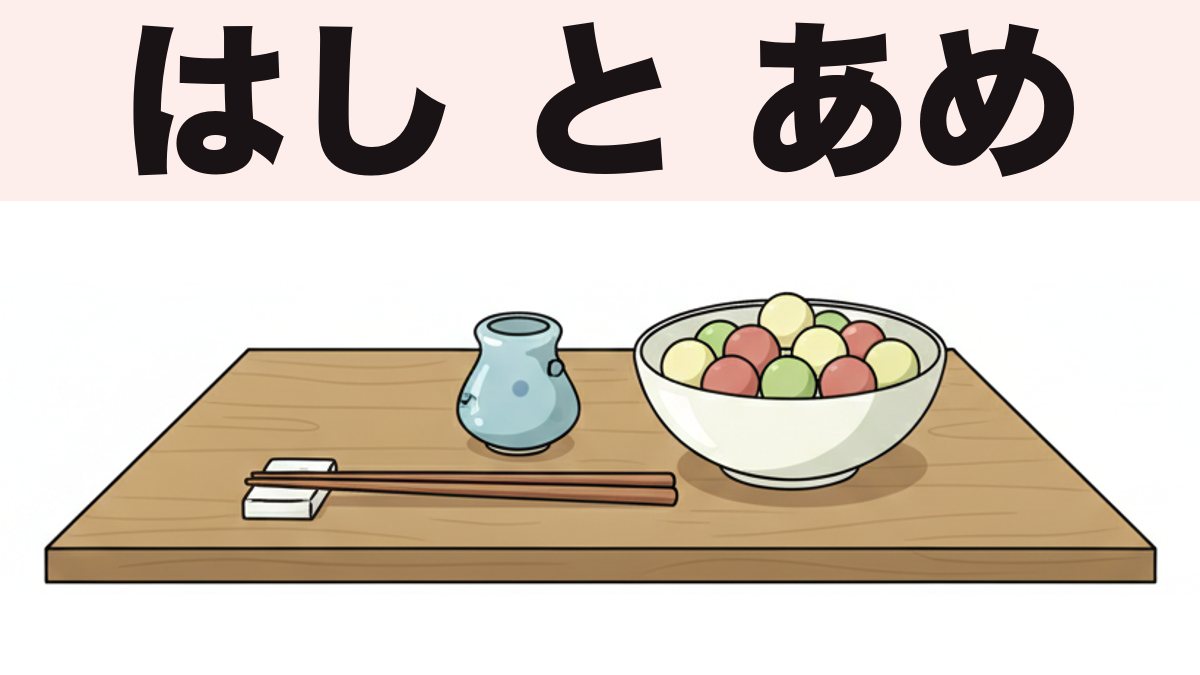
Japanese has an unusual number of homophones because it has an unusually small sound inventory. Three things sort them out: pitch accent, kanji in writing, and — for the ones that defeat both — workarounds that speakers invented on purpose. Learning that third category is the part that actually helps.
日本語に同音異義語が多いのは、音の数が少ないからです。分けているのは3つです。アクセント、書く時の漢字、そして、その2つでも分けられないことばのために、話す人が作った「言いかえ」です。3つめを知ると、本当に役に立ちます。
Learners worry about this far more than they need to, because context does almost all the work. But the cases where context is not enough are genuinely interesting, and they explain some otherwise baffling things you will hear people say.
The basics
Why there are so many
Japanese has around 100 possible syllables, against several thousand in a language like English or Mandarin. When a thousand years of Chinese vocabulary is poured into a sound system that small, collisions are guaranteed.
The result is that a two-syllable Sino-Japanese reading like こうしょう maps to dozens of different words — negotiation, a factory, an official, a proper noun, and more. Nobody memorises those. They read the kanji.
Pitch accent separates some of them
Japanese distinguishes words by the pitch pattern across the syllables, not by stress. The classic example:
| Word | Kanji | Tokyo pitch |
|---|---|---|
| chopsticks | 箸 | HA-shi (high, then down) |
| bridge | 橋 | ha-SHI (rises, then drops after) |
| edge | 端 | ha-SHI (rises, stays up) |
橋 and 端 sound identical alone; they differ once a particle follows, because 橋が drops after the し and 端が does not.
Another pair you will meet early:
雨(あめ) — rain. (high, then down) 飴(あめ) — candy. (rises and stays)
Pitch is real and it matters, but it is not where a learner should start. Native speakers mishear each other too and repair it from context, which is exactly what you will do.
Kanji separates the rest
In writing there is no ambiguity at all, which is a large part of why Japanese kept kanji in the first place. Consider かみ:
| Kanji | Meaning |
|---|---|
| 紙 | paper |
| 髪 | hair |
| 神 | god |
And かえる:
| Kanji | Meaning |
|---|---|
| 帰る | to go home |
| 変える | to change |
| 買える | can buy |
| 蛙 | frog |
On the page these are four unrelated words that happen to rhyme. Only in speech do they collide, and even then, 家に帰る and カエルを見た are not going to be confused by anyone.
Beyond the basics
The workarounds native speakers use
This is the genuinely useful part. For a handful of pairs, context is not reliable enough, so Japanese speakers deliberately say the word differently.
化学 and 科学 are both かがく — chemistry and science. In a context where both are plausible, speakers say 化学 as ばけがく, using the native reading of 化 (ばける, "to transform"). It is not a dialect or a mistake; it is a repair, and chemists use it constantly.
私立 and 市立 are both しりつ — private (school) and municipal. The repair is to spell them out with native readings: 私立 becomes わたくしりつ and 市立 becomes いちりつ. You will hear this on the news.
The existence of these tells you something useful: when Japanese speakers cannot disambiguate from context, they do not shrug. They fix it. So if you are ever genuinely unsure, asking is completely normal — see asking what something means for the phrasing.
The reverse problem: one spelling, two readings
Homophones are same sound, different kanji. Japanese also has the opposite — same kanji, different sound, different meaning.
市場(いちば) — a marketplace, a physical one with stalls. 市場(しじょう) — a market in the economic sense.
Identical in writing. And 人気 is にんき ("popularity") or ひとけ ("sign of people around"), depending entirely on which word is meant. These are genuinely harder than homophones, because writing does not save you.
How do you ask which word someone meant?
The standard question is about the kanji, not the meaning.
どんな漢字ですか。 — Which kanji is it? どう書きますか。 — How do you write it?
Asking どんな漢字ですか is completely ordinary and native speakers ask each other constantly, especially about names. It is the single most useful sentence in this whole area.
Does this matter for a learner?
Less than you fear, in three ways:
- Context resolves almost everything. You will not mistake 雨 for 飴 in a sentence about the weather.
- Reading is unambiguous. Every homophone problem disappears the moment it is written.
- Native speakers repair instantly. If you say 橋 with the wrong pitch, you will be understood and possibly not even noticed.
Where it does matter is listening comprehension of unfamiliar vocabulary. When you hear a Sino-Japanese word you do not know, you cannot look it up from the sound alone — which is why asking どんな漢字ですか is a genuine skill rather than an admission of weakness.
How does it show up in anime and wordplay?
Homophones are the engine of Japanese puns, and puns are everywhere — in names, in shop signs, in jokes that land flat in subtitles.
ダジャレ — a pun, usually a groan-worthy one. 布団が吹っ飛んだ。 — "The futon blew away." (ふとん/ふっとんだ — the standard example of a terrible pun)
Character names lean on this constantly, and it is one of the things that genuinely does not survive translation. When a subtitle says something that seems oddly unfunny, a homophone is often the reason.
Common mistakes
- Assuming pitch does not matter. It is a real part of the language, and 橋 and 箸 genuinely differ. Just do not let it block you from speaking.
- Trying to memorise homophone lists. Learn words with their kanji instead, and the collisions never arise.
- Panicking mid-conversation. Ask どんな漢字ですか. It is a normal question between native speakers.
- Thinking ばけがく is a mistake. It is a deliberate repair used by professionals.
- Confusing homophones with the reverse case. 市場 read two ways is a different problem, and writing does not solve it.
- Assuming subtitles carry the joke. Puns built on homophones usually cannot be translated, which is why some scenes look flat in English.
Practice
Answers are hidden — build yours first, then open. Questions 1 and 2 are a pair: the same three sounds, separated two different ways.
1. はし can be three words. Which three?
Show answer
箸 (chopsticks), 橋 (bridge), 端 (edge) — identical in kana, distinct in kanji, and separated in speech by pitch.
2. How do 橋 and 端 differ in speech, given both rise?
Show answer
What happens to the following particle — 橋が drops after the し; 端が stays up. Alone they sound the same; with a particle attached they do not. This is the pair to question 1: kanji separates them on paper, pitch in speech.
3. What is the difference between 雨 and 飴?
Show answer
Rain and candy — 雨 is high then down; 飴 rises and stays. Context resolves it in practice, which is what native speakers rely on too.
4. Why does Japanese have so many homophones?
Show answer
A small sound inventory — around 100 possible syllables, into which a thousand years of Chinese vocabulary was poured. Collisions were inevitable.
5. Why do people say ばけがく?
Show answer
To distinguish 化学 from 科学 — both are かがく. 化 is read with its native ばける, and chemists use it constantly. A deliberate repair, not an error.
6. How are 私立 and 市立 distinguished in speech?
Show answer
わたくしりつ and いちりつ — both are しりつ otherwise. You will hear the long forms on the news.
7. Ask which kanji a word uses.
Show answer
どんな漢字ですか — completely ordinary, and native speakers ask each other this constantly, especially about names.
8. What is the difference between 市場 (いちば) and 市場 (しじょう)?
Show answer
A physical marketplace vs a market in the economic sense — same kanji, two readings. This is the reverse problem, and writing does not solve it.
9. Name the four words written かえる.
Show answer
帰る (go home), 変える (change), 買える (can buy), 蛙 (frog) — four unrelated words that only collide in speech, where context sorts them instantly.
10. Why do some anime jokes seem unfunny in subtitles?
Show answer
They are homophone puns — ダジャレ built on words that sound alike in Japanese and share nothing in English. The joke cannot survive the translation.
FAQ
Should I study pitch accent? Eventually, and passively at first. Listening a lot will give you most of it without drills. Formal pitch study pays off around intermediate level, when your pronunciation is otherwise good enough for the pitch to be the remaining thing.
Are homophones a reason to learn kanji? They are one of the best reasons. Once you know a word with its kanji, you have learned a distinct thing rather than a sound with several possible meanings. Learners who avoid kanji hit exactly this wall.
Do Japanese people ever get confused? Yes, which is why the repairs exist. In ordinary conversation it is rare, and when it happens it is fixed in one exchange: どっちの? followed by an explanation.
Is this worse in Japanese than in other languages? More frequent, yes, mainly because of the small syllable inventory combined with heavy borrowing from Chinese. But the writing system compensates completely, which is why the language never had pressure to fix it.
What is 当て字? Kanji chosen for their sound rather than their meaning — common in old borrowings and in names. It is the same sound-versus-meaning tension from the other direction, and it is why some names are genuinely unreadable without being told.
How do I look up a word I only heard? Guess the kanji from the meaning and search that, or type the kana into a dictionary and read the list of candidates. If you are talking to someone, どんな漢字ですか is faster than either.
Vocabulary from this article
Tap the block to select all of it, then copy. In Anki: File → Import, note type Basic, separator Tab — the first column becomes the front, the second the back.
箸	はし — chopsticks
橋	はし — bridge
端	はし — edge
雨	あめ — rain
飴	あめ — candy
紙	かみ — paper
髪	かみ — hair
神	かみ — god
帰る	かえる — to go home
変える	かえる — to change
蛙	かえる — frog
化学	かがく — chemistry
科学	かがく — science
私立	しりつ — private (institution)
市立	しりつ — municipal
市場	いちば — marketplace
人気	にんき — popularity
漢字	かんじ — kanji
書く	かく — to write
布団	ふとん — futon
I'm Yuuki, a Japanese teacher based in Tokyo. I've taught on italki as a Top 1% teacher and watched over 1,500 anime. Learners treat homophones as a threat and they are really a reason to learn kanji — once a word arrives with its character attached, it stops being one sound with five meanings and becomes five separate words, which is what it always was.
Sources: the author's own lessons and standard reference grammars.
学習者は、必要よりずっと心配します。ほとんどは場面で分かるからです。でも、場面でも足りない場合はおもしろいですし、日本の人がときどき言う「へんな読み方」の理由もそこにあります。
基本
なぜ多いのか
日本語の音のくみあわせは100くらいです。英語や中国語は何千もあります。そこに1000年ぶんの中国のことばが入れば、ぶつかるのは当たり前です。
だから「こうしょう」のような2音のことばは、何十もの別のことばになります。だれも覚えていません。漢字を見ています。
アクセントが分けるもの
日本語は強さではなく、高さでことばを分けます。有名な例です。
| ことば | 漢字 | 東京のアクセント |
|---|---|---|
| はし(食べる道具) | 箸 | はし (高く始まって下がる) |
| はし(川の上) | 橋 | はし (上がって、後で下がる) |
| はし(ものの先) | 端 | はし (上がったまま) |
「橋」と「端」は、それだけだと同じに聞こえます。助詞がつくと分かれます。「橋が」は「し」の後で下がり、「端が」は下がりません。
もう1つ、早く出会う組です。
雨(あめ) — 高く始まって下がる。 。飴(あめ) — 上がったまま。
アクセントは本当にありますし、大事です。でも、学習者が最初にやるところではありません。日本の人どうしでも聞きまちがえて、場面で直しています。あなたも同じことをします。
漢字が分けるもの
書けば、あいまいさはゼロです。日本語が漢字を手ばなさなかった大きな理由です。「かみ」を見てください。
| 漢字 | 意味 |
|---|---|
| 紙 | paper |
| 髪 | hair |
| 神 | god |
「かえる」も同じです。
| 漢字 | 意味 |
|---|---|
| 帰る | to go home |
| 変える | to change |
| 買える | can buy |
| 蛙 | frog |
紙の上では、音がにているだけの4つの別のことばです。ぶつかるのは話す時だけで、それでも「家に帰る」と「カエルを見た」をまちがえる人はいません。
もう少し先へ
日本の人が使う「言いかえ」
ここが本当に役に立ちます。いくつかの組は、場面だけでは足りません。だから、わざとちがう読み方をします。
化学 と 科学 は、どちらも「かがく」です。両方ありえる場面では、「化学」を ばけがく と読みます。「化ける」の読み方を使っています。方言でも間ちがいでもなく、直すための言いかえで、けんきゅう者はふつうに使います。
私立 と 市立 も、どちらも「しりつ」です。「私立」を わたくしりつ、「市立」を いちりつ と読みます。ニュースでも聞きます。
これが教えてくれることがあります。日本の人も、場面で分けられない時は、かたをすくめません。直します。だから、分からない時に聞くのは、まったくふつうのことです。
反対の問題: 同じ漢字、ちがう読み方
同音異義語は「同じ音・ちがう漢字」です。日本語には反対もあります。「同じ漢字・ちがう音・ちがう意味」です。
市場(いちば) — 店が並ぶ、本当の市場。 。市場(しじょう) — けいざいの市場。
書いても同じです。「人気」も「にんき」(人気がある)か「ひとけ」(人のけはい)かで意味が変わります。こちらの方がむずかしいです。書いても助けてくれません。
どのことばか、どう聞きますか
聞くのは意味ではなく、漢字です。
どんな漢字ですか。 — Which kanji is it? どう書きますか。 — How do you write it?
「どんな漢字ですか」は完全にふつうの質問で、日本の人どうしも、とくに名前についていつも聞いています。この分野でいちばん役に立つ文です。
学習者にとって、どれくらい大事ですか
思うより小さいです。理由は3つあります。
- 場面がほとんど解決します。 天気の話で「雨」と「飴」をまちがえません。
- 読む時は問題がありません。 書いたしゅんかんに消えます。
- 日本の人はすぐ直します。 「橋」をちがうアクセントで言っても、通じますし、気づかれないこともあります。
本当に大事になるのは、知らないことばを聞いた時です。音だけでは調べられません。だから「どんな漢字ですか」は、弱さではなく技じゅつです。
アニメやことば遊びではどう出ますか
同音異義語は、日本語のだじゃれのエンジンです。名前にも、お店の看板にも、字まくでは伝わらない冗談にも使われます。
ダジャレ — だじゃれ。だいたい「うーん」となるやつです。 布団が吹っ飛んだ。 — ふとん/ふっとんだ。だじゃれの代表です。
キャラクターの名前にもよく使われていて、これは本当にほん訳できません。字まくで急につまらなく見える場面があったら、たいてい同音異義語が原いんです。
よくある間違い
- アクセントは関係ないと思うこと。 本当にあります。ただ、話すのを止める理由にはしないでください。
- 同音異義語のリストを覚えようとすること。 ことばを漢字といっしょに覚えれば、ぶつかりません。
- 会話でこまってしまうこと。 「どんな漢字ですか」と聞いてください。ふつうの質問です。
- 「ばけがく」を間ちがいだと思うこと。 わざとの言いかえです。
- 反対の問題と混ぜること。 「市場」の2つの読み方は別の問題で、書いても解決しません。
- 字まくが冗談を運ぶと思うこと。 同音異義語のだじゃれは、たいてい訳せません。
練習
答えはかくれています。まず自分の答えを作ってから開いてください。1番と2番は対になっています。
1. 「はし」は3つのことばになります。何ですか。
答えを見る
箸・橋・端 — かなでは同じ、漢字ではちがい、話す時はアクセントで分かれます。
2. 「橋」と「端」は、どちらも上がります。話す時どこがちがいますか。
答えを見る
後ろの助詞です — 「橋が」は「し」の後で下がり、「端が」は下がりません。それだけだと同じに聞こえます。1番と対です。
3. 「雨」と「飴」はどうちがいますか。
答えを見る
雨と、あめ玉です — 「雨」は高く始まって下がり、「飴」は上がったままです。ふだんは場面で分かります。
4. なぜ日本語に同音異義語が多いのですか。
答えを見る
音の数が少ないからです — 100くらいのくみあわせに、1000年ぶんの中国のことばが入りました。
5. なぜ「ばけがく」と言うのですか。
答えを見る
「化学」と「科学」を分けるためです — どちらも「かがく」です。「化ける」の読み方を使った、わざとの言いかえです。
6. 「私立」と「市立」は、話す時どう分けますか。
答えを見る
わたくしりつ と いちりつ — どちらも「しりつ」です。ニュースでも聞きます。
7. どの漢字か聞いてください。
答えを見る
どんな漢字ですか — 完全にふつうの質問です。日本の人どうしも、名前についていつも聞きます。
8. 「市場(いちば)」と「市場(しじょう)」はどうちがいますか。
答えを見る
店の並ぶ市場と、けいざいの市場 — 同じ漢字で読み方が2つです。書いても解決しない、反対の問題です。
9. 「かえる」と書く4つのことばは何ですか。
答えを見る
帰る・変える・買える・蛙 — 話す時だけぶつかる、関係のない4つです。場面ですぐ分かります。
10. アニメの冗談が、字まくでつまらなく見えることがあるのはなぜですか。
答えを見る
同音異義語のだじゃれだからです — 日本語では音がにていても、英語では何の関係もありません。冗談が訳を通れません。
よくある質問
アクセントを勉強した方がいいですか。 いつかは、そして最初は聞くだけで大丈夫です。たくさん聞けば、多くは自然に入ります。きちんと勉強するのは中級からで得です。
同音異義語は漢字を勉強する理由になりますか。 いちばんいい理由の1つです。漢字といっしょに覚えると、「いくつも意味のある音」ではなく「別々のことば」になります。
日本の人もこんらんしますか。 します。だから言いかえがあります。ふだんはまれで、あっても1回のやりとりで直ります。「どっちの?」と聞くだけです。
ほかの言語よりひどいですか。 数は多いです。音が少なくて、中国からたくさん借りたからです。でも書けば完全に分かるので、直す必要が生まれませんでした。
「当て字」は何ですか。 意味ではなく音で選んだ漢字です。古い外来語や名前に多いです。音と意味のきんちょうの、反対がわです。名前が読めないことがあるのは、これが理由です。
聞いただけのことばは、どう調べますか。 意味から漢字を予そうして調べるか、かなで引いて出てきた候補を見ます。人と話しているなら「どんな漢字ですか」の方が早いです。
この記事に出た単語
ブロックをタップすると全部選べます。そのままコピーしてください。Anki では ファイル → 読み込み、ノートタイプ 基本、区切り タブ。1列目が表、2列目が裏になります。
同音異義語	どうおんいぎご — homophone
箸	はし — chopsticks
橋	はし — bridge
端	はし — edge
雨	あめ — rain
飴	あめ — candy
紙	かみ — paper
髪	かみ — hair
神	かみ — god
帰る	かえる — to go home
変える	かえる — to change
蛙	かえる — frog
化学	かがく — chemistry
科学	かがく — science
私立	しりつ — private (institution)
市立	しりつ — municipal
市場	いちば — marketplace
人気	にんき — popularity
漢字	かんじ — kanji
書く	かく — to write
布団	ふとん — futon
私はユウキです。東京で日本語を教えています。 italki の Top 1% の先生で、アニメは1,500本以上見ました。みんな同音異義語をこわがりますが、じつは漢字を勉強する理由です。ことばが漢字といっしょに来ると、「5つの意味を持つ1つの音」ではなく「5つの別のことば」になります。もともとそうだったのです。
More drills like the ones above, plus a timed JLPT-style mock test: Practice · N4上のような練習問題と、時間つきのJLPT形式のもぎ試験: 練習ページ · N4
Want to try this in a real conversation?
本当の会話で、ためしてみませんか?
30-minute trial lesson, $13. Times shown in your own timezone.
30分の体験レッスン、$13。時間はあなたのタイムゾーンで表示されます。
Book a trial lesson · $13