だけ vs しか: two words for "only," and one of them is a complaintだけ と しか: 同じ「only」でも、片方は文句です
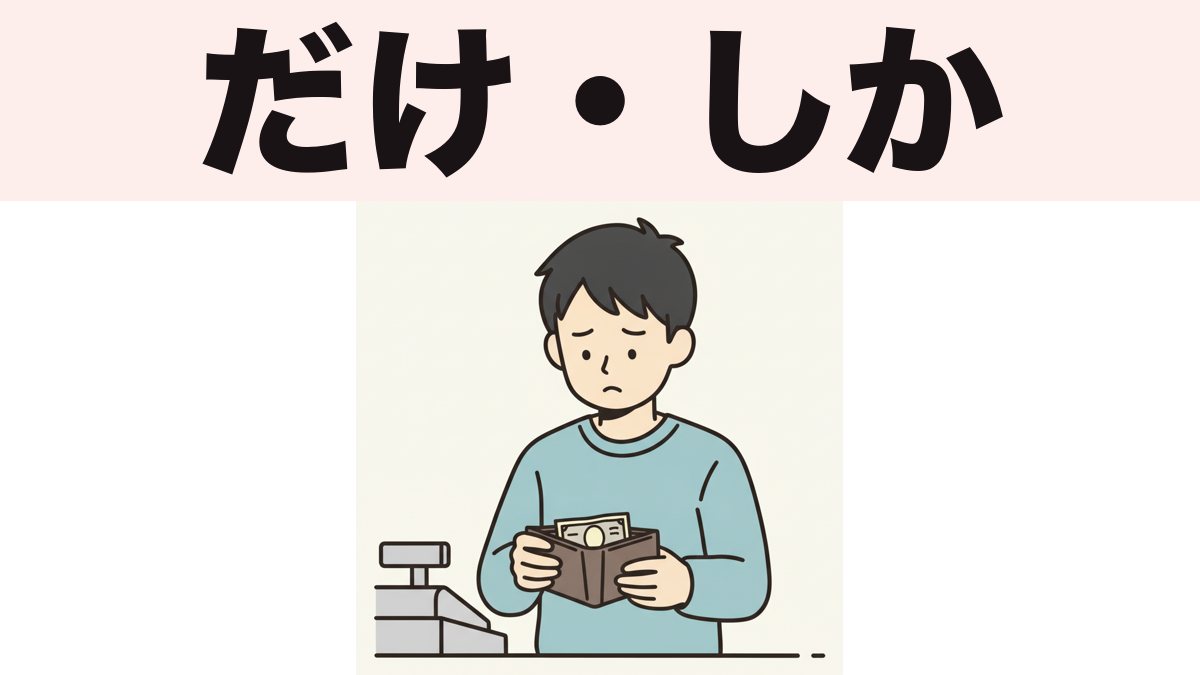
だけ and しか both translate as "only," and they are not interchangeable. だけ is neutral and takes a positive verb. しか **requires** a negative verb and adds a judgement: this is less than it should be. 1000円だけあります is a statement; 1000円しかありません is a problem.
「だけ」と「しか」はどちらも "only" ですが、入れかえられません。「だけ」はふつうの言い方で、ふつうの動詞をとります。「しか」は**うちけしの動詞がひつよう**で、「それでは足りない」という気もちが入ります。「1000円だけあります」はじじつ、「1000円しかありません」はこまっている文です。
Learners tend to use だけ for everything, which is safe and slightly flat. Adding しか gives you a whole register of mild complaint that Japanese uses constantly.
The basics
The two shapes
| Word | Verb | Feeling |
|---|---|---|
| だけ | Positive | Neutral fact: this and no more |
| しか | Negative | Only this, and that is not enough |
一人だけ来ました。 — Only one person came. (polite past — a plain fact) 一人しか来ませんでした。 — Only one person came. (polite past — and that was disappointing)
The English is identical. The Japanese carries an attitude in the second one, and native speakers hear it clearly.
しか forces the negative
This is not a stylistic preference. しか cannot appear with a positive verb:
- 1000円しかあります → wrong
- 1000円しかありません → right
水しか飲みません。 — I only drink water. (polite — literally "I don't drink [anything] but water")
It works like the question word + も pattern: the meaning is positive in English and the Japanese verb is negative, because the sentence is built as an exclusion.
What happens to the particles
だけ can sit alongside を and が, or replace them. しか always replaces them.
| With を | With が | |
|---|---|---|
| だけ | パンだけ食べます / パンをだけ… (rare) | 私だけが知っている |
| しか | パンしか食べません | 私しか知りません |
に and で survive in front of both: 日曜日にだけ, 東京でしか.
この店でしか買えません。 — You can only buy it at this shop. (polite — で survives, then しか, then a negative)
Beyond the basics
だけしか, for emphasis
Stacking them is grammatical and emphatic, and it still needs the negative:
これだけしかありません。 — This is all there is. (polite — resigned, slightly apologetic)
You will hear this from shop staff when something is nearly sold out.
だけ can attach to verbs and adjectives
しか is mostly for nouns and quantities. だけ is freer:
見るだけです。 — I'm just looking. (polite — the standard thing to say to shop staff) 好きなだけ食べてください。 — Eat as much as you like. (polite — だけ after a な-adjective clause)
見るだけです is worth memorising whole. It is the polite, complete answer when someone asks if you need help in a shop.
だけで: "with just this"
これだけでいいです。 — This is enough / just this, thanks. (polite)
だけで covers "with only," and it is how you decline extras without a long sentence.
The size of the number changes which one you want
Compare:
5分だけ待ってください。 — Please wait just five minutes. (polite — small, and framed as reasonable) 5分しか待てません。 — I can only wait five minutes. (polite — and that is a constraint)
Same five minutes. だけ presents it as sufficient; しか presents it as a limit you are up against. Choosing the wrong one makes you sound either oddly relaxed or oddly annoyed.
しか in fixed expressions
Two are worth knowing as vocabulary:
- 〜するしかない — "there's no choice but to": やるしかない ("we just have to do it")
- しかたない — "it can't be helped" (a different word historically, but the same resigned register)
もう行くしかありません。 — There's nothing for it but to go. (polite)
〜しかない is extremely common in anime dialogue at the moment a character commits to something.
Common mistakes
- 1000円しかあります. しか demands a negative: 1000円しかありません.
- パンをしか食べません. しか replaces を. It is パンしか食べません.
- Using だけ where the situation is a complaint. 一人だけ来ました reports; 一人しか来ませんでした complains. Pick deliberately.
- Using しか with a positive adjective. 高いしかない is not a sentence.
- Translating しか as "only" and stopping. The negative verb is part of the grammar, not an extra.
Practice
Answers are hidden — build yours first, then open. Questions 1 and 2 are a pair: identical English, different attitude.
1. Say "only one person came," as a plain fact.
Show answer
一人だけ来ました — だけ with a positive verb reports without judgement.
2. Say "only one person came," implying that was disappointing.
Show answer
一人しか来ませんでした — しか plus a negative verb carries "and that is not enough." This is the pair to question 1.
3. Something is wrong here: 1000円しかあります。
Show answer
1000円しかありません — しか cannot appear with a positive verb. The negative is part of the grammar.
4. Something is wrong here: パンをしか食べません。
Show answer
パンしか食べません — しか replaces を and が. に and で survive in front of it.
5. Say "you can only buy it at this shop."
Show answer
この店でしか買えません — で survives, しか follows, and the verb is negative.
6. A shop assistant asks if you need help. Decline politely.
Show answer
見るだけです — a complete, natural answer. Worth memorising whole.
7. Say "this is all there is," resignedly.
Show answer
これだけしかありません — stacking them is emphatic, and it still needs the negative.
8. Say "please wait just five minutes" and "I can only wait five minutes."
Show answer
5分だけ待ってください / 5分しか待てません — だけ frames it as sufficient, しか as a limit you are up against.
9. Say "there's nothing for it but to go."
Show answer
もう行くしかありません — 〜するしかない is the fixed "no choice but to" pattern.
10. Say "eat as much as you like."
Show answer
好きなだけ食べてください — だけ attaches freely to clauses, where しか mostly wants nouns and quantities.
FAQ
Can しか follow a verb? Only in the するしかない pattern. For ordinary "only doing X," use だけ: 見るだけ.
Is しか rude? No, but it is loaded. It signals shortage or constraint, so using it about someone's gift or effort would sound ungrateful.
What is the difference from ばかり? ばかり means "nothing but," often with a critical edge about repetition: ゲームばかりしている ("all he does is play games"). だけ is a quantity limit, ばかり is a pattern.
Can I use だけ with a number and no verb? Yes: 二つだけ ("just two"). It works as a complete answer.
Does しか ever mean "since"? No — you are thinking of 〜てから. The syllables are unrelated.
Is のみ the same as だけ? Yes, in meaning; のみ is formal and written. Signs use it constantly: 関係者のみ ("staff only").
Vocabulary from this article
Tap the block to select all of it, then copy. In Anki: File → Import, note type Basic, separator Tab — the first column becomes the front, the second the back.
一人	ひとり — one person
来る	くる — to come
円	えん — yen
水	みず — water
飲む	のむ — to drink
店	みせ — shop
買う	かう — to buy
見る	みる — to look, to see
好き	すき — to like
食べる	たべる — to eat
5分	ごふん — five minutes
待つ	まつ — to wait
行く	いく — to go
知る	しる — to know
日曜日	にちようび — Sunday
東京	とうきょう — Tokyo
関係者	かんけいしゃ — staff, people concerned
高い	たかい — expensive
I'm Yuuki, a Japanese teacher based in Tokyo. I've taught on italki as a Top 1% teacher and watched over 1,500 anime. Learners who only ever use だけ sound fine and slightly neutral about everything. しか is where you start being able to complain in Japanese, which is a bigger part of sounding natural than anyone admits.
Sources: the author's own lessons and standard reference grammars.
何にでも「だけ」を使う人が多いです。安全ですが、少し平らです。「しか」を足すと、日本語がよく使う「かるい文句」のはんいが手に入ります。
基本
2つの形
| ことば | 動詞 | 気もち |
|---|---|---|
| だけ | ふつう | それだけ、というじじつ |
| しか | うちけし | それだけで、足りない |
一人だけ来ました。 — Only one person came. 一人しか来ませんでした。 — Only one person came (and that was disappointing).
英語は同じです。日本語は2つ目に気もちが入っていて、日本人にははっきり聞こえます。
「しか」はうちけしをよぶ
これはこのみの問題ではありません。
- 1000円しかあります → 間違い
- 1000円しかありません → 正しい
水しか飲みません。 — I only drink water.
「疑問詞+も+うちけし」と同じしくみです。英語では positive、日本語ではうちけし。文が「それ以外をのぞく」形でできているからです。
助詞はどうなるか
「だけ」は「を」「が」といっしょでもいいし、置きかえてもいいです。「しか」はいつも置きかえます。
| を | が | |
|---|---|---|
| だけ | パンだけ食べます | 私だけが知っている |
| しか | パンしか食べません | 私しか知りません |
「に」「で」は前にのこります。「日曜日にだけ」「東京でしか」。
この店でしか買えません。 — You can only buy it at this shop.
もう少しくわしく
「だけしか」
かさねると強くなります。うちけしはやはりひつようです。
これだけしかありません。 — This is all there is.
売り切れそうな時に、お店の人がよく言います。
「だけ」は動詞や形容詞にもつく
「しか」はおもに名詞や数です。「だけ」はもっと自由です。
見るだけです。 — I'm just looking. 好きなだけ食べてください。 — Eat as much as you like.
「見るだけです」はまるごとおぼえてください。お店で声をかけられた時の、完せいな答えです。
「だけで」」 これで足りる
これだけでいいです。 — This is enough.
同じ5分でも変わる
5分だけ待ってください。 — Please wait just five minutes. 5分しか待てません。 — I can only wait five minutes.
「だけ」は「それでじゅうぶん」、「しか」は「それが限界(げんかい)」です。まちがえると、へんにのんきか、へんにおこっているように聞こえます。
かたまりの言い方
- 〜するしかない — 「やるしかない」
- しかたない — 「どうしようもない」
もう行くしかありません。 — There's nothing for it but to go.
「〜しかない」は、アニメでキャラクターがかくごを決める場めんによく出ます。
よくある間違い
- 1000円しかあります。 うちけしがいります。
- パンをしか食べません。 「しか」は「を」を置きかえます。
- 文句の場めんで「だけ」。 「一人だけ来ました」は報こく、「一人しか来ませんでした」は文句です。
- 形容詞に「しか」。 「高いしかない」は文になりません。
- 「しか」を "only" とだけ覚える。 うちけしの動詞まで含めて1つの文法です。
練習
答えはかくれています。まず自分で作ってから開いてください。1番と2番が対です。英語は同じで、気もちがちがいます。
1. 「一人来ました」をじじつとして言ってください。
答えを見る
一人だけ来ました — 「だけ」+ふつうの動詞は、はんだんを入れません。
2. 「一人しか来なかった(がっかり)」を言ってください。
答えを見る
一人しか来ませんでした — 「しか」+うちけしに「足りない」が入ります。1番と対です。
3. 直してください: 1000円しかあります。
答えを見る
1000円しかありません — 「しか」はふつうの動詞と使えません。
4. 直してください: パンをしか食べません。
答えを見る
パンしか食べません — 「しか」は「を」「が」を置きかえます。「に」「で」はのこります。
5. 「この店でだけ買えます」を「しか」で言ってください。
答えを見る
この店でしか買えません — 「で」がのこって、動詞がうちけしになります。
6. お店で「何かお探しですか」と言われました。ことわってください。
答えを見る
見るだけです — これだけで完せいな答えです。
7. 「これでぜんぶです(もうありません)」を言ってください。
答えを見る
これだけしかありません — かさねると強くなり、うちけしはやはりいります。
8. 「5分待ってください」と「5分しか待てません」— ちがいは?
答えを見る
5分だけだけじゅうぶん/5分しかしか限かい — 同じ5分でも、気もちが反対です。
9. 「もう行くしかない」をていねいに言ってください。
答えを見る
もう行くしかありません — 「〜するしかない」はかたまりの言い方です。
10. 「好きなだけ食べてください」— どうして「しか」は使えませんか。
答えを見る
「しか」はおもに名詞・数につくから — 「だけ」は文にも自由につきます。
この記事に出た単語
ブロックをタップすると全部選べます。そのままコピーしてください。Anki では ファイル → 読み込み、ノートタイプ 基本、区切り タブ。1列目が表、2列目が裏になります。
一人	ひとり — one person
来る	くる — to come
円	えん — yen
水	みず — water
飲む	のむ — to drink
店	みせ — shop
買う	かう — to buy
見る	みる — to look, to see
好き	すき — to like
食べる	たべる — to eat
5分	ごふん — five minutes
待つ	まつ — to wait
行く	いく — to go
知る	しる — to know
日曜日	にちようび — Sunday
東京	とうきょう — Tokyo
高い	たかい — expensive
限界	げんかい — limit
私はユウキです。東京で日本語を教えています。 italki の Top 1% の先生で、アニメは1,500本以上見ました。「だけ」しか使わない人は、何に対しても平らに聞こえます。「しか」は、日本語で文句が言えるようになる入り口です。そしてそれは、みんなが思うよりずっと「自ぜんに聞こえる」ことの大きな部分です。
More drills like the ones above, plus a timed JLPT-style mock test: Practice · N4上のような練習問題と、時間つきのJLPT形式のもぎ試験: 練習ページ · N4
Want to try this in a real conversation?
本当の会話で、ためしてみませんか?
30-minute trial lesson, $13. Times shown in your own timezone.
30分の体験レッスン、$13。時間はあなたのタイムゾーンで表示されます。
Book a trial lesson · $13