休憩, 休暇, 休み: three words for a break, and one of them is not a verb「休憩」「休暇」「休み」のちがい・「休暇します」はまちがい
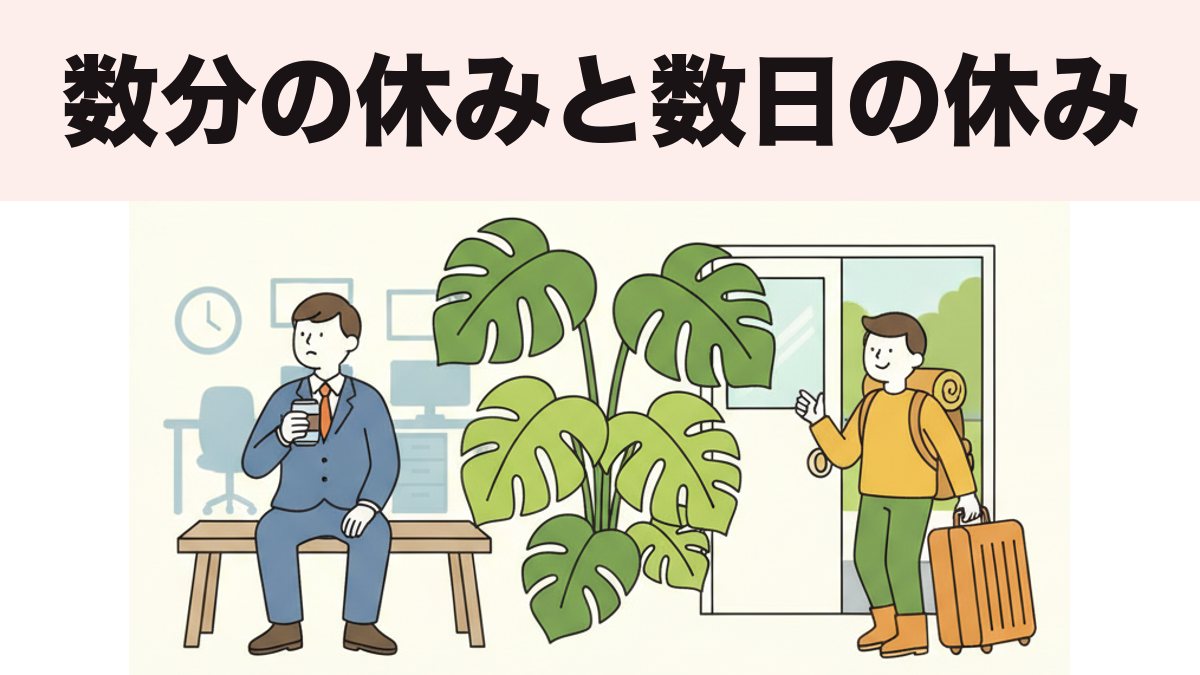
休憩 is a break inside a working day. 休暇 is leave counted in days. 休み is the ordinary word that covers both and also means "closed" and "absent." If you only learn one, learn 休み.
「休憩」は一日の中の短い休みです。「休暇」は日で数える休みです。「休み」はどちらも言える、ふつうのことばです。一つだけ覚えるなら「休み」です。
The trap is not the meanings, which are reasonably intuitive. It is that 休憩 takes します and 休暇 does not, and that 休み does four unrelated jobs depending on the sentence it sits in.
The basics
The three words, side by side
| Word | Reading | How long | Where it appears |
|---|---|---|---|
| 休憩 | きゅうけい | Minutes to an hour | Inside a shift, a lesson, a drive |
| 休暇 | きゅうか | Days to weeks | Work leave, on forms and in HR language |
| 休み | やすみ | Anything | Everyday speech, for all of the above |
| 休日 | きゅうじつ | A whole day | Calendars, opening hours, timetables |
| 連休 | れんきゅう | Several days in a row | News, travel talk, holiday planning |
十分休憩しましょう。 — Let's take a ten-minute break. (polite) 来週、休暇を取ります。 — I'm taking leave next week. (polite) 明日は休みです。 — Tomorrow is my day off. (polite)
The rule that actually matters
休憩 takes します. 休暇 takes 取る. They are not interchangeable.
ちょっと休憩します。 — I'll take a short break. (polite) 休暇を取ります。 — I'll take leave. (polite) 休暇します。 — (unnatural — do not say this)
休憩 is a suru-verb. 休暇 is a pure noun: it is something you take (取る), get (もらう), use (使う) or are on (休暇中). This single fact fixes most of the mistakes learners make with this group.
休み does four different jobs
Look at what the same word means in four sentences:
明日は休みです。 — Tomorrow is a day off. (a holiday) この店は今日休みです。 — This shop is closed today. (closed) 田中さんは今日休みです。 — Tanaka is off today. (absent) 夏休みに日本へ行きます。 — I'm going to Japan in the summer holidays. (a school vacation)
Only context separates them. This is why 休みです is one of the most useful sentences in the language and also one of the most ambiguous.
The verb 休む carries the same spread: to rest, to take a day off, and to be absent.
今日は休みます。 — I'm taking today off. / I'll be absent today. (polite) 少し休んでください。 — Please rest a little. (polite)
If you are calling in sick, 休みます is the word you want — the article on saying you're unwell has the rest of that phone call.
Beyond the basics
定休日: the one travellers need
定休日 (ていきゅうび) is a shop's regular closing day — the day it is shut every week. It appears on shop doors, on Google listings and on websites, and missing it is the most common way a planned visit fails.
定休日: 水曜日 — Closed on Wednesdays. (written, on a sign) 本日休業 — Closed today. (written, on a sign)
本日休業 (ほんじつきゅうぎょう) is the temporary version: closed today specifically. 臨時休業 (りんじきゅうぎょう) means closed unexpectedly. If you see either taped to a door, the shop is not opening later.
休日 vs 祝日 vs 祭日
- 休日 — any non-working day, including weekends
- 祝日 (しゅくじつ) — a national holiday, the ones printed in red on a calendar
- 祭日 (さいじつ) — historically a religious festival day; now largely folded into 祝日, and people say 祝祭日 as a set phrase
So every 祝日 is a 休日, but most 休日 are just Saturdays and Sundays. Days of the week and calendar vocabulary are in the days and dates article.
連休 and the holiday weeks
連休 is consecutive days off. 三連休 is a three-day weekend. The big ones have names — ゴールデンウィーク in late spring, シルバーウィーク in autumn when the dates line up — and they dominate travel conversation for weeks beforehand.
今週末は三連休です。 — We have a three-day weekend this week. (polite)
The workplace set
These appear on forms and in conversation with colleagues:
- 有給休暇 (ゆうきゅうきゅうか) — paid leave, usually shortened to 有給 (ゆうきゅう)
- 育児休暇 (いくじきゅうか) — childcare leave, shortened to 育休 (いくきゅう)
- 産休 (さんきゅう) — maternity leave
- 欠勤 (けっきん) — absence from work, the neutral HR word
- 欠席 (けっせき) — absence from a class or event
- 休講 (きゅうこう) — a class cancelled by the teacher or institution
休講 is the one students need. If a notice says 本日休講, the lesson is not happening.
How it sounds in anime
Three things worth listening for.
First, 休憩! shouted on its own is the standard "break time!" — on a film set, in a training scene, in a kitchen. It works as a complete utterance.
Second, ゆっくり休んで is the standard line for "get some rest," usually said to someone injured or exhausted. ゆっくり here means "at your own pace," not "slowly."
Third, 夏休み is the entire premise of a large number of episodes. When you hear it in the first minute, the episode is about what the characters do with unstructured time.
Common mistakes
- 休暇します. 休暇 is a noun. Say 休暇を取ります, or just 休みます.
- 休憩 for a day off. 休憩 is minutes, not days. A day off is 休み or 休暇.
- 休み中 for "on a break." 休憩中 is the break; 休み中 sounds like the whole holiday period. A shop sign reading 休憩中 means "back shortly."
- Answering 今日は休みですか with はい when you meant the shop. The sentence works for people and shops both — add 店は or the person's name if it matters.
- Reading 休日 as やすみび. It is きゅうじつ. 休み日 is not a word.
- Using 欠席 at work. 欠席 is for classes and events; work absence is 欠勤. Using the wrong one is not serious, but it marks you out.
FAQ
What is the difference between 休み and 休憩? Length and structure. 休憩 is a pause inside an activity, usually measured in minutes and often scheduled. 休み is a whole day or period away from it. A lunch break is 休憩; a public holiday is 休み.
How do I ask for a break politely in a lesson or a meeting? 少し休憩してもいいですか — "may I take a short break?" The 〜てもいいですか pattern is covered in asking permission.
Is 休暇 used in conversation? Less than you would think. Between colleagues people say 休み or 有給. 休暇 shows up in writing, in HR contexts, and when the leave is long enough to be an event.
What does 休業 mean on a shop door? Closed for business. 本日休業 is today only, 臨時休業 is an unexpected closure, and 定休日 is the regular weekly closing day.
Does 休む always mean sleeping? No. It means to rest, to take time off, or to be absent. お休みなさい as a goodnight greeting is a separate fixed expression built from the same verb.
What is 有給 exactly? 有給休暇, paid annual leave. In conversation it is almost always shortened: 有給を取る, "to take a paid day off."
Practice
Questions 1 and 2 are a pair: the same idea of "taking a break," with the two words that behave differently.
1. Say "I'll take a short break," politely.
Show answer
ちょっと休憩します。 — 休憩 is a suru-verb, so します attaches directly.
2. Say "I'm taking leave next week," politely.
Show answer
来週、休暇を取ります。 — 休暇 is a pure noun and does not take します. 休暇します is the mistake this article exists for.
3. A shop sign reads 定休日: 水曜日. What does it tell you?
Show answer
The shop is closed every Wednesday. 定休日 is the regular weekly closing day, not a one-off. 本日休業 would be today only.
4. Say "This shop is closed today," politely.
Show answer
この店は今日休みです。 — 休み covers "closed" as well as "day off." Context does the work.
5. Ask permission to take a short break, politely.
Show answer
少し休憩してもいいですか。 — 休憩する in て-form plus もいいですか. Minutes, so 休憩 and not 休暇.
6. You are phoning work to say you will not come in today. What do you say?
Show answer
今日は休みます。 — the verb 休む covers absence. 欠勤します is the HR word and sounds odd said aloud to your own manager.
7. What is 有給 short for, and what does it mean?
Show answer
有給休暇 — paid annual leave. In speech almost always shortened: 有給を取る.
8. A university notice says 本日休講. What has happened?
Show answer
Today's class is cancelled. 休講 is a class called off by the teacher or institution, not a student being absent — that would be 欠席.
9. Fix this: 来週休暇します。
Show answer
来週休暇を取ります。 — or simply 来週休みます. 休暇 takes 取る, もらう or 使う, never します.
10. Say "We have a three-day weekend this week," politely.
Show answer
今週末は三連休です。 — 連休 is consecutive days off, counted with the ordinary number: 三連休.
Vocabulary from this article
Tap the block to select all of it, then copy. In Anki: File → Import, note type Basic, separator Tab — the first column becomes the front, the second the back.
休憩	きゅうけい — a short break
休暇	きゅうか — leave (from work)
休み	やすみ — day off; closed; absence
休む	やすむ — to rest, to take off, to be absent
休日	きゅうじつ — a non-working day
祝日	しゅくじつ — a national holiday
連休	れんきゅう — consecutive days off
定休日	ていきゅうび — regular weekly closing day
休業	きゅうぎょう — closed for business
臨時休業	りんじきゅうぎょう — unexpected closure
有給休暇	ゆうきゅうきゅうか — paid leave
育児休暇	いくじきゅうか — childcare leave
産休	さんきゅう — maternity leave
欠勤	けっきん — absence from work
欠席	けっせき — absence from class or an event
休講	きゅうこう — cancelled class
夏休み	なつやすみ — summer holidays
取る	とる — to take
I'm Yuuki, a Japanese teacher based in Tokyo. I've taught on italki as a Top 1% teacher and watched over 1,500 anime. 休暇します is the single most reliable tell that someone learned this set from a dictionary rather than from use — and it takes about thirty seconds to fix.
Sources: the author's own lessons and standard reference grammars.
意味はそんなに難しくありません。むずかしいのは、「休憩」は「します」がつくのに、「休暇」にはつかないことです。そして「休み」は、文によって4つの意味になります。
基本
3つのことば
| ことば | よみ | 長さ | 使う場所 |
|---|---|---|---|
| 休憩 | きゅうけい | 数分〜1時間 | 仕事・レッスン・運転の途中 |
| 休暇 | きゅうか | 日〜週 | 会社の書類・人事のことば |
| 休み | やすみ | どれでも | ふつうの会話 |
| 休日 | きゅうじつ | 一日 | カレンダー・営業時間 |
| 連休 | れんきゅう | 何日か続く | ニュース・旅行の話 |
十分休憩しましょう。 — Let's take a ten-minute break. (polite) 来週、休暇を取ります。 — I'm taking leave next week. (polite) 明日は休みです。 — Tomorrow is my day off. (polite)
いちばん大事な決まり
「休憩」には「します」。「休暇」には「取る」。入れかえられません。
ちょっと休憩します。 — I'll take a short break. (polite) 休暇を取ります。 — I'll take leave. (polite) 休暇します。 — (まちがい)
「休憩」は「する」がつくことばです。「休暇」はふつうの名詞なので、「取る」「もらう」「使う」といっしょに使います。
「休み」は4つの仕事をします
明日は休みです。 — Tomorrow is a day off. (休日) この店は今日休みです。 — This shop is closed today. (閉まっている) 田中さんは今日休みです。 — Tanaka is off today. (来ていない) 夏休みに日本へ行きます。 — I'm going to Japan in the summer holidays. (学校の長い休み)
どれも同じことばです。前後で分かります。
動詞の「休む」も同じように広いです。
今日は休みます。 — I'm taking today off. (polite) 少し休んでください。 — Please rest a little. (polite)
もう少し先へ
「定休日」は旅行の人に大事
定休日(ていきゅうび) は、毎週決まって閉まる日です。お店のドアや地図のページに書いてあります。
定休日: 水曜日 — Closed on Wednesdays. (written) 本日休業 — Closed today. (written)
「本日休業(ほんじつきゅうぎょう)」は今日だけ、「臨時休業(りんじきゅうぎょう)」は急に閉めた時です。
「休日」と「祝日」と「祭日」
- 休日 — 仕事のない日(土日もふくむ)
- 祝日(しゅくじつ) — 国の休みの日(カレンダーの赤い日)
- 祭日(さいじつ) — 昔の神事の日。今は「祝祭日」とまとめて言うことが多い
「祝日」はぜんぶ「休日」ですが、「休日」の多くはただの土日です。
「連休」
「連休」は続いた休みです。「三連休」は3日続く休みです。春の「ゴールデンウィーク」、秋の「シルバーウィーク」が有名です。
今週末は三連休です。 — We have a three-day weekend this week. (polite)
会社のことば
- 有給休暇(ゆうきゅうきゅうか) — お金が出る休み。「有給」と短く言う
- 育児休暇(いくじきゅうか) — 子どものための休み。「育休」
- 産休(さんきゅう) — 出産の休み
- 欠勤(けっきん) — 仕事を休むこと(書類のことば)
- 欠席(けっせき) — 授業や会を休むこと
- 休講(きゅうこう) — 先生や学校が授業を休みにすること
「本日休講」と出ていたら、その授業はありません。
アニメでの聞こえ方
3つあります。
1つめ。「休憩!」だけで「休みだ!」という意味になります。
2つめ。「ゆっくり休んで」は、けがや疲れている人に言う決まった言い方です。この「ゆっくり」は「自分のペースで」という意味です。
3つめ。「夏休み」は話の始まりによく出ます。出てきたら、その回は自由な時間の話です。
よくあるまちがい
- 「休暇します」と言う。 「休暇」は名詞です。「休暇を取ります」か「休みます」です。
- 一日の休みを「休憩」と言う。 「休憩」は分の長さです。
- 「休み中」で「休憩している」と言う。 お店の「休憩中」は「すぐ戻ります」です。
- 「休日」を「やすみび」と読む。 「きゅうじつ」です。
- 会社で「欠席」を使う。 会社は「欠勤」、授業は「欠席」です。
FAQ
「休み」と「休憩」のちがいは? 長さです。「休憩」は何かの途中の短い休み、「休み」は一日やそれ以上です。
レッスンや会議で休みたい時は? 「少し休憩してもいいですか」と言います。
「休暇」は会話で使いますか? あまり使いません。同じ職場の人とは「休み」か「有給」と言います。
お店の「休業」は? 閉まっているという意味です。「本日休業」は今日だけ、「臨時休業」は急な休み、「定休日」は毎週です。
「休む」は寝ることですか? ちがいます。休む・仕事を休む・来ない、の3つです。「おやすみなさい」は別の決まった言い方です。
練習
1番と2番は対です。「休む」という同じ話ですが、ことばの形がちがいます。
1. 「ちょっと休みます」を「休憩」で、ていねいに。
答えを見る
ちょっと休憩します。 — 「休憩」は「する」がつくことばです。
2. 「来週、休みを取ります」を「休暇」で、ていねいに。
答えを見る
来週、休暇を取ります。 — 「休暇」に「します」はつきません。この記事でいちばん大事な点です。
3. お店に「定休日: 水曜日」と書いてあります。どういう意味ですか。
答えを見る
毎週水曜日は閉まっています。 今日だけなら「本日休業」です。
4. 「この店は今日閉まっています」を「休み」で、ていねいに。
答えを見る
この店は今日休みです。 — 「休み」は「閉まっている」も表せます。
5. 「少し休んでもいいですか」を「休憩」で。
答えを見る
少し休憩してもいいですか。 — 短い休みなので「休暇」ではありません。
6. 会社に電話して「今日は行きません」と言います。
答えを見る
今日は休みます。 — 「欠勤します」は書類のことばで、口で言うと固すぎます。
7. 「有給」は何を短くしたことばですか。
答えを見る
有給休暇です。 お金が出る休みで、「有給を取る」と言います。
8. 大学に「本日休講」と出ています。何がありましたか。
答えを見る
今日の授業がなくなりました。 学生が休むのは「欠席」です。
9. 直してください: 来週休暇します。
答えを見る
来週休暇を取ります。 — または「来週休みます」。「休暇」は「取る・もらう・使う」といっしょに使います。
10. 「今週末は3日続けて休みです」を「連休」で、ていねいに。
答えを見る
今週末は三連休です。 — 数はふつうの読み方で「さんれんきゅう」です。
この記事に出た単語
このブロックをタップして全部選び、コピーしてください。Anki では File → Import、ノートタイプ 基本、区切り タブ を選びます。1列目が表、2列目が裏になります。
休憩	きゅうけい — a short break
休暇	きゅうか — leave (from work)
休み	やすみ — day off; closed; absence
休む	やすむ — to rest, to take off, to be absent
休日	きゅうじつ — a non-working day
祝日	しゅくじつ — a national holiday
連休	れんきゅう — consecutive days off
定休日	ていきゅうび — regular weekly closing day
休業	きゅうぎょう — closed for business
臨時休業	りんじきゅうぎょう — unexpected closure
有給休暇	ゆうきゅうきゅうか — paid leave
育児休暇	いくじきゅうか — childcare leave
産休	さんきゅう — maternity leave
欠勤	けっきん — absence from work
欠席	けっせき — absence from class or an event
休講	きゅうこう — cancelled class
夏休み	なつやすみ — summer holidays
取る	とる — to take
More drills like the ones above, plus a timed JLPT-style mock test: Practice · N4上のような練習問題と、時間つきのJLPT形式のもぎ試験: 練習ページ · N4
Want to try this in a real conversation?
本当の会話で、ためしてみませんか?
30-minute trial lesson, $13. Times shown in your own timezone.
30分の体験レッスン、$13。時間はあなたのタイムゾーンで表示されます。
Book a trial lesson · $13