てもいいですか: how to actually ask "can I...?" in Japaneseてもいいですか: 「〜してもいい?」の言い方
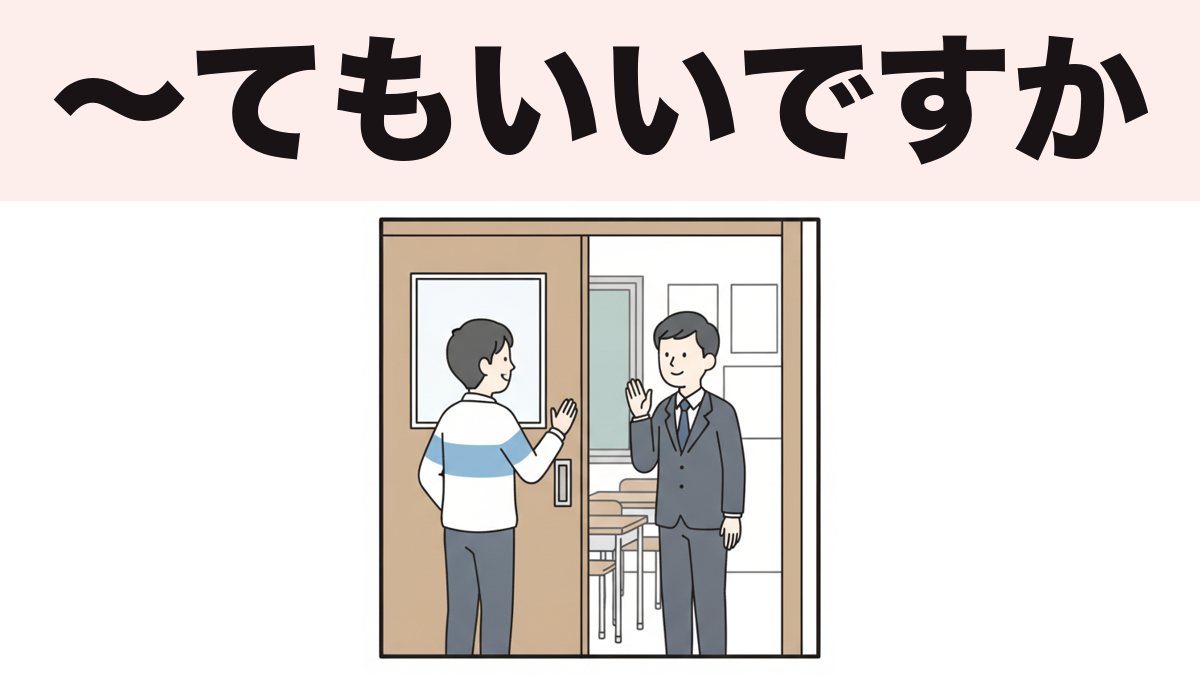
〜てもいいですか asks for permission by literally saying "even if I do this, is it fine?" — and in real conversation, most of that sentence gets dropped.
〜てもいいですか は、「これをしても、大丈夫ですか」という意味です。でも、会話では、この文の多くの部分が消えます。
Textbooks teach it as a fixed phrase to memorize. It is actually three small pieces stacked together, and once you can see the pieces, you can build the casual, rude, and formal versions yourself instead of memorizing each one separately.
The basics
What does てもいいですか literally mean?
Break it apart and it stops being mysterious:
- て — the te-form of a verb, the connector that links actions
- も — "even" / "also"
- いい — good, fine
- ですか — the polite question ending
Put together: "even if [I do this], is it good?" — which is just a roundabout, softened way of asking permission. Japanese avoids direct requests, and this construction is the main tool for that.
写真を撮ってもいいですか。 — May I take a photo? (polite, to a stranger or shop staff) ここに座ってもいいですか。 — Is it okay if I sit here? (polite, general use)
How do you build it from any verb?
Take the te-form of the verb and add もいいですか. That's the whole formula.
入ってもいいですか。 — May I come in? (polite, at a classroom or office door) ちょっと聞いてもいいですか。 — Can I ask you something? (polite, a soft conversation opener)
The only trap is grammar, not meaning: you need the te-form, not the dictionary form. 座るもいいですか is wrong; 座ってもいいですか is right. If your te-form conjugation is shaky, that is the actual bottleneck here, not the phrase itself.
Where will you actually hear and use it?
Almost anywhere a stranger has authority over the space you're in: shops, classrooms, someone else's home, a train seat next to a stranger, an office.
窓を開けてもいいですか。 — Is it okay if I open the window? (polite, shared space) これ、試着してもいいですか。 — Can I try this on? (polite, retail)
It is the default "may I" for anyone you are not close with — which, per our politeness switch, is most people you'll talk to.
Beyond the basics
How casual can it get?
In real speech, ですか is usually the first thing to disappear.
トイレ、行ってもいい? — Can I go to the bathroom? (casual, dropped ですか, rising intonation carries the question) これ、食べてもいい? — Can I eat this? (casual, friend or family) 見てもいい? — Can I look? (casual)
Push it further and even もいい can shrink to just もいいかな (asking yourself out loud, softer, less direct) or, in a context where the verb is obvious from what you're holding or pointing at, just いい? — nothing but the question particle, with the whole request carried by gesture and tone. Anime leans on this constantly: a character holds up food, looks at someone, and says only いい?
What's the difference between てもいいですか and てください?
They point in opposite directions. てもいいですか asks permission for yourself to do something. てください asks someone else to do something.
座ってもいいですか。 — May I sit? (you're asking to do it) 座ってください。 — Please sit. (you're asking them to do it)
Mixing these up is one of the most common beginner errors, because in English "can I sit here" and "please, sit" can both sound like polite offers depending on tone — in Japanese the grammar draws a hard line.
Is there a more formal version?
Yes — swap いいですか for よろしいでしょうか when you want extra deference: a business meeting, a doctor's office, a very senior person.
拝見してもよろしいでしょうか。 — Might I take a look? (very formal, business register)
You will rarely need this as a learner, but recognizing it matters — it shows up in customer service Japanese constantly.
The negative version means something different
なくてもいいですか is not "may I not" in the sense of refusing — it asks whether an action is optional, i.e., "is it okay if I don't do this?"
今日は宿題をしなくてもいいですか。 — Is it okay if I don't do homework today? (asking if something is optional)
This is a separate question from prohibition — for what happens when the answer is a hard "no," see 〜てはいけません, the grammar point that sits on the other side of this one.
How do people actually answer, beyond a flat yes or no?
Real answers rarely stop at いいです. They usually come with a small addition that softens or contextualizes the permission:
はい、どうぞ。 — Yes, go ahead. (warm, inviting — very common when handing something over or gesturing toward a seat) いいですよ。 — Sure, that's fine. (the よ adds reassurance, like "no need to worry") ちょっと今は… — It's a bit... not right now. (trailing off, a soft no without ever saying no)
Notice that どうぞ alone — without even a verb — is a complete, natural answer to a permission question. Once someone asks 座ってもいいですか, どうぞ by itself does the entire job of "please, go ahead."
How to practise it
Walk around your day and silently turn small actions into てもいいですか questions: opening a window, taking the last coffee, sitting in a particular seat. You don't need anyone to answer — the goal is building the te-form + もいいですか reflex until it stops requiring translation in your head.
Then do the reverse: next time you're watching something and a character asks for permission, listen for how much of the full form actually survives. Counting how often it shrinks to just いい? is a fast way to tune your ear to real spoken Japanese instead of textbook Japanese.
Common mistakes
- Using the dictionary form instead of the te-form. 座るもいいですか is not grammatical; it has to be 座ってもいいですか.
- Reaching for ましょうか instead. ましょうか means "shall I [do this for you]" — an offer, not a request for permission. 持ちましょうか = "shall I carry it?" is a completely different sentence from 持ってもいいですか = "may I carry it?"
- Using よろしいでしょうか with friends. It is correct, but it lands as oddly stiff — the equivalent of asking your roommate "might I possibly use the microwave?"
- Assuming a yes always sounds like いいです. A soft Japanese "no" rarely says the word no. すみません、ちょっと… ("sorry, it's a bit...") trailing off is a refusal — a pattern worth knowing before you ask.
The politeness ladder
| Form | Feel | Example |
|---|---|---|
| 〜てもよろしいでしょうか | Very formal, maximum deference | 伺ってもよろしいでしょうか |
| 〜てもいいですか | Standard polite — the safe default | 座ってもいいですか |
| 〜てもいい? | Casual, spoken | 座ってもいい? |
| 〜てもいいかな | Casual, softer, thinking aloud | 座ってもいいかな |
| いい? (verb implied by context) | Very casual, shorthand | (holding the last snack) いい? |
FAQ
Is てもいいですか rude to say to a teacher or boss? No — it's the standard polite register and perfectly appropriate. よろしいでしょうか exists for moments that call for even more formality, not because てもいいですか is somehow too casual.
How do you say yes or no in response? A plain yes is はい、いいですよ. A polite no almost never uses the word no — expect すみません、ちょっと… or ここはちょっと… trailing into silence.
Is てもいいですか the same as できますか? No. できますか asks about ability or possibility ("can this be done?"). てもいいですか asks about permission ("am I allowed to do this?"). 撮影できますか asks whether photography is possible here at all; 撮ってもいいですか asks whether you personally may take one.
Can you drop ですか completely? Yes, in casual speech — てもいい? with rising intonation, or in very informal moments just いい? once context makes the verb obvious.
What does 〜てもいいんじゃない mean — is that the same grammar? Related but different in force. 〜てもいいんじゃない reads as a suggestion — "wouldn't it be fine to...?" — often used to reassure someone else it's okay, rather than to ask permission for yourself.
Does adding かな change the meaning? It softens it into a half-question to yourself — 座ってもいいかな sounds like thinking out loud, which paradoxically often reads as more polite than a direct question because it doesn't pressure the other person for an immediate answer.
Do you need to answer with a full sentence? No — most real answers are short. どうぞ ("go ahead"), うん、いいよ ("sure"), or a hesitant ちょっと… all work as complete responses on their own. Matching a short question with a short answer is more natural than building a full sentence either way.
I'm Yuuki, a Japanese teacher based in Tokyo. I've taught on italki as a Top 1% teacher and watched over 1,500 anime, so most of the example sentences on this blog come from lines I've actually heard students ask about — including this one, which comes up in nearly every beginner's first few lessons.
Sources: the author's own lessons and standard reference grammars.
教科書では、これを1つの決まった形として覚えます。でも本当は、小さいパーツが3つ組み合わさっているだけです。パーツが見えれば、カジュアルな形も、ていねいすぎる形も、自分で作れるようになります。
基本の形
てもいいですか の意味は?
分けて考えると、わかりやすくなります。
- て — 動詞の「て形」。動作をつなぐ形
- も — 「〜でも」
- いい — 大丈夫、良い
- ですか — ていねいな質問の形
合わせると「〜しても、大丈夫ですか」という意味です。日本語は、直接お願いすることをさけます。この形は、そのための道具です。
写真を撮ってもいいですか。 — May I take a photo? (ていねい・知らない人やお店の人に) ここに座ってもいいですか。 — Is it okay if I sit here? (ていねい・ふつうに使える)
どんな動詞にも使える作り方は?
動詞の「て形」に「もいいですか」をつけるだけです。
入ってもいいですか。 — May I come in? (ていねい・教室やオフィスのドアで) ちょっと聞いてもいいですか。 — Can I ask you something? (ていねい・会話の始めに)
気をつけるのは意味ではなく、形です。「座るもいいですか」はまちがいです。「座ってもいいですか」が正しい形です。て形がまだ不安な人は、そこが本当の弱点です。
どこで実際に使う?
お店、教室、人の家、電車の隣の席、オフィスなど、その場所に対して「相手のほうが立場が上」の場所ならほとんど使えます。
窓を開けてもいいですか。 — Is it okay if I open the window? (ていねい・共有スペース) これ、試着してもいいですか。 — Can I try this on? (ていねい・お店)
親しくない人への「いい?」の基本形です。だ・です の記事で書いた通り、親しくない人が会話の相手のほとんどです。
もっと深く
カジュアルにすると、どうなる?
実際の会話では、「ですか」が一番先に消えます。
トイレ、行ってもいい? — Can I go to the bathroom? (カジュアル・ですか が消える。イントネーションで質問になる) これ、食べてもいい? — Can I eat this? (カジュアル・友だちや家族に) 見てもいい? — Can I look? (カジュアル)
もっと崩すと、「もいいかな」(自分に聞くような、やわらかい言い方)になったり、何を指しているか場面でわかるときは「いい?」だけになったりします。アニメでは、食べ物を持ち上げて、相手を見て、「いい?」とだけ言う場面がよくあります。
てもいいですか と てください の違いは?
意味が反対の方向です。てもいいですか は「自分が」することの許可を聞きます。てください は「相手に」してほしいことを頼みます。
座ってもいいですか。 — May I sit? (自分がする許可を聞く) 座ってください。 — Please sit. (相手にお願いする)
この2つを混同するのは、よくあるまちがいです。英語では「can I sit here」も「please, sit」も、どちらもていねいに聞こえることがありますが、日本語の文法ははっきり分けます。
もっとていねいな形はある?
あります。「いいですか」を「よろしいでしょうか」に変えると、さらにていねいになります。会議、病院、目上の人と話すときなどです。
拝見してもよろしいでしょうか。 — Might I take a look? (とてもていねい・ビジネス)
学習者が使う場面は少ないですが、聞いたときにわかることが大事です。接客の日本語では、よく出てきます。
否定の形は、意味がちがう
なくてもいいですか は「〜しなくても大丈夫か」という意味です。「してはいけない」ではなく、「しなくてもOK」という質問です。
今日は宿題をしなくてもいいですか。 — Is it okay if I don't do homework today? (することが「必要ではない」かを聞く)
これは禁止とはちがう話です。本当にダメなときの言い方は、〜てはいけませんの記事で説明しています。この記事の反対側にある文法です。
「はい」「いいえ」以外の答え方は?
実際の答えは、「いいです」だけで終わらないことが多いです。
はい、どうぞ。 — Yes, go ahead. (あたたかい・物を渡すときや席をすすめるときによく使う) いいですよ。 — Sure, that's fine. (よ が安心感を足す) ちょっと今は… — It's a bit... not right now. (最後まで言わない・やわらかい「いいえ」)
「どうぞ」だけで、動詞なしで完全な答えになることに注目してください。「座ってもいいですか」に対して、「どうぞ」だけで「どうぞ座ってください」の意味になります。
練習のしかた
1日の中で、小さい動作を「てもいいですか」の質問にしてみてください。窓を開ける、最後のコーヒーを飲む、特定の席に座る、などです。誰かに答えてもらう必要はありません。目的は、て形+もいいですか が頭の中で翻訳なしに出てくるようにすることです。
次に、逆の練習をしてください。アニメで誰かが許可を求めている場面を見たら、その文がどれだけ短くなっているか聞いてみてください。どれくらい「いい?」だけまで崩れているか数えると、教科書の日本語ではなく、本物の話しことばに耳が慣れていきます。
よくあるまちがい
- 辞書形を使ってしまう。 「座るもいいですか」は文法的に正しくありません。「座ってもいいですか」が正解です。
- 「ましょうか」を使ってしまう。 「ましょうか」は「〜しましょうか」」相手のために何かをする申し出です。お願いではありません。「持ちましょうか」(運びましょうか?)は、「持ってもいいですか」(運んでもいいですか?)とはまったくちがう文です。
- 友だちに「よろしいでしょうか」を使う。 文法はまちがっていませんが、変に堅く聞こえます。ルームメイトに「電子レンジを使ってもよろしいでしょうか」と聞くようなものです。
- 「はい」はいつも「いいです」の形だと思ってしまう。 日本語のやわらかい「いいえ」は、めったに「いいえ」と言いません。「すみません、ちょっと…」と言って止まるのは、断っているサインです。知っておくとよいパターンです。
ていねいさの段階
| 形 | 感じ | 例 |
|---|---|---|
| 〜てもよろしいでしょうか | とてもていねい・最大の敬意 | 伺ってもよろしいでしょうか |
| 〜てもいいですか | 標準のていねい・安全な基本形 | 座ってもいいですか |
| 〜てもいい? | カジュアル・話しことば | 座ってもいい? |
| 〜てもいいかな | カジュアル・やわらかい・独り言のよう | 座ってもいいかな |
| いい?(動詞は場面でわかる) | とてもカジュアル・省略形 | (最後のお菓子を持ちながら)いい? |
FAQ
先生や上司に「てもいいですか」を使うと失礼ですか? 失礼ではありません。標準のていねいな言い方です。「よろしいでしょうか」は、さらに特別な場面のためにあるもので、「てもいいですか」がカジュアルすぎるわけではありません。
「はい」「いいえ」はどう答える? 「はい、いいですよ」がふつうの「はい」です。ていねいな「いいえ」は、ほとんど「いいえ」と言いません。「すみません、ちょっと…」「ここはちょっと…」と言って止まることが多いです。
「てもいいですか」と「できますか」は同じ? ちがいます。「できますか」は能力や可能性を聞きます(「これはできますか?」)。「てもいいですか」は許可を聞きます(「してもいいですか?」)。「撮影できますか」はここで写真を撮ること自体が可能かを聞き、「撮ってもいいですか」は自分が撮ってよいかを聞いています。
「ですか」を全部省略できる? できます。カジュアルな会話では「てもいい?」(上がるイントネーションで)、もっとくだけると「いい?」だけになります。
「てもいいんじゃない」も同じ文法? 似ていますが、少しちがいます。「〜てもいいんじゃない」は提案のように聞こえます。「〜してもいいんじゃない?」は、相手に「大丈夫だよ」と伝えるときによく使われ、自分の許可を求める言い方ではありません。
「かな」をつけると意味が変わる? 自分への半分の質問のように、やわらかくなります。「座ってもいいかな」は独り言のように聞こえ、直接の質問より丁寧に感じられることがあります。相手にすぐの返事を求めないからです。
必ず文で答えなければいけない? いいえ。実際の答えはほとんど短いです。「どうぞ」「うん、いいよ」「ちょっと…」だけでも、完全な答えになります。短い質問には短い答えのほうが自然です。
More drills like the ones above, plus a timed JLPT-style mock test: Practice · N5上のような練習問題と、時間つきのJLPT形式のもぎ試験: 練習ページ · N5
Want to try this in a real conversation?
本当の会話で、ためしてみませんか?
30-minute trial lesson, $13. Times shown in your own timezone.
30分の体験レッスン、$13。時間はあなたのタイムゾーンで表示されます。
Book a trial lesson · $13