Asking for directions in Japanese: 一番近い駅, and the four words in the answer道の聞き方: 「一番近い駅」と、答えに出る4つのことば
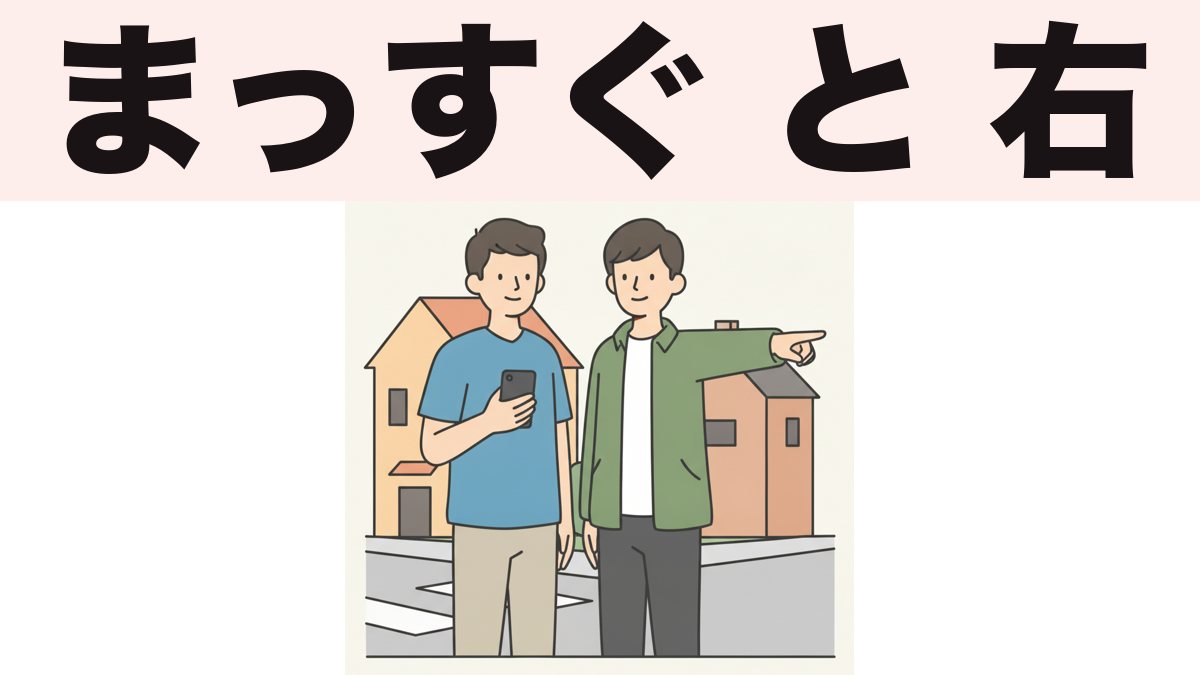
すみません、〜はどこですか is the question. The hard part is the answer, and it is built from four words: まっすぐ (straight), 右 (right), 左 (left) and 曲がる (to turn). Learn those four and most direction-giving in Japan becomes parseable, even at speed.
聞くのは「すみません、〜はどこですか」です。むずかしいのは答えのほうです。答えは4つのことばでできています。「まっすぐ」「右」「左」「曲がる」。この4つが分かれば、早口の道案内もだいたい聞き取れます。
Asking is easy. Understanding what comes back is the skill, and it is worth practising deliberately, because a direction you cannot parse is worse than not asking.
The basics
Asking
すみません、駅はどこですか。 — Excuse me, where is the station? (polite, the standard question) この近くにコンビニはありますか。 — Is there a convenience store near here? (polite — use when you do not know if one exists)
Those two cover different situations. どこですか assumes the thing exists and asks for its location. ありますか asks whether it exists at all, which is the right question for "a" convenience store rather than "the" station.
一番近い and 最寄り
一番近い駅はどこですか。 — Where is the nearest station? (polite — the everyday phrasing) 最寄り駅はどこですか。 — Where is the nearest station? (polite — slightly more formal, and the word on signs)
最寄り (もより) means "nearest" and is the word used in writing, on property listings and in announcements. 一番近い is the plain spoken equivalent. Both are understood everywhere; 最寄り駅 is worth recognizing because you will see it printed constantly.
The four words in the answer
| Japanese | Reading | Meaning |
|---|---|---|
| まっすぐ | まっすぐ | straight ahead |
| 右 | みぎ | right |
| 左 | ひだり | left |
| 曲がる | まがる | to turn |
| 角 | かど | corner |
| 信号 | しんごう | traffic light |
| 交差点 | こうさてん | intersection |
| 突き当たり | つきあたり | the end of the road |
まっすぐ行って、二つ目の角を右に曲がってください。 — Go straight and turn right at the second corner. (polite — the classic answer)
That sentence is the shape most answers take: a direction, a landmark, a turn. If you can hold those three slots in your head while listening, you will catch the answer even when it comes fast.
Note the particle: 右に曲がる. The に marks the direction you end up facing, the same に as in 電車に乗る.
Beyond the basics
Counting the landmark
〜つ目 (めじめ) and 〜番目 (ばんめ) both mean "the Nth."
二つ目の信号を左です。 — It's left at the second traffic light. (polite — note that 曲がってください is often dropped)
一つ目, 二つ目, 三つ目 use the native counting series and are what people say for corners and lights. If you have worked through Japanese counters, this is that system doing an everyday job.
Distance and time
歩いて五分ぐらいです。 — It's about five minutes on foot. (polite — the most common answer of all) ここから遠いですか。 — Is it far from here? (polite — the question worth asking before you set off)
歩いて五分 is the standard unit of Japanese distance. Property listings measure walking distance in minutes rather than metres, at a conventional 80 metres per minute, which is why 駅から徒歩五分 appears on every rental advertisement.
For asking how long in general, どれくらいかかりますか is the flexible version.
Checking you understood
This is the part learners skip and should not.
まっすぐ行って、右ですね。 — Go straight, then right — is that right? (polite — repeating back with ね) すみません、もう一度お願いします。 — Sorry, once more please. (polite)
Repeating the key words back with ね is far more effective than asking someone to repeat the whole thing. It shows exactly which part you got, so the other person can correct the one piece you missed instead of starting again.
もう一度お願いします is the other essential. It is short, polite and gets a slower second attempt from almost anyone.
When you cannot follow at all
地図で教えてもらえますか。 — Could you show me on a map? (polite — hold up your phone) 一緒に来てもらえますか。 — Could you come with me? (polite — a big ask, but people often say yes)
Holding up a phone map turns a listening problem into a pointing problem, and it is not an admission of defeat — Japanese people do it with each other constantly.
Position words in the answer
Answers frequently use the position vocabulary: 駅の前 (in front of the station), 銀行の隣 (next to the bank), 交差点の角 (at the corner of the intersection).
コンビニの向かいにあります。 — It's opposite the convenience store. (polite)
If those are shaky, Japanese position words covers the の that holds them together, which is the piece most learners drop.
Common mistakes
- Using を with 曲がる. 右に曲がってください. The に marks the resulting direction.
- Asking どこですか about something that may not exist. For "is there a X near here," use ありますか.
- Not repeating back. A silent nod means the other person cannot tell which part you missed.
- Asking もう一度 for the whole answer. Repeating back the part you did get is faster and more polite.
- Expecting street names. Most Japanese streets have no names. Directions use landmarks, corners and traffic lights instead, which is why those four words matter so much.
- Reading 最寄り as さいより. It is もより.
The full exchange
| Step | Japanese | Notes |
|---|---|---|
| Open | すみません | Always start here |
| Ask (it exists) | 〜はどこですか | For a known place |
| Ask (unsure) | この近くに〜はありますか | For any one of a kind |
| Ask nearest | 一番近い〜はどこですか | 最寄り〜 in writing |
| Ask distance | 遠いですか / 歩いて何分ですか | Before setting off |
| Confirm | 〜ですね | Repeat the key words back |
| Ask again | もう一度お願いします | Short and polite |
| Escape hatch | 地図で教えてもらえますか | Turns listening into pointing |
| Close | ありがとうございました | Past tense — the help is complete |
Practice
Questions 1 and 2 are the pair: two questions that look similar and are for different situations.
1. Ask politely where the station is.
Show answer
すみません、駅はどこですか。 — どこですか assumes it exists, which a station does.
2. Ask whether there is a convenience store nearby.
Show answer
この近くにコンビニはありますか。 — ありますか asks whether one exists at all, which is the right question here.
3. Ask for the nearest station, in the spoken way.
Show answer
一番近い駅はどこですか。 — 最寄り駅はどこですか is the same question in a slightly more formal register.
4. Say "go straight and turn right at the second corner."
Show answer
まっすぐ行って、二つ目の角を右に曲がってください。 — Direction, landmark, turn. And 右に, never 右を.
5. Confirm that you understood: "straight, then right, yes?"
Show answer
まっすぐ行って、右ですね。 — Repeating the key words back with ね shows exactly what you caught.
6. Ask for the answer again, politely.
Show answer
もう一度お願いします。 — Short, polite, and it gets you a slower second attempt.
7. Ask someone to show you on a map.
Show answer
地図で教えてもらえますか。 — Hold up your phone. This turns a listening problem into a pointing problem.
8. Say "it's about five minutes on foot."
Show answer
歩いて五分ぐらいです。 — The standard unit of Japanese distance, used on every rental listing.
9. Fix this: 右を曲がってください。
Show answer
右に曲がってください。 — に marks the direction you end up facing, like 電車に乗る.
10. How do you read 最寄り?
Show answer
もより — Not さいより. It means "nearest" and appears constantly in writing.
FAQ
Why don't Japanese directions use street names? Because most streets do not have them. Addresses are based on nested blocks rather than roads, so directions are given with landmarks, corners and traffic lights. That is why まっすぐ, 右, 左 and 曲がる carry so much of the load.
Is it okay to stop a stranger to ask? Yes, and it is normal. Start with すみません, keep the question short, and finish with ありがとうございました in the past tense, which marks the help as completed.
What if they answer with 〜の方 or あっち? 〜の方 (ほう) means "in that direction" and あっち is the casual "over there." Both usually come with a gesture, and the gesture is the real answer.
How far is 徒歩五分 exactly? By the property-listing convention, about 400 metres — the standard is 80 metres per minute. Actual walking time varies, and the convention does not account for hills or traffic lights.
Should I ask station staff instead of passers-by? Inside a station, yes — 駅員 deal with this all day and are used to non-Japanese speakers. Outside, anyone will do, and shop staff are a good bet because they know the immediate area well.
What is 突き当たり? The point where a road stops and you must turn. 突き当たりを右 means "turn right where the road ends," which is a very common instruction in Japanese residential streets.
Vocabulary from this article
Tap the block to select all of it, then copy. In Anki: File → Import, note type Basic, separator Tab — the first column becomes the front, the second the back.
まっすぐ	まっすぐ — straight ahead
右	みぎ — right
左	ひだり — left
曲がる	まがる — to turn
角	かど — corner
信号	しんごう — traffic light
交差点	こうさてん — intersection
突き当たり	つきあたり — the end of the road
最寄り	もより — nearest
近く	ちかく — nearby
遠い	とおい — far
地図	ちず — map
徒歩	とほ — on foot
駅員	えきいん — station attendant
教える	おしえる — to tell, to teach
渡る	わたる — to cross
向かい	むかい — opposite
一番	いちばん — the most, number one
I'm Yuuki, a Japanese teacher based in Tokyo. I've taught on italki as a Top 1% teacher and watched over 1,500 anime. The skill nobody practises is repeating the answer back — students rehearse the question a hundred times and then freeze at the reply, which is the half that actually gets you there.
Sources: the author's own lessons and standard reference grammars.
聞くのは簡単です。返ってきたことばを分かるのが、本当の力です。分からない道案内は、聞かないより困ります。
基本
聞き方
すみません、駅はどこですか。 — Excuse me, where is the station? (polite, the standard question) この近くにコンビニはありますか。 — Is there a convenience store near here? (polite — use when you do not know if one exists)
2つは場面がちがいます。「どこですか」は「あることは分かっている」時です。「ありますか」は「あるかどうか分からない」時です。
「一番近い」と「最寄り」
一番近い駅はどこですか。 — Where is the nearest station? (polite — the everyday phrasing) 最寄り駅はどこですか。 — Where is the nearest station? (polite — slightly more formal)
「最寄り(もより)」は「いちばん近い」です。書く時に使います。不動産の広告やお知らせでよく見ます。話す時は「一番近い」です。
答えに出る4つのことば
| 日本語 | 読み方 | 意味 |
|---|---|---|
| まっすぐ | まっすぐ | straight |
| 右 | みぎ | right |
| 左 | ひだり | left |
| 曲がる | まがる | to turn |
| 角 | かど | corner |
| 信号 | しんごう | traffic light |
| 交差点 | こうさてん | intersection |
| 突き当たり | つきあたり | end of the road |
まっすぐ行って、二つ目の角を右に曲がってください。 — Go straight and turn right at the second corner. (polite — the classic answer)
答えは、だいたいこの形です。「方向」「目印」「曲がる」。この3つを頭に置いて聞くと、早口でも取れます。
助詞に気をつけてください。「右に曲がる」です。「電車に乗る」と同じ「に」です。
もう少し先へ
目印を数える
「〜つ目」「〜番目」は「N番目の」です。
二つ目の信号を左です。 — It's left at the second traffic light. (polite — 曲がってください is often dropped)
「一つ目」「二つ目」「三つ目」を使います。
きょりと時間
歩いて五分ぐらいです。 — It's about five minutes on foot. (polite — the most common answer of all) ここから遠いですか。 — Is it far from here? (polite — worth asking before you set off)
日本では、きょりを「歩いて何分」で言います。不動産の広告も、メートルではなく分で書きます。「駅から徒歩五分」です。
分かったか確かめる
ここを、みんな飛ばします。飛ばさないでください。
まっすぐ行って、右ですね。 — Go straight, then right — is that right? (polite — repeating back with ね) すみません、もう一度お願いします。 — Sorry, once more please. (polite)
大事なことばをくり返して「〜ですね」と言うほうが、「もう一度」より役に立ちます。どこまで分かったかが相手に見えるので、足りないところだけ直してもらえます。
全然分からない時
地図で教えてもらえますか。 — Could you show me on a map? (polite — hold up your phone) 一緒に来てもらえますか。 — Could you come with me? (polite — a big ask, but people often say yes)
スマホの地図を出すと、「聞く問題」が「指さす問題」になります。日本の人も、おたがいによくやります。
場所のことばもよく出ます
コンビニの向かいにあります。 — It's opposite the convenience store. (polite)
「駅の前」「銀行の隣」「交差点の角」。「の」が必要です。
よくある間違い
- 「曲がる」に「を」を使う。 「右に曲がってください」です。
- あるか分からないものに「どこですか」と聞く。 「ありますか」です。
- くり返して確かめない。 うなずくだけだと、どこが分からなかったか伝わりません。
- 全部「もう一度」と言う。 分かったところを言うほうが早いです。
- 道の名前が出ると思う。 日本の道には名前がほとんどありません。だから目印と角と信号を使います。
- 「最寄り」を「さいより」と読む。 「もより」です。
全体の流れ
| 順番 | 日本語 | メモ |
|---|---|---|
| 声をかける | すみません | ここから |
| 聞く(あると分かっている) | 〜はどこですか | 駅など |
| 聞く(分からない) | この近くに〜はありますか | コンビニなど |
| いちばん近いのを聞く | 一番近い〜はどこですか | 書く時は「最寄り」 |
| きょりを聞く | 遠いですか / 歩いて何分ですか | 出発の前に |
| 確かめる | 〜ですね | くり返す |
| もう一度 | もう一度お願いします | 短く |
| 最後の手 | 地図で教えてもらえますか | 指さしにする |
| お礼 | ありがとうございました | 終わったので「ました」 |
練習
1番と2番が組です。似ていますが、場面がちがいます。
1. 「駅はどこですか」と、ていねいに聞いてください。
答えを見る
すみません、駅はどこですか。 — 駅はあると分かっているので「どこですか」です。
2. 「この近くにコンビニはありますか」と聞いてください。
答えを見る
この近くにコンビニはありますか。 — あるかどうか分からないので「ありますか」です。
3. いちばん近い駅を、話しことばで聞いてください。
答えを見る
一番近い駅はどこですか。 — 「最寄り駅はどこですか」は少しかたい言い方です。
4. 「まっすぐ行って、二つ目の角を右に曲がってください」と言ってください。
答えを見る
まっすぐ行って、二つ目の角を右に曲がってください。 — 「右に」です。「右を」ではありません。
5. 「まっすぐ行って、右ですね」と確かめてください。
答えを見る
まっすぐ行って、右ですね。 — くり返すと、どこまで分かったかが伝わります。
6. ていねいに、もう一度お願いしてください。
答えを見る
もう一度お願いします。 — 短くて、ていねいです。
7. 地図で教えてもらってください。
答えを見る
地図で教えてもらえますか。 — スマホを出すと、指さしで解決します。
8. 「歩いて五分ぐらいです」と言ってください。
答えを見る
歩いて五分ぐらいです。 — 日本のきょりは「歩いて何分」です。
9. 直してください: 右を曲がってください。
答えを見る
右に曲がってください。 — 「に」です。
10. 「最寄り」は何と読みますか。
答えを見る
もより — 書く時によく出ます。
よくある質問
どうして道の名前を使わないのですか。 日本の道には名前がほとんどないからです。住所はブロックの番号でできています。だから目印と角と信号を使います。
知らない人に声をかけてもいいですか。 いいです。ふつうです。「すみません」で始めて、短く聞いて、最後に「ありがとうございました」と言います。
「あっち」「〜の方」と言われたら、どうしますか。 「〜の方(ほう)」は「そっちの方向」、「あっち」は「あちら」です。たいてい手で指してくれます。その手が本当の答えです。
「徒歩五分」はどのくらいですか。 不動産の広告のきまりでは、1分分80メートルで計算します。だいたい400メートルです。坂や信号は入っていません。
駅員さんに聞くほうがいいですか。 駅の中ならそうです。外なら、だれでも大丈夫です。お店の人は、まわりをよく知っています。
「突き当たり」は何ですか。 道が終わって、曲がるしかないところです。「突き当たりを右」は、住宅地でよく聞きます。
この記事に出た単語
このブロックを長く押して全部選び、コピーしてください。Ankiでは ファイル → 読み込み、ノートタイプは 基本、区切りは タブ にします。左が表、右が裏になります。
まっすぐ	まっすぐ — straight ahead
右	みぎ — right
左	ひだり — left
曲がる	まがる — to turn
角	かど — corner
信号	しんごう — traffic light
交差点	こうさてん — intersection
突き当たり	つきあたり — the end of the road
最寄り	もより — nearest
近く	ちかく — nearby
遠い	とおい — far
地図	ちず — map
徒歩	とほ — on foot
駅員	えきいん — station attendant
教える	おしえる — to tell, to teach
渡る	わたる — to cross
向かい	むかい — opposite
一番	いちばん — the most, number one
日本語教師のユウキです。東京にいます。 italkiで Top 1% の教師をしています。アニメは1,500本以上見ました。だれも練習しないのが「答えをくり返して確かめること」です。質問は100回練習するのに、返事のところで止まってしまいます。でも、そこが目的地に着くための半分です。
More drills like the ones above, plus a timed JLPT-style mock test: Practice · N5上のような練習問題と、時間つきのJLPT形式のもぎ試験: 練習ページ · N5
Want to try this in a real conversation?
本当の会話で、ためしてみませんか?
30-minute trial lesson, $13. Times shown in your own timezone.
30分の体験レッスン、$13。時間はあなたのタイムゾーンで表示されます。
Book a trial lesson · $13