ある vs いる: two verbs for "there is," and the line is not quite "aliveある と いる: さかい目は「生きている」ではありません
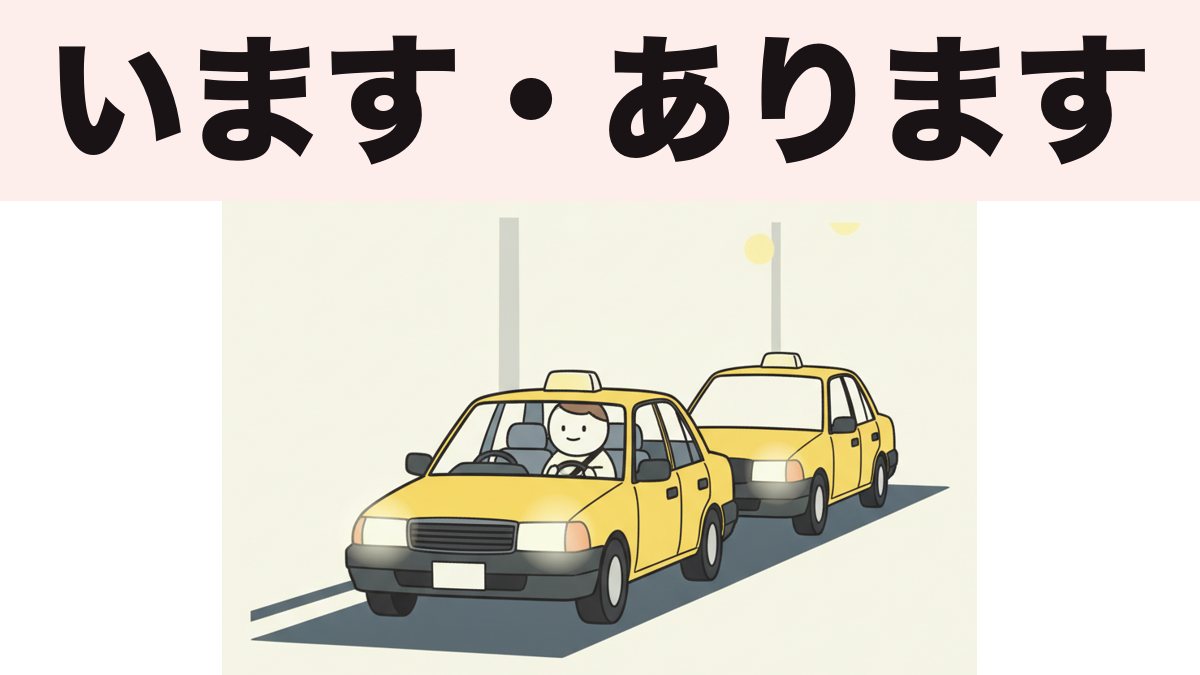
Japanese has two verbs for "there is": いる for things that move under their own power, ある for everything else. Textbooks say "animate versus inanimate," which is close enough to start with and wrong at the edges — plants are alive and take ある, and a taxi can take either depending on whether someone is driving it.
日本語には「there is」が2つあります。自分で動くものは「いる」、それ以外は「ある」。教科書は「生きているかどうか」と書きますが、はしの方ではちがいます。植物は生きていても「ある」ですし、タクシーは運てんしゅがいるかどうかで変わります。
Both take が, both are irregular in useful ways, and ある has a second job that is arguably more common than its first: saying that an event exists.
The basics
The core split
| Verb | Used for | Example |
|---|---|---|
| いる | People, animals — things that move themselves | 猫がいます |
| ある | Objects, plants, buildings, abstract things | 本があります |
部屋に猫がいます。 — There's a cat in the room. (polite — animate) 机の上に本があります。 — There's a book on the desk. (polite — inanimate)
Note the particle pattern: place + に + thing + が + ある/いる. The place takes に because に marks a point of existence, and the thing takes が because it is what exists.
The negative and past forms
ある is irregular in the negative — this is the one conjugation to memorise:
| ある | いる | |
|---|---|---|
| Polite | あります | います |
| Polite negative | ありません | いません |
| Plain | ある | いる |
| Plain negative | ない (not あらない) | いない |
| Plain past | あった | いた |
ない is not a separate word you learn later — it is the plain negative of ある, which is why it turns up everywhere in the language as a negative ending.
Both take が, never を
時間がありません。 — I don't have time. (polite — が, not を)
を never appears with these verbs. If you find yourself writing 時間をあります, the sentence has slipped into English word order. The が here is the ordinary "what exists" が.
Beyond the basics
The edge cases, and what the line really is
The rule is not "alive." It is moves under its own power:
| Thing | Verb | Why |
|---|---|---|
| Plant, tree, flower | ある | Alive, but does not move itself |
| Fish, insect | いる | Moves itself |
| A parked, empty taxi | ある | Just an object |
| A taxi with a driver waiting | いる | There is a person in it |
| A robot or an AI character | Usually いる | Treated as an agent |
| A dead person, remembered | いる | Still a person in the speaker's framing |
| A bus on the timetable | ある | A scheduled service, not a vehicle |
庭に木があります。 — There's a tree in the garden. (polite — plants take ある) 外にタクシーがいます。 — There's a taxi outside. (polite — implying a driver is in it, waiting)
That last distinction is real and native speakers use it without thinking. あります for the taxi describes a vehicle; います describes a taxi that could drive you somewhere.
ある also means "an event happens"
This use is at least as frequent as the "object exists" one:
明日、会議があります。 — There's a meeting tomorrow. (polite — an event) 日曜日にテストがありました。 — There was a test on Sunday. (polite past)
An event is not a physical thing sitting somewhere, but Japanese treats "the meeting exists" as the natural way to say it takes place. The same pattern covers 用事がある ("I have something on"), 時間がある, パーティーがある.
ある for possession
車がありますか。 — Do you have a car? (polite — literally "does a car exist [for you]?")
For possessions, ある and 持っている overlap. ある is more about availability, 持っている more about ownership in hand. For people — family, friends — it is いる: 兄弟がいますか ("do you have siblings?").
いる vs 〜ている
These look the same and are not. いる on its own is the verb "to exist." Attached to a te-form, it makes the teiru form:
部屋に犬がいます。 — There's a dog in the room. (the verb いる) 犬が走っています。 — The dog is running. (te-form + いる)
The grammar came from the same word, which is why 走っている literally reads as "exists in a state of having run."
ある in fixed expressions
Several very common phrases are just ある doing its job:
意味がありません。 — It's meaningless / there's no point. (polite)
Also 興味がある ("to be interested"), 関係がある ("to be related"), 人気がある ("to be popular"). These are worth learning whole, because the English equivalents are adjectives and the Japanese ones are existence sentences.
Common mistakes
- 車がいます for a parked car. Unless someone is in it, use あります.
- 犬があります. Animals move themselves: います.
- Using を. 時間をあります is not a sentence. It is 時間があります.
- あらない. The plain negative of ある is ない, full stop.
- 兄弟があります. People take いる: 兄弟がいます.
- Forgetting the event use. "There's a meeting" is 会議があります, not 会議をします unless you are the one holding it.
Practice
Answers are hidden — build yours first, then open. Questions 4 and 5 are a pair: same taxi, and the verb tells you whether anyone is in it.
1. Say "there's a cat in the room."
Show answer
部屋に猫がいます — place + に, thing + が, and いる because a cat moves itself.
2. Something is wrong here: 机の上に本がいます。
Show answer
本があります — a book does not move under its own power.
3. What is the plain negative of ある?
Show answer
ない — not あらない. This is why ない turns up as the negative ending throughout the language.
4. There is an empty parked taxi outside. Say it.
Show answer
外にタクシーがあります — with nobody in it, it is just an object.
5. There is a taxi outside with a driver waiting. Say it.
Show answer
外にタクシーがいます — います implies someone is in it and it could take you somewhere. This is the pair to question 4.
6. Something is wrong here: 庭に木がいます。
Show answer
木があります — plants are alive but do not move themselves. The line is movement, not life.
7. Say "there's a meeting tomorrow."
Show answer
明日、会議があります — Japanese says an event "exists." This use of ある is at least as common as the object one.
8. Something is wrong here: 時間をありません。
Show answer
時間がありません — ある and いる never take を. The sentence has slipped into English word order.
9. Ask someone whether they have siblings.
Show answer
兄弟がいますか — people take いる, even in the "do you have" sense.
10. What is the difference between 部屋に犬がいます and 犬が走っています?
Show answer
The verb いる vs the te-form + いる — the first says the dog exists there, the second is the progressive. They come from the same word, which is why they look alike.
FAQ
Are ある and いる written in kanji? 有る and 居る exist but are rarely used. Kana is standard for both.
Which one for a robot? Usually いる, because it is treated as an agent. A switched-off machine in a box is ある.
What about a bus? バスがあります for the service ("there's a bus at 7"), バスがいます for a specific bus sitting there.
Is いらっしゃる related? Yes — it is the honorific form of いる (and of 行く and 来る). 先生がいらっしゃいます is the polite way to say a teacher is present.
Why is ある's negative ない? Historically ない is a separate adjective meaning "non-existent," which took over the negative slot. That is also why it conjugates like an い-adjective: なかった, なくて.
Can I use ある about people ever? In some fixed and literary phrasings (子どもがある for having children is dated but exists). As a learner, use いる for people every time.
Vocabulary from this article
Tap the block to select all of it, then copy. In Anki: File → Import, note type Basic, separator Tab — the first column becomes the front, the second the back.
部屋	へや — room
猫	ねこ — cat
机	つくえ — desk
上	うえ — on top, above
本	ほん — book
時間	じかん — time
庭	にわ — garden
木	き — tree
外	そと — outside
犬	いぬ — dog
走る	はしる — to run
明日	あした — tomorrow
会議	かいぎ — meeting
日曜日	にちようび — Sunday
用事	ようじ — an errand, something on
車	くるま — car
兄弟	きょうだい — siblings
意味	いみ — meaning
興味	きょうみ — interest
関係	かんけい — relation
人気	にんき — popularity
先生	せんせい — teacher
子ども	こども — child
I'm Yuuki, a Japanese teacher based in Tokyo. I've taught on italki as a Top 1% teacher and watched over 1,500 anime. The taxi pair is the one I use in lessons, because it shows the rule is not a biology question. Japanese is asking whether the thing can act — and once a learner hears that, the plants stop being confusing.
Sources: the author's own lessons and standard reference grammars.
どちらも「が」をとります。そして「ある」には、もう1つの仕事があります。「できごとがある」と言う使い方で、こちらの方が多いくらいです。
基本
まん中のルール
| 動詞 | 何に使うか | れい |
|---|---|---|
| いる | 人・動物(自分で動くもの) | 猫がいます |
| ある | もの・植物・たてもの・見えないもの | 本があります |
部屋に猫がいます。 — There's a cat in the room. 机の上に本があります。 — There's a book on the desk.
形は 場しょ+に+もの+が+ある/いる。場しょは「に」(いる点だから)、ものは「が」(あるものだから)です。
うちけしとかこ
「ある」のうちけしは形が変わります。ここだけおぼえてください。
| ある | いる | |
|---|---|---|
| ていねい | あります | います |
| ていねい・うちけし | ありません | いません |
| ふつう | ある | いる |
| ふつう・うちけし | ない(あらない ではない) | いない |
| ふつう・かこ | あった | いた |
「ない」はあとで習うべつのことばではありません。「ある」のうちけしです。だから日本語じゅうで、うちけしの終わり方として出てきます。
「が」をとる。「を」はとらない
時間がありません。 — I don't have time.
「時間をあります」と書いてしまったら、英語の語順になっています。
もう少しくわしく
はしの方と、本当のさかい目
ルールは「生きている」ではなく、自分で動くかです。
| もの | 動詞 | りゆう |
|---|---|---|
| 植物・木・花 | ある | 生きているが、自分で動かない |
| 魚・虫 | いる | 自分で動く |
| だれもいない止まったタクシー | ある | ただのもの |
| 運てんしゅがまっているタクシー | いる | 中に人がいる |
| ロボット・AIのキャラ | ふつう いる | 行動するものとしてあつかう |
| バスの便 | ある | 車ではなく「便」 |
庭に木があります。 — There's a tree in the garden. 外にタクシーがいます。 — There's a taxi outside.
このちがいは本当にあって、日本人は考えずに使い分けます。「あります」は車のこと、「います」は乗せてくれるタクシーのことです。
「ある」= できごとがある
こちらの使い方も、とても多いです。
明日、会議があります。 — There's a meeting tomorrow. 日曜日にテストがありました。 — There was a test on Sunday.
「用事がある」「時間がある」「パーティーがある」も同じです。
「ある」」 持っている
車がありますか。 — Do you have a car?
ものは「ある」と「持っている」の両方が使えます。「ある」は「使える状きょうか」、「持っている」は「自分のものか」に近いです。人(家族・友だち)は「いる」です。「兄弟がいますか」。
「いる」と「〜ている」
にていますが、べつです。
部屋に犬がいます。 — There's a dog in the room. 犬が走っています。 — The dog is running.
もとは同じことばです。だから「走っている」は「走った状たいである」と読めます。
かたまりの言い方
意味がありません。 — It's meaningless.
「興味がある」「関係がある」「人気がある」も同じです。英語では形容詞ですが、日本語では「ある」の文です。
よくある間違い
- 止まっている車に「います」。 人が乗っていなければ「あります」です。
- 犬があります。 動物は「います」です。
- 「を」を使う。 「時間をあります」は文になりません。
- あらない。 「ある」のうちけしは「ない」です。
- 兄弟があります。 人は「います」です。
- できごとの使い方をわすれる。 「会議があります」です。
練習
答えはかくれています。まず自分で作ってから開いてください。4番と5番が対です。同じタクシーで、動詞が「中に人がいるか」を伝えます。
1. 「部屋に猫がいます」— 助詞の形を言ってください。
答えを見る
場しょ+に、もの+が — 猫は自分で動くので「いる」です。
2. 直してください: 机の上に本がいます。
答えを見る
本があります — 本は自分で動きません。
3. 「ある」のふつうのうちけしは?
答えを見る
ない — 「あらない」ではありません。だから日本語じゅうでうちけしとして出てきます。
4. だれも乗っていないタクシーが外に止まっています。言ってください。
答えを見る
外にタクシーがあります — 人がいなければ、ただのものです。
5. 運てんしゅがまっているタクシーが外にいます。言ってください。
答えを見る
外にタクシーがいます — 中に人がいて、乗せてくれます。4番と対です。
6. 直してください: 庭に木がいます。
答えを見る
木があります — 植物は生きていますが、自分で動きません。さかい目は「動くか」です。
7. 「明日、会議があります」— この「ある」は何ですか。
答えを見る
できごとがある、の「ある」 — ものの「ある」と同じくらいよく使います。
8. 直してください: 時間をありません。
答えを見る
時間がありません — 「ある」「いる」は「を」をとりません。
9. 「きょうだいはいますか」を「いる」で聞いてください。
答えを見る
兄弟がいますか — 人は「いる」です。「持っている」の意味でも同じです。
10. 「部屋に犬がいます」と「犬が走っています」のちがいは?
答えを見る
動詞の「いる」/て形+いる — もとは同じことばなので、形がにています。
この記事に出た単語
ブロックをタップすると全部選べます。そのままコピーしてください。Anki では ファイル → 読み込み、ノートタイプ 基本、区切り タブ。1列目が表、2列目が裏になります。
部屋	へや — room
猫	ねこ — cat
机	つくえ — desk
上	うえ — on top, above
本	ほん — book
時間	じかん — time
庭	にわ — garden
木	き — tree
外	そと — outside
犬	いぬ — dog
走る	はしる — to run
明日	あした — tomorrow
会議	かいぎ — meeting
日曜日	にちようび — Sunday
用事	ようじ — an errand, something on
車	くるま — car
兄弟	きょうだい — siblings
意味	いみ — meaning
興味	きょうみ — interest
関係	かんけい — relation
人気	にんき — popularity
植物	しょくぶつ — plant
虫	むし — insect
魚	さかな — fish
私はユウキです。東京で日本語を教えています。 italki の Top 1% の先生で、アニメは1,500本以上見ました。レッスンではタクシーの2つの文を使います。これが、生きものかどうかの話ではないと分かるからです。日本語が聞いているのは「そのものは動けるか」です。そう聞こえた時に、植物のなぞが消えます。
More drills like the ones above, plus a timed JLPT-style mock test: Practice · N5上のような練習問題と、時間つきのJLPT形式のもぎ試験: 練習ページ · N5
Want to try this in a real conversation?
本当の会話で、ためしてみませんか?
30-minute trial lesson, $13. Times shown in your own timezone.
30分の体験レッスン、$13。時間はあなたのタイムゾーンで表示されます。
Book a trial lesson · $13