あげる, くれる, もらう: which way is the thing moving?あげる・くれる・もらう: ものはどっちへ動きますか
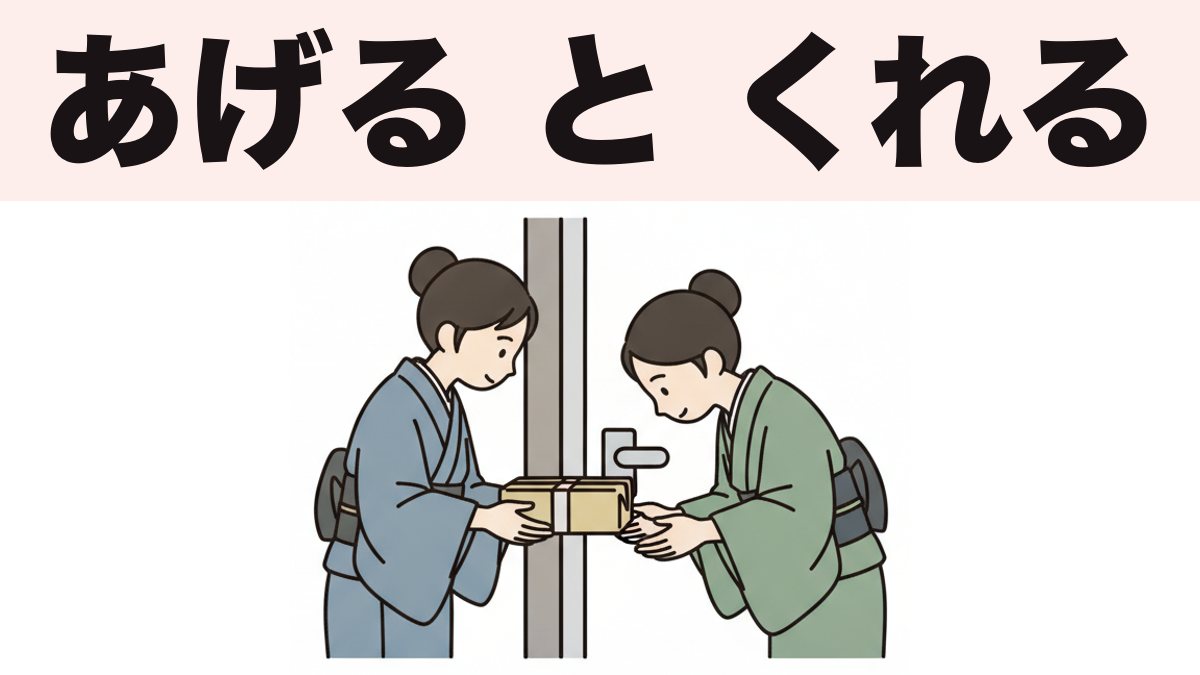
Japanese has two words for "give" — あげる and くれる — and choosing between them has nothing to do with politeness. あげる is used when the thing moves away from you; くれる when it moves toward you. もらう flips the sentence around so the receiver is the subject.
日本語には「give」が2つあります。「あげる」と「くれる」です。えらび方はていねいさではありません。ものが自分から出ていくなら「あげる」、自分に来るなら「くれる」です。「もらう」は、同じことを受け取る人の側から言う形です。
English has one "give" and lets word order sort out who got what. Japanese instead builds the direction into the verb, which means a sentence with the wrong verb is not slightly off — it points the wrong way.
The basics
The three verbs
私は友達にプレゼントをあげました。 — I gave my friend a present. (away from me) 友達が私にプレゼントをくれました。 — My friend gave me a present. (toward me) 私は友達にプレゼントをもらいました。 — I received a present from my friend. (toward me, told from my side)
Look at what changes: in the くれる sentence, the friend is the が subject. In the もらう sentence, I am the subject. Both describe the same event from different ends.
| Verb | Who is the subject | Direction | Particle for the other person |
|---|---|---|---|
| あげる | The giver (usually me) | Away from me | に |
| くれる | The giver (someone else) | Toward me | に (often dropped) |
| もらう | The receiver (usually me) | Toward me | に or から |
The rule that decides everything
くれる is the only one of the three that can point at you. If something arrives at you or at someone in your circle, the verb is くれる — or もらう if you want to be the subject. あげる can never do it.
✗ 友達が私に本をあげました。 。○ 友達が私に本をくれました。 — My friend gave me a book.
This is the single most common mistake with this set, and it is worth over-correcting: the moment the receiver is you, あげる is off the table.
"Your circle" is wider than you
くれる also covers your family, your team, your company — anyone Japanese treats as inside your group.
先生が弟に本をくれました。 — The teacher gave my younger brother a book. (my brother counts as my side) 部長が息子にプレゼントをくれた。 — The manager gave my son a present.
This is the same in-group instinct that runs through the polite-vs-casual switch: Japanese constantly asks whether someone is inside or outside your circle, and grammar changes with the answer.
Beyond the basics
The polite and humble versions
Each verb has a version for when the other person outranks you. These are not optional decoration — you will hear them constantly in shops and offices.
| Neutral | Humble (I do it) | Honorific (they do it) |
|---|---|---|
| あげる | さしあげる | — |
| くれる | — | くださる |
| もらう | いただく | — |
先生が本をくださいました。 — My teacher gave me a book. (honorific — they are above me) 先生に本をいただきました。 — I received a book from my teacher. (humble — I lower myself)
くださる and いただく describe the same event from the two ends, exactly like くれる and もらう. And やる is the downward version of あげる, used for plants, pets and small children — 花に水をやる ("water the flowers"). Used toward an adult it is rude, so recognise it and do not produce it.
The te-form versions: doing favours
Attach these to the te-form and they stop being about objects and start being about actions.
友達が手伝ってくれた。 — A friend helped me (and I'm grateful). 友達に手伝ってもらった。 — I got a friend to help me. (same event, my side) 友達を手伝ってあげた。 — I helped my friend (as a favour).
This is how Japanese expresses gratitude structurally. 友達が手伝った is grammatically correct and sounds cold — like a report. くれる is what makes it a kindness.
The trap: 〜てあげる can sound condescending
Because あげる frames the action as a favour you are bestowing, using it toward someone senior is a real mistake.
✗ 先生、教えてあげます。 。○ 先生に教えていただきました。 — My teacher taught me. (humble, correct)
持ってあげる ("I'll carry it for you") said to a friend is warm. Said to a client, it announces that you are doing them a favour. With anyone above you, either drop the あげる entirely (持ちます) or switch to the offering form (お持ちします).
The safe habit: use 〜てくれる and 〜てもらう freely, and be careful every single time you reach for 〜てあげる.
〜ていただけますか — the most useful polite request
もらう's humble form gives you the standard polite request, and it is the single highest-value phrase in this whole family.
手伝っていただけますか。 — Could you help me? (formal, polite) 手伝ってもらえますか。 — Could you help me? (polite, everyday) 手伝ってくれる? — Can you help me? (casual)
That ladder works with any verb in the te-form: 見せていただけますか, 待ってもらえますか, 貸してくれる?. Learn the three rungs once and every verb you know becomes a polite request.
How does it sound in anime?
くれる carries most of the emotional weight, because it is the verb of someone doing something for you:
来てくれてありがとう。 — Thank you for coming. (literally "thank you for coming for me") 助けてくれた。 — You saved me. 信じてくれるの? — You'll believe me?
来てくれてありがとう is worth memorising exactly as it stands. 来てありがとう is not what people say — the くれて is what turns the arrival into something done for you, and without it the thanks has nothing to attach to.
Common mistakes
- あげる for something given to you. 友達が私に本をあげました is wrong. If it arrives at you, the verb is くれる.
- 〜てあげる toward someone senior. It frames you as doing them a favour. Use the plain verb or a humble form instead.
- Forgetting your family counts as "you." 先生が弟に本をくれました — your brother is inside your circle, so くれる is right.
- Using やる toward an adult. It is the downward form, fine for plants and pets, rude to people.
- Dropping くれる when someone helped you. 友達が手伝った is a report; 友達が手伝ってくれた is gratitude. Japanese expects the second.
- Mixing up who takes が. With くれる the giver is the subject; with もらう the receiver is. Swapping them produces a sentence that says the opposite of what happened.
Practice
Answers are hidden — build yours first, then open. Questions 2 and 3 are a pair: the same event, told from the two ends.
1. Something is wrong here: 友達が私に本をあげました。
Show answer
友達が私に本をくれました — the book arrives at you, so it must be くれる. あげる can never point at the speaker.
2. Say "my friend gave me a present," with the friend as the subject.
Show answer
友達がプレゼントをくれました — with くれる, the giver takes が. 私に is usually dropped because くれる already tells you it came to you.
3. Say the same thing with yourself as the subject.
Show answer
私は友達にプレゼントをもらいました — もらう flips the sentence: the receiver becomes the subject, and the giver takes に or から. This is the pair to question 2 — same event, opposite end.
4. Your teacher gave your younger brother a book. Which verb?
Show answer
くれる — 先生が弟に本をくれました — your brother is inside your circle, so the book arrived on your side of the line.
5. Something is wrong here: 先生、教えてあげます。
Show answer
先生に教えていただきました — 〜てあげる frames you as granting a favour, which cannot point upward. Use the humble いただく instead.
6. Say "a friend helped me" so that it sounds grateful.
Show answer
友達が手伝ってくれた — without くれた it is a flat report. くれる is how Japanese marks something as done for you.
7. Make 手伝ってくれる? into a formal polite request.
Show answer
手伝っていただけますか — the ladder runs くれる? → もらえますか → いただけますか, from casual to formal. It works with any te-form verb.
8. What is the honorific version of くれる, and who is it for?
Show answer
くださる — for when the giver is above you — 先生が本をくださいました. Its partner いただく tells the same event from your side.
9. Why is 花に水をやる fine but 先生に本をやる rude?
Show answer
やる is the downward form — normal for plants, pets and small children, and insulting toward an adult, especially a superior.
10. Why is 来てありがとう not what people say?
Show answer
It's missing くれて — 来てくれてありがとう. The くれて is what marks the arrival as something done for you, which is what the thanks attaches to.
FAQ
Is あげる ever used when I'm not the giver? Yes — for two other people, when neither is in your circle: 田中さんが山田さんに本をあげました. The rule is not "I give"; it is "it does not come toward me or mine."
Can I drop 私に with くれる? Almost always, and you usually should. くれる already says it came to you, so 友達がプレゼントをくれました is more natural than spelling out 私に.
What about 〜てくれない? and 〜てもらえない? Both are requests in negative form, and like ませんか the negative makes them softer: 手伝ってくれない? ("couldn't you help me?"). 〜ていただけないでしょうか is the very formal end of the same idea.
Is いただきます at meals the same word? Yes, and it explains the phrase: いただきます is the humble "I receive," said before eating to acknowledge receiving the food. It is not "let's eat" — it is closer to "I gratefully receive this."
How do I say "I had someone do it" versus "I made them do it"? 〜てもらう is "I got them to do it," and it implies they were willing. For making someone do something against their preference, you need the causative させる. 手伝ってもらった and 手伝わせた are very different social situations.
Does もらう take に or から? Both work with people. から is clearer and is required when the giver is an organisation: 会社からもらいました. With an individual, 友達にもらった and 友達からもらった are both fine.
Vocabulary from this article
Tap the block to select all of it, then copy. In Anki: File → Import, note type Basic, separator Tab — the first column becomes the front, the second the back.
あげる	あげる — to give (away from me)
くれる	くれる — to give (toward me)
もらう	もらう — to receive
くださる	くださる — to give (honorific)
いただく	いただく — to receive (humble)
友達	ともだち — friend
本	ほん — book
先生	せんせい — teacher
弟	おとうと — younger brother
息子	むすこ — son
部長	ぶちょう — department manager
手伝う	てつだう — to help
教える	おしえる — to teach
助ける	たすける — to save, to help
信じる	しんじる — to believe
持つ	もつ — to carry, to hold
見せる	みせる — to show
待つ	まつ — to wait
貸す	かす — to lend
花	はな — flower
水	みず — water
会社	かいしゃ — company
I'm Yuuki, a Japanese teacher based in Tokyo. I've taught on italki as a Top 1% teacher and watched over 1,500 anime. The conjugation is easy and the direction is not — and the mistake that actually matters is 〜てあげる pointed upward, because it is grammatically perfect and quietly announces that you have done your boss a favour.
Sources: the author's own lessons and standard reference grammars.
英語は「give」が1つで、ことばのじゅんばんでだれが受け取ったかを決めます。日本語は向きを動詞の中に入れます。だから動詞をまちがえると、「少し変」ではなく「反対を向いた文」になります。
基本
3つの動詞
私は友達にプレゼントをあげました。 — I gave my friend a present. (自分から出る) 友達が私にプレゼントをくれました。 — My friend gave me a present. (自分に来る) 私は友達にプレゼントをもらいました。 — I received a present from my friend. (同じことを自分の側から)
何が変わったか見てください。「くれる」の文では、友達が「が」の主語です。「もらう」の文では、私が主語です。同じできごとを、はしから見ています。
| 動詞 | 主語 | 向き | もう一人の助詞 |
|---|---|---|---|
| あげる | あげる人(ふつう私) | 自分から出る | に |
| くれる | あげる人(ほかの人) | 自分に来る | に(よく落ちる) |
| もらう | もらう人(ふつう私) | 自分に来る | に か から |
ぜんぶを決めるルール
自分を指せるのは「くれる」だけです。 自分や自分のがわの人にものが来たら、動詞は「くれる」です。主語を自分にしたいなら「もらう」です。「あげる」はぜったいにできません。
✗ 友達が私に本をあげました。 。○ 友達が私に本をくれました。 — My friend gave me a book.
これがいちばん多い間ちがいです。受け取るのが自分だと分かったしゅんかんに、「あげる」は消えます。
「自分のがわ」は思ったより広いです
「くれる」は、家族・チーム・会社にも使います。日本語が「自分のがわ」と考える人ぜんぶです。
先生が弟に本をくれました。 — The teacher gave my younger brother a book. 部長が息子にプレゼントをくれた。 — The manager gave my son a present.
これは敬語と同じ感かくです。日本語はいつも「その人は内がわか、外がわか」を聞いています。
もう少し先へ
ていねいな形
相手が目上の時の形があります。かざりではありません。お店や会社でいつも聞きます。
| ふつう | けんじょう(自分がする) | そんけい(相手がする) |
|---|---|---|
| あげる | さしあげる | — |
| くれる | — | くださる |
| もらう | いただく | — |
先生が本をくださいました。 — My teacher gave me a book. (そんけい) 先生に本をいただきました。 — I received a book from my teacher. (けんじょう)
「くださる」と「いただく」は、同じできごとを両はしから言っています。「くれる」と「もらう」と同じです。
「やる」は下に向けた「あげる」です。植物・ペット・小さい子どもに使います。「花に水をやる」。大人に使うと失礼なので、聞いて分かるだけでいいです。
「て形」の形: 親切をやりとりする
「て形」につけると、ものではなく、してもらったことの話になります。
友達が手伝ってくれた。 — A friend helped me (ありがたい)。 友達に手伝ってもらった。 — I got a friend to help me. 友達を手伝ってあげた。 — I helped my friend (親切として)。
日本語は、これで「ありがとう」を文の形にします。「友達が手伝った」は文法として正しいですが、冷たいです。記録みたいです。「くれる」が、それを親切にします。
落とし穴: 「〜てあげる」は上から聞こえます
「あげる」は「私があなたに親切をします」という形です。だから目上の人には使えません。
✗ 先生、教えてあげます。 。○ 先生に教えていただきました。 — My teacher taught me.
友だちへの「持ってあげる」はあたたかいです。お客さんへの「持ってあげます」は、「私が親切をしています」と言ってしまいます。目上の人には「持ちます」か「お持ちします」です。
安全なくせ: 「〜てくれる」と「〜てもらう」は自由に使い、「〜てあげる」は毎回考えてください。
〜ていただけますか — いちばん役に立つおねがい
「もらう」のけんじょう形が、ていねいなおねがいになります。このなかまでいちばん役に立ちます。
手伝っていただけますか。 — Could you help me? (とてもていねい) 手伝ってもらえますか。 — Could you help me? (ふつうにていねい) 手伝ってくれる? — Can you help me? (くだけた形)
このはしごは、どの動詞でも使えます。「見せていただけますか」「待ってもらえますか」「貸してくれる?」。3だんを1回覚えれば、知っている動詞ぜんぶがおねがいになります。
アニメではどう聞こえますか?
「くれる」が気もちを運びます。「自分のために何かしてくれた」という動詞だからです。
来てくれてありがとう。 — Thank you for coming. 助けてくれた。 — You saved me. 信じてくれるの? — You'll believe me?
「来てくれてありがとう」はそのまま覚えてください。「来てありがとう」とは言いません。「くれて」が「自分のために来てくれた」にしています。それがないと、ありがとうがどこにもつきません。
よくある間違い
- 自分がもらったのに「あげる」。 「友達が私に本をあげました」は間ちがいです。自分に来たら「くれる」です。
- 目上の人に「〜てあげる」。 「私が親切をします」という形になります。ふつうの動詞か、けんじょう形にします。
- 家族が「自分のがわ」だと忘れること。 「先生が弟に本をくれました」が正しいです。
- 大人に「やる」。 植物やペットにはいいですが、人には失礼です。
- 助けてもらったのに「くれる」を落とすこと。 「友達が手伝った」は記録、「友達が手伝ってくれた」はありがとうです。
- 「が」がだれにつくか混ぜること。 「くれる」はあげる人が主語、「もらう」はもらう人が主語です。反対にすると、反対のことを言ってしまいます。
練習
答えはかくれています。まず自分の答えを作ってから開いてください。2番と3番は対になっています。
1. 直してください: 友達が私に本をあげました。
答えを見る
友達が私に本をくれました — 本が自分に来たので「くれる」です。「あげる」は自分を指せません。
2. 「友達がプレゼントをくれた」を、友達を主語にして言ってください。
答えを見る
友達がプレゼントをくれました — 「くれる」ではあげる人が「が」です。「私に」は、くれるがもう教えているので、ふつう落とします。
3. 同じことを、自分を主語にして言ってください。
答えを見る
私は友達にプレゼントをもらいました — 「もらう」は文をひっくり返します。もらう人が主語で、あげる人が「に」か「から」です。2番と同じできごとの、反対のはしです。
4. 先生が弟に本をあげました。どの動詞を使いますか。
答えを見る
くれる — 先生が弟に本をくれました — 弟は自分のがわなので、本は自分のがわに来ました。
5. 直してください: 先生、教えてあげます。
答えを見る
先生に教えていただきました — 「〜てあげる」は「私が親切をします」なので、上には向けられません。けんじょうの「いただく」にします。
6. 「友達が手伝った」を、ありがたい気もちが出る形にしてください。
答えを見る
友達が手伝ってくれた — 「くれた」がないと、ただの記録です。日本語はこれで「してもらった」ことをしるします。
7. 「手伝ってくれる?」をとてもていねいにしてください。
答えを見る
手伝っていただけますか — はしごは「くれる?→もらえますか→いただけますか」です。どの「て形」の動詞でも使えます。
8. 「くれる」のそんけい形は何ですか。だれに使いますか。
答えを見る
くださる — 目上の人がくれた時 — 先生が本をくださいました。相手の「いただく」は、同じことを自分の側から言います。
9. 「花に水をやる」はよくて、「先生に本をやる」が失礼なのはなぜですか。
答えを見る
「やる」は下に向けた形だからです — 植物・ペット・小さい子どもにはふつうですが、大人には失礼です。
10. 「来てありがとう」と言わないのはなぜですか。
答えを見る
「くれて」がないからです — 「来てくれてありがとう」です。「くれて」が「自分のために来た」にして、そこにありがとうがつきます。
よくある質問
自分があげる人でない時も「あげる」を使いますか。 使います。ほかの2人の話で、どちらも自分のがわでない時です。「田中さんが山田さんに本をあげました」。ルールは「私があげる」ではなく、「自分や自分のがわに来ない」です。
「くれる」で「私に」を落としてもいいですか。 ほとんどいつも落とせますし、落とした方が自然です。「くれる」がもう「自分に来た」と言っているからです。
「〜てくれない?」「〜てもらえない?」は何ですか。 どちらも否定の形のおねがいです。「ませんか」と同じで、否定の方がやわらかくなります。「手伝ってくれない?」。とてもていねいな形は「〜ていただけないでしょうか」です。
ごはんの前の「いただきます」も同じことばですか。 同じです。だから意味が分かります。「いただきます」は「ありがたく受け取ります」です。「さあ食べよう」ではありません。
「してもらう」と「させる」はどうちがいますか。 「〜てもらう」は「してくれるようにたのんだ」で、相手が いやがっていません。いやがることをさせるなら「使役(させる)」です。「手伝ってもらった」と「手伝わせた」は、ぜんぜんちがう場面です。
「もらう」は「に」ですか「から」ですか。 人にはどちらも使えます。「から」の方がはっきりします。会社や組しきからは「から」です。「会社からもらいました」。
この記事に出た単語
ブロックをタップすると全部選べます。そのままコピーしてください。Anki では ファイル → 読み込み、ノートタイプ 基本、区切り タブ。1列目が表、2列目が裏になります。
あげる	あげる — to give (away from me)
くれる	くれる — to give (toward me)
もらう	もらう — to receive
くださる	くださる — to give (honorific)
いただく	いただく — to receive (humble)
友達	ともだち — friend
本	ほん — book
先生	せんせい — teacher
弟	おとうと — younger brother
息子	むすこ — son
部長	ぶちょう — department manager
手伝う	てつだう — to help
教える	おしえる — to teach
助ける	たすける — to save, to help
信じる	しんじる — to believe
持つ	もつ — to carry, to hold
見せる	みせる — to show
待つ	まつ — to wait
貸す	かす — to lend
花	はな — flower
水	みず — water
会社	かいしゃ — company
私はユウキです。東京で日本語を教えています。 italki の Top 1% の先生で、アニメは1,500本以上見ました。形はかんたんですが、向きはむずかしいです。本当にこまるのは、上の人への「〜てあげる」です。文法はかんぺきなのに、「私が上司に親切をしました」と静かに言ってしまいます。
More drills like the ones above, plus a timed JLPT-style mock test: Practice · N4上のような練習問題と、時間つきのJLPT形式のもぎ試験: 練習ページ · N4
Want to try this in a real conversation?
本当の会話で、ためしてみませんか?
30-minute trial lesson, $13. Times shown in your own timezone.
30分の体験レッスン、$13。時間はあなたのタイムゾーンで表示されます。
Book a trial lesson · $13