やばい meaning: the one word that covers "amazing", "terrible" and "I have to go「やばい」: 「すごい」も「まずい」も「もう行かなきゃ」も、この1語
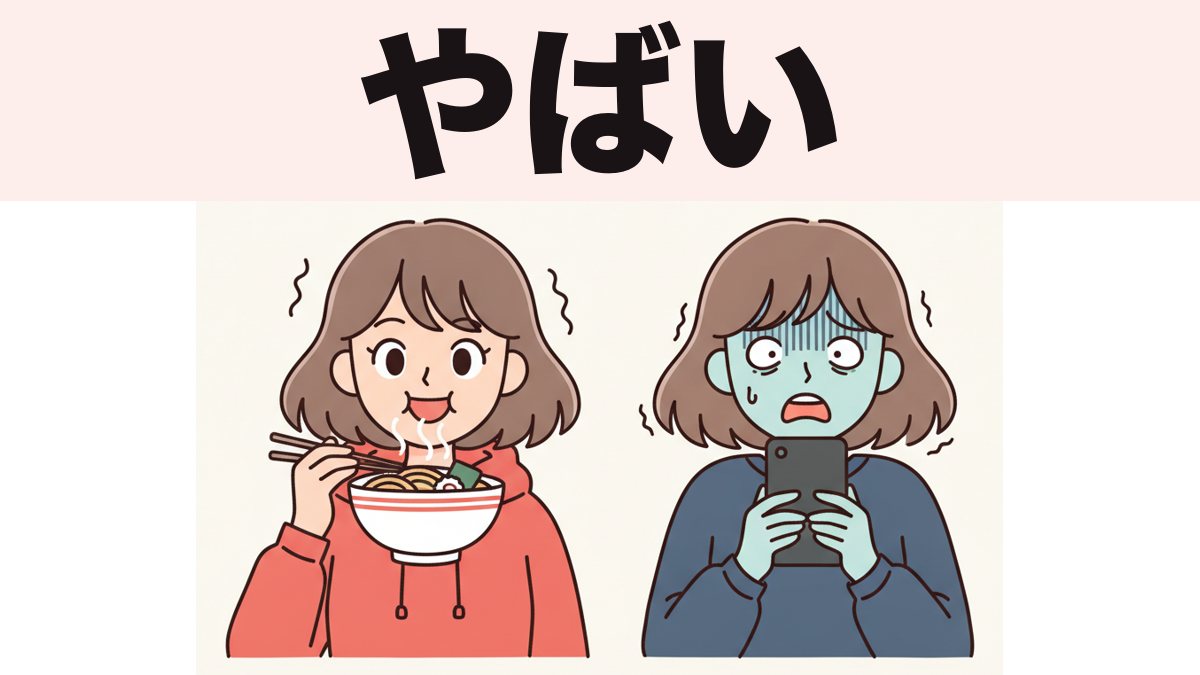
やばい means "this is a lot" and nothing more specific than that — the direction, good or bad, comes entirely from tone and context. It is the closest Japanese has to English "insane" or "sick", and it is the single most useful slang word to understand.
「やばい」は「これは、ふつうじゃない」という意味です。いいことか、わるいことかは、言葉ではなく、声の感じと場面で決まります。英語の "insane" や "sick" に近いです。
Textbooks avoid it because it has no clean translation, which leaves learners hearing it fifteen times an episode with no idea what happened. The word is not vague to Japanese ears, though. Native speakers read the direction instantly from three things: intonation, facial expression, and what is physically in front of them. Once you know what to listen for, so can you.
The basics
What does やばい actually mean?
Historically it meant "dangerous" — specifically, "the police are about to notice", as criminal slang. That original meaning is still alive:
やばい、財布忘れた。 — Oh no, I forgot my wallet. (the original sense: something has gone wrong) この道、夜はちょっとやばいよ。 — This street is a bit sketchy at night. (literally dangerous)
Then, roughly from the 1990s, younger speakers started using it for overwhelming good things too, and that use is now completely mainstream:
このラーメン、やばい。 — This ramen is insane. (good — said while eating happily) あの人の絵、やばくない? — Isn't that person's art unbelievable? (good, seeking agreement)
Same word, opposite emotions. The grammar does not change at all.
How do you tell good やばい from bad やばい?
Three signals, in order of reliability:
- What is happening. If someone is eating and says やばい, the food is extraordinary. If they are looking at their phone and say やばい, something has gone wrong.
- Pitch and length. A long, falling やば〜い usually reads as admiration. A short, sharp やばっ is alarm.
- What follows. やばい、遅刻する ("I'm going to be late") is bad. やばい、おいしい is good. The second clause resolves it immediately.
There is no rule that makes it safe to use before you can hear it, which is the honest answer to "when can I start saying it?" — listen first.
Is it rude?
Not rude, but casual — very casual. It sits at the same level as plain-form speech with friends, and it does not belong in a job interview, a first meeting with a client, or a message to a teacher you do not know well. Older speakers sometimes find the "good" meaning grating, the way some English speakers feel about "literally".
やばい、めっちゃおいしい。 — Oh my god, this is so good. (casual, friends, a meal)
Beyond the basics
The slang you will actually hear around it
These cluster with やばい in everyday casual speech, and most of them are absent from textbooks:
| Word | Literal | What it does |
|---|---|---|
| マジ | seriously | "Really?" / intensifier: マジで美味しい |
| めっちゃ | very (Kansai origin, now national) | Stronger than とても, casual |
| ガチ | serious, for real | ガチで勉強する = study seriously, no joking |
| エモい | from English "emotional" | Nostalgic, moving, bittersweet |
| 泣ける | can make you cry | A story is genuinely moving |
| うざい | annoying | Sharp; do not aim it at people you like |
| きもい | gross, creepy | Strong insult, avoid using |
| 沼 | swamp | A hobby you cannot climb out of |
この曲、エモいよね。 — This song really hits, doesn't it. (casual, nostalgic warmth) 最終回、泣けた。 — The last episode made me cry. (casual, about a story)
沼, 廃人 and the vocabulary of obsession
Fandom Japanese has its own words for "I have lost control of my hobby", and they are genuinely useful if you spend time in anime or game communities.
- 沼 (ぬま) — a swamp. 沼にハマる means you have sunk into a hobby and cannot get out. 声優沼, ソシャゲ沼.
- 廃人 (はいじん) — literally "ruined person". Someone who plays a game to an extreme degree. Used self-deprecatingly and half-proudly.
- リア充 (リアじゅう) — from リアル ("real life") + 充実 ("fulfilled"). Someone whose offline life is going well: partner, friends, plans on the weekend. Originally an insult thrown from online communities outward, now mostly a joke.
- 時間が溶ける — "time melts". What happens when you open a gacha game at 9pm.
ソシャゲに時間が溶けた。 — I melted my whole day into a mobile game. (casual, rueful) 完全に声優沼にハマってる。 — I've fallen completely into the voice-actor rabbit hole. (casual, fandom)
These are the words that make online Japanese readable. They are also the words that date fastest — リア充 already sounds slightly 2010s to younger speakers.
Why does slang so often start as a negative word?
やばい (dangerous → amazing), 鬼 (demon → extremely: 鬼かわいい), 半端ない (not half-done → incredible). Japanese intensifiers overwhelmingly come from words for danger, excess or the supernatural, because the job of an intensifier is to say "this exceeds normal", and things that exceed normal used to be frightening.
English does the same thing — "terrific" and "terrible" are the same root — which is a useful way to explain to yourself why a single word can point both ways without anyone being confused.
Where slang will get you into trouble
The risk is not saying something rude. The risk is saying something young in a setting that expected something neutral. A 40-year-old customer saying やばい to a friend in a shop is fine; an adult learner using it in a business email reads as someone who learned Japanese exclusively from streaming. The fix is not to avoid slang, but to keep a neutral version of every slang word you like:
| Casual | Neutral equivalent |
|---|---|
| やばい (good) | すごい / すばらしい |
| やばい (bad) | まずい / 大変だ |
| めっちゃ | とても |
| マジで | 本当に |
| うざい | わずらわしい |
Common mistakes
- Assuming やばい is always negative because that is how the dictionary lists it. Half of real uses are enthusiastic.
- Using it in writing to someone senior. Spoken casual Japanese and written polite Japanese are different registers; slang crosses that line badly.
- Saying きもい to a person. It is far stronger than "gross" in English and lands as a real insult.
- Treating めっちゃ as Kansai-only. It spread nationally decades ago. It is casual, not regional, at this point.
- Translating エモい as "emo". It comes from the English word but means nostalgic or moving, not gloomy.
- Over-seasoning. Two slang words in a sentence sounds natural; five sounds like a costume. Mixing slang with filler words is what makes casual speech sound real, not volume.
Practice
Say your answer out loud before opening each one. Questions 3 and 4 are a pair: the same word, two opposite meanings.
1. What did やばい originally mean?
Show answer
Dangerous — specifically underworld slang for "we are about to get caught". The positive meaning is a much later development.
2. Someone tastes a dish and says やばい with a long, falling tone. Good or bad?
Show answer
Good — a stretched やば〜い over food is admiration. The situation plus the intonation decides it, not the word.
3. Translate: やばい、電車が来ない。
Show answer
Oh no, the train isn't coming — the second clause is a problem, so やばい is the original negative sense.
4. Translate: やばい、このアニメ面白すぎる。
Show answer
Oh my god, this anime is too good — the second clause is praise, so やばい is enthusiasm. Same word, resolved by what follows.
5. Your boss asks how a project went. Why is やばかったです a bad answer even if it was fine?
Show answer
It is too casual for work, and it is ambiguous — your boss cannot tell whether it went brilliantly or collapsed. Use すごくうまくいきました or 大変でした.
6. What does 沼にハマる mean?
Show answer
To fall into a hobby you cannot escape — 沼 is a swamp. The metaphor is sinking, slowly and willingly.
7. Someone says リア充 about a friend. What are they describing?
Show answer
Someone whose offline life is going well — リアル + 充実. Partner, social plans, a life outside the screen. Usually said as a joke now.
8. Rewrite めっちゃおいしかった in neutral polite Japanese.
Show answer
とてもおいしかったです — めっちゃ → とても, and add です. Every slang word is worth learning with its neutral twin.
9. What is the difference between 泣ける and 泣いた?
Show answer
泣ける = "it can make you cry" (a property of the story); 泣いた = "I cried" (what you did) — 泣ける is the potential form used as a review: この映画は泣ける.
10. Why is きもい riskier than うざい?
Show answer
きもい attacks the person, not the behaviour — うざい says "you are being annoying"; きもい says "you are repulsive". Recognise both, use neither at people.
FAQ
Can I use やばい as a beginner? Understand it first, use it second. Nothing bad happens if you use it correctly with friends, but the good/bad direction is carried by tone, and tone is the last thing to arrive. Listening for it costs nothing.
Is やばい written in kanji? It has one (ヤバい / 危ない-adjacent writings appear), but the standard modern spelling is hiragana やばい or katakana ヤバい for emphasis. You will almost never see it in kanji.
What is the difference between やばい and すごい? すごい is neutral-intensity and safe in polite speech. やばい is stronger, casual-only, and ambiguous in direction. すごい can also go both ways (すごい雨 = terrible rain), but far less dramatically.
Do adults use this slang or is it teenagers only? Adults use やばい, マジ, めっちゃ and ガチ freely in casual settings. リア充 and 廃人 are internet-culture words and skew younger and more online.
Is エモい used the way English speakers use "emo"? No. It borrows the word but means moved, nostalgic, wistful — the feeling of an old photo or a good ending, not a musical genre.
How do I keep learning slang without a teacher correcting me? Watch what characters say and who they say it to. Slang is a relationship marker; if you note the pair (word + relationship) rather than the word alone, you learn the register at the same time as the vocabulary.
Vocabulary from this article
Tap the block to select all of it, then copy. In Anki: File → Import, note type Basic, separator Tab — the first column becomes the front, the second the back.
やばい	やばい — amazing; terrible; risky
すごい	すごい — amazing (neutral)
マジ	まじ — seriously, for real
めっちゃ	めっちゃ — very (casual)
ガチ	がち — serious, no joking
エモい	えもい — moving, nostalgic
泣ける	なける — moving enough to make you cry
うざい	うざい — annoying
沼	ぬま — swamp; an inescapable hobby
廃人	はいじん — someone consumed by a game
時間	じかん — time
財布	さいふ — wallet
遅刻	ちこく — being late
最終回	さいしゅうかい — final episode
曲	きょく — song, track
本当に	ほんとうに — really, truly
大変	たいへん — tough, serious
危ない	あぶない — dangerous
I'm Yuuki, a Japanese teacher based in Tokyo. I've taught on italki as a Top 1% teacher and watched over 1,500 anime. やばい is the word learners ask me about most after their first month of watching things without subtitles — and the answer is always the same: stop looking for the translation and start listening for the direction.
Sources: the author's own lessons and standard reference grammars.
教科書には出てきません。訳せないからです。でも、アニメでは1話に何回も出てきます。日本人は迷いません。①今、何が起きているか ②声の高さと長さ ③そのあとに何を言うか、の3つですぐ分かります。
基本
もとの意味
もとは「あぶない」という意味でした。(昔は「警察に見つかりそう」という悪い人の言葉でした。)この意味は今もあります。
やばい、財布忘れた。 — Oh no, I forgot my wallet. (the original sense: something has gone wrong) この道、夜はちょっとやばいよ。 — This street is a bit sketchy at night. (literally dangerous)
1990年代ごろから、若い人が「すごくいい」の意味でも使うようになりました。今はふつうの使い方です。
このラーメン、やばい。 — This ramen is insane. (good — said while eating happily) あの人の絵、やばくない? — Isn't that person's art unbelievable? (good, seeking agreement)
いいのか、わるいのか
- 場面 — 食べながら「やばい」」おいしい。スマホを見て「やばい」」わるいことが起きた。
- 声 — 長くて下がる「やば〜い」」かんどう。短い「やばっ」」おどろき・こまった。
- 次の文 — 「やばい、遅刻する」」わるい。「やばい、おいしい」」いい。
失礼ですか
失礼ではありませんが、とてもカジュアルです。ふつう体と同じ場面だけで使います。面接やお客さんへのメールでは使いません。
やばい、めっちゃおいしい。 — Oh my god, this is so good. (casual, friends, a meal)
もう少し先へ
いっしょに使うことば
| ことば | もとの意味 | 使い方 |
|---|---|---|
| マジ | まじめ | 「本当?」/強める: マジで美味しい |
| めっちゃ | とても(関西から) | 「とても」のカジュアル版 |
| ガチ | 本気 | ガチで勉強するする本気で勉強する |
| エモい | 英語の emotional | なつかしい・心が動く |
| 泣ける | 泣くことができる | 話がとても感動的 |
| うざい | うるさい・めんどう | 強いので人に言わない |
| きもい | 気持ちわるい | とても強い悪口。使わない |
| 沼 | ぬま | 出られない趣味 |
この曲、エモいよね。 — This song really hits, doesn't it. (casual, nostalgic warmth) 最終回、泣けた。 — The last episode made me cry. (casual, about a story)
趣味のことば
- 沼(ぬま) — 「沼にハマる」」趣味から出られない。声優沼、ソシャゲ沼。
- 廃人(はいじん) — ゲームをやりすぎる人。自分で言うことが多いです。
- リア充 — 「リアル」+「充実」。ネットの外の生活が楽しい人。今はじょうだんです。
- 時間が溶ける — 気づいたら何時間もたっていた、という意味です。
ソシャゲに時間が溶けた。 — I melted my whole day into a mobile game. (casual, rueful) 完全に声優沼にハマってる。 — I've fallen completely into the voice-actor rabbit hole. (casual, fandom)
なぜ「わるい言葉」が「すごい」になるの?
「やばい」(あぶない→すごい)、「鬼」(おに→鬼かわいい)、「半端ない」。強める言葉は、もともと「ふつうじゃない・こわい」という意味の言葉から生まれます。英語の terrific と terrible も同じ形です。
気をつけるところ
失礼になるより、「わかい話し方」になるのが問題です。だから、カジュアルな言葉には、ふつうの言い方もいっしょにおぼえます。
| カジュアル | ふつう |
|---|---|
| やばい(いい) | すごい/すばらしい |
| やばい(わるい) | まずい/大変だ |
| めっちゃ | とても |
| マジで | 本当に |
| うざい | わずらわしい |
よくあるまちがい
- 「やばい」はいつもわるい意味だと思う。 半分はいい意味です。
- 目上の人へのメールで使う。 話し言葉と書き言葉はちがいます。
- 人に「きもい」と言う。 とても強い悪口です。
- 「めっちゃ」は関西だけだと思う。 今は全国で使います。
- 「エモい」を英語の emo だと思う。 「なつかしい・感動する」という意味です。
- 1つの文にたくさん入れる。 2つは自然、5つは変です。あいづちやフィラーと組み合わせるほうが自然になります。
練習
まず声に出してから、答えを見てください。3番と4番はペアです。
1. 「やばい」のもとの意味は?
答えを見る
あぶない — 悪い人の言葉で「見つかりそう」という意味でした。いい意味はあとからできました。
2. 食べながら、長く「やば〜い」と言いました。いい?わるい?
答えを見る
いい意味 — 長くのばすと、かんどうです。場面と声で決まります。
3. 「やばい、電車が来ない。」の意味は?
答えを見る
こまった、電車が来ない — あとの文が問題なので、わるい意味です。
4. 「やばい、このアニメ面白すぎる。」の意味は?
答えを見る
すごい、このアニメは面白すぎる — あとの文がほめているので、いい意味です。
5. 上司に「やばかったです」と答えるのは、なぜよくないですか。
答えを見る
カジュアルすぎて、意味も分からないから — よかったのか、だめだったのか伝わりません。「すごくうまくいきました」「大変でした」と言います。
6. 「沼にハマる」の意味は?
答えを見る
趣味から出られなくなる — 沼沼swamp。ゆっくりしずんでいくイメージです。
7. 「リア充」はどんな人ですか。
答えを見る
ネットの外の生活が楽しい人 — リアル+充実。今はじょうだんとして使います。
8. 「めっちゃおいしかった」を、ふつうのていねいな形にしてください。
答えを見る
とてもおいしかったです — めっちゃ→とても、そして「です」をつけます。
9. 「泣ける」と「泣いた」のちがいは?
答えを見る
泣けるる話のせいしつ、泣いたた自分がしたこと — 「この映画は泣ける」は可能形で、かんそうの言い方です。
10. 「きもい」が「うざい」より強いのはなぜ?
答えを見る
「うざい」は行動を、「きもい」は人そのものを言うから — どちらも人には使わないほうがいいです。
よくある質問
初級でも使っていいですか。 まず聞いて分かるように、それから使いましょう。いい・わるいは声で決まるので、声の感じが分かってからで十分です。
漢字で書きますか。 ふつうは「やばい」か「ヤバい」です。漢字はほとんど見ません。
「やばい」と「すごい」のちがいは? 「すごい」はていねいな場面でも使えます。「やばい」はカジュアルだけで、意味の方向もあいまいです。
大人も使いますか。 「やばい」「マジ」「めっちゃ」「ガチ」は大人も使います。「リア充」「廃人」はネットの言葉で、若い人が多いです。
「エモい」は英語の emo と同じですか。 ちがいます。「なつかしい」「心が動く」という意味です。
先生がいない時、どうやっておぼえますか。 「だれが、だれに言ったか」もいっしょにメモしてください。カジュアルな言葉は、関係を表す言葉だからです。
この記事に出た単語
下のブロックをタップして全部えらび、コピーしてください。Anki では ファイル → 読み込み、ノートの種類は 基本、区切りは タブ です。
やばい	やばい — amazing; terrible; risky
すごい	すごい — amazing (neutral)
マジ	まじ — seriously, for real
めっちゃ	めっちゃ — very (casual)
ガチ	がち — serious, no joking
エモい	えもい — moving, nostalgic
泣ける	なける — moving enough to make you cry
うざい	うざい — annoying
沼	ぬま — swamp; an inescapable hobby
廃人	はいじん — someone consumed by a game
時間	じかん — time
財布	さいふ — wallet
遅刻	ちこく — being late
最終回	さいしゅうかい — final episode
曲	きょく — song, track
本当に	ほんとうに — really, truly
大変	たいへん — tough, serious
危ない	あぶない — dangerous
私はユウキです。東京で日本語を教えています。 italki の Top 1% の先生で、アニメは1,500本以上見ました。字まくなしで見はじめた人が、いちばんよく聞くのが「やばい」です。答えはいつも同じです。訳をさがさないで、方向を聞いてください。
More drills like the ones above, plus a timed JLPT-style mock test: Practice · N4上のような練習問題と、時間つきのJLPT形式のもぎ試験: 練習ページ · N4
Want to try this in a real conversation?
本当の会話で、ためしてみませんか?
30-minute trial lesson, $13. Times shown in your own timezone.
30分の体験レッスン、$13。時間はあなたのタイムゾーンで表示されます。
Book a trial lesson · $13