〜たり〜たり: the list that says "and other things like that〜たり〜たり: 「ほかにもあるけど」のリスト
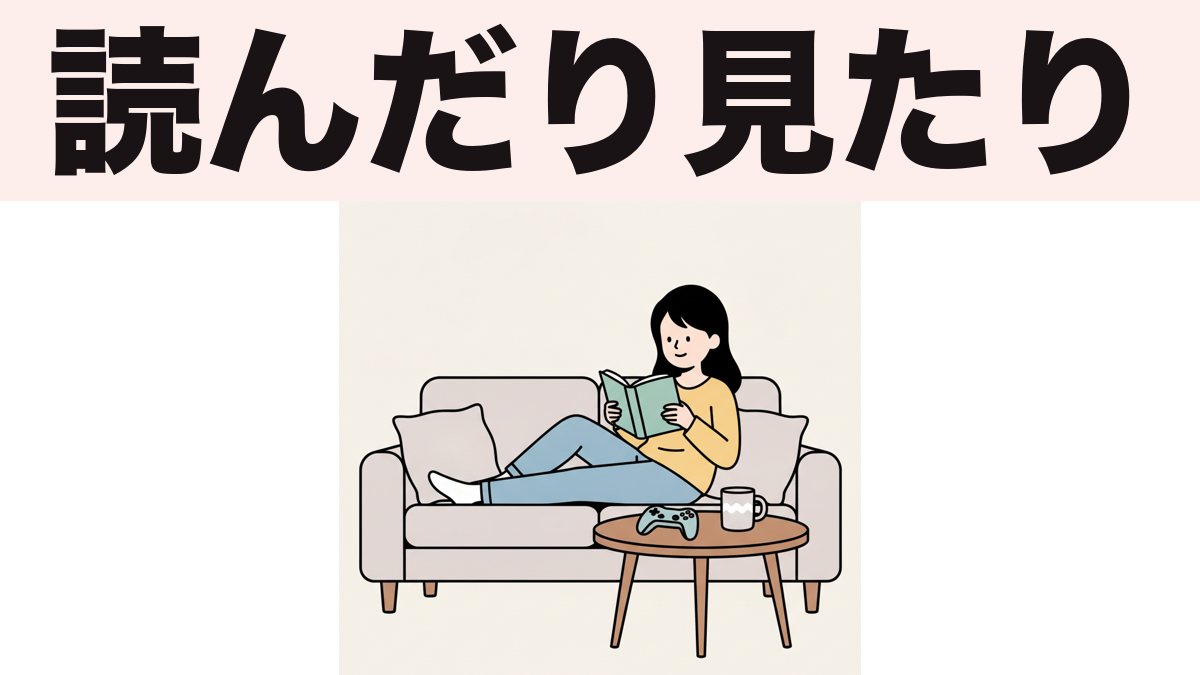
〜たり〜たり lists a couple of actions as *examples* and quietly implies there were others. It is built from the past plain form, and the sentence has to end with する — dropping that final する is the single most common mistake with this grammar.
「〜たり〜たり」は、動作をいくつか**れいとして**ならべて、「ほかにもある」と伝えます。作り方はかこの形+「り」。そして文のさいごは「する」でしめます。この「する」を落とすのが、いちばん多い間違いです。
Learners usually already have the te-form for joining actions, so たり feels redundant. It isn't. The te-form gives a complete sequence; たり gives a sample. That difference is the whole reason the grammar exists.
The basics
How do you build it?
Take the plain past form of the verb and add り. Then close the sentence with する.
| Verb | Plain past | + り |
|---|---|---|
| 食べる | 食べた | 食べたり |
| 飲む | 飲んだ | 飲んだり |
| する | した | したり |
| 来る | 来た | 来たり |
| 行く | 行った | 行ったり |
週末は本を読んだり、映画を見たりします。 — On weekends I do things like read and watch films. (polite present — habits) 昨日は掃除したり、買い物したりしました。 — Yesterday I cleaned, did some shopping, that sort of thing. (polite past)
Notice that the tense of the whole sentence lives on the final する, not on the たり. 見たりします is present; 見たりしました is past. The past shape inside たり is just how the form is built — it carries no tense of its own, the same way とき clauses work.
Why does it have to end in する?
Because 〜たり is not a verb — it's a noun-like listing form. It needs a verb to attach to, and する is that verb. Leaving it off produces a sentence with no predicate:
- 本を読んだり、映画を見たり。 → incomplete in writing, though very common in casual speech as a trailing "…and stuff"
- 本を読んだり、映画を見ます。 → wrong. The two halves don't match.
The second one is the error that actually happens: learners write one たり and then finish the second verb normally. Both items need り, and する closes them.
It always means "among other things"
This is the meaning, not a nuance. 〜たり explicitly says the list is a sample.
休みの日は、寝たり、ゲームをしたりしています。 — On days off I sleep, play games, things like that. (polite, teiru for an ongoing habit)
If you list everything you did and use たり, you have accidentally implied there was more. If you want a genuinely complete list, use the te-form instead: 寝て、ゲームをしました.
Beyond the basics
One たり on its own
A single たり is perfectly grammatical and very common. It softens the statement into "for example, things like this":
たまに泣いたりします。 — Sometimes I cry and that sort of thing. (polite, softened — the たり makes it less blunt)
This softening use is everywhere in real conversation. 心配したりしないで ("don't go worrying about it") is gentler than 心配しないで, because the たり turns the worry into one example of a whole category of reactions you're waving off.
Alternating pairs: 行ったり来たり
When the two verbs are opposites, たり stops meaning "for example" and starts meaning "back and forth, repeatedly":
雨が降ったりやんだりしています。 — The rain keeps starting and stopping. (polite, ongoing) 部屋を行ったり来たりしていました。 — He was pacing back and forth in the room. (polite past, ongoing)
These pairs are close to fixed vocabulary: 行ったり来たり (pacing), 降ったりやんだり (on and off), 上がったり下がったり (fluctuating), 泣いたり笑ったり (laughing and crying). Learn them whole.
〜たり〜たり with adjectives and nouns
Less common, but it works. Adjectives take かったり, nouns and な-adjectives take だったり:
店によって、高かったり安かったりします。 — Depending on the shop, it's expensive or cheap. (polite — variation across cases) 休みは日曜だったり月曜だったりします。 — My day off is Sunday, or Monday, it varies. (polite)
With this pattern the meaning shifts again — toward "it varies, it depends." If your adjective past forms are solid, かったり costs you nothing new.
たり vs て-form vs し
Three ways to join things, three different jobs:
| Form | What it lists | Implication |
|---|---|---|
| 〜て、〜て | Actions in sequence | A complete, ordered account |
| 〜たり〜たりする | Example actions | There were others |
| 〜し、〜し | Reasons or qualities | There are more reasons |
朝ごはんを食べて、学校に行きました。 — I ate breakfast and went to school. (sequence — in that order) 朝は食べたり食べなかったりします。 — In the mornings I eat sometimes and sometimes don't. (variation)
The し pattern is the closest cousin: 〜し also implies an unfinished list, but it lists reasons, where たり lists actions.
したりしなかったり
Pairing a verb with its own negative is a compact way to say "sometimes yes, sometimes no":
彼は来たり来なかったりです。 — He shows up sometimes and not others. (polite, slightly resigned)
Note that this one often ends in です rather than します, because it has become a description of a state rather than an action.
Common mistakes
- Forgetting the final する. 本を読んだり、映画を見たり。 needs します or しました to be a complete sentence in writing.
- Only marking one item. 本を読んだり、映画を見ます is broken. Both verbs take り.
- Using the dictionary form. 読むたり does not exist. It is built from the past: 読んだ → 読んだり.
- Using たり for a complete list. If you actually did exactly two things and want to say so, use the te-form. たり always leaks "and other stuff."
- Doubling the tense. 読んだりしました is correct; 読んだりしたりしました is not. Only the final する takes the tense.
Practice
Answers are hidden — build yours first, then open. Questions 4 and 5 are a pair: same two actions, and only the connector changes.
1. Make たり from 飲む.
Show answer
飲んだり — plain past 飲んだ, then り. The past shape is how the form is built; it carries no tense.
2. Something is wrong here: 週末は本を読んだり、映画を見ます。
Show answer
映画を見たりします — both items need り, and the sentence closes with する.
3. Something is wrong here: 読むたり、書くたりします。
Show answer
読んだり、書いたりします — たり attaches to the plain past form, not the dictionary form.
4. Say "I ate breakfast and went to school" — a complete, ordered account.
Show answer
朝ごはんを食べて、学校に行きました — the te-form, because this is a full sequence with nothing left out.
5. Say "On weekends I do things like eat out and go to the cinema."
Show answer
週末は外で食べたり、映画を見たりします — たり, because these are examples. This is the pair to question 4: the te-form reports, たり samples.
6. Say "The rain keeps starting and stopping."
Show answer
雨が降ったりやんだりしています — with opposite verbs, たり means alternation rather than "for example."
7. Put the sentence 本を読んだりします into the past.
Show answer
本を読んだりしました — only the final する moves. The たり never changes.
8. How do you say "depending on the shop, it's expensive or cheap"?
Show answer
店によって、高かったり安かったりします — い-adjectives take かったり. Here the pattern means "it varies."
9. Why is 心配したりしないで softer than 心配しないで?
Show answer
たり turns the worry into one example of a category — you are waving off a whole kind of reaction rather than issuing a direct instruction about one.
10. What does 彼は来たり来なかったりです say about him?
Show answer
He turns up some days and not others — pairing a verb with its own negative is the compact way to say "it varies." It ends in です because it describes a state.
FAQ
Do I need exactly two たり? No. One is fine and common (softening), and three is possible though it starts to feel like a list for its own sake. Two is the default.
Can I use it for future plans? Yes: 日本で寿司を食べたり、お寺に行ったりしたいです ("I want to do things like eat sushi and visit temples"). The たい goes on the final する.
Does the order matter? Not grammatically. Because the list is explicitly incomplete, nobody reads it as a sequence — which is exactly what separates it from the te-form.
Is 〜たりして a thing? Yes — たりして at the end of a sentence adds a playful "…or something," often for a half-joking guess: 明日は雪が降ったりして ("maybe it'll even snow tomorrow").
Can I use たり with just one verb repeated? Only with its negative: 行ったり行かなかったり. Repeating the same positive verb twice does not mean anything.
Is the final する ever replaced? です appears in the したりしなかったり pattern, and です/でした can close adjective and noun versions. Otherwise する is the standard closer.
Vocabulary from this article
Tap the block to select all of it, then copy. In Anki: File → Import, note type Basic, separator Tab — the first column becomes the front, the second the back.
週末	しゅうまつ — weekend
読む	よむ — to read
映画	えいが — film, movie
見る	みる — to see, to watch
掃除	そうじ — cleaning
買い物	かいもの — shopping
休み	やすみ — day off, holiday
寝る	ねる — to sleep
泣く	なく — to cry
笑う	わらう — to laugh
雨	あめ — rain
降る	ふる — to fall (rain, snow)
部屋	へや — room
店	みせ — shop
高い	たかい — expensive, high
安い	やすい — cheap
日曜	にちよう — Sunday
朝ごはん	あさごはん — breakfast
学校	がっこう — school
心配	しんぱい — worry
雪	ゆき — snow
I'm Yuuki, a Japanese teacher based in Tokyo. I've taught on italki as a Top 1% teacher and watched over 1,500 anime. Almost every learner who reaches this point writes one たり, then finishes the second verb normally, and the sentence quietly breaks. Marking both items and closing with する is the whole fix.
Sources: the author's own lessons and standard reference grammars.
「て形」で動作をつなげる方法はもう知っているので、「たり」はいらないように見えます。でもちがいます。「て形」はぜんぶを順番に言います。「たり」はれいを出すだけです。
基本
作り方
動詞のふつうのかこの形に「り」をつけます。さいごは「する」です。
| 動詞 | かこの形 | +り |
|---|---|---|
| 食べる | 食べた | 食べたり |
| 飲む | 飲んだ | 飲んだり |
| する | した | したり |
| 来る | 来た | 来たり |
| 行く | 行った | 行ったり |
週末は本を読んだり、映画を見たりします。 — On weekends I do things like read and watch films. 昨日は掃除したり、買い物したりしました。 — Yesterday I cleaned, did some shopping, that sort of thing.
文のじかんは、さいごの「する」が持っています。「見たりします」は今、「見たりしました」はかこです。中の「たり」はじかんを持ちません。
どうして「する」がいるのか
「〜たり」は動詞ではありません。ならべるための形です。だから動詞がいります。それが「する」です。
- 本を読んだり、映画を見たり。 → 書きことばでは、まだ終わっていません(話しことばではよくあります)
- 本を読んだり、映画を見ます。 → 間違いです。左と右の形が合っていません
2つ目がよく起きます。1つだけ「たり」にして、2つ目をふつうに終わらせてしまいます。
いつも「ほかにもある」
これは意味そのものです。ニュアンスではありません。
休みの日は、寝たり、ゲームをしたりしています。 — On days off I sleep, play games, things like that.
ぜんぶ言ってから「たり」を使うと、「ほかにもある」と言ってしまいます。ぜんぶ言いたい時は「て形」を使います。
もう少しくわしく
「たり」1つでもいい
1つでも正しいです。よく使います。やわらかくなります。
たまに泣いたりします。 — Sometimes I cry and that sort of thing.
「心配したりしないで」は「心配しないで」よりやさしく聞こえます。「たり」が、心配を「そういうたぐいのこと」の1つにするからです。
反対の動詞のペア
2つが反対の動詞だと、意味が「行ったり来たり」に変わります。
雨が降ったりやんだりしています。 — The rain keeps starting and stopping. 部屋を行ったり来たりしていました。 — He was pacing back and forth in the room.
「行ったり来たり」「降ったりやんだり」「上がったり下がったり」「泣いたり笑ったり」は、ことばとしておぼえてください。
形容詞と名詞にもつく
い形容詞は「かったり」、な形容詞と名詞は「だったり」です。
店によって、高かったり安かったりします。 — Depending on the shop, it's expensive or cheap. 休みは日曜だったり月曜だったりします。 — My day off is Sunday, or Monday, it varies.
この時の意味は「いろいろ」「時による」に変わります。
「たり」「て」「し」
| 形 | 何をならべるか | ほのめかし |
|---|---|---|
| 〜て、〜て | 順番の動作 | ぜんぶ言った |
| 〜たり〜たりする | れいの動作 | ほかにもある |
| 〜し、〜し | 理由 | 理由はほかにもある |
朝ごはんを食べて、学校に行きました。 — I ate breakfast and went to school. 朝は食べたり食べなかったりします。 — In the mornings I eat sometimes and sometimes don't.
「したりしなかったり」
動詞と、その動詞のうちけしをならべると、「時による」になります。
彼は来たり来なかったりです。 — He shows up sometimes and not others.
これは「です」で終わることが多いです。動作ではなく、じょうたいのせつめいになるからです。
よくある間違い
- さいごの「する」を落とす。 書きことばでは「します」「しました」がいります。
- 1つだけ「り」にする。 両方に「り」をつけます。
- じしょ形につける。 「読むたり」はありません。「読んだり」です。
- ぜんぶのリストに使う。 ぜんぶ言いたい時は「て形」です。
- じかんを2回入れる。 「読んだりしました」は正しい。「読んだりしたりしました」は間違いです。
練習
答えはかくれています。まず自分で作ってから開いてください。4番と5番が対です。動作は同じで、つなぎ方だけが変わります。
1. 「飲む」を「たり」の形にしてください。
答えを見る
飲んだり — かこの形「飲んだ」に「り」。かこの形は作り方で、じかんの意味はありません。
2. 直してください: 週末は本を読んだり、映画を見ます。
答えを見る
映画を見たりします — 両方に「り」をつけて、「する」でしめます。
3. 直してください: 読むたり、書くたりします。
答えを見る
読んだり、書いたりします — じしょ形ではなく、かこの形につきます。
4. 「朝ごはんを食べて、学校に行きました」— これはぜんぶを順番に言っていますか。
答えを見る
はい、ぜんぶを順番に言っています — 「て形」はぜんぶを言う形です。
5. 「週末は外で食べたり、映画を見たりします」は何がちがいますか。
答えを見る
これはれいで、ほかにもあります — 4番と対です。「て形」は報こく、「たり」はサンプルです。
6. 「雨がふって、やんで、またふります」を「たり」で言ってください。
答えを見る
雨が降ったりやんだりしています — 反対の動詞だと「くりかえし」の意味になります。
7. 「本を読んだりします」をかこにしてください。
答えを見る
本を読んだりしました — さいごの「する」だけが動きます。
8. 「店によって、値段がちがいます」を「たり」で言ってください。
答えを見る
店によって、高かったり安かったりします — い形容詞は「かったり」。意味は「いろいろ」です。
9. 「心配したりしないで」は「心配しないで」よりどうしてやさしいですか。
答えを見る
「たり」が心配を「そういうこと」の1つにするから — 1つのことを直接止めるのではなく、たぐいごとやわらかく止めています。
10. 「彼は来たり来なかったりです」はどういう意味ですか。
答えを見る
来る日もあるし、来ない日もある — 動詞とうちけしをならべると「時による」になります。じょうたいなので「です」で終わります。
この記事に出た単語
ブロックをタップすると全部選べます。そのままコピーしてください。Anki では ファイル → 読み込み、ノートタイプ 基本、区切り タブ。1列目が表、2列目が裏になります。
週末	しゅうまつ — weekend
読む	よむ — to read
映画	えいが — film, movie
見る	みる — to see, to watch
掃除	そうじ — cleaning
買い物	かいもの — shopping
休み	やすみ — day off, holiday
寝る	ねる — to sleep
泣く	なく — to cry
笑う	わらう — to laugh
雨	あめ — rain
降る	ふる — to fall (rain, snow)
部屋	へや — room
店	みせ — shop
高い	たかい — expensive, high
安い	やすい — cheap
日曜	にちよう — Sunday
朝ごはん	あさごはん — breakfast
学校	がっこう — school
心配	しんぱい — worry
値段	ねだん — price
私はユウキです。東京で日本語を教えています。 italki の Top 1% の先生で、アニメは1,500本以上見ました。ここまで来た人のほとんどが、「たり」を1つだけ書いて、2つ目をふつうに終わらせます。そして文が静かにこわれます。両方に「り」、さいごに「する」。それだけで直ります。
More drills like the ones above, plus a timed JLPT-style mock test: Practice · N4上のような練習問題と、時間つきのJLPT形式のもぎ試験: 練習ページ · N4
Want to try this in a real conversation?
本当の会話で、ためしてみませんか?
30-minute trial lesson, $13. Times shown in your own timezone.
30分の体験レッスン、$13。時間はあなたのタイムゾーンで表示されます。
Book a trial lesson · $13