〜によると: "according to," and the そうです you must not drop〜によると: 落としてはいけない「そうです」
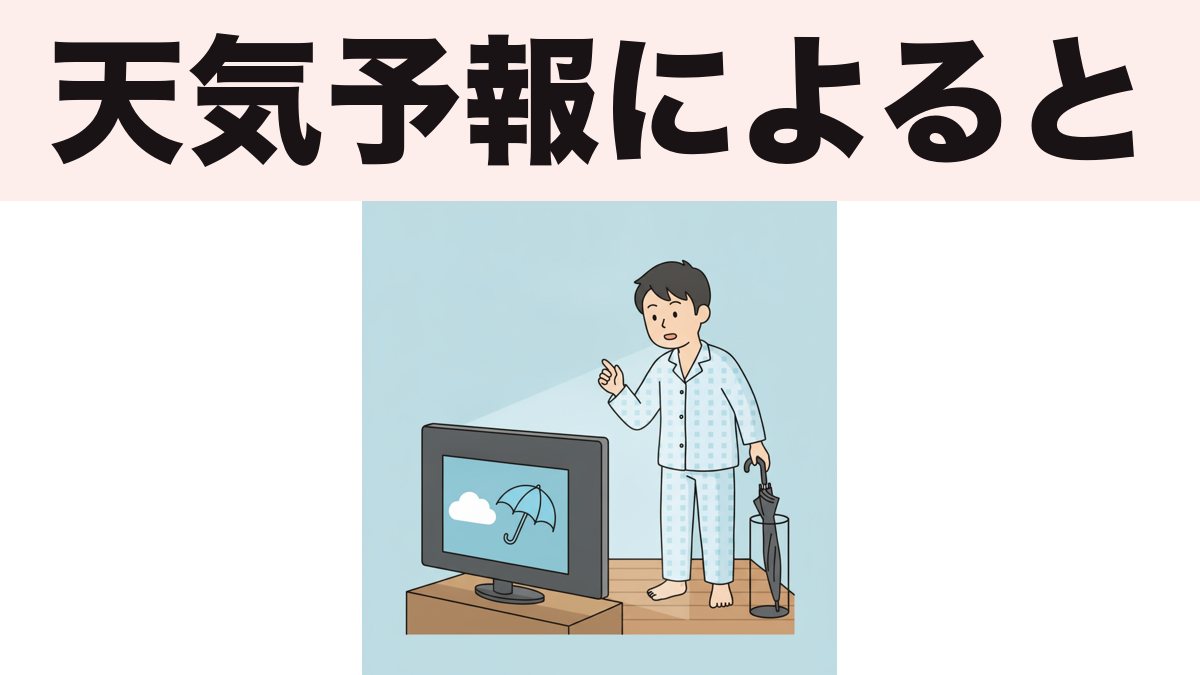
〜によると names where you got your information, and the sentence it opens must close with そうです, らしいです or ということです. Finishing flat — 天気予報によると、雨が降ります — quietly converts the forecast into your own prediction, which is not what you meant.
「〜によると」は、じょうほうのもとを言います。そして、その文は「そうです」「らしいです」「ということです」で終わらないといけません。「天気予報によると、明日は雨が降ります」と終わると、天気よほうが自分のよそうになってしまいます。
This is a two-part construction. Learners reliably remember the first half and forget the second, and the result is a sentence that sounds like you are personally guaranteeing the weather.
The basics
The shape
source + によると + statement + そうです
天気予報によると、明日は雨が降るそうです。 — According to the forecast, it'll rain tomorrow. (polite) ニュースによると、地震があったそうです。 — According to the news, there was an earthquake. (polite)
The によると half names the source. The そうです half marks the statement as reported. Both halves are doing necessary work, and the second one is the one people drop.
What can close the sentence
| Ending | Feel |
|---|---|
| 〜そうです | Neutral reporting — the default |
| 〜らしいです | Slightly less committed |
| 〜ということです | Formal, common in business and news |
| 〜とのことです | Very formal, written |
担当者によると、今週中に届くとのことです。 — According to the person in charge, it will arrive this week. (very formal — business email)
そうです is the one to master first. For the difference between this そうです and the other そう (the one meaning "looks like"), see そうです: looks like vs I heard — they attach differently and mean unrelated things.
What counts as a source
Anything that can be quoted: a person, a document, a broadcast, a study.
友達によると、あの店はもう閉まったそうです。 — According to a friend, that shop has closed. (polite) 調査によると、日本人の約半分がそう答えたそうです。 — According to the survey, about half of Japanese people answered that way. (polite — note: this is an example sentence, not a real statistic)
You cannot use によると with yourself. 私によると is not a sentence — for your own view, use 私は…と思います.
Beyond the basics
によると vs によって: two completely different grammar points
They share によ and nothing else.
| Form | Meaning | Example |
|---|---|---|
| 〜によると | According to (source of information) | ニュースによると |
| 〜によって | Depending on / by means of / by (agent) | 人によって |
人によって違います。 — It depends on the person. (polite — によって, not によると)
If you can replace the English with "according to," it is によると. If you can replace it with "depending on," "by means of," or a passive "by," it is によって. Learners at this level mix them up constantly, and the sentences come out sounding almost right.
によれば is the formal twin
報告書によれば、問題はすでに解決したということです。 — According to the report, the problem has already been resolved. (formal, written)
によると and によれば mean the same thing; によれば is more written and slightly stiffer. In speech, によると is the natural choice almost always.
The casual version has no によると at all
In conversation, Japanese usually names the source with a plain quotation instead:
友達が、あの店もう閉まったって言ってた。 — A friend said that shop has closed. (casual — って言ってた does the whole job)
〜って言ってた is what people actually say. によると belongs to slightly careful speech, news, and writing. Knowing both means you can move between registers instead of sounding formal with friends.
Why the そうです matters so much
Japanese draws a hard line between what you know and what you were told. らしい, ようだ and みたい all exist to mark that line, and そうです is the plainest of the family. Dropping it does not just sound unfinished — it changes who is responsible for the claim.
明日は雨が降ります。 — It will rain tomorrow. (polite — you are asserting this) 明日は雨が降るそうです。 — I hear it'll rain tomorrow. (polite — someone else is)
In a work context, that distinction has consequences, which is why business Japanese leans so heavily on とのことです.
The reporting そうだ attaches to the plain form
Unlike the "looks like" そう, the hearsay そうだ takes the plain form of anything, with no changes:
| Word type | Form | Example |
|---|---|---|
| Verb | plain | 降るそうです |
| い-adjective | plain | 高いそうです |
| な-adjective | だ | 便利だそうです |
| Noun | だ | 学生だそうです |
Note that な-adjectives and nouns keep their だ here — the opposite of what happens before かもしれない.
Common mistakes
- Dropping そうです. 天気予報によると、明日は雨が降ります makes it your forecast.
- Using によると for your own opinion. 私によると is not Japanese.
- Confusing によると and によって. "According to" vs "depending on."
- Dropping だ before そうです. 便利そうです means "it looks convenient"; 便利だそうです means "I hear it's convenient." One syllable, two different grammar points.
- Using によると with friends. って言ってた is what a native speaker says in casual conversation.
Practice
Answers are hidden — build yours first, then open. Questions 6 and 7 are a pair: one だ decides which grammar point you used.
1. Say "according to the forecast, it'll rain tomorrow."
Show answer
天気予報によると、明日は雨が降るそうです — both halves are required: によると names the source, そうです marks it as reported.
2. Something is wrong here: ニュースによると、地震がありました。
Show answer
地震があったそうです — without そうです you are reporting the earthquake as your own knowledge.
3. Something is wrong here: 私によると、この店はおいしいです。
Show answer
私はこの店はおいしいと思います — によると needs an external source. You cannot cite yourself.
4. Rewrite ニュースによると… for a formal business email.
Show answer
担当者によると、〜とのことです — とのことです is the formal written closer, and によれば is the stiffer form of によると.
5. Say the same thing casually: a friend told you the shop closed.
Show answer
友達が、あの店もう閉まったって言ってた — casual Japanese quotes directly. によると belongs to careful speech and writing.
6. What does 便利そうです mean?
Show answer
"It looks convenient" — the appearance そう, attached to the bare stem.
7. What does 便利だそうです mean?
Show answer
"I hear it's convenient" — the hearsay そうだ, which keeps the だ. This is the pair to question 6: one syllable, two grammar points.
8. Something is wrong here: 人によると違います。
Show answer
人によって違います — "depending on" is によって. によると is only "according to."
9. Why does dropping そうです matter in a work email?
Show answer
It moves responsibility for the claim onto you — Japanese marks the line between what you know and what you were told, and business writing takes that line seriously.
10. Attach the hearsay そうです to 学生.
Show answer
学生だそうです — nouns keep their だ before the hearsay そうだ, unlike before かもしれない where the だ is deleted.
FAQ
Can によると come in the middle of a sentence? It normally opens the sentence, but it can follow a topic: この記事は、専門家によると間違いだそうです. Front position is clearer.
Is 〜によりますと a real form? Yes — it is the polite-verb version, common in news broadcasts. 気象庁によりますと… is a standard NHK opening.
Do I need によると if I already use そうです? No. 雨が降るそうです is complete without naming a source. によると adds the citation.
What about 〜って? The casual quoting particle: 雨が降るって ("apparently it'll rain"). Very common, very informal.
Can らしいです replace そうです here? Yes, with a small shift: らしい keeps a bit more distance from the claim. Both are correct after によると.
Is によると used with written sources? Constantly: 記事によると, 説明書によると, データによると. Written sources are its natural home.
Vocabulary from this article
Tap the block to select all of it, then copy. In Anki: File → Import, note type Basic, separator Tab — the first column becomes the front, the second the back.
天気予報	てんきよほう — weather forecast
明日	あした — tomorrow
雨	あめ — rain
降る	ふる — to fall (rain)
地震	じしん — earthquake
友達	ともだち — friend
店	みせ — shop
閉まる	しまる — to close
調査	ちょうさ — survey, investigation
答える	こたえる — to answer
担当者	たんとうしゃ — person in charge
今週	こんしゅう — this week
届く	とどく — to arrive, to be delivered
報告書	ほうこくしょ — report
問題	もんだい — problem
解決	かいけつ — resolution
違う	ちがう — to differ
便利	べんり — convenient
学生	がくせい — student
記事	きじ — article
専門家	せんもんか — expert
説明書	せつめいしょ — instruction manual
I'm Yuuki, a Japanese teacher based in Tokyo. I've taught on italki as a Top 1% teacher and watched over 1,500 anime. Learners get によると right and then stop, because in English "according to the forecast, it will rain tomorrow" is a complete sentence. In Japanese it isn't — and the missing half is the half that says the forecast is not yours.
Sources: the author's own lessons and standard reference grammars.
これは2つでひとくみの形です。みんな前半をおぼえて、後半をわすれます。すると、天気を自分がほしょうしているような文になります。
基本
形
もと + によると + 内よう + そうです
天気予報によると、明日は雨が降るそうです。 — According to the forecast, it'll rain tomorrow. ニュースによると、地震があったそうです。 — According to the news, there was an earthquake.
「によると」がもとを言い、「そうです」が「聞いた話です」としるしをつけます。落ちるのは2つ目です。
文の終わり方
| 終わり | 感じ |
|---|---|
| 〜そうです | ふつうの伝え方(まずこれ) |
| 〜らしいです | 少しきょりがある |
| 〜ということです | かたい・仕事やニュース |
| 〜とのことです | とてもかたい・書きことば |
担当者によると、今週中に届くとのことです。 — According to the person in charge, it will arrive this week.
「もと」になるもの
人・書るい・ほうそう・ちょうさ。引用できるものなら何でもです。
友達によると、あの店はもう閉まったそうです。 — According to a friend, that shop has closed. 調査によると、日本人の約半分がそう答えたそうです。 — According to the survey, about half of Japanese people answered that way.
自分には使えません。「私によると」は文になりません。自分の考えは「私は…と思います」です。
もう少しくわしく
「によると」と「によって」
にているのは「によ」だけです。
| 形 | 意味 | れい |
|---|---|---|
| 〜によると | 〜が言うには | ニュースによると |
| 〜によって | 〜で変わる/〜によって(される) | 人によって |
人によって違います。 — It depends on the person.
英語で "according to" になるなら「によると」。"depending on" になるなら「によって」です。
「によれば」はかたい方
報告書によれば、問題はすでに解決したということです。 — According to the report, the problem has already been resolved.
意味は同じで、「によれば」の方が書きことばです。会話ではほとんど「によると」です。
会話では「によると」を使いません
友達が、あの店もう閉まったって言ってた。 — A friend said that shop has closed.
「〜って言ってた」が、じっさいの会話の形です。「によると」は、ていねいな話し方・ニュース・書きことばです。
どうして「そうです」が大事か
日本語は、「自分が知っていること」と「人から聞いたこと」をはっきり分けます。
明日は雨が降ります。 — It will rain tomorrow. 明日は雨が降るそうです。 — I hear it'll rain tomorrow.
仕事ではこのちがいにせきにんがついてきます。だからビジネスの文しょでは「とのことです」がよく使われます。
伝聞の「そうだ」の形
見た目の「そう」とちがって、伝聞の「そうだ」はふつうの形にそのままつきます。
| しゅるい | 形 | れい |
|---|---|---|
| 動詞 | ふつうの形 | 降るそうです |
| い形容詞 | ふつうの形 | 高いそうです |
| な形容詞 | だ | 便利だそうです |
| 名詞 | だ | 学生だそうです |
「な形容詞」と名詞は「だ」がのこります。「かもしれない」の前とは反対です。
よくある間違い
- 「そうです」を落とす。 自分のよそうになってしまいます。
- 自分の考えに使う。 「私によると」は言いません。
- 「によると」と「によって」をまぜる。 「〜が言うには」と「〜で変わる」です。
- 「そうです」の前の「だ」を落とす。 「便利そうです」」見た目。「便利だそうです」」聞いた話。
- 友だちに「によると」を使う。 会話は「って言ってた」です。
練習
答えはかくれています。まず自分で作ってから開いてください。6番と7番が対です。「だ」1つで文法が変わります。
1. 「天気よほうでは明日は雨だそうです」を「によると」で言ってください。
答えを見る
天気予報によると、明日は雨が降るそうです — 2つでひとくみです。もとと、「聞いた話」のしるしです。
2. 直してください: ニュースによると、地震がありました。
答えを見る
地震があったそうです — 「そうです」がないと、自分が知っていることになります。
3. 直してください: 私によると、この店はおいしいです。
答えを見る
私はこの店はおいしいと思います — 「によると」は外のもとにだけ使います。
4. 仕事のメールの形にしてください。
答えを見る
担当者によると、〜とのことです — 「とのことです」が書きことばのしめ方です。
5. 友だちから聞いた話を、くだけて言ってください。
答えを見る
友達が、あの店もう閉まったって言ってた — 会話は直接引用です。
6. 「便利そうです」はどういう意味ですか。
答えを見る
便利に見えます — 見た目の「そう」です。
7. 「便利だそうです」はどういう意味ですか。
答えを見る
便利だと聞きました — 伝聞の「そうだ」で、「だ」がのこります。6番と対です。
8. 直してください: 人によると違います。
答えを見る
人によって違います — 「〜で変わる」は「によって」です。
9. 仕事のメールで「そうです」を落とすと、何が変わりますか。
答えを見る
せきにんが自分に来ます — 「知っていること」と「聞いたこと」の線が動きます。
10. 「学生」に伝聞の「そうです」をつけてください。
答えを見る
学生だそうです — 名詞は「だ」がのこります。「かもしれない」の前とは反対です。
この記事に出た単語
ブロックをタップすると全部選べます。そのままコピーしてください。Anki では ファイル → 読み込み、ノートタイプ 基本、区切り タブ。1列目が表、2列目が裏になります。
天気予報	てんきよほう — weather forecast
明日	あした — tomorrow
雨	あめ — rain
降る	ふる — to fall (rain)
地震	じしん — earthquake
友達	ともだち — friend
店	みせ — shop
閉まる	しまる — to close
調査	ちょうさ — survey, investigation
答える	こたえる — to answer
担当者	たんとうしゃ — person in charge
今週	こんしゅう — this week
届く	とどく — to arrive, to be delivered
報告書	ほうこくしょ — report
問題	もんだい — problem
解決	かいけつ — resolution
違う	ちがう — to differ
便利	べんり — convenient
学生	がくせい — student
直接	ちょくせつ — direct
私はユウキです。東京で日本語を教えています。 italki の Top 1% の先生で、アニメは1,500本以上見ました。「によると」までは正しく言えて、そこで止まる人が多いです。英語では "according to the forecast, it will rain tomorrow" で文が終わるからです。日本語では終わりません。足りない後半が、「そのよそうは自分のものではない」と言う部分です。
More drills like the ones above, plus a timed JLPT-style mock test: Practice · N4上のような練習問題と、時間つきのJLPT形式のもぎ試験: 練習ページ · N4
Want to try this in a real conversation?
本当の会話で、ためしてみませんか?
30-minute trial lesson, $13. Times shown in your own timezone.
30分の体験レッスン、$13。時間はあなたのタイムゾーンで表示されます。
Book a trial lesson · $13