によって: what "it depends" actually means in Japaneseによって: 「場合による」との本当のちがい
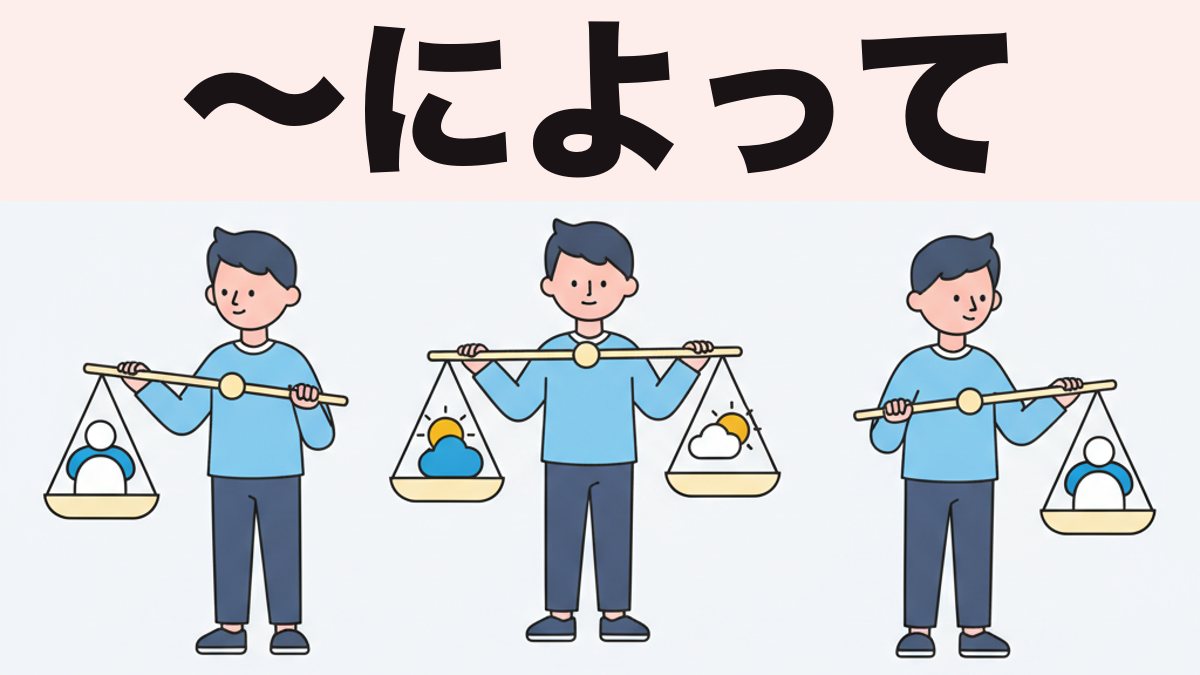
〜によって means "depending on X" or "by means of X" — the same three characters cover variation, method, and the passive "by," and context is what tells you which one you're looking at.
〜によって は、「Xによってちがう」(変化)と、「Xによって作られた」(受け身の「〜によって」)の、両方の意味で使われます。同じ3文字が、いくつもの仕事をしています。文脈で、どの意味かがわかります。
This is one of the first grammar points where a single form does more than one job, which is exactly why it gets confusing. Learn the three jobs separately and it stops being one slippery rule and becomes three simple ones.
The basics
What does によって mean when something varies?
Its most common job: marking the factor that causes something to differ from case to case.
人によって考え方が違います。 — People's ways of thinking differ depending on the person. 天気によって予定が変わります。 — Plans change depending on the weather. 場所によって値段が違います。 — Prices differ by location.
The pattern is almost always X によって、Y が違う/変わる — "Y differs/changes depending on X." If you see によって followed by 違う or 変わる, this is the job it's doing.
How do you build it?
Attach によって directly to a noun. That's the whole mechanic — no conjugation, no verb form to worry about.
やり方によって結果が変わる。 — The result changes depending on how you do it. 時期によって混み具合が違う。 — How crowded it is differs depending on the time of year.
Is により the same thing?
Yes — により is the slightly more formal, more written version of によって. You'll see it in news headlines, notices, and academic writing; によって covers both speech and writing comfortably.
台風により、電車が止まりました。 — Trains stopped due to the typhoon. (written/formal register) 台風によって、電車が止まりました。 — Trains stopped because of the typhoon. (same meaning, everyday register)
Beyond the basics
What's the passive "by" use?
によって also marks the agent in a formal passive sentence — who or what did the action, when the sentence is built around the thing that got acted on.
この寺は聖徳太子によって建てられました。 — This temple was built by Prince Shotoku. この小説は実話によって書かれた。 — This novel was written based on a true story.
Don't confuse this with で, which marks the material or instrument something was made with rather than the agent who made it.
この橋は木で作られています。 — This bridge is made of wood. (で = material) この橋は江戸時代の職人によって作られました。 — This bridge was built by Edo-period craftsmen. (によって = agent)
For everyday spoken passives about people ("I was scolded by my teacher"), Japanese usually reaches for に instead — 先生に叱られた, not 先生によって叱られた. によって's passive use mostly lives in formal, written, historical, or ceremonial sentences.
How is によって different from 次第?
次第 (しだい) also translates as "depends on," but the feel is stronger: it says the outcome is entirely contingent on that one factor, nothing else — closer to "it's completely up to X."
それは人次第です。 — That's entirely up to the person. 天気次第で中止になります。 — It'll be cancelled depending on the weather — and that's the deciding factor.
によって leaves room for multiple contributing factors; 次第 points at one factor as the whole answer.
What about 場合による — is that the same idea again?
場合による (or the shorter, very common 場合によります) means "it depends on the situation" — used as a standalone answer far more often than によって is.
場合によります。 — It depends [on the situation]. (a complete, standalone answer to a question) 時と場合による。 — It depends on the time and the situation. (a natural way to hedge, casual-to-neutral)
There's also a purely casual, spoken-only cousin worth knowing: 〜によりけり, which means roughly the same as によって/による but only ever appears as a loose, conversational shrug.
それは人によりけりだね。 — Well, that depends on the person, I guess.
You won't see によりけり in formal writing, but you'll hear it constantly once you know to listen for it.
Does によって ever attach to a whole clause instead of a noun?
Only indirectly — によって wants a noun in front of it, so a clause gets nominalized first with か or の before によって can attach.
誰が担当するかによって、進め方が変わります。 — How we proceed depends on who's in charge. (誰が担当するか — "who's in charge" — turned into a noun-like clause with か before によって)
This pattern is common once sentences get longer and more abstract — meetings, planning, anything where the deciding factor is itself a small question rather than a simple noun like 人 or 場所.
How do you actually say "it depends" in Japanese?
The short answer people use most is 場合によります — "it depends on the situation." It is polite, it is a complete sentence on its own, and it is the standard way to decline to commit without sounding evasive.
場合によります。 — It depends. (polite — the all-purpose version) 人によりますね。 — It depends on the person, doesn't it. (polite — the ね invites agreement) 時と場合によります。 — It depends on the time and the situation. (polite — a fixed pair, slightly more emphatic)
Three things worth knowing about it:
- によります is the polite form of による, so it already carries the politeness. You do not need to add anything.
- Naming the factor makes it warmer. 場合によります is neutral; 人によります, 天気によります and 値段によります all sound more helpful because they tell the listener what the answer hinges on.
- The casual version drops the ます: 場合による or just それによる. In very casual speech people also say 時と場合によるかな.
What to avoid is translating "it depends" as たぶん ("probably") or わかりません ("I don't know"). Both are true-ish and neither is what you mean — たぶん commits you to a guess, and わかりません closes the topic. によります keeps it open and honest at the same time.
How to practise it
Take a handful of everyday nouns — 天気, 人, 時期, 場所 — and build a variation sentence for each: X によって Y が違う. You'll notice the pattern repeats so cleanly that after five or six, it stops feeling like grammar and starts feeling like a template you can fill in on demand.
Then, next time someone asks you a yes-or-no question you genuinely can't answer cleanly, try reaching for 場合によります instead of a flat maybe. It's a small swap, but it's the kind of natural hedge that makes intermediate Japanese sound noticeably less textbook.
Common mistakes
- Using によって for plain cause and effect. によって marks a varying factor or a formal passive agent — it is not a general-purpose "because." 雨によって、傘を持ってきた sounds off; 雨だったので傘を持ってきた ("since it was raining, I brought an umbrella") is the natural everyday version. Reach for から or ので for ordinary reasons.
- Mixing up によって (agent) and で (material/means). 木によって作られた reads oddly; 木で作られた is correct for material. Save によって's passive use for a named agent doing something formal — who built it, who wrote it, who decided it.
- Treating によって and 次第 as interchangeable. They overlap but aren't identical: によって allows for several contributing factors, while 次第 says one factor is the whole story.
- Forgetting による is the noun-modifying form. Mid-sentence, adverbial use is によって: 天気によって変わる. Right before a noun, it becomes による: 天気による変化 ("change due to weather"). Same grammar point, different grammatical slot.
- Dropping によって entirely and just juxtaposing two nouns. 人考え方が違います without によって is not a complete, natural sentence — the particle is doing real grammatical work here, not just adding nuance, so it can't be skipped the way some optional particles can.
Where によって sits
| Expression | What it signals | Register |
|---|---|---|
| 〜によって | Varies by X / formal passive "by" | Neutral, spoken and written |
| 〜により | Same meaning, more formal | Written, formal |
| 〜による | Noun-modifying form (before a noun) | Neutral |
| 〜次第 | Entirely contingent on X, nothing else | Neutral, slightly firmer |
| 場合による | Depends on the situation (standalone answer) | Neutral, very common in speech |
| 〜によりけり | It varies / who's to say (casual shrug) | Casual, spoken only |
FAQ
What's the difference between によって and による? Same grammar point, different slot. によって is used mid-sentence, adverbially, before a verb: 天気によって変わる. による comes right before a noun it's modifying: 天気による変化.
How is によって different from 次第? によって allows multiple contributing factors and describes variation generally. 次第 says the outcome hinges entirely on that one thing — "it's up to X and nothing else."
Can によって mean "because of"? Loosely, in its passive-agent or basis sense — this novel is based on (によって) a true story. For ordinary daily causation ("it's raining, so I brought an umbrella"), Japanese reaches for から or ので instead, not によって, since those particles describe plain cause and effect rather than a varying factor or a formal agent.
Is により more formal than によって? Yes. により shows up constantly in news, notices, and official writing. によって is comfortable in both speech and writing, which makes it the safer default while you're still learning to feel out the registers.
How do you casually say "it depends on the situation"? 場合による or the fuller 場合によります covers it as a direct answer. 時と場合による adds "and the timing" for extra hedging. 〜によりけり is the loosest, most conversational version, closer to "eh, who knows, it varies."
Does によって ever attach directly to a verb? No — it needs a noun (or a nominalized clause with か or の, as above). If you're tempted to attach it straight to a verb, that's usually a sign the sentence wants から, ので, or ば instead, depending on what kind of connection you're actually describing.
I'm Yuuki, a Japanese teacher based in Tokyo. I teach on italki as a Top 1% teacher and I've watched over 1,500 anime, and によって is one of those grammar points that quietly shows up in almost every intermediate lesson once students start building longer, more nuanced sentences.
Sources: the author's own lessons and standard reference grammars.
これは、1つの形がいくつもの仕事をする最初の文法の1つで、だから混乱しやすいのです。3つの仕事を分けて覚えれば、1つのすべりやすいルールではなく、3つのシンプルなルールになります。
基本の形
によって が「変化」を表すときの意味は?
いちばんよく使われる意味は、「何かがちがう理由になっている要素」を示すことです。
人によって考え方が違います。 — People's ways of thinking differ depending on the person. 天気によって予定が変わります。 — Plans change depending on the weather. 場所によって値段が違います。 — Prices differ by location.
パターンはほとんどいつも「Xによって、Yが違う/変わる」です。によって の後に「違う」や「変わる」が来たら、この使い方だと考えてください。
作り方は?
名詞に「によって」をつけるだけです。活用も、動詞の形も考える必要がありません。
やり方によって結果が変わる。 — The result changes depending on how you do it. 時期によって混み具合が違う。 — How crowded it is differs depending on the time of year.
「により」も同じ意味?
はい。「により」は「によって」より、少し正式で、書きことばに近い言い方です。ニュースの見出しや、お知らせ、論文でよく見ます。「によって」は話しことばにも書きことばにも使えます。
台風により、電車が止まりました。 — Trains stopped due to the typhoon. (書きことば・正式) 台風によって、電車が止まりました。 — Trains stopped because of the typhoon. (同じ意味・日常)
もっと深く
受け身の「〜によって」とは?
によって は、正式な受け身の文で、「誰が・何が、それをしたか」を示すこともあります。「されたこと」を主役にした文で使われます。
この寺は聖徳太子によって建てられました。 — This temple was built by Prince Shotoku. この小説は実話によって書かれた。 — This novel was written based on a true story.
これを、材料や道具を表す「で」と混同しないでください。
この橋は木で作られています。 — This bridge is made of wood. (でで材料) この橋は江戸時代の職人によって作られました。 — This bridge was built by Edo-period craftsmen. (によってによって作った人)
日常会話で「先生に叱られた」のような受け身は、ふつう「に」を使います。「先生によって叱られた」とはあまり言いません。によって の受け身は、正式な、書きことばや歴史的な文でよく使われます。
によって と 次第 のちがいは?
次第(しだい)も「〜による」と訳されますが、意味はもっと強いです。「その1つの要素だけで、すべてが決まる」という感じです。
それは人次第です。 — That's entirely up to the person. 天気次第で中止になります。 — It'll be cancelled depending on the weather — and that's the deciding factor.
によって は、複数の要素が関わる余地があります。次第 は、1つの要素がすべての答えだと言っています。
場合による も同じ考え方?
場合による(または、よく使う「場合によります」)は、「状況によります」という意味で、によって よりも、それだけで答えになることが多いです。
場合によります。 — It depends [on the situation]. (それだけで完全な答え) 時と場合による。 — It depends on the time and the situation. (自然な、ぼかした言い方)
もう1つ、会話だけで使う「〜によりけり」も覚えておくと便利です。によって・による と近い意味ですが、くだけた、肩をすくめるような言い方です。
それは人によりけりだね。 — Well, that depends on the person, I guess.
によりけり は正式な文章では見ませんが、耳で聞くと、意外とよく使われています。
によって は、節(文の一部)にもつく?
直接はつきません。によって の前には名詞が必要なので、文の一部を名詞のようにするために、「か」や「の」を先につけます。
誰が担当するかによって、進め方が変わります。 — How we proceed depends on who's in charge.
これは、文が長く、抽象的になるほどよく出てきます。会議、計画など、決め手が単純な名詞ではなく、小さな疑問そのものである場合です。
「it depends」は日本語で何と言いますか
いちばんよく使うのは 「場合によります」 です。ていねいで、これだけで1つの文になります。「まだ決められません」を、にげずに言える形です。
場合によります。 — It depends. (polite — the all-purpose version) 人によりますね。 — It depends on the person, doesn't it. (polite — the ね invites agreement) 時と場合によります。 — It depends on the time and the situation. (polite — a fixed pair)
3つ、覚えておくといいことがあります。
- 「によります」はもうていねいな形です。 ほかに何も足さなくて大丈夫です。
- 何で決まるかを言うと、やさしく聞こえます。 「人によります」「天気によります」「値段によります」のほうが、相手に情報が伝わります。
- ふつうの言い方は「場合による」「それによる」です。 もっとくだけると「時と場合によるかな」も言います。
気をつけたいのは、「たぶん」や「わかりません」に言いかえないことです。「たぶん」は当てずっぽうになり、「わかりません」は話が終わってしまいます。「によります」は、正直なまま話を続けられます。
練習のしかた
天気、人、時期、場所のような、身近な名詞をいくつか選んで、それぞれ「Xによって、Yが違う」の文を作ってみてください。5つ、6つ作ると、文法というより、当てはめるだけのテンプレートのように感じられてきます。
次に、はっきり「はい」か「いいえ」で答えられない質問をされたときに、ただの「わからない」ではなく「場合によります」を使ってみてください。小さな言い換えですが、これができると、中級の日本語が教科書っぽく聞こえなくなります。
よくあるまちがい
- によって を、ふつうの原因・結果に使ってしまう。 によって は「変化する要素」か、正式な受け身の「行為者」を示すもので、なんでも使える「だから」ではありません。「雨によって、傘を持ってきた」は不自然です。「雨だったので、傘を持ってきた」が自然な言い方です。ふつうの理由には、から や ので を使ってください。
- によって(行為者)と で(材料・手段)を混同する。 「木によって作られた」は不自然です。「木で作られた」が正しい言い方です。によって の受け身は、誰が正式に何かを作った・書いた・決めたか、というときのために取っておいてください。
- によって と 次第 を同じ意味だと思ってしまう。 重なる部分はありますが、同じではありません。によって は複数の要素が関わる余地があり、次第 は1つの要素がすべてだと言っています。
- による が名詞を修飾する形だと忘れてしまう。 文の途中、副詞のように使うのが によって です(天気によって変わる)。名詞のすぐ前に来るときは による になります(天気による変化変化「天気による変化」)。同じ文法ですが、置く場所がちがいます。
- によって を省略して、2つの名詞を並べただけにしてしまう。 「人考え方が違います」は、によって がないと、自然な完全な文になりません。この助詞は、ニュアンスを足すだけのものではなく、文法的に必要な働きをしています。省略できる助詞とはちがいます。
によって の立ち位置
| 表現 | 意味 | 使う場面 |
|---|---|---|
| 〜によって | Xによって変わる/正式な受け身の「〜によって」 | ふつう・話しことばも書きことばも |
| 〜により | 同じ意味・より正式 | 書きことば・正式 |
| 〜による | 名詞を修飾する形(名詞の前) | ふつう |
| 〜次第 | その1つの要素だけで決まる | ふつう・少し強め |
| 場合による | 状況による(それだけで答えになる) | ふつう・会話でよく使う |
| 〜によりけり | 人それぞれ/さあどうだろう(くだけた言い方) | カジュアル・会話だけ |
FAQ
によって と による のちがいは? 同じ文法ですが、置く場所がちがいます。によって は文の途中、副詞のように動詞の前で使います(天気によって変わる)。による は、修飾する名詞のすぐ前に来ます(天気による変化)。
によって と 次第 のちがいは? によって は複数の要素が関わる余地があり、変化を一般的に説明します。次第 は、その1つのことだけで結果が決まる、という意味です。
によって は「〜のせいで」という意味になる? 受け身や根拠のニュアンスなら、ゆるく使えます。この小説は実話に「よって」書かれた、のようにです。でも、日常の単純な原因(雨が降ったから、傘を持ってきた)には、から や ので を使います。によって は変化する要素や、正式な行為者を表すためのものだからです。
により は によって より正式? はい。により はニュース、お知らせ、公式な文章でよく見ます。によって は話しことばにも書きことばにも使えるので、まだ使い分けに慣れていないうちは、こちらを基本にすると安全です。
「状況による」とカジュアルに言うには? 場合による、または、もう少しきちんと言うなら 場合によります で答えになります。時と場合による は「タイミングにもよる」というニュアンスを足せます。〜によりけり は、いちばんくだけた、会話だけの言い方で、「さあ、人それぞれだよね」に近い感じです。
によって は動詞に直接つく? つきません。名詞(または、か・の で名詞のようにした文の一部)が必要です。動詞に直接つけたくなったら、たいていは から・ので・ば など、別の言い方が合っている合図です。
More drills like the ones above, plus a timed JLPT-style mock test: Practice · N3上のような練習問題と、時間つきのJLPT形式のもぎ試験: 練習ページ · N3
Want to try this in a real conversation?
本当の会話で、ためしてみませんか?
30-minute trial lesson, $13. Times shown in your own timezone.
30分の体験レッスン、$13。時間はあなたのタイムゾーンで表示されます。
Book a trial lesson · $13