〜なし: the short, hard way to say "without" in Japanese〜なし: みじかくて強い「〜がない」の言い方
なし is "none / without", and it is grammatically a noun rather than a verb ending — which is why it can end a sentence with a blunt finality that ありません never manages, and why declarations in fiction reach for it.
「なし」は「ない」の名前の形です。動詞の終わり方ではないので、文を「です」も「ます」もなしで終われます。だから「ありません」より強く、きっぱり聞こえます。
Most learners meet ない first and assume なし is a dusty alternative. It is not. なし is alive in ordinary Japanese — on menus, in schedules, in rules — and it also carries a weight in spoken declarations that makes it the ending of choice for the kind of line a character says once and does not repeat.
The basics
What is なし?
The noun form of ない. Where ない is "does not exist", なし is "absence of", and because it is a noun it attaches to other nouns directly and stands on its own.
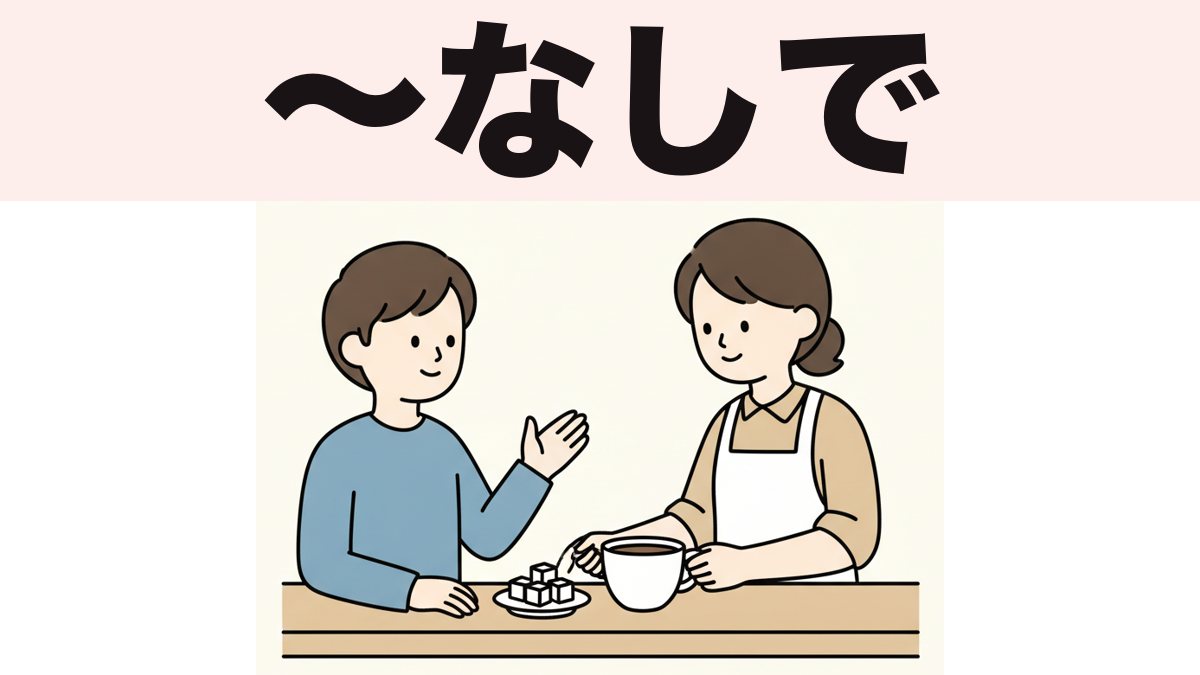
砂糖なしでお願いします。 — Without sugar, please. (polite — a café order) 今日は宿題なしです。 — There's no homework today. (polite)
No particle is needed between the noun and なし. 砂糖のなし and 砂糖をなし are both wrong; it is simply 砂糖なし.
The three everyday forms
- 〜なし — the bare noun: 予約なし, 問題なし.
- 〜なしで — "without doing / having": 予約なしで入れます.
- 〜なしに — same meaning, slightly more formal and more common in writing: 許可なしに入るな.
予約なしで大丈夫ですか。 — Is it okay without a reservation? (polite — a genuinely useful question) 許可なしに入ってはいけません。 — You must not enter without permission. (formal, a notice)
なしで and なしに are close enough that you will rarely go wrong choosing either, but notices and rules lean に and conversation leans で.
Where you will actually read it
Signs, menus and schedules, because なし is short and fits where a sentence would not.
本日、休みなし。 — Open today, no closing. (a shop sign)
Once you start noticing it, なし turns up constantly in written Japanese that has to fit in a small space — which is most of the Japanese a visitor actually reads.
Beyond the basics
Why なし ends declarations
Because it is a noun, なし can close a sentence with no verb inflection at all — no です, no ます, no tense. That gives it a finality that ありません, which is still a polite verb doing polite verb things, cannot produce.
我が生涯に一片の悔いなし。 — In my whole life, not one regret. (archaic, declamatory — a famous line) 問題なし。 — No problems. (clipped, a report)
The second one is ordinary. 問題なし is what someone says checking equipment or finishing a task, and it is brisk rather than dramatic. The register runs from "status report" to "final words", and the grammar is identical.
なし vs ない vs ありません
Same meaning, three different levels of finish.
| Form | Feel | Example |
|---|---|---|
| なし | Clipped, noun-like, final | 問題なし |
| ない | Plain, casual | 問題ない |
| ありません | Polite, complete | 問題ありません |
問題ありません。 — There is no problem. (polite — what you say to a client) 問題ない。 — It's fine. (casual — what you say to a friend)
You cannot substitute なし freely into polite conversation. 問題なしです exists and sounds slightly brusque; 問題ありません is the safe polite version. This is the same register ladder that runs through most of spoken Japanese, and if the polite-versus-casual line is still unclear, keigo vs casual Japanese is the article that sets it out.
〜なしに and 〜ないで
Both translate as "without doing", but they attach to different things. なしに takes a noun; ないで takes a verb.
何も言わないで帰った。 — He went home without saying anything. (casual — verb + ないで) 連絡なしに休んだ。 — He took the day off without notice. (neutral — noun + なしに)
Choosing between them is usually a matter of whether you have a noun available. 連絡 exists, so なしに works; for "without saying", 言う has no convenient noun, so ないで is the natural route.
抜き — the other "without"
ぬき (抜き), from 抜く "to remove", is the everyday spoken alternative, and it is what you actually say in a restaurant.
わさび抜きでお願いします。 — Without wasabi, please. (polite — standard restaurant Japanese) 冗談抜きで、これはすごい。 — Joking aside, this is amazing. (casual)
抜き implies something has been taken out of a default, which is why it fits food orders so well. なし is more neutral: it simply reports an absence. For an order, 抜き is the more natural of the two — and the rest of what to say at the table, including the reaction that is expected on the first bite, is in Japanese words for delicious.
〜なしではいられない
A set pattern worth recognising: "cannot do without".
コーヒーなしではいられない。 — I can't get by without coffee. (casual)
It is one of the standard ways to say you depend on something, and the grammar is just なしで plus the potential negative of いる.
Common mistakes
- Adding a particle before なし. It is 砂糖なし, not 砂糖のなし or 砂糖をなし.
- Using なし where ありません is expected. In polite conversation, 問題ありません is the safe form; 問題なし is a status report, not a reply to a client.
- Attaching なしに to a verb. Verbs take ないで. なしに takes nouns.
- Using なし in a restaurant. 抜き is the natural word for removing an ingredient: わさび抜き, not わさびなし.
- Assuming it is archaic. 予約なし, 休みなし and 問題なし are all current, ordinary Japanese.
The four ways to say "without"
| Form | Attaches to | Register | Example |
|---|---|---|---|
| 〜なし | Noun | Clipped, written | 問題なし |
| 〜なしで | Noun | Neutral, spoken | 予約なしで |
| 〜なしに | Noun | Formal, written | 許可なしに |
| 〜抜きで | Noun | Casual, spoken | わさび抜きで |
| 〜ないで | Verb | Neutral | 言わないで |
FAQ
Is なし old-fashioned? No. The declamatory use sounds archaic because of the sentences it appears in, but 予約なし and 問題なし are everyday modern Japanese.
Can I say 問題なしです? You can, and it is understood, but it sounds clipped. 問題ありません is the natural polite form.
What is the difference between なしで and 抜きで? 抜き implies removal from a default state, so it suits food orders and "jokes aside". なし simply reports absence.
How do I ask if I can enter without a reservation? 予約なしで大丈夫ですか, or 予約なしで入れますか. Both are natural and useful.
Is 一片 a common word? Not in speech — 一片 (いっぺん), "a single fragment", is literary. The famous line it appears in is recognisable to most Japanese speakers, but you would not use the word in conversation.
What is the opposite of なし? あり. You will see the pair on forms and menus: 有り/無し, meaning "with / without", often written 有・無.
Practice
Build each answer before opening it. Questions 4 and 5 are a pair — same meaning, different things to attach to.
1. Order a coffee without sugar.
Show answer
砂糖なしでお願いします — no particle between the noun and なし.
2. Something is wrong here: 砂糖のなしでお願いします。
Show answer
砂糖なしでお願いします — なし attaches directly. No の, no を.
3. Ask whether it's okay without a reservation.
Show answer
予約なしで大丈夫ですか — 予約なしで入れますか also works.
4. Say "he took the day off without notice."
Show answer
連絡なしに休んだ — なしに takes a noun. This is the pair to question 5.
5. Say "he went home without saying anything."
Show answer
何も言わないで帰った — a verb takes ないで, not なしに. This is the pair to question 4.
6. Order sushi without wasabi.
Show answer
わさび抜きでお願いします — 抜き is the natural word for removing an ingredient.
7. Reply to a client that there is no problem.
Show answer
問題ありません — 問題なし is a status report, and it sounds clipped to a client.
8. Say "I can't get by without coffee."
Show answer
コーヒーなしではいられない — なしで plus the potential negative of いる.
9. Translate: 冗談抜きで、これはすごい。
Show answer
Joking aside, this is amazing — 抜き removes something from the default, here the joking.
10. What is the opposite of なし on a form?
Show answer
あり(有り) — 有・無 is the with/without pair you will see on forms and menus.
Vocabulary from this article
Tap the block to select all of it, then copy. In Anki: File → Import, note type Basic, separator Tab — the first column becomes the front, the second the back.
無し	なし — without, none
有り	あり — with, existing
抜く	ぬく — to remove, to pull out
予約	よやく — reservation
許可	きょか — permission
連絡	れんらく — contact, notice
問題	もんだい — problem
砂糖	さとう — sugar
宿題	しゅくだい — homework
冗談	じょうだん — joke
生涯	しょうがい — one's whole life
悔い	くい — regret
休み	やすみ — rest, day off
帰る	かえる — to go home
大丈夫	だいじょうぶ — all right, fine
本日	ほんじつ — today (formal)
I'm Yuuki, a Japanese teacher based in Tokyo. I've taught on italki as a Top 1% teacher and watched over 1,500 anime. なし is one of those words students first meet in a famous line and then never notice again — when in fact they walk past it on shop signs several times a day.
Sources: the author's own lessons and standard reference grammars.
多くの人は「ない」を先に習って、「なし」は古い言い方だと思います。ちがいます。「なし」はふつうの日本語です。メニュー、よていひょう、きそくによく出ます。そして、一度だけ言うような強い言葉にも使われます。
基本
「なし」とは
「ない」の名前の形です。「ない」は「存在しない」、「なし」は「ないこと」です。名前なので、ほかの名前にそのまま付きます。
砂糖なしでお願いします。 — Without sugar, please. (polite — a café order) 今日は宿題なしです。 — There's no homework today. (polite)
あいだにじょしは入りません。「砂糖のなし」「砂糖をなし」はまちがいです。
三つの形
- 〜なし — 名前だけ。「予約なし」「問題なし」。
- 〜なしで — 「〜がなくても」。「予約なしで入れます」。
- 〜なしに — 同じ意味。少しかたく、書き言葉に多いです。「許可なしに入るな」。
予約なしで大丈夫ですか。 — Is it okay without a reservation? (polite — a genuinely useful question) 許可なしに入ってはいけません。 — You must not enter without permission. (formal, a notice)
「なしで」と「なしに」は、ほとんど同じです。お知らせやきそくは「に」、会話は「で」が多いです。
どこで読むか
かんばん、メニュー、よていひょうです。みじかいので、せまい場所に入ります。
本日、休みなし。 — Open today, no closing. (a shop sign)
気をつけて見ると、書かれた日本語にとてもよく出てきます。
もう少しくわしく
強く言い切れる理由
名前なので、動詞の形をかえずに文を終われます。時けいも、丁寧さの形も付きません。だから「ありません」より強く聞こえます。
我が生涯に一片の悔いなし。 — In my whole life, not one regret. (archaic, declamatory — a famous line) 問題なし。 — No problems. (clipped, a report)
二つ目はふつうの言い方です。きかいを点けんしたあとや、しごとが終わったときに言います。
「なし」「ない」「ありません」
意味は同じで、仕上げ方がちがいます。
| 形 | かんじ | 例 |
|---|---|---|
| なし | みじかい・言い切る | 問題なし |
| ない | ふつう・カジュアル | 問題ない |
| ありません | 丁寧 | 問題ありません |
問題ありません。 — There is no problem. (polite — what you say to a client) 問題ない。 — It's fine. (casual — what you say to a friend)
丁寧な会話に「なし」をそのまま入れないでください。「問題なしです」は少しぶっきらぼうです。→ 敬語とふつうの言い方
「〜なしに」と「〜ないで」
どちらも「〜しないで」ですが、付くものがちがいます。「なしに」は名前に、「ないで」は動詞に付きます。
何も言わないで帰った。 — He went home without saying anything. (casual — verb + ないで) 連絡なしに休んだ。 — He took the day off without notice. (neutral — noun + なしに)
名前があるかどうかで決まります。「連絡」はあるので「なしに」が使えます。
「抜き」
「抜く」から来た言葉です。話すときはこちらが多いです。レストランではこれを使います。
わさび抜きでお願いします。 — Without wasabi, please. (polite — standard restaurant Japanese) 冗談抜きで、これはすごい。 — Joking aside, this is amazing. (casual)
「抜き」は「もとからあるものを取る」という意味です。だから食べもののちゅうもんに合います。→ おいしいの言い方
「〜なしではいられない」
おぼえておくとよい形です。「〜がないと生きていけない」という意味です。
コーヒーなしではいられない。 — I can't get by without coffee. (casual)
よくあるまちがい
- 前にじょしを入れる。「砂糖なし」です。「砂糖のなし」ではありません。
- 丁寧な場面で「なし」を使う。 お客さまには「問題ありません」です。
- 動詞に「なしに」を付ける。 動詞は「ないで」です。
- レストランで「なし」を使う。「わさび抜き」が自然です。
- 古い言葉だと思う。「予約なし」「休みなし」「問題なし」は今の日本語です。
四つの「〜なしで」
| 形 | 付くもの | かたさ | 例 |
|---|---|---|---|
| 〜なし | 名前 | みじかい・書き言葉 | 問題なし |
| 〜なしで | 名前 | ふつう・話し言葉 | 予約なしで |
| 〜なしに | 名前 | かたい・書き言葉 | 許可なしに |
| 〜抜きで | 名前 | カジュアル・話し言葉 | わさび抜きで |
| 〜ないで | 動詞 | ふつう | 言わないで |
よくある質問
「なし」は古い? いいえ。強い言い方が古く聞こえるだけです。「予約なし」「問題なし」は今の言葉です。
「問題なしです」と言える? 言えますが、少しぶっきらぼうです。「問題ありません」が自然です。
「なしで」と「抜きで」のちがいは? 「抜き」は「もとからあるものを取る」です。食べもののちゅうもんに合います。
予約なしで入れるか聞くには? 「予約なしで大丈夫ですか」「予約なしで入れますか」。
「一片」はよく使う? 話し言葉では使いません。書き言葉です。有名な一文でよく知られています。
「なし」の反対は? 「あり」です。ようしやメニューで「有・無」と書かれます。
練習
答えを見る前に、自分で作ってください。4番と5番はペアです。
1. さとうを入れないコーヒーをたのむ。
答えを見る
砂糖なしでお願いします — あいだにじょしは入りません。
2. まちがいをなおす: 砂糖のなしでお願いします。
答えを見る
砂糖なしでお願いします — 「の」も「を」も入りません。
3. 予約なしで入れるか聞く。
答えを見る
予約なしで大丈夫ですか — 「予約なしで入れますか」でもいいです。
4. 「連絡しないで休んだ」と言う。
答えを見る
連絡なしに休んだ — 「なしに」は名前に付きます。5番とペアです。
5. 「何も言わないで帰った」と言う。
答えを見る
何も言わないで帰った — 動詞には「ないで」です。4番とペアです。
6. わさびを入れないおすしをたのむ。
答えを見る
わさび抜きでお願いします — 食べものは「抜き」が自然です。
7. お客さまに「問題ない」と伝える。
答えを見る
問題ありません — 「問題なし」はほうこくの言い方です。
8. 「コーヒーがないとだめだ」と言う。
答えを見る
コーヒーなしではいられない — 「なしで」+「いられない」です。
9. やくす: 冗談抜きで、これはすごい。
答えを見る
じょうだんではなく、本当にすごい — 「抜き」でじょうだんを取っています。
10. ようしの「なし」の反対は?
答えを見る
あり(有り) — 「有・無」で書かれます。
この記事に出た単語
上のブロックをタップしてぜんぶ選んで、コピーしてください。Ankiでは ファイル → インポート、ノートタイプは 基本、区切りは タブ です。左が表、右がうらになります。
無し	なし — without, none
有り	あり — with, existing
抜く	ぬく — to remove, to pull out
予約	よやく — reservation
許可	きょか — permission
連絡	れんらく — contact, notice
問題	もんだい — problem
砂糖	さとう — sugar
宿題	しゅくだい — homework
冗談	じょうだん — joke
生涯	しょうがい — one's whole life
悔い	くい — regret
休み	やすみ — rest, day off
帰る	かえる — to go home
大丈夫	だいじょうぶ — all right, fine
本日	ほんじつ — today (formal)
More drills like the ones above, plus a timed JLPT-style mock test: Practice · N3上のような練習問題と、時間つきのJLPT形式のもぎ試験: 練習ページ · N3
Want to try this in a real conversation?
本当の会話で、ためしてみませんか?
30-minute trial lesson, $13. Times shown in your own timezone.
30分の体験レッスン、$13。時間はあなたのタイムゾーンで表示されます。
Book a trial lesson · $13