これ, それ, あれ, どれ: the こそあど grid and how to read itこれ・それ・あれ・どれ: こそあど の表
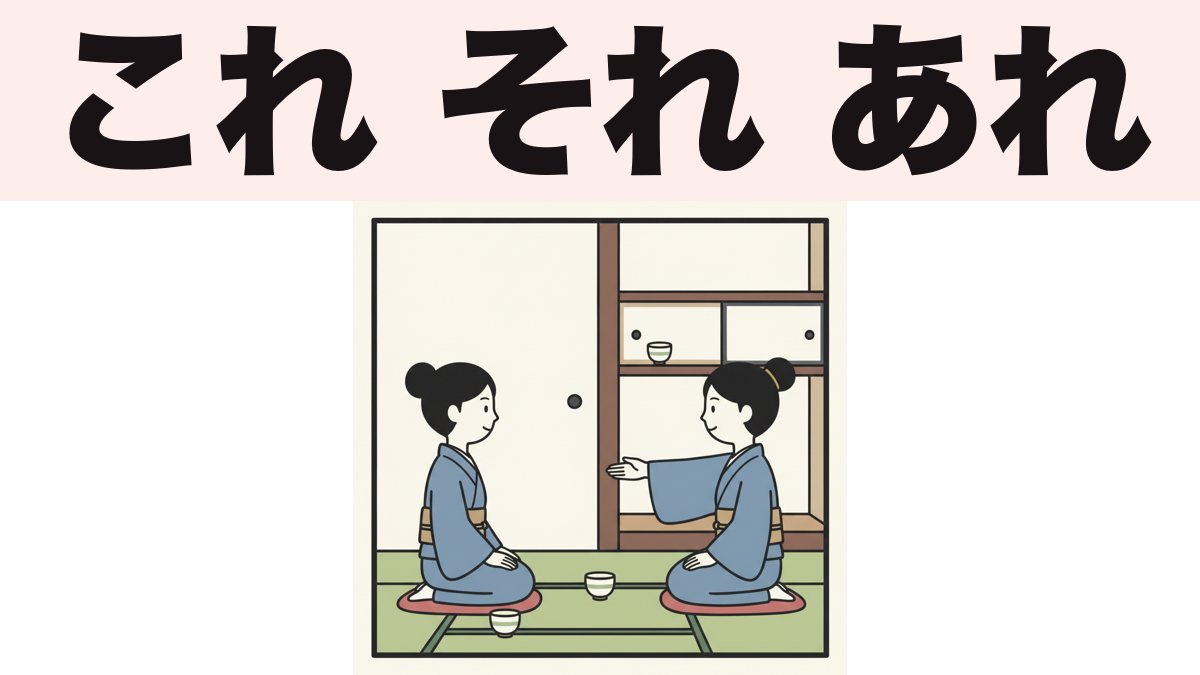
Japanese demonstratives are not "this / that / that over there" — they are a map of who the thing belongs to. こ is near me, そ is near you, あ is away from both of us, and ど asks. Once you see it as a grid, twenty words collapse into five rows and four columns.
日本語の指示詞は「this / that / that over there」ではありません。「だれのものか」の地図です。「こ」は私の近く、「そ」はあなたの近く、「あ」は二人から遠い、「ど」は質問です。表として見ると、20個のことばが5つの行と4つの列になります。
This is one of the few places where Japanese is more systematic than English, and learners usually meet it as twenty separate vocabulary items instead of one pattern. The pattern is called こそあど, after the four initial sounds.
The basics
The grid
| こ (near me) | そ (near you) | あ (away from both) | ど (question) | |
|---|---|---|---|---|
| Thing | これ | それ | あれ | どれ |
| + noun | この本 | その本 | あの本 | どの本 |
| Place | ここ | そこ | あそこ | どこ |
| Direction / polite | こちら | そちら | あちら | どちら |
| Manner | こう | そう | ああ | どう |
| Kind of | こんな | そんな | あんな | どんな |
Every row follows the same four-way split. Learn the columns once and the whole table is yours.
これは何ですか。 — What is this? (I'm holding it — and how to ask what a word means is a different question entirely) それはいくらですか。 — How much is that? (it's near you) あれは何ですか。 — What's that over there? (far from both of us)
これ vs この — the error everyone makes
これ is a noun: it stands alone and means "this thing." この is a modifier: it must be followed by a noun.
✗ これ本は面白いです。 。○ この本は面白いです。 — This book is interesting. ○ これは面白いです。 — This is interesting.
Same for それ/その, あれ/あの, どれ/どの. If a noun follows, use the の form. If nothing follows, use the れ form. There are no exceptions.
そ is the listener's territory
This is the part English does not have. そ does not mean "medium distance" — it means "yours, or the thing you just mentioned."
その本、貸してください。 — Lend me that book. (the one you're holding)
It also covers anything the other person brought up that you have no direct knowledge of:
A: 昨日、新しい店に行きました。 — I went to a new restaurant yesterday. B: そうですか。その店はどこですか。 — Oh really? Where is that restaurant? (you mentioned it, so それ/その)
Using あの there would be wrong, because あ implies you both know it.
Beyond the basics
あ is for shared memory
あ is not only about physical distance. It also marks something both speakers already know — outside the conversation, in your common past.
あの店、覚えてる? — Remember that restaurant? (we both went) あの人、元気かな。 — I wonder how that person is doing. (we both know who)
This is the difference that decides そ vs あ in conversation about things nobody can see. If only one of you knows it, そ. If you both do, あ. Getting this right is one of the quiet markers of Japanese that sounds natural rather than assembled.
あの as a filler is a different word
あの at the start of a sentence, with a pause, is not pointing at anything. It is the Japanese "um" — used to get someone's attention or buy a second.
あのう、すみません。 — Um, excuse me. あの、ちょっといいですか。 — Er, do you have a moment?
You can tell them apart instantly: filler あの stands alone and is often stretched to あのう; the demonstrative あの is glued to a noun.
こちら: the polite column
The こちら row does double duty. Literally it means direction, but it is also the polite version of both これ and ここ, and どちら is the polite どこ and the polite 誰.
こちらへどうぞ。 — This way, please. こちらはいかがですか。 — How about this one? (polite, shop staff) どちらから来ましたか。 — Where are you from? (polite version of どこから) どちら様ですか。 — Who is this, please? (polite 誰 — on the phone or at a door)
Shop and hotel staff use this row constantly. こちらこそ ("likewise," literally "this side, precisely") is another fixed phrase from it, and the standard reply to ありがとうございました or よろしくお願いします.
そう is everywhere because こう/そう/ああ is a row
The manner row explains a word you already use constantly.
そうです。 — That's right. (literally: it is that way) そうですね。 — Let me see. / You're right. どう思いますか。 — What do you think? (how do you think?) こうやって、押します。 — You press it like this. (demonstrating)
Note this そう is unrelated to the 〜そう of "looks like" and "I heard". Same sound, different word — the demonstrative そう is a pointer, not an ending.
こんな/そんな/あんな — "this kind of"
The last row is about type rather than identity, and それ vs そんな is worth keeping apart.
そんなこと言わないで。 — Don't say that kind of thing. こんな店、初めて。 — I've never been to a place like this. どんな音楽が好きですか。 — What kind of music do you like?
そんな in particular carries emotion. そんなこと… trailing off is a whole reaction on its own — closer to "don't say things like that" than a neutral description.
How does it sound in anime?
The そ and あ rows carry a lot of dialogue, mostly in short reactions:
そうか。 — I see. (casual) そんなこと… — Something like that…? (trailing off in disbelief) あいつか。 — That guy, huh. (あいつ — the rough あの人)
あいつ, こいつ, そいつ are the rough versions of あの人 and friends. They are extremely common in anime and genuinely rude in real conversation, so recognise them and keep them out of your own speech.
Common mistakes
- これ本. これ stands alone; この needs a noun. これは本です or この本は…
- Using あの for something only you know. If the other person doesn't know it, あ is wrong — use そ if they mentioned it, or introduce it first.
- Using それ for something you're both looking at across the room. If it is far from both of you, that is あれ.
- Treating こちら as only "this direction." It is the polite これ and ここ too, which is why shop staff say it constantly.
- Mixing up あの and あのう. Glued to a noun it points; standing alone with a pause it is "um."
- Using あいつ/こいつ. They are the rough forms and are genuinely impolite. あの人 is the neutral choice.
Practice
Answers are hidden — build yours first, then open. Questions 1 and 2 are a pair: the same word, and whether a noun follows decides the form.
1. Something is wrong here: これ本は面白いです。
Show answer
この本は面白いです — これ stands alone as a noun; この must be followed by a noun. Same split for それ/その and あれ/あの.
2. Say "this is interesting" with no noun.
Show answer
これは面白いです — with nothing following, use the れ form. This is the pair to question 1: one rule, two shapes.
3. Someone is holding a book you want to borrow. Which word for "that book"?
Show answer
その本 — そ is the listener's territory. その本、貸してください.
4. A friend mentions a restaurant you have never been to. How do you refer to it?
Show answer
その店 — they brought it up and you have no direct knowledge of it, so そ. あの店 would claim you both know it.
5. You and a friend both went to a restaurant years ago. How do you refer to it?
Show answer
あの店 — あ marks shared memory, not just physical distance. あの店、覚えてる?
6. Make どこから来ましたか polite.
Show answer
どちらから来ましたか — the こちら row is the polite column. どちら is the polite どこ, and also the polite 誰 in どちら様ですか.
7. What is あのう in あのう、すみません doing?
Show answer
It's a filler, not a demonstrative — standing alone and stretched, it means "um." The demonstrative あの is always glued to a noun.
8. Say "you press it like this" while demonstrating.
Show answer
こうやって、押します — こう is the manner row: "in this way." Its partners are そう, ああ and どう.
9. What is the difference between そのこと and そんなこと?
Show answer
Identity vs type — そのこと is "that matter" (a specific one). そんなこと is "that kind of thing," and usually carries feeling: そんなこと言わないで.
10. Why should you avoid saying あいつ?
Show answer
It's the rough form of あの人 — common in anime, genuinely rude in conversation. Recognise it; say あの人.
FAQ
Is そ really about the listener and not distance? Mostly, yes. For physical objects it usually works out the same, because things near your listener are a few steps from you. But for things nobody can see — a restaurant, a person, an idea — そ means "yours / the one you raised," and distance has nothing to do with it.
When do I use こちら instead of これ? In service situations and formal speech: shop staff, hotels, business. It is also what you use to introduce someone — こちらは田中さんです ("this is Tanaka") — where これ would be insulting, since これ is for objects.
What about the 〜ら plural forms? これら, それら, あれら exist and mean "these, those," but they are written and stiff. In speech Japanese usually leaves number unmarked: これ covers both "this" and "these" with no change.
Is どちら really the polite 誰? In the fixed phrase どちら様ですか, yes — it is the standard way to ask who someone is on the phone or at the door. Asking 誰ですか directly in that situation sounds blunt.
What is こそあど as a term? It is just the four initial sounds used as a name for the system: こ・そ・あ・ど. Japanese grammar books use it the way English books say "wh-words," and knowing the term makes it much easier to look things up.
Why do shop staff say こちらこそ? It is a fixed phrase meaning "no, it's I who should thank you" — literally "this side, precisely." It is the standard reply to thanks or to よろしくお願いします, and one of the highest-value set phrases for a beginner.
Vocabulary from this article
Tap the block to select all of it, then copy. In Anki: File → Import, note type Basic, separator Tab — the first column becomes the front, the second the back.
これ	これ — this (thing, near me)
それ	それ — that (thing, near you)
あれ	あれ — that (thing, over there)
どれ	どれ — which one
ここ	ここ — here
そこ	そこ — there
あそこ	あそこ — over there
どこ	どこ — where
こちら	こちら — this way; this one (polite)
どちら	どちら — which way; where (polite); who (polite)
こんな	こんな — this kind of
そんな	そんな — that kind of
どんな	どんな — what kind of
本	ほん — book
店	みせ — shop, restaurant
面白い	おもしろい — interesting
貸す	かす — to lend
覚える	おぼえる — to remember
押す	おす — to press
音楽	おんがく — music
初めて	はじめて — for the first time
元気	げんき — well, healthy
I'm Yuuki, a Japanese teacher based in Tokyo. I've taught on italki as a Top 1% teacher and watched over 1,500 anime. Learners arrive holding twenty words and leave holding one grid — and the part that keeps paying off long after N5 is そ versus あ for things nobody can see, which is what makes a conversation sound like two people who share a past.
Sources: the author's own lessons and standard reference grammars.
ここは、日本語が英語よりきちんとしているめずらしい場所です。でも多くの人は、20個のことばをべつべつに覚えます。この仕組みを「こそあど」と言います。4つの最初の音です。
基本
表
| こ(私の近く) | そ(あなたの近く) | あ(二人から遠い) | ど(質問) | |
|---|---|---|---|---|
| もの | これ | それ | あれ | どれ |
| +名詞 | この本 | その本 | あの本 | どの本 |
| 場所 | ここ | そこ | あそこ | どこ |
| 方向・ていねい | こちら | そちら | あちら | どちら |
| やり方 | こう | そう | ああ | どう |
| 種類 | こんな | そんな | あんな | どんな |
どの行も、同じ4つの分け方です。列を1回覚えれば、表ぜんぶが使えます。
これは何ですか。 — What is this? (私が持っています) それはいくらですか。 — How much is that? (あなたの近くです) あれは何ですか。 — What's that over there? (二人から遠いです)
これ と この — みんながする間ちがい
「これ」は名詞です。1つで立って、「このもの」という意味です。「この」は名詞の前につく形です。後ろに名詞が必要です。
✗ これ本は面白いです。 。○ この本は面白いです。 — This book is interesting. ○ これは面白いです。 — This is interesting.
「それ/その」「あれ/あの」「どれ/どの」も同じです。後ろに名詞があれば「の」の形、なければ「れ」の形です。れいがいはありません。
「そ」は相手のじんち
ここは英語にありません。「そ」は「まん中のきょり」ではありません。「あなたのもの」「あなたが今言ったもの」です。
その本、貸してください。 — Lend me that book. (あなたが持っています)
相手が出した話で、自分は知らないもの。これも「そ」です。
A: 昨日、新しい店に行きました。 B: そうですか。その店はどこですか。 — (あなたが言った店なので「その」)
ここで「あの店」はまちがいです。「あ」は「二人とも知っている」という意味だからです。
もう少し先へ
「あ」は二人の思い出
「あ」はきょりだけではありません。会話の外で、二人ともが知っているものにも使います。
あの店、覚えてる? — Remember that restaurant? (二人で行きました) あの人、元気かな。 — I wonder how that person is doing. (二人とも知っています)
見えないものの話で「そ」か「あ」かを決めるのは、これです。片方しか知らなければ「そ」、二人とも知っていれば「あ」。ここが合うと、日本語が「組み立てた文」ではなく「二人の会話」に聞こえます。
フィラーの「あの」はべつのことば
文のはじめの、少し止まる「あの」は、何も指していません。日本語の "um" です。
あのう、すみません。 — Um, excuse me. あの、ちょっといいですか。 — Er, do you have a moment?
見分け方はかんたんです。フィラーの「あの」は1つで立って、「あのう」とのばすこともあります。指示詞の「あの」は、いつも名詞にくっついています。
こちら: ていねいな列
「こちら」の行は2つの仕事をします。もとの意味は方向ですが、「これ」と「ここ」のていねいな形でもあります。「どちら」は「どこ」のていねいな形で、「だれ」のていねいな形でもあります。
こちらへどうぞ。 — This way, please. こちらはいかがですか。 — How about this one? (お店の人) どちらから来ましたか。 — Where are you from? どちら様ですか。 — Who is this, please? (電話やげんかんで)
お店やホテルの人がいつも使います。「こちらこそ」も、この行の決まった言い方です。「ありがとうございました」「よろしくお願いします」への返事です。
「そう」がよく出るのは、これが1つの行だから
やり方の行が、いつも使っていることばのせつめいになります。
そうです。 — That's right. (そのやり方です) そうですね。 — Let me see. / You're right. どう思いますか。 — What do you think? こうやって、押します。 — You press it like this.
この「そう」は、「〜そうです(見た感じ・聞いた話)」とは関係ありません。音が同じで、べつのことばです。指示詞の「そう」は、指すことばです。
こんな・そんな・あんな —「こういう種類の」
さいごの行は、「どれか」ではなく「どんな種類か」です。「それ」と「そんな」は分けてください。
そんなこと言わないで。 — Don't say that kind of thing. こんな店、初めて。 — I've never been to a place like this. どんな音楽が好きですか。 — What kind of music do you like?
「そんな」には気もちが入ります。「そんなこと…」と止めるだけで、1つの返事になります。
アニメではどう聞こえますか?
「そ」と「あ」の行が、短い返事でよく出ます。
そうか。 — I see. そんなこと… — Something like that…? あいつか。 — That guy, huh.
「あいつ」「こいつ」「そいつ」は、「あの人」のらんぼうな形です。アニメにはよく出ますが、本当の会話では失礼です。聞いて分かるだけにして、自分では使わないでください。
よくある間違い
- これ本。 「これ」は1つで立ちます。「この」は名詞が必要です。
- 自分しか知らないものに「あの」。 相手が知らないなら「あ」は使えません。相手が言ったなら「そ」、はじめて出すならまず紹介します。
- 二人から遠いものに「それ」。 二人から遠ければ「あれ」です。
- 「こちら」を方向だけだと思うこと。 ていねいな「これ」「ここ」でもあります。
- 「あの」と「あのう」を混ぜること。 名詞につけば指示詞、1つで止まればフィラーです。
- 「あいつ」「こいつ」を使うこと。 らんぼうな形です。「あの人」にしてください。
練習
答えはかくれています。まず自分の答えを作ってから開いてください。1番と2番は対になっています。
1. 直してください: これ本は面白いです。
答えを見る
この本は面白いです — 「これ」は1つで立つ名詞、「この」は名詞の前につく形です。「それ/その」「あれ/あの」も同じです。
2. 名詞なしで「これは面白い」と言ってください。
答えを見る
これは面白いです — 後ろに名詞がないので「れ」の形です。1番と対で、1つのルールの2つの形です。
3. 相手が持っている本をかりたいです。どれを使いますか。
答えを見る
その本 — 「そ」は相手のじんちです。「その本、貸してください」。
4. 友だちが、行ったことのないお店の話をしました。どう言いますか。
答えを見る
その店 — 相手が出した話で、自分は知らないので「そ」です。「あの店」だと「二人とも知っている」になります。
5. 友だちと何年も前にいっしょに行ったお店です。どう言いますか。
答えを見る
あの店 — 「あ」は二人の思い出にも使います。「あの店、覚えてる?」
6. 「どこから来ましたか」をていねいにしてください。
答えを見る
どちらから来ましたか — 「こちら」の行がていねいな列です。「どちら様ですか」は「だれ」のていねいな形です。
7. 「あのう、すみません」の「あのう」は何ですか。
答えを見る
フィラーで、指示詞ではありません — 1つで止まって、のばします。指示詞の「あの」は、いつも名詞にくっついています。
8. やって見せながら「こうやります」と言ってください。
答えを見る
こうやって、押します — 「こう」はやり方の行です。なかまは「そう」「ああ」「どう」です。
9. 「そのこと」と「そんなこと」はどうちがいますか。
答えを見る
どれか、どんな種類か — 「そのこと」は決まった1つのことです。「そんなこと」は「そういう種類のこと」で、気もちが入ります。
10. 「あいつ」を使わない方がいいのはなぜですか。
答えを見る
「あの人」のらんぼうな形だからです — アニメには多いですが、会話では失礼です。「あの人」にしてください。
よくある質問
「そ」は本当にきょりではなく相手のものですか。 ほとんどそうです。ものの場合は結果が同じになります。相手の近くのものは、自分から少し遠いからです。でも見えないもの(お店・人・考え)では、「あなたが出した話」という意味で、きょりは関係ありません。
「これ」より「こちら」を使うのはいつですか。 サービスの場面とかたい場面です。お店・ホテル・仕事。人を紹介する時も「こちらは田中さんです」です。「これは田中さんです」は、人をものにしてしまうので失礼です。
「これら」はありますか。 あります。でも書きことばで、かたいです。日本語はふつう数を言わないので、「これ」だけで「this」も「these」も表せます。
「どちら」は本当に「だれ」の意味になりますか。 「どちら様ですか」という決まった言い方ではそうです。電話やげんかんでふつうに使います。そこで「誰ですか」と言うと、きつく聞こえます。
「こそあど」ということばは何ですか。 4つの最初の音を並べた名前です。こ・そ・あ・ど。日本語の文法の本で使うので、覚えると調べやすくなります。
お店の人はなぜ「こちらこそ」と言うのですか。 決まった言い方で、「いいえ、こちらこそありがとうございます」という意味です。お礼や「よろしくお願いします」への返事です。
この記事に出た単語
ブロックをタップすると全部選べます。そのままコピーしてください。Anki では ファイル → 読み込み、ノートタイプ 基本、区切り タブ。1列目が表、2列目が裏になります。
これ	これ — this (thing, near me)
それ	それ — that (thing, near you)
あれ	あれ — that (thing, over there)
どれ	どれ — which one
ここ	ここ — here
そこ	そこ — there
あそこ	あそこ — over there
どこ	どこ — where
こちら	こちら — this way; this one (polite)
どちら	どちら — which way; where (polite); who (polite)
こんな	こんな — this kind of
そんな	そんな — that kind of
どんな	どんな — what kind of
本	ほん — book
店	みせ — shop, restaurant
面白い	おもしろい — interesting
貸す	かす — to lend
覚える	おぼえる — to remember
押す	おす — to press
音楽	おんがく — music
初めて	はじめて — for the first time
元気	げんき — well, healthy
私はユウキです。東京で日本語を教えています。 italki の Top 1% の先生で、アニメは1,500本以上見ました。みんな20個のことばを持ってきて、1つの表を持って帰ります。N5 のあとも長く役に立つのは、見えないものの「そ」と「あ」です。ここが合うと、会話が「同じ思い出を持つ二人」の話に聞こえます。
More drills like the ones above, plus a timed JLPT-style mock test: Practice · N5上のような練習問題と、時間つきのJLPT形式のもぎ試験: 練習ページ · N5
Want to try this in a real conversation?
本当の会話で、ためしてみませんか?
30-minute trial lesson, $13. Times shown in your own timezone.
30分の体験レッスン、$13。時間はあなたのタイムゾーンで表示されます。
Book a trial lesson · $13