〜から〜まで: "from" and "to," and the one extra syllable that changes everything〜から〜まで: 1文字ふえると、意味が変わります
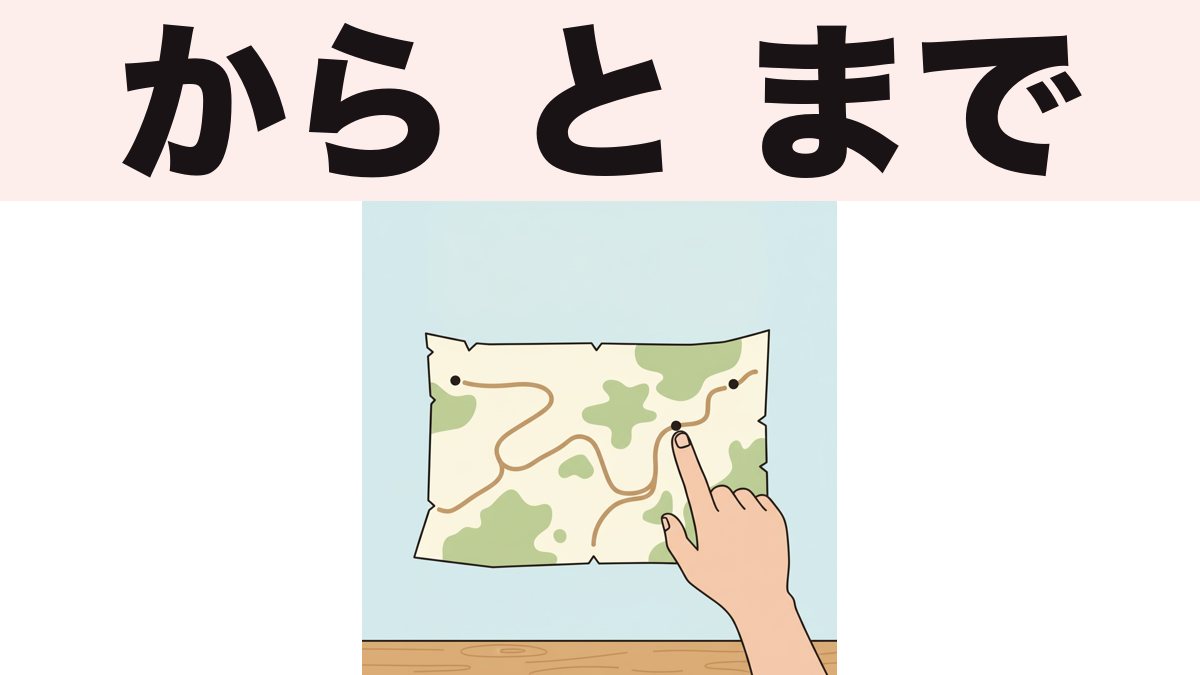
から marks where something starts and まで marks where it ends — in time (九時から五時まで) or in space (東京から大阪まで). The thing to watch is までに: adding に turns "until" into "by," and that single syllable is the difference between "work until Friday" and "finish it by Friday."
「から」は始まるところ、「まで」は終わるところです。時間(九時から五時まで)にも、場所(東京から大阪まで)にも使います。気をつけるのは「までに」です。「に」が1つ入るだけで、「〜まで続ける」が「〜までに終わらせる」に変わります。
This is one of the first grammar pairs a beginner learns and one of the last they stop making errors in, because the から/まで half is genuinely simple and the まで/までに half is genuinely not.
The basics
から: the starting point
から attaches directly to a noun and means "from" — a time, a place, or a source.
九時から働きます。 — I work from nine. (polite, describing a schedule) 東京から来ました。 — I came from Tokyo. (polite, the standard self-introduction line)
There is no particle between the noun and から. 九時にから is wrong — から replaces the に you would otherwise use.
まで: the end point
まで is から's partner and means "until" or "as far as."
五時まで働きます。 — I work until five. (polite) 大阪まで行きます。 — I'll go as far as Osaka. (polite, on a train)
Note the "as far as" sense with places: 大阪まで行きます says Osaka is where you stop, which is subtly different from 大阪に行きます ("I'm going to Osaka"). The まで version emphasizes the extent of the journey; the に version just names the destination.
The pair together
Used together, they bracket a stretch of time or space.
月曜日から金曜日まで学校があります。 — I have school from Monday to Friday. (polite, a weekly schedule) 駅から家まで歩きます。 — I walk from the station to my house. (polite)
Either half can be dropped if it is obvious. 五時まで大丈夫です ("I'm free until five") does not need a から if the listener knows you are talking about now.
Beyond the basics
まで vs までに: continuing vs deadline
This is the distinction that matters, and it is worth slowing down for.
- まで — the action continues up to that point
- までに — the action must be completed by that point
五時まで待ちます。 — I'll wait until five. (polite — the waiting continues right up to five) 五時までに来てください。 — Please come by five. (polite — arriving is a single event that must happen before five)
The test is whether the verb describes something ongoing or something that happens once. 待つ (wait), 働く (work), 勉強する (study) stretch across time, so they take まで. 来る (come), 出す (submit), 終わる (finish) happen at a point, so they take までに.
金曜日までに提出してください。 — Please submit it by Friday. (polite, a deadline) 金曜日まで働きます。 — I'll work until Friday. (polite — 働く stretches, so まで is correct here)
Get this wrong in a work email and you will have said something that does not parse. 金曜日まで提出してください reads as "please keep submitting it until Friday," which is not a request anyone makes.
から also means "because"
The same から does double duty as a reason marker, attached to a clause rather than a noun.
寒いから、窓を閉めます。 — It's cold, so I'll close the window. (casual-polite)
Position tells you which job it is doing. After a noun, it is "from." After a full clause, it is "because." For the difference between this から and ので, see から vs ので — the choice is about how much you want to push your reason at the listener.
〜てから: "after doing"
Attach から to the te-form and you get a sequence marker.
ご飯を食べてから、出かけます。 — I'll go out after eating. (polite)
This is the same "starting point" idea applied to an action rather than a noun: eating is the point the going-out starts from. It has its own set of traps, covered in 〜てから — chiefly that 食べたから means "because I ate," a completely different sentence.
からの and までの: modifying a noun
To attach a から or まで phrase to a noun, insert の.
東京からの電車は遅れています。 — The train from Tokyo is delayed. (polite, a station announcement) 大阪までの切符をください。 — A ticket to Osaka, please. (polite, at a ticket window)
大阪までの切符 is worth memorizing as a chunk — it is the most efficient way to buy a ticket in Japanese, and the の is not optional.
から as "made from"
With materials, から means the source material has been transformed; で means it has not.
ワインはぶどうから作ります。 — Wine is made from grapes. (polite — the grapes are no longer recognizable) この机は木で作りました。 — This desk was made of wood. (polite — it is still wood)
This is a small distinction that Japanese marks and English mostly does not, and it is a satisfying one once you see it: から for chemical change, で for assembly.
Common mistakes
- Using まで for a deadline. 金曜日まで出してください means "keep submitting until Friday." The deadline version is 金曜日までに.
- Adding に before から. 九時にから is not a sentence. から replaces the に.
- Using までに with a continuing verb. 五時までに待ちます is odd — waiting stretches, so it takes まで.
- Dropping the の in からの / までの. 大阪まで切符 is missing a piece. It is 大阪までの切符.
- Confusing から (from) with から (because). Check what it is attached to: a noun means "from," a clause means "because."
- Using から for materials that stay visible. 木から作った机 suggests the wood was processed beyond recognition. For a plain wooden desk, use で.
まで or までに?
| Verb type | Particle | Example |
|---|---|---|
| Continuing (待つ, 働く, 勉強する) | まで | 五時まで待ちます |
| One-off (来る, 出す, 終わる) | までに | 五時までに来てください |
| Stating a range of time | 〜から〜まで | 九時から五時まで |
| Stating a range of space | 〜から〜まで | 駅から家まで |
| Attaching to a noun | 〜からの / 〜までの | 大阪までの切符 |
Practice
Questions 1 and 2 are the pair that decides whether your Japanese email makes sense.
1. Say "I'll wait until five," politely.
Show answer
五時まで待ちます。 — 待つ stretches across time, so it takes まで.
2. Say "please come by five," politely.
Show answer
五時までに来てください。 — 来る happens once, so it needs までに. One syllable, completely different meaning.
3. Say "I have school from Monday to Friday."
Show answer
月曜日から金曜日まで学校があります。 — から and まで bracket the range, with no extra particles.
4. Say "I came from Tokyo."
Show answer
東京から来ました。 — から attaches straight to the noun. No に in front of it.
5. Buy a ticket to Osaka at a window.
Show answer
大阪までの切符をください。 — The の is required to attach まで to 切符. Worth memorizing whole.
6. Say "please submit it by Friday."
Show answer
金曜日までに提出してください。 — A deadline for a one-off action: までに.
7. Say "I'll go out after eating."
Show answer
ご飯を食べてから、出かけます。 — て-form plus から. 食べたから would mean "because I ate."
8. Say "wine is made from grapes."
Show answer
ワインはぶどうから作ります。 — から, because the grapes are transformed beyond recognition. A wooden desk would take で.
9. Fix this: 九時にから働きます。
Show answer
九時から働きます。 — から replaces the に. They cannot both appear.
10. Fix this: 金曜日まで出してください。
Show answer
金曜日までに出してください。 — The original says "keep submitting until Friday." A deadline needs までに.
FAQ
Is まで ever used with に for a continuing action? No. If the action stretches across time, まで is correct and までに would be ungrammatical. The に specifically marks a point by which a completed event must occur.
What is the difference between 大阪に行きます and 大阪まで行きます? に names the destination; まで emphasizes the extent of the journey — "as far as Osaka." On a train, まで is more natural because you are describing how far you travel. For a plan, に is the neutral choice.
Can から and まで both be dropped? Each can be dropped when it is obvious from context. Dropping both leaves you with a bare noun, which no longer expresses a range at all.
Does から need の before every noun? Only when the から phrase is modifying the noun directly: 東京からの電車. If から is modifying a verb, no の appears: 東京から来ました.
How do I say "from now on"? これから. It is a fixed expression and one of the most useful two-word phrases in the language — これからよろしくお願いします is standard when starting anything with someone new.
Is までに used with a time span like "within three days"? For a span, Japanese prefers 三日以内に ("within three days"). までに needs a specific point: 三日後までに would mean "by three days from now," which is a point, not a span.
Vocabulary from this article
Tap the block to select all of it, then copy. In Anki: File → Import, note type Basic, separator Tab — the first column becomes the front, the second the back.
から	から — from; because
まで	まで — until, as far as
までに	までに — by (a deadline)
働く	はたらく — to work
待つ	まつ — to wait
提出	ていしゅつ — submission
出す	だす — to submit, to put out
切符	きっぷ — ticket
遅れる	おくれる — to be delayed
閉める	しめる — to close
寒い	さむい — cold
出かける	でかける — to go out
作る	つくる — to make
木	き — tree, wood
机	つくえ — desk
以内	いない — within
月曜日	げつようび — Monday
金曜日	きんようび — Friday
I'm Yuuki, a Japanese teacher based in Tokyo. I've taught on italki as a Top 1% teacher and watched over 1,500 anime. まで and までに is the error that survives longest in my students' writing — everyone learns the rule in one minute, and then writes 金曜日まで送ってください in a real email six months later.
Sources: the author's own lessons and standard reference grammars.
初めのころに習う文法ですが、間違いが最後まで残ります。「から・まで」は簡単で、「まで・までに」はむずかしいからです。
基本
「から」: 始まるところ
名詞にそのままつきます。時間、場所、出どころに使います。
九時から働きます。 — I work from nine. (polite, describing a schedule) 東京から来ました。 — I came from Tokyo. (polite, the standard self-introduction line)
名詞と「から」の間に助詞は入りません。「九時にから」は間違いです。「から」が「に」のかわりになります。
「まで」: 終わるところ
五時まで働きます。 — I work until five. (polite) 大阪まで行きます。 — I'll go as far as Osaka. (polite, on a train)
場所の時は「そこまで行って、そこで終わる」という意味です。「大阪に行きます」は行き先を言うだけですが、「大阪まで行きます」は「そこまでの道のり」を言っています。
2つ一緒に
月曜日から金曜日まで学校があります。 — I have school from Monday to Friday. (polite, a weekly schedule) 駅から家まで歩きます。 — I walk from the station to my house. (polite)
分かる時は、どちらか片方だけでも大丈夫です。「五時まで大丈夫です」で通じます。
もう少し先へ
「まで」と「までに」
ここがいちばん大事です。
- まで — その時まで、ずっと続ける
- までに — その時までに、終わらせる
五時まで待ちます。 — I'll wait until five. (polite — the waiting continues right up to five) 五時までに来てください。 — Please come by five. (polite — arriving is a single event that must happen before five)
見分け方は、動詞が「続くこと」か「1回で終わること」かです。「待つ」「働く」「勉強する」は続きます。だから「まで」です。「来る」「出す」「終わる」は1回です。だから「までに」です。
金曜日までに提出してください。 — Please submit it by Friday. (polite, a deadline) 金曜日まで働きます。 — I'll work until Friday. (polite — 働く stretches, so まで is correct here)
仕事のメールでまちがえると、意味が通じません。「金曜日まで提出してください」は「金曜日までずっと出し続けてください」になります。
「から」は「because」にもなります
同じ「から」が、理由も表します。名詞ではなく、文につきます。
寒いから、窓を閉めます。 — It's cold, so I'll close the window. (casual-polite)
どちらかは、前を見れば分かります。名詞の後ろなら「from」、文の後ろなら「because」です。
「〜てから」
て形につけると、順番を表します。
ご飯を食べてから、出かけます。 — I'll go out after eating. (polite)
「食べたから」は「食べたので」です。ぜんぜんちがう文になります。
「からの」「までの」
名詞につける時は「の」を入れます。
東京からの電車は遅れています。 — The train from Tokyo is delayed. (polite, a station announcement) 大阪までの切符をください。 — A ticket to Osaka, please. (polite, at a ticket window)
「大阪までの切符」は、そのまま覚えてください。切符を買う時にいちばん短い言い方です。「の」は落とせません。
材料の「から」
形が変わったものは「から」、形が残っているものは「で」です。
ワインはぶどうから作ります。 — Wine is made from grapes. (polite — the grapes are no longer recognizable) この机は木で作りました。 — This desk was made of wood. (polite — it is still wood)
よくある間違い
- しめきりに「まで」を使う。 「金曜日まで出してください」は「ずっと出し続けて」です。「までに」です。
- 「から」の前に「に」を入れる。 「九時にから」は間違いです。
- 続く動詞に「までに」を使う。 「五時までに待ちます」は変です。
- 「からの」「までの」の「の」を落とす。 「大阪まで切符」は足りません。
- 「から」の2つの意味をまぜる。 前が名詞か文かを見ます。
- 形が残る材料に「から」を使う。 木の机は「木で」です。
「まで」か「までに」か
| 動詞の種類 | 助詞 | 例 |
|---|---|---|
| 続く(待つ・働く・勉強する) | まで | 五時まで待ちます |
| 1回(来る・出す・終わる) | までに | 五時までに来てください |
| 時間のはんい | 〜から〜まで | 九時から五時まで |
| 場所のはんい | 〜から〜まで | 駅から家まで |
| 名詞につける | 〜からの / 〜までの | 大阪までの切符 |
練習
1番と2番が大事です。仕事のメールで意味が変わります。
1. 「五時まで待ちます」と言ってください。
答えを見る
五時まで待ちます。 — 「待つ」は続くので「まで」です。
2. 「五時までに来てください」と言ってください。
答えを見る
五時までに来てください。 — 「来る」は1回なので「までに」です。
3. 「月曜日から金曜日まで学校があります」と言ってください。
答えを見る
月曜日から金曜日まで学校があります。 — ほかの助詞はいりません。
4. 「東京から来ました」と言ってください。
答えを見る
東京から来ました。 — 「に」は入れません。
5. 切符売り場で「大阪までの切符をください」と言ってください。
答えを見る
大阪までの切符をください。 — 「の」が必要です。
6. 「金曜日までに出してください」と言ってください。
答えを見る
金曜日までに提出してください。 — しめきりなので「までに」です。
7. 「ご飯を食べてから出かけます」と言ってください。
答えを見る
ご飯を食べてから、出かけます。 — 「食べたから」は「理由」になります。
8. 「ワインはぶどうから作ります」と言ってください。
答えを見る
ワインはぶどうから作ります。 — 形が変わるので「から」です。
9. 直してください: 九時にから働きます。
答えを見る
九時から働きます。 — 「に」と「から」は一緒に使えません。
10. 直してください: 金曜日まで出してください。
答えを見る
金曜日までに出してください。 — しめきりは「までに」です。
よくある質問
続く動詞に「までに」を使えますか。 使えません。続く時は「まで」だけです。
「大阪に行きます」と「大阪まで行きます」はちがいますか。 「に」は行き先だけ、「まで」は「そこまでの道のり」を言います。電車の話なら「まで」が自然です。
「から」も「まで」も落とせますか。 分かる時は、どちらか片方を落とせます。両方落とすと、はんいの意味がなくなります。
「からの」の「の」はいつも必要ですか。 名詞につける時だけです。「東京からの電車」は必要、「東京から来ました」は不要です。
「これから」は何ですか。 「今から先」です。決まった言い方です。「これからよろしくお願いします」はとてもよく使います。
「3日以内」は「までに」ですか。 「以内に」を使います。「までに」は1つの時点に使います。
この記事に出た単語
このブロックを長く押して全部選び、コピーしてください。Ankiでは ファイル → 読み込み、ノートタイプは 基本、区切りは タブ にします。左が表、右が裏になります。
から	から — from; because
まで	まで — until, as far as
までに	までに — by (a deadline)
働く	はたらく — to work
待つ	まつ — to wait
提出	ていしゅつ — submission
出す	だす — to submit, to put out
切符	きっぷ — ticket
遅れる	おくれる — to be delayed
閉める	しめる — to close
寒い	さむい — cold
出かける	でかける — to go out
作る	つくる — to make
木	き — tree, wood
机	つくえ — desk
以内	いない — within
月曜日	げつようび — Monday
金曜日	きんようび — Friday
日本語教師のユウキです。東京にいます。 italkiで Top 1% の教師をしています。アニメは1,500本以上見ました。「まで」と「までに」は、生徒の文にいちばん長く残る間違いです。ルールは1分で分かるのに、半年後の本当のメールで「金曜日まで送ってください」と書いてしまいます。
More drills like the ones above, plus a timed JLPT-style mock test: Practice · N5上のような練習問題と、時間つきのJLPT形式のもぎ試験: 練習ページ · N5
Want to try this in a real conversation?
本当の会話で、ためしてみませんか?
30-minute trial lesson, $13. Times shown in your own timezone.
30分の体験レッスン、$13。時間はあなたのタイムゾーンで表示されます。
Book a trial lesson · $13