Japanese pronouns: 私, 僕, 俺 and why the word for "I" is a costume「私」「僕」「俺」: 日本語の「わたし」は、ことばというより服です
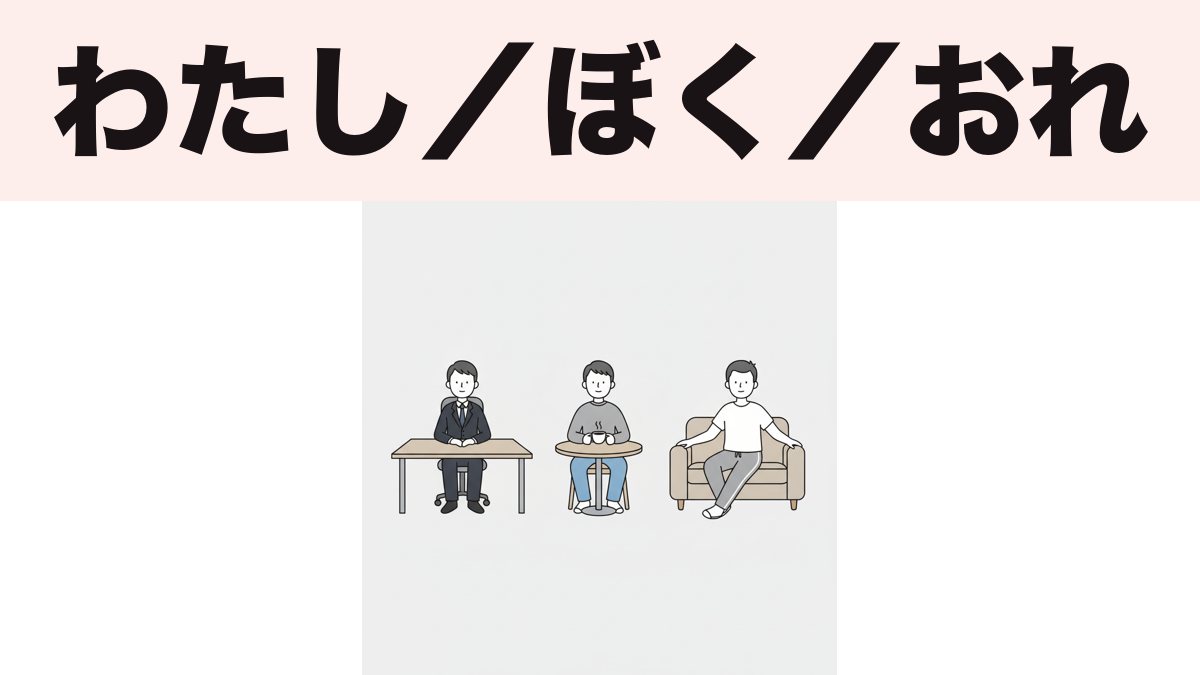
Japanese pronouns are not neutral labels like English "I" and "you" — every one of them announces your gender, age, formality and attitude the moment you open your mouth. Which is exactly why fluent speakers avoid them whenever they can.
日本語の「わたし」は、英語の "I" とちがいます。どれを使うかで、あなたの性別・年れい・ていねいさ・きもちが、すぐに相手に伝わります。だから日本語が上手な人は、できるだけ使いません。
English gives you one word for "I" and you use it in a job interview, a fight, and a bedtime story. Japanese gives you a shelf full of them, and picking one is closer to picking an outfit than picking a word. This is also the single fastest way to make a sentence sound wrong while every individual word in it is correct.
The basics
What are the main words for "I"?
These four cover almost everything you will ever need to say yourself.
| Pronoun | Reading | Who uses it | Feel |
|---|---|---|---|
| 私 | わたし | anyone | The safe default. Neutral, polite, works everywhere. |
| 私 | わたくし | anyone, formal | Same kanji, stiffer reading. Ceremonies, business, apologies. |
| 僕 | ぼく | men and boys (some women) | Soft, modest, slightly boyish. Common from childhood through adulthood. |
| 俺 | おれ | men | Casual, blunt, masculine. Friends and family only. |
| あたし | — | women, casual | Softened わたし. Spoken, rarely written. |
| うち | — | women, casual, west Japan | Regional and young-sounding. |
If you remember nothing else: 私 is never wrong. It can be slightly over-formal with close friends, and that is the worst thing that will happen to you.
私はコーヒーにします。 — I'll have a coffee. (neutral, safe in any situation) 僕は甘いものが苦手なんです。 — I'm not great with sweet things. (soft, friendly, male speaker) 俺、もう帰るわ。 — I'm heading home. (casual, male, among friends)
How do you say "you"?
Mostly, you don't. This is the part that surprises learners most.
あなた is taught as "you" in every first textbook, and then almost nobody uses it. Between adults it can sound cold, distant, or oddly intimate depending on context — it is the word a wife uses for her husband, and also the word a form letter uses for a stranger. Neither of those is what you mean when you are chatting with a classmate.
Instead, Japanese uses the person's name plus さん, or their role, exactly where English would use "you":
田中さんは何を飲みますか。 — What are you drinking, Tanaka-san? (literally "what will Tanaka-san drink" — this is the normal way to ask) 先生もいらっしゃいますか。 — Are you coming too, sensei? (role word instead of a pronoun)
きみ and おまえ exist, but both carry a downward tilt — an older man to a younger one, a boss to a subordinate, a character in anime being deliberately rough. They are not casual-friendly equivalents of "you" the way 俺 is a casual-friendly equivalent of "I".
Why do sentences work with no pronoun at all?
Because Japanese lets you drop anything the listener can already infer, and in a conversation between two people, who is doing what is almost always inferable. Adding 私は to every sentence is one of the clearest learner tells there is.
昨日、映画を見ました。 — I watched a movie yesterday. (no pronoun; "I" is obvious because you are the one speaking) これ、食べる? — Are you going to eat this? (no pronoun; "you" is obvious because you are the one being asked)
Use 私は when you are contrasting — when it matters that it was you and not someone else. That is what the particle は is doing there in the first place, which is worth reading about separately in は vs が.
Beyond the basics
What do pronouns tell you in anime?
A lot, on purpose. Japanese fiction uses 役割語 (yakuwarigo, "role language") — speech patterns that instantly signal a character type without the script having to explain anything. Pronouns do most of that work.
- 俺様 (おれさま) — "I" plus the honorific さま applied to yourself. Arrogant, self-important, usually a villain or a rival who is about to lose.
- わし — elderly men, professors, mountain hermits. Real old men do not reliably talk like this; fiction says they do.
- 拙者 (せっしゃ) — samurai. Pairs with 〜でござる instead of です.
- 我輩 / 吾輩 (わがはい) — grandiose, archaic, comic when used by a cat or a small animal.
- あたい — rough, working-class, old-fashioned female speech.
This is why a character can change pronoun mid-series and it reads as an entire character arc. It is also why copying your favourite character's pronoun is risky: you may be reproducing a costume designed to mark someone as a 16th-century swordsman.
Anime is genuinely useful input, but this is one of the places it will lie to you about everyday speech — the same way it will about role-marked sentence endings.
Do real people switch pronouns?
Constantly, and it is not a personality change. The same man can use 私 in a meeting, 僕 with a client he likes, and 俺 with his brother, all in one day. The pronoun tracks the relationship, not the person.
私が担当いたします。 — I'll be handling this. (work, formal — with the humble verb to match) 俺がやるよ。 — I'll do it. (same offer, to a friend)
Boys often switch from 僕 to 俺 somewhere in their teens as a marker of growing up, and some men switch back to 僕 at work because 俺 is too rough there. Women have a narrower set in practice: 私 dominates, with あたし as the casual option.
What about 彼 and 彼女?
彼 (he) and 彼女 (she) exist, but they are much less common than English "he" and "she", and both have a second meaning: boyfriend and girlfriend. Saying 彼女は来ますか can be read as "is your girlfriend coming?" instead of "is she coming?"
Use the person's name, or あの人 ("that person"), which is the real everyday third-person word:
あの人、日本語がすごく上手ですね。 — That person's Japanese is really good, isn't it. (natural third-person reference)
Why does 自分 sometimes mean "I" and sometimes "you"?
自分 basically means "oneself". In standard Japanese it reflects back on whoever the sentence is about — 自分でやりました means "I did it myself" or "he did it himself" depending on context. In Kansai speech it can be thrown at the listener and mean "you", which catches people out. And in sports and military contexts, men use 自分 as a flat, disciplined "I".
Common mistakes
- Starting every sentence with 私は. Grammatically fine, unmistakably foreign. Drop it unless you are contrasting yourself with someone else.
- Using あなた as a default "you". Use the person's name plus さん. If you do not know their name, restructure the sentence so you do not need the word at all.
- Copying 俺 from anime and using it with a teacher or a stranger. It is not rude between friends, and it is very rude upward.
- Adding さん to your own name — or to your own pronoun. 俺様 is a joke or a villain. Honorifics point outward, never at yourself.
- Assuming 彼女 always means "she". In half of real contexts it means "girlfriend", and the ambiguity is genuinely there for Japanese listeners too.
The register ladder
| Situation | "I" | "You" |
|---|---|---|
| Ceremony, formal business | わたくし | お客様 / 社長 / role word |
| Work, first meeting | 私 | 〜さん (name) |
| Friendly but polite | 私 / 僕 | 〜さん (name) |
| Close friends, family | 俺 / あたし / 僕 | 〜 (name alone), or nothing |
| Anime villain | 俺様 | 貴様 (きさま) |
Practice
Answers are hidden — say yours out loud first. Questions 4 and 5 are a pair: the same sentence, two different relationships.
1. You are introducing yourself at a job interview. Which pronoun?
Show answer
私(わたし)、or わたくし for extra formality — 僕 is too soft for an interview and 俺 would end it early. 私 is never the wrong answer.
2. Fix this: 私は昨日私の友達と私の家で映画を見ました。
Show answer
昨日、友達と家で映画を見ました — every 私 here is inferable, so all three drop. Japanese deletes what the listener already knows.
3. You want to ask a classmate named Yamada what he is eating. Translate "what are you eating?"
Show answer
山田さん、何を食べていますか — the name replaces "you". あなたは何を食べていますか is grammatical but sounds cold and textbook-ish.
4. A man says 俺がやるよ to his younger brother. What is the register?
Show answer
Casual and completely normal — 俺 with family is the default for many adult men. Nothing rude is happening.
5. The same man says 俺がやるよ to his new boss. What is the register?
Show answer
Rude, or at least startlingly over-familiar — the words did not change, the relationship did. He would say 私がやります here.
6. A character says 我輩は猫である. What does the pronoun tell you before you even reach the verb?
Show answer
Archaic, pompous, self-important — and therefore funny attached to a cat — 我輩 is 役割語 for a grandiose old-fashioned speaker. The joke lives entirely in the pronoun.
7. Your friend says 彼女は来ないよ. Why might you need to ask a follow-up question?
Show answer
彼女 means both "she" and "girlfriend" — "she isn't coming" and "my girlfriend isn't coming" are the same sentence. Context usually settles it; sometimes it genuinely doesn't.
8. Translate "that person is really good at Japanese" without using a name.
Show answer
あの人は日本語がすごく上手です — あの人 is the everyday third-person reference. 彼 and 彼女 are used far less than English "he" and "she".
9. A woman wants a casual version of 私. What are her options?
Show answer
あたし, or うち in western Japan — 僕 and 俺 are used by some women as a style choice, but they read as deliberately masculine, not neutral.
10. Someone asks 自分、どこから来たん? in Kansai. Who are they asking about?
Show answer
You — 自分 means "oneself" in standard Japanese, but in Kansai speech it is aimed at the listener and means "you". This one trips up Japanese speakers from other regions too.
FAQ
Can women use 僕 or 俺? They can, and some do — in song lyrics, in fiction, and as a personal style choice. It is read as deliberately masculine or as a persona, not as neutral. If you want a casual female option, あたし is the unmarked one.
Is 私 ever too formal? Only mildly. Among very close friends it can sound a touch stiff, the way "I shall" sounds in English. That is a much smaller problem than picking 俺 in the wrong room.
Why does my textbook use あなた so much? Because textbook sentences have no context, and あなた is the only pronoun that works without knowing anyone's name. In real conversation you always know the name, so you always use the name.
Is 貴様 ("kisama") a polite word? It has 貴 in it. It was polite, centuries ago. It has since flipped completely and is now an insult — the "you bastard" of anime fight scenes. Historical politeness is not a guide to current politeness.
Do I need to learn all of these to read manga? Recognise them, yes; use them, no. Reading is where 役割語 pays off, because a single pronoun tells you the character's age, gender and attitude before any dialogue explains it.
What do I call a group — is there a "we"? 私たち (we), 僕たち, 俺たち — add たち to whichever "I" you use. うち can also mean "us / our company / our family", which is why 「うちの会社」means "the company I work at".
Vocabulary from this article
Tap the block to select all of it, then copy. In Anki: File → Import, note type Basic, separator Tab — the first column becomes the front, the second the back.
私	わたし — I, me (neutral)
私	わたくし — I, me (very formal)
僕	ぼく — I, me (soft, mostly male)
俺	おれ — I, me (casual, male)
君	きみ — you (downward, casual)
自分	じぶん — oneself; "you" in Kansai
彼	かれ — he; boyfriend
彼女	かのじょ — she; girlfriend
役割語	やくわりご — role language
担当	たんとう — being in charge of
苦手	にがて — not good at, not fond of
上手	じょうず — skilled, good at
友達	ともだち — friend
先生	せんせい — teacher (also used as "you")
会社	かいしゃ — company
帰る	かえる — to go home
映画	えいが — movie
猫	ねこ — cat
I'm Yuuki, a Japanese teacher based in Tokyo. I've taught on italki as a Top 1% teacher and watched over 1,500 anime. Pronouns are the thing students most often learn from fiction and then have to unlearn in conversation — nobody is harmed by 私, and quite a few people have been startled by 俺.
Sources: the author's own lessons and standard reference grammars.
英語は "I" が1つだけです。会社の面接でも、けんかでも、同じ言葉を使います。日本語はたくさんあります。えらぶのは「ことば」ではなく「服」に近いです。ここをまちがえると、1つ1つの単語は正しいのに、文ぜんたいが変になります。
基本
「わたし」の言い方
| ことば | 読み方 | 使う人 | かんじ |
|---|---|---|---|
| 私 | わたし | だれでも | いちばん安全。どこでも使えます。 |
| 私 | わたくし | だれでも(とても丁寧) | 式や仕事、あやまる時。 |
| 僕 | ぼく | 男の人(女の人も少し) | やわらかい。少し子どもっぽい。 |
| 俺 | おれ | 男の人 | カジュアル。友だちと家ぞくだけ。 |
| あたし | — | 女の人(カジュアル) | 「わたし」をやわらかくした形。 |
| うち | — | 女の人・西日本 | 方言。若い人が使います。 |
1つだけおぼえるなら、「私」はぜったいにまちがいになりません。友だちと話す時、少しかたい感じがするだけです。
私はコーヒーにします。 — I'll have a coffee. (neutral, safe in any situation) 僕は甘いものが苦手なんです。 — I'm not great with sweet things. (soft, friendly, male speaker) 俺、もう帰るわ。 — I'm heading home. (casual, male, among friends)
「あなた」は使いません
教科書は「あなたあなたyou」と教えます。でも、日本人はあまり使いません。冷たく聞こえたり、反対に、とても近い感じ(つまが夫に言う言い方)になったりします。
かわりに、名前+さんを使います。
田中さんは何を飲みますか。 — What are you drinking, Tanaka-san? (the name is used where English uses "you") 先生もいらっしゃいますか。 — Are you coming too, sensei? (a role word instead of a pronoun)
「きみ」「おまえ」もありますが、上の人が下の人に言う感じです。友だちどうしの「you」ではありません。
主語を言わない
相手が分かることは、言いません。毎回「私は」と言うと、すぐに「日本語を勉強している人」だと分かります。
昨日、映画を見ました。 — I watched a movie yesterday. (no pronoun needed; the speaker is obviously "I") これ、食べる? — Are you going to eat this? (no pronoun needed; the listener is obviously "you")
「私は」を使うのは、ほかの人とくらべる時です。それが助詞「は」の仕事です。くわしくは「は」と「が」を読んでください。
もう少し先へ
アニメの「わたし」
日本のアニメやマンガには役割語(やくわりご)があります。話し方でキャラクターの種類が分かる、というしくみです。
- 俺様(おれさま) — 自分に「さま」をつけます。えらそう。だいたい悪役です。
- わし — おじいさん、博士。本物のおじいさんはあまり使いません。
- 拙者(せっしゃ) — さむらい。「〜でござる」といっしょに使います。
- 我輩(わがはい) — 古くて、えらそうで、こっけいです。
- あたい — 少し古い、はっきりした女の人の話し方。
キャラクターの言い方をまねすると、あぶないです。それは「服」だからです。ていねいさの切りかえも同じです。
本当の人も、切りかえます
同じ男の人が、会議では「私」、好きなお客さんには「僕」、弟には「俺」を使います。人が変わったのではありません。関係が変わったのです。
私が担当いたします。 — I'll be handling this. (at work, formal) 俺がやるよ。 — I'll do it. (the same offer, to a friend)
「彼」「彼女」
「彼」「彼女」はありますが、英語の he / she ほど使いません。そして、「彼氏」「彼女」(boyfriend / girlfriend)の意味もあります。ふつうは名前か「あの人」を使います。
あの人、日本語がすごく上手ですね。 — That person's Japanese is really good, isn't it. (the everyday way to say "he/she")
「自分」
「自分」は「自分じしん」という意味です。でも関西では、相手に向かって「自分自分あなた」の意味で使います。これは他の地方の日本人もおどろきます。
よくあるまちがい
- 毎回「私は」と言う。 正しいですが、自然ではありません。
- 「あなた」を「you」のかわりに使う。 名前+さんを使ってください。
- アニメの「俺」を先生に使う。 友だちにはOK、目上の人にはとても失礼です。
- 自分の名前や自分に「さま」をつける。 「俺様」は悪役かじょうだんです。
- 「彼女」はいつも "she" だと思う。 半分くらいは「girlfriend」の意味です。
ていねいさの表
| 場面 | 「わたし」 | 「あなた」 |
|---|---|---|
| 式・大事な仕事 | わたくし | お客様・社長など |
| 仕事・はじめて会う人 | 私 | 〜さん(名前) |
| ていねいだけど親しい | 私・僕 | 〜さん(名前) |
| 友だち・家ぞく | 俺・あたし・僕 | 名前だけ、または言わない |
| アニメの悪役 | 俺様 | 貴様(きさま) |
練習
まず自分で言ってから、答えを見てください。4番と5番はペアです。同じ文で、関係だけがちがいます。
1. 会社の面接です。どれを使いますか。
答えを見る
私(わたし)、もっと丁寧なら わたくし — 「僕」はやわらかすぎ、「俺」は面接が終わります。
2. 直してください: 私は昨日私の友達と私の家で映画を見ました。
答えを見る
昨日、友達と家で映画を見ました — 3つの「私」は全部いりません。相手が分かることは言いません。
3. 山田さんに「何を食べていますか」と聞きたいです。
答えを見る
山田さん、何を食べていますか — 名前が「you」のかわりです。「あなたは」は冷たく聞こえます。
4. 男の人が弟に「俺がやるよ」と言いました。どんな感じですか。
答えを見る
ふつうです — 家ぞくに「俺」は自然です。失礼ではありません。
5. 同じ人が、新しい上司に「俺がやるよ」と言いました。
答えを見る
とても失礼です — ことばは同じ、関係がちがいます。ここでは「私がやります」です。
6. 「我輩は猫である」の「我輩」から、何が分かりますか。
答えを見る
古くて、えらそうな話し方 — 役割語です。それが猫なので、おもしろいのです。
7. 友だちが「彼女は来ないよ」と言いました。なぜ聞き返しますか。
答えを見る
「彼女」は she と girlfriend の両方の意味だから — 日本人も分からない時があります。
8. 名前を使わないで「あの人は日本語が上手です」と言ってください。
答えを見る
あの人は日本語がすごく上手です — 「あの人」がふつうの言い方です。「彼」「彼女」はあまり使いません。
9. 女の人のカジュアルな「私」は?
答えを見る
あたし、西日本なら うち — 「僕」「俺」を使う女の人もいますが、わざと男っぽくしています。
10. 関西で「自分、どこから来たん?」と聞かれました。だれのことですか。
答えを見る
あなたのこと — 標準語では「自分自分oneself」ですが、関西では「あなた」の意味になります。
よくある質問
女の人が「僕」「俺」を使ってもいいですか。 使う人もいます。歌やマンガでよく見ます。でも「わざと男っぽくしている」と伝わります。ふつうのカジュアルは「あたし」です。
「私」はかたすぎませんか。 少しだけです。とても仲のいい友だちに、ちょっとかたい感じがするくらいです。場所をまちがえた「俺」より、ずっと安全です。
なぜ教科書は「あなた」を使うのですか。 教科書の文には場面がないからです。名前が分からない時、「あなた」しか使えません。本当の会話では、名前を知っています。
「貴様(きさま)」はていねいですか。 昔はていねいでした。今は反対で、けんかの言葉です。
「私たち」はどう言いますか。 「たち」をつけます。私たち・僕たち・俺たち。「うち」は「うちの会社」」「私の会社」の意味にもなります。
この記事に出た単語
下のブロックをタップして全部えらび、コピーしてください。Anki では ファイル → 読み込み、ノートの種類は 基本、区切りは タブ です。
私	わたし — I, me (neutral)
私	わたくし — I, me (very formal)
僕	ぼく — I, me (soft, mostly male)
俺	おれ — I, me (casual, male)
君	きみ — you (downward, casual)
自分	じぶん — oneself; "you" in Kansai
彼	かれ — he; boyfriend
彼女	かのじょ — she; girlfriend
役割語	やくわりご — role language
担当	たんとう — being in charge of
苦手	にがて — not good at, not fond of
上手	じょうず — skilled, good at
友達	ともだち — friend
先生	せんせい — teacher (also used as "you")
会社	かいしゃ — company
帰る	かえる — to go home
映画	えいが — movie
猫	ねこ — cat
私はユウキです。東京で日本語を教えています。 italki の Top 1% の先生で、アニメは1,500本以上見ました。「わたし」の言い方は、アニメでおぼえて、あとで直すことがいちばん多いところです。「私」でこまった人はいません。「俺」でおどろかれた人は何人もいます。
More drills like the ones above, plus a timed JLPT-style mock test: Practice · N4上のような練習問題と、時間つきのJLPT形式のもぎ試験: 練習ページ · N4
Want to try this in a real conversation?
本当の会話で、ためしてみませんか?
30-minute trial lesson, $13. Times shown in your own timezone.
30分の体験レッスン、$13。時間はあなたのタイムゾーンで表示されます。
Book a trial lesson · $13