Japanese onomatopoeia: ドキドキ, ペコペコ, and the "sound" of silenceオノマトペ: ドキドキ・ペコペコ、そして「しーん」という音
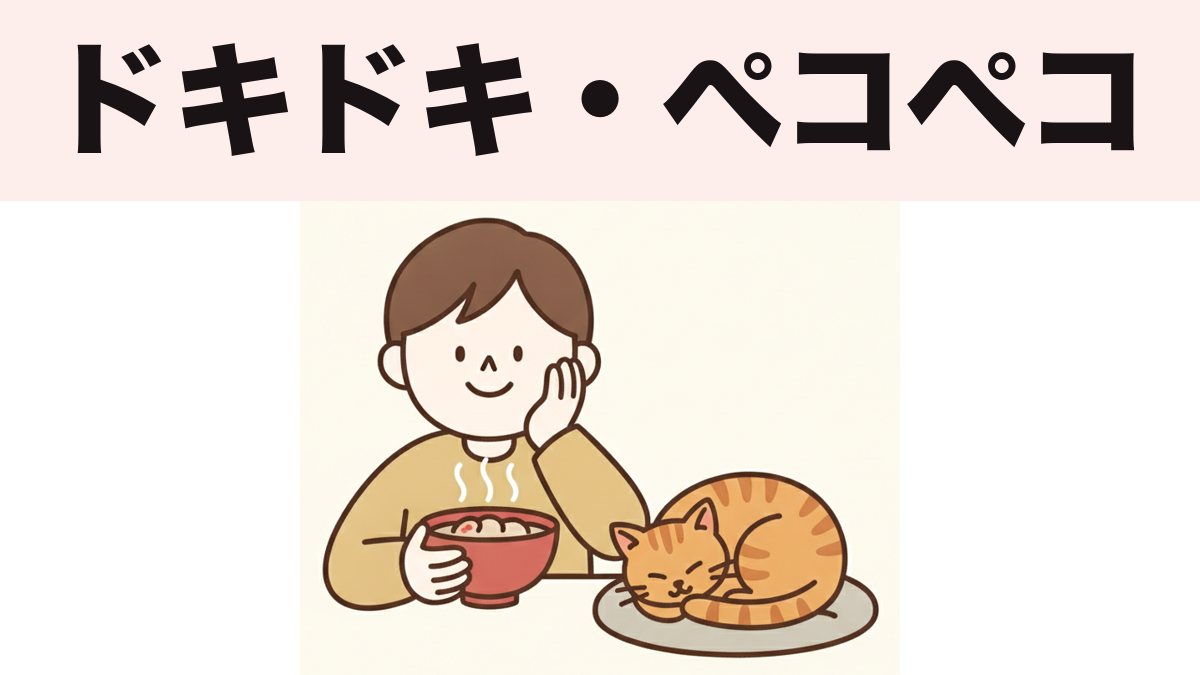
Japanese has two families of onomatopoeia: 擬音語, which imitate sounds, and 擬態語, which imitate *states* — feelings, textures, ways of moving. The second family is the surprising one. ワクワク is not a noise anybody makes; it is what excitement is like, turned into a word.
日本語のオノマトペには2つの家族があります。音をまねる「擬音語」と、**ようす**をまねる「擬態語」です。おどろくのは2つめです。「ワクワク」はだれも出さない音で、うれしさそのものをことばにしたものです。
Learners often file these as childish, because in English onomatopoeia lives in comics and picture books. In Japanese they are ordinary adult vocabulary, they appear in news writing, and a doctor will ask you to choose between two of them.
The basics
The two families
擬音語 (giongo) — actual sounds. Usually written in katakana.
| Word | Sound |
|---|---|
| ワンワン | a dog barking |
| ザーザー | heavy rain |
| ガタガタ | rattling |
| ゴロゴロ | thunder rumbling |
| パチパチ | clapping, crackling |
擬態語 (gitaigo) — states and manners, with no sound at all. Usually hiragana.
| Word | State |
|---|---|
| ドキドキ | heart pounding — nervous or excited |
| ワクワク | excited anticipation |
| ペコペコ | very hungry |
| キラキラ | sparkling |
| ニコニコ | smiling |
| ぐっすり | sleeping soundly |
| ぼーっと | spacing out |
| しっかり | firmly, properly |
お腹がペコペコです。 — I'm starving. 緊張してドキドキしています。 — I'm nervous, my heart's pounding. 昨日はぐっすり寝ました。 — I slept soundly last night.
How they attach to a sentence
Three common shapes, and most words prefer one.
With する — the word becomes a verb:
ドキドキする — to have your heart pound. わくわくする — to be excited.
With と — adverbially, often for one-off sounds or manner:
ゆっくりと歩く — to walk slowly. ドアがバタンと閉まった。 — The door shut with a bang.
Bare, as an adverb:
ぐっすり寝る — to sleep soundly. しっかり持ってください。 — Hold it firmly.
The repeated ones (ドキドキ, キラキラ) usually take する. The 〜り ones (ぐっすり, しっかり, ゆっくり, はっきり) usually stand alone as adverbs. That is a rough rule but it covers most of what you will meet.
They are not childish
This is the misconception worth killing early. 擬態語 appear in serious writing, in business, and in medicine.
Go to a Japanese doctor with a headache and you will be asked to choose:
ズキズキ — throbbing. チクチク — prickling, sharp and small. ガンガン — pounding, heavy. ヒリヒリ — burning, stinging.
There is no more precise vocabulary available; these are the precise words. A learner who cannot use them cannot describe pain accurately in Japanese, which is a real practical gap and not a stylistic one.
Beyond the basics
しーん: the sound of no sound
Japanese has a word for silence that behaves like a sound word.
しーん — the "sound" of total silence.
It is written into manga panels where nothing is happening and nobody is speaking, and it is used in speech too: しーんとした部屋 ("a dead-silent room"). English has no equivalent — "silence" is a noun describing an absence, not a word imitating it. This is the clearest single demonstration that 擬態語 are not imitating sounds at all; they are imitating how something is.
The doubling tells you something
Repeated forms (ドキドキ, ニコニコ, ゴロゴロ) usually mean the state continues or repeats. Single forms often mean it happened once.
| Repeated | Single |
|---|---|
| ドキドキ — heart pounding, ongoing | ドキッ — one startled thump |
| キラキラ — sparkling continuously | キラッ — one flash |
| ニコニコ — smiling away | ニコッ — one smile |
The っ ending on the single versions is doing real work: it marks the sharp, complete, one-time version of the same thing. This is the same doubling instinct as 〜ば〜ほど and 〜ても〜ても — repeating something in Japanese turns an event into a process.
One word, several meanings
Some are genuinely ambiguous and resolved by context.
ゴロゴロ — thunder rumbling / a cat purring / lazing around at home / something heavy rolling. ぺらぺら — speaking a language fluently / paper-thin and flimsy.
日本語がぺらぺらですね is a compliment ("your Japanese is fluent"). The same word about a jacket is not.
How does it sound in anime?
Onomatopoeia is written directly into manga art as effect text, and a large amount of it is 擬態語 — describing a mood rather than a noise.
シーン… — dead silence. ドキッ — a startled heartbeat. ニヤニヤ — smirking unpleasantly. イライラする — to be irritated.
ニヤニヤ versus ニコニコ is worth knowing: both are smiling, and only one of them is friendly. ニコニコ is a warm open smile; ニヤニヤ is a smirk, and describing someone that way is not a compliment.
Where to meet them in the wild
Three places give you a lot of exposure quickly, in rough order of how much you will absorb per hour:
- Manga. The effect text drawn into panels is almost entirely onomatopoeia, and because it sits next to a picture of what it means, you learn it without a dictionary. This is the single best reason to read manga as study material rather than only watching.
- Food packaging and advertising. ふわふわ (fluffy), もちもち (chewy), さくさく (crisp), とろとろ (melting) are printed on things you are holding. Texture words are a whole sub-family, and Japanese food writing runs on them.
- Weather forecasts. ザーザー, しとしと (drizzling), じめじめ (humid and unpleasant) come up daily and are said slowly and clearly.
The texture family in particular is worth a separate look: もちもち, さくさく, ふわふわ, ぱさぱさ (dry and crumbly), ねばねば (sticky). There is no compact English for most of these, which is why translated menus in Japan so often sound strange — the original was doing something English cannot do in one word.
Common mistakes
- Treating them as childish. They are standard adult vocabulary, including in medicine and business writing.
- Forgetting する. ドキドキ on its own is a noise-word; ドキドキする is the verb. Most repeated forms need it.
- Using ぺらぺら about an object as a compliment. Fluent for languages, flimsy for things.
- Mixing up ニコニコ and ニヤニヤ. One is warm, one is a smirk.
- Assuming katakana always means a sound. The katakana/hiragana split is a tendency, not a rule — plenty of 擬態語 appear in katakana for emphasis.
- Skipping them entirely. You cannot describe pain, texture, sleep quality or mood precisely in Japanese without them.
Practice
Answers are hidden — build yours first, then open. Questions 1 and 2 are a pair: two words that look alike and differ by one sound.
1. What does ドキドキ mean?
Show answer
Heart pounding — nervous or excited — a 擬態語, since it describes a state. The repeated form means it is ongoing.
2. What does ドキッ mean?
Show answer
One startled thump — the っ ending marks the sharp, one-time version. This is the pair to question 1: repetition means ongoing, っ means once.
3. Say "I'm starving."
Show answer
お腹がペコペコです — ペコペコ is a 擬態語 for extreme hunger, and completely normal for an adult to say.
4. Your doctor asks about a headache. What are you being asked to choose between?
Show answer
ズキズキ, チクチク, ガンガン, ヒリヒリ — throbbing, prickling, pounding, burning. These are the precise medical vocabulary; there is no more technical alternative.
5. What is the difference between 擬音語 and 擬態語?
Show answer
Sounds vs states — 擬音語 imitate actual noises (ワンワン, ザーザー). 擬態語 imitate how something is (ワクワク, キラキラ), with no sound involved at all.
6. What does しーん represent?
Show answer
Total silence — a word that imitates the absence of sound. English has no equivalent, and it is the clearest proof that these words are not really about noise.
7. Which form takes する: ぐっすり or ドキドキ?
Show answer
ドキドキ — repeated forms usually take する. The 〜り forms (ぐっすり, しっかり, ゆっくり) stand alone as adverbs: ぐっすり寝る.
8. Someone says 日本語がぺらぺらですね. Is that good?
Show answer
Yes — it means fluent — but the same word about a jacket means flimsy and paper-thin. Context decides entirely.
9. What is the difference between ニコニコ and ニヤニヤ?
Show answer
A warm smile vs a smirk — both describe smiling, and only ニコニコ is friendly. Describing someone as ニヤニヤ is not a compliment.
10. Name three things ゴロゴロ can mean.
Show answer
Thunder rumbling, a cat purring, lazing around at home — and something heavy rolling. Context does all the work.
FAQ
How many should I learn? Start with the ones about your own body and mood: ペコペコ, ドキドキ, ぐっすり, イライラ, ぼーっと. Those come up daily. Add the pain words before you need a doctor, not after.
Are they written in katakana or hiragana? Sound words lean katakana, state words lean hiragana, and both rules get broken for emphasis. It is a tendency worth knowing and not worth worrying about.
Do they have a grammar of their own? Somewhat. Beyond する and と, some take に (ぐちゃぐちゃになる, "to become a mess") and some function as な-adjectives. Learn each one with the shape it usually appears in rather than trying to derive it.
Why does Japanese have so many? Estimates run to several thousand, far more than English. One reason is that Japanese has relatively few adjectives compared to its verb inventory, and 擬態語 fill that expressive space — where English reaches for an adjective, Japanese often reaches for one of these.
Can I make up new ones? Native speakers do, especially in manga, and the patterns are productive enough that a new one is usually understood. As a learner, stick to real ones — an invented one will read as an error rather than as creativity.
What about ちゃんと and きちんと? Both mean "properly," and both are 擬態語 in the same family as しっかり. ちゃんと is the casual everyday one, きちんと is slightly more formal and implies neatness. They are among the most used words in the language.
Vocabulary from this article
Tap the block to select all of it, then copy. In Anki: File → Import, note type Basic, separator Tab — the first column becomes the front, the second the back.
擬音語	ぎおんご — sound-imitating word
擬態語	ぎたいご — state-imitating word
ドキドキ	ドキドキ — heart pounding (nervous, excited)
ワクワク	ワクワク — excited anticipation
ペコペコ	ペコペコ — very hungry
キラキラ	キラキラ — sparkling
ニコニコ	ニコニコ — smiling warmly
ニヤニヤ	ニヤニヤ — smirking
ゴロゴロ	ゴロゴロ — rumbling; purring; lazing about
イライラ	イライラ — irritated
ぐっすり	ぐっすり — soundly (asleep)
しっかり	しっかり — firmly, properly
ぼーっと	ぼーっと — spacing out
ゆっくり	ゆっくり — slowly
ちゃんと	ちゃんと — properly
ぺらぺら	ぺらぺら — fluent; flimsy
お腹	おなか — stomach
緊張	きんちょう — nervousness
部屋	へや — room
寝る	ねる — to sleep
I'm Yuuki, a Japanese teacher based in Tokyo. I've taught on italki as a Top 1% teacher and watched over 1,500 anime. Learners skip these because they look like comic-book noises, and then cannot answer a doctor asking whether the pain is ズキズキ or チクチク — which is the moment it stops being a stylistic question.
Sources: the author's own lessons and standard reference grammars.
学習者は「子どもっぽい」と思いがちです。英語ではマンガや絵本のことばだからです。日本語ではふつうの大人のことばで、ニュースにも出ますし、お医者さんは2つのうちどちらかを選ばせます。
基本
2つの家族
擬音語 — 本当の音です。だいたいカタカナで書きます。
| ことば | 音 |
|---|---|
| ワンワン | 犬 |
| ザーザー | 強い雨 |
| ガタガタ | がたつく音 |
| ゴロゴロ | かみなり |
| パチパチ | はく手・火 |
擬態語 — ようすや気もちで、音はありません。だいたいひらがなです。
| ことば | ようす |
|---|---|
| ドキドキ | 心ぞうが速い(きんちょう・わくわく) |
| ワクワク | 楽しみ |
| ペコペコ | とてもおなかがすいた |
| キラキラ | 光る |
| ニコニコ | 笑っている |
| ぐっすり | よく眠る |
| ぼーっと | 何も考えていない |
| しっかり | ちゃんと |
お腹がペコペコです。 — I'm starving. 緊張してドキドキしています。 — I'm nervous, my heart's pounding. 昨日はぐっすり寝ました。 — I slept soundly last night.
文へのつけ方
3つの形があって、ことばごとに好みがあります。
「する」をつける — 動詞になります。
ドキドキする — 心ぞうが速くなる。 。わくわくする — 楽しみにする。
「と」をつける — 副詞のように。1回の音や、やり方に多いです。
ゆっくりと歩く — to walk slowly. ドアがバタンと閉まった。 — The door shut with a bang.
そのまま副詞として:
ぐっすり寝る — to sleep soundly. しっかり持ってください。 — Hold it firmly.
くり返す形(ドキドキ・キラキラ)は、だいたい「する」です。「〜り」の形(ぐっすり・しっかり・ゆっくり・はっきり)は、だいたいそのまま副詞です。
子どもっぽくありません
ここを最初に消しておきたいです。擬態語はまじめな文章にも、仕事にも、医りょうにも出ます。
頭がいたくて日本のお医者さんに行くと、こう聞かれます。
ズキズキ — throbbing. チクチク — prickling. ガンガン — pounding. ヒリヒリ — burning.
これよりくわしいことばはありません。これがくわしいことばです。使えないと、日本語でいたみを正かくに言えません。文体の問題ではなく、生活の問題です。
もう少し先へ
しーん: 音がない音
日本語には、しずけさを表す「音のことば」があります。
しーん — まったくしずかなようす。
マンガのコマで、何も起きていない時に書かれます。話す時にも使います。「しーんとした部屋」。英語にはありません。"silence" は「ないこと」を言う名詞で、まねたことばではありません。擬態語が音をまねていないことの、いちばんはっきりしたしょうこです。
くり返しが教えてくれること
くり返す形(ドキドキ・ニコニコ・ゴロゴロ)は、続いているか、くり返していることが多いです。1つだけの形は、1回のことが多いです。
| くり返し | 1回 |
|---|---|
| ドキドキ — 続いている | ドキッ — 1回びっくり |
| キラキラ — 光り続ける | キラッ — 1回光る |
| ニコニコ — 笑い続ける | ニコッ — 1回笑う |
「っ」で終わる形が、するどい1回を表しています。日本語は、くり返すと「できごと」が「続くこと」になります。
1つのことばに、いくつもの意味
前後でしか分からないものもあります。
ゴロゴロ — かみなり/ねこがのどを鳴らす/家でだらだらする/重いものが転がる。 。ぺらぺら — ことばが上手/紙のようにうすい。
「日本語がぺらぺらですね」はほめことばです。同じことばを上着について言うと、そうではありません。
アニメではどう聞こえますか?
マンガでは、絵の中に直せつ書かれます。そして多くが擬態語で、音ではなく気ぶんを表しています。
シーン… — まったくの静けさ。 。ドキッ — びっくりした心ぞう。 。ニヤニヤ — いやな笑い方。 。イライラする — いらいらする。
「ニヤニヤ」と「ニコニコ」は覚えてください。どちらも笑っていますが、やさしいのは1つだけです。「ニコニコ」はあたたかい笑顔、「ニヤニヤ」はにやにや笑いで、人に言うとほめことばになりません。
どこで出会えますか
たくさん浴びられる場所が3つあります。
- マンガ。 コマに書かれている音は、ほとんどオノマトペです。絵のとなりにあるので、辞書なしで覚えられます。マンガを教ざいにするいちばんの理由です。
- 食べもののパッケージとこうこく。 ふわふわ・もちもち・さくさく・とろとろ。手に持っているものに書いてあります。食べもののことばは、これで動いています。
- 天気よほう。 ザーザー・しとしと(細かい雨)・じめじめ(しつどが高くていやな感じ)。毎日出ますし、ゆっくりはっきり言ってくれます。
とくに「食かん」のなかまは見てみてください。もちもち・さくさく・ふわふわ・ぱさぱさ(かわいてぼろぼろ)・ねばねば。英語に短いことばがないので、日本のメニューの英語訳が変になることが多いです。もとのことばが、英語には1語でできないことをしています。
よくある間違い
- 子どもっぽいと思うこと。 大人のふつうのことばで、医りょうや仕事の文章にも出ます。
- 「する」を忘れること。 「ドキドキ」だけでは音のことばです。「ドキドキする」が動詞です。
- ものに「ぺらぺら」をほめことばとして使うこと。 ことばなら上手、ものならうすいです。
- 「ニコニコ」と「ニヤニヤ」を混ぜること。 一方はあたたかく、一方はにやにやです。
- カタカナならいつも音だと思うこと。 だいたいそうですが、強めるためにカタカナで書く擬態語もあります。
- ぜんぶとばすこと。 いたみ・手ざわり・ねむり・気ぶんは、これがないと正かくに言えません。
練習
答えはかくれています。まず自分の答えを作ってから開いてください。1番と2番は対になっています。
1. 「ドキドキ」はどんな意味ですか。
答えを見る
心ぞうが速いこと(きんちょう・わくわく) — ようすを表すので擬態語です。くり返す形なので、続いています。
2. 「ドキッ」はどんな意味ですか。
答えを見る
1回びっくりした心ぞう — 「っ」がするどい1回を表します。1番と対で、くり返しは続くこと、「っ」は1回です。
3. 「とてもおなかがすいた」と言ってください。
答えを見る
お腹がペコペコです — 大人がふつうに言うことばです。
4. 頭がいたくてお医者さんに行きました。何を聞かれますか。
答えを見る
ズキズキ・チクチク・ガンガン・ヒリヒリ — これがくわしいことばで、ほかの言い方はありません。
5. 擬音語と擬態語はどうちがいますか。
答えを見る
音か、ようすか — 擬音語は本当の音(ワンワン・ザーザー)、擬態語はようす(ワクワク・キラキラ)で、音はありません。
6. 「しーん」は何を表していますか。
答えを見る
まったくの静けさ — 音がないことをまねたことばです。英語にはありません。
7. 「する」がつくのはどちらですか: ぐっすり/ドキドキ。
答えを見る
ドキドキ — くり返す形は「する」がつきます。「〜り」の形(ぐっすり・しっかり・ゆっくり)はそのまま副詞です。
8. 「日本語がぺらぺらですね」はほめことばですか。
答えを見る
はい。「上手ですね」です — でも同じことばを上着に使うと「うすい」になります。
9. 「ニコニコ」と「ニヤニヤ」はどうちがいますか。
答えを見る
あたたかい笑顔と、にやにや笑い — どちらも笑っていますが、やさしいのは「ニコニコ」だけです。
10. 「ゴロゴロ」の意味を3つ言ってください。
答えを見る
かみなり・ねこがのどを鳴らす・家でだらだらする — 重いものが転がる意味もあります。前後で決まります。
よくある質問
いくつ覚えればいいですか。 自分の体と気もちのことばから始めてください。ペコペコ・ドキドキ・ぐっすり・イライラ・ぼーっと。毎日使います。いたみのことばは、必要になる前に覚えてください。
カタカナですか、ひらがなですか。 音のことばはカタカナ、ようすのことばはひらがなに寄ります。でも強めるために反対にすることもあります。気にしすぎなくていいです。
文法はありますか。 少しあります。「する」「と」のほかに、「に」(ぐちゃぐちゃになる)や「な形容詞」のように使うものもあります。ことばごとに、よく出る形でいっしょに覚えてください。
なぜ日本語にこんなに多いのですか。 数千あると言われていて、英語よりずっと多いです。日本語は動詞にくらべて形容詞が少なく、擬態語がその場所をうめている、という見方があります。
新しく作ってもいいですか。 日本の人はマンガなどで作りますし、たいてい通じます。でも学習者が作ると、工夫ではなく間ちがいに見えます。ある形を使ってください。
「ちゃんと」と「きちんと」は何ですか。 どちらも「正しく」で、「しっかり」と同じ家族の擬態語です。「ちゃんと」が毎日の形、「きちんと」は少しかたくて「きれいに」の感じが入ります。日本語でいちばんよく使うことばの1つです。
この記事に出た単語
ブロックをタップすると全部選べます。そのままコピーしてください。Anki では ファイル → 読み込み、ノートタイプ 基本、区切り タブ。1列目が表、2列目が裏になります。
擬音語	ぎおんご — sound-imitating word
擬態語	ぎたいご — state-imitating word
ドキドキ	ドキドキ — heart pounding (nervous, excited)
ワクワク	ワクワク — excited anticipation
ペコペコ	ペコペコ — very hungry
キラキラ	キラキラ — sparkling
ニコニコ	ニコニコ — smiling warmly
ニヤニヤ	ニヤニヤ — smirking
ゴロゴロ	ゴロゴロ — rumbling; purring; lazing about
イライラ	イライラ — irritated
ぐっすり	ぐっすり — soundly (asleep)
しっかり	しっかり — firmly, properly
ぼーっと	ぼーっと — spacing out
ゆっくり	ゆっくり — slowly
ちゃんと	ちゃんと — properly
ぺらぺら	ぺらぺら — fluent; flimsy
お腹	おなか — stomach
緊張	きんちょう — nervousness
部屋	へや — room
寝る	ねる — to sleep
私はユウキです。東京で日本語を教えています。 italki の Top 1% の先生で、アニメは1,500本以上見ました。みんな「マンガの音」に見えるので、とばします。そして、お医者さんに「ズキズキですか、チクチクですか」と聞かれて答えられません。そこで、文体の話ではなくなります。
More drills like the ones above, plus a timed JLPT-style mock test: Practice · N4上のような練習問題と、時間つきのJLPT形式のもぎ試験: 練習ページ · N4
Want to try this in a real conversation?
本当の会話で、ためしてみませんか?
30-minute trial lesson, $13. Times shown in your own timezone.
30分の体験レッスン、$13。時間はあなたのタイムゾーンで表示されます。
Book a trial lesson · $13