Japanese family words: why 兄 and お兄さん are the same brother家族のことば: 「兄」と「お兄さん」は、同じお兄さんです
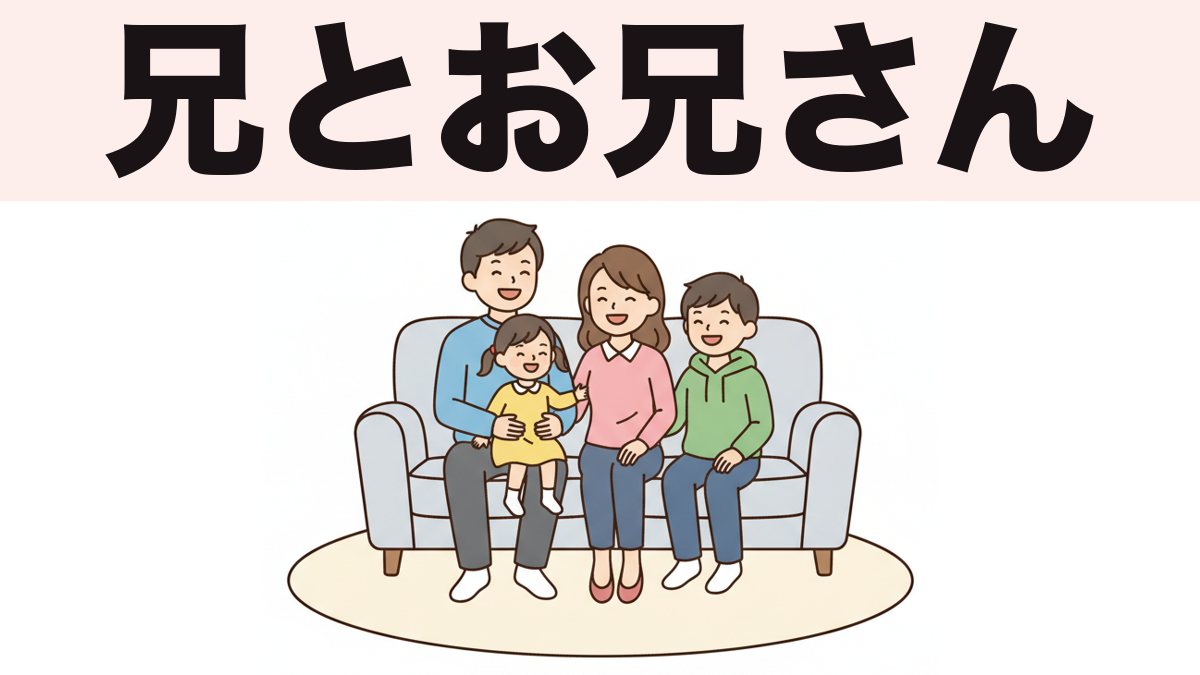
Japanese has two words for almost every family member. 兄 is your own older brother when you mention him to someone outside the family; お兄さん is someone else's older brother — and also what you call your own brother to his face. One rule explains all of it: you lower your own group and raise everybody else's.
日本語は、家族のことばが2つずつあります。「兄」は、外の人に話す時の自分の兄。「お兄さん」は、ほかの人の兄——そして、自分の兄を呼ぶ時の言い方です。ルールは1つだけ。自分の側を下げて、相手の側を上げる。
Textbooks usually present this as two vocabulary lists to memorise, which makes it twice the work and half as memorable. It is one rule with two outputs, and the rule shows up everywhere else in Japanese too.
The basics
The two sets
| Relation | Your own family (to outsiders) | Someone else's family |
|---|---|---|
| Father | 父 (ちち) | お父さん (おとうさん) |
| Mother | 母 (はは) | お母さん (おかあさん) |
| Older brother | 兄 (あに) | お兄さん (おにいさん) |
| Older sister | 姉 (あね) | お姉さん (おねえさん) |
| Younger brother | 弟 (おとうと) | 弟さん (おとうとさん) |
| Younger sister | 妹 (いもうと) | 妹さん (いもうとさん) |
| Grandfather | 祖父 (そふ) | おじいさん |
| Grandmother | 祖母 (そぼ) | おばあさん |
| Husband | 夫 (おっと) | ご主人 (ごしゅじん) |
| Wife | 妻 (つま) | 奥さん (おくさん) |
| Son | 息子 (むすこ) | 息子さん (むすこさん) |
| Daughter | 娘 (むすめ) | 娘さん (むすめさん) |
| Family | 家族 (かぞく) | ご家族 (ごかぞく) |
兄は東京で働いています。 — My older brother works in Tokyo. (polite; talking about your own brother to someone else) お兄さんは何をされていますか。 — What does your older brother do? (polite; asking about theirs)
The left column is plain, the right column has お or ご or さん attached. That is not decoration — it is the politeness pointing outward.
Why two sets? The 内/外 rule
Japanese sorts people into 内 (うち, inside — your family, your company, your group) and 外 (そと, outside — everyone else). When you speak to someone outside, you lower your own side and raise theirs.
This is the same mechanism behind humble and respectful verbs: 申します about yourself, おっしゃいます about them. Family words are simply the noun version of the pattern, and if you have met service keigo, you already know the logic.
It also explains something that confuses learners: a Japanese employee refers to their own company president without honorifics when speaking to a customer, because the president is 内. Rank inside the group stops mattering the moment an outsider is present.
What do you call your own brother to his face?
お兄ちゃん, お兄さん, or 兄さん — the respectful set. Within the family, the hierarchy is real and older siblings get the honorific form.
お兄ちゃん、ちょっと来て。 — Hey, come here a sec. (casual, to your own older brother)
But younger siblings have no honorific form of address. You call your younger brother by his name, not 弟. In fact 弟 and 妹 are almost never used as terms of address at all — they are only for describing the relationship to someone else.
That asymmetry is the shape of the whole system: age up gets a title, age down gets a name.
Beyond the basics
How do you talk about your family size?
何人家族ですか。 — How many people are in your family? (polite; a very common getting-to-know-you question) 四人家族です。 — There are four of us. (polite; counter + 家族)
If counters are still shaky, this is a good place to practise them, since family questions come up constantly in first conversations.
兄弟 and 姉妹
- 兄弟 (きょうだい) — siblings, used generally, even for sisters.
- 姉妹 (しまい) — sisters specifically.
- 一人っ子 (ひとりっこ) — an only child.
兄弟はいますか。 — Do you have any siblings? (polite) 姉が一人います。 — I have one older sister. (polite; note が, not は)
Japanese asks about birth order more than English does, so 上 (older) and 下 (younger) come up naturally: 上の姉, 下の弟.
ご主人 and 奥さん — worth a note
ご主人 literally means "the master" and 奥さん comes from 奥 ("the inner part of the house"). Both are standard and used constantly, and both carry history a lot of speakers are now aware of. Neutral alternatives exist and are increasingly common:
- パートナー — partner, gender-neutral.
- 旦那さん (だんなさん) — a slightly softer alternative to ご主人.
- 〜さんの奥さん → many people simply use the person's name.
As a learner, ご主人 and 奥さん will not offend anyone and are the safest to recognise. When speaking, matching whatever the other person uses is the easiest correct choice.
What about お父さん for your own father?
You use it to him, and increasingly about him in casual speech. The strict 父/お父さん split holds in formal situations — a job interview, a business call, a written self-introduction — and relaxes considerably among friends.
父は医者です。 — My father is a doctor. (polite, formal register — a job interview) うちのお父さんが言ってた。 — My dad was saying... (casual, with friends)
うちの ("my / our") in front of a family word is a very common casual softener, and it is the same うち as in 内/外.
Extended family, briefly
叔父/伯父 (おじ, uncle — different kanji for younger and older than your parent), 叔母/伯母 (おば, aunt), いとこ (cousin), 甥 (おい, nephew), 姪 (めい, niece), 親戚 (しんせき, relatives). The honorific versions are おじさん and おばさん, which double as the everyday words for "middle-aged man / woman" — and stretching the vowel changes them to おじいさん and おばあさん, "old man / old woman". Another length-sensitive pair worth saying out loud a few times.
Common mistakes
- Using お兄さん for your own brother when talking to an outsider. It raises your own family, which is backwards. Say 兄.
- Using 兄 to address your brother directly. Inside the family, older siblings take the honorific form.
- Calling your younger brother 弟 to his face. Use his name.
- Saying お父さんは医者です in a job interview. The formal register wants 父.
- Putting さん on your own family in a business context. Same rule as never putting さん on your own name.
- Assuming 兄弟 means only brothers. It is the general word for siblings.
Practice
Say each answer out loud first. Questions 1 and 2 are a pair: the same brother, two directions.
1. Tell a new colleague that your older brother works in Tokyo.
Show answer
兄は東京で働いています — your own family to an outsider, so the plain word 兄.
2. Ask that colleague what their older brother does.
Show answer
お兄さんは何をされていますか — their family, so the honorific word. Same person-type, opposite word.
3. What do you call your own older sister to her face?
Show answer
お姉ちゃん / お姉さん — inside the family, older siblings take the honorific form.
4. What do you call your own younger brother to his face?
Show answer
His name — 弟 is not a form of address. Age up gets a title; age down gets a name.
5. What does 内/外 mean here?
Show answer
Your group vs everyone else — you lower 内 (your family, your company) and raise 外 when speaking across the line.
6. Answer: 何人家族ですか。
Show answer
〜人家族です — for example 四人家族です. Counter plus 家族, no particle needed.
7. Say "I have one older sister."
Show answer
姉が一人います — が marks what exists. 姉は一人います shifts the emphasis to contrast.
8. Does 兄弟 mean only brothers?
Show answer
No — it is the general word for siblings — 姉妹 is specifically sisters.
9. Fix this, said in a job interview: お父さんは医者です。
Show answer
父は医者です — formal register, your own family, so the plain word.
10. What is the difference between おじさん and おじいさん?
Show answer
Uncle / middle-aged man vs grandfather / old man — one long vowel apart, and worth practising out loud.
FAQ
Why does the honorific set get used for my own family at home? Because inside the family, the hierarchy between siblings and generations is what is being marked, and there is no outsider present to be raised. The plain set only becomes necessary when you cross the 内/外 line.
Is it rude to call someone おばさん? It can be, if they are not old enough to want it. おばさん means both "aunt" and "middle-aged woman", and used on a stranger it can land badly. Use すみません to get attention instead.
How do I refer to a friend's parents? お父さん and お母さん, or 〜さんのお父さん. Never 父 or 母 — those belong exclusively to your own family.
What do I call my partner in Japanese? 彼 / 彼女 for boyfriend and girlfriend, 夫 / 妻 for your own husband and wife when talking to outsiders, and ご主人 / 奥さん or パートナー for someone else's. Many people now just use the person's name.
Is 家族 only blood relatives? Generally, yes — but Japanese draws the 内 line socially as well, which is why 内 covers your company too. 家族 itself stays fairly literal.
Do I need both sets from the beginning? Learn to recognise both from the start, and produce the plain set first, since you will talk about your own family more than anyone else's in early conversations.
Vocabulary from this article
Tap the block to select all of it, then copy. In Anki: File → Import, note type Basic, separator Tab — the first column becomes the front, the second the back.
家族	かぞく — family
父	ちち — my father
母	はは — my mother
兄	あに — my older brother
姉	あね — my older sister
弟	おとうと — younger brother
妹	いもうと — younger sister
祖父	そふ — my grandfather
祖母	そぼ — my grandmother
夫	おっと — my husband
妻	つま — my wife
息子	むすこ — son
娘	むすめ — daughter
兄弟	きょうだい — siblings
姉妹	しまい — sisters
一人っ子	ひとりっこ — only child
親戚	しんせき — relatives
いとこ	いとこ — cousin
I'm Yuuki, a Japanese teacher based in Tokyo. I've taught on italki as a Top 1% teacher and watched over 1,500 anime. Family words are where students first meet the inside/outside rule, and once it clicks here it explains half of keigo for free — which is why I teach them as one rule rather than two lists.
Sources: the author's own lessons and standard reference grammars.
教科書は「2つのリストをおぼえてください」と言います。それだと2倍の量になります。でも、ルールは1つです。そして、そのルールは日本語のほかの所にも出てきます。
基本
2つのことば
| 関係 | 自分の家族(外の人に) | ほかの人の家族 |
|---|---|---|
| 父 | 父(ちち) | お父さん |
| 母 | 母(はは) | お母さん |
| 兄 | 兄(あに) | お兄さん |
| 姉 | 姉(あね) | お姉さん |
| 弟 | 弟(おとうと) | 弟さん |
| 妹 | 妹(いもうと) | 妹さん |
| 祖父 | 祖父(そふ) | おじいさん |
| 祖母 | 祖母(そぼ) | おばあさん |
| 夫 | 夫(おっと) | ご主人 |
| 妻 | 妻(つま) | 奥さん |
| 息子 | 息子(むすこ) | 息子さん |
| 娘 | 娘(むすめ) | 娘さん |
| 家族 | 家族 | ご家族 |
兄は東京で働いています。 — My older brother works in Tokyo. (your own brother, to someone else) お兄さんは何をされていますか。 — What does your older brother do? (asking about theirs)
左は そのまま、右は「お」「ご」「さん」がつきます。ていねいさが外に向いているのです。
「内」と「外」
日本語は人を、内(うちうち自分の家族・自分の会社)と外(そとそとほかの人)に分けます。外の人に話す時は、自分の側を下げます。
これは「申します/おっしゃいます」と同じしくみです。家族のことばは、その名詞版です(お店の敬語)。
だから、会社の人がお客さんに話す時、自分の社長にも「さん」をつけません。外の人がいるとき、内の中の上下は消えます。
自分の兄を呼ぶ時は?
「お兄ちゃん」「お兄さん」「兄さん」——ていねいなほうです。家の中では、年上のきょうだいは上だからです。
お兄ちゃん、ちょっと来て。 — Hey, come here a sec. (to your own older brother)
でも、年下のきょうだいを呼ぶ言い方はありません。「弟」「妹」は呼びかけに使いません。名前で呼びます。
年上には名前(タイトル)、年下には名前そのもの。これが全体の形です。
もう少し先へ
家族の人数
何人家族ですか。 — How many people are in your family? (a very common question) 四人家族です。 — There are four of us. (counter + 家族)
助数詞の練習にもちょうどいいです。
「兄弟」と「姉妹」
- 兄弟(きょうだい) — きょうだい全体(女の人が入ってもOK)
- 姉妹(しまい) — 姉妹だけ
- 一人っ子(ひとりっこ) — きょうだいがいない人
兄弟はいますか。 — Do you have any siblings? (polite) 姉が一人います。 — I have one older sister. (polite; が, not は)
「上の姉」「下の弟」のように、上下もよく言います。
「ご主人」「奥さん」について
「ご主人」はもともと「主人(あるじ)」、「奥さん」は「奥(家の おく)」から来ています。今もふつうに使いますが、気にする人もいます。最近は、
- パートナー
- 旦那さん
- 名前で呼ぶ
学習者としては「ご主人」「奥さん」で失礼になることはありません。相手が使っている言い方に合わせるのがいちばん簡単です。
自分の父を「お父さん」と言う?
本人には言います。友だちとの会話でも言います。「父」を使うのは、面接や仕事など、かたい場面です。
父は医者です。 — My father is a doctor. (formal — a job interview) うちのお父さんが言ってた。 — My dad was saying... (casual, with friends)
「うちの」は、この「内」と同じことばです。
親せき
叔父・伯父(おじ)、叔母・伯母(おば)、いとこ、甥(おい)、姪(めい)、親戚(しんせき)。ていねいな形は「おじさん」「おばさん」で、これは「中年の男の人・女の人」の意味にもなります。のばすと「おじいさん」「おばあさん」」おじいさん・おばあさんです。ここも長さが大事です。
よくあるまちがい
- 外の人に自分の兄を「お兄さん」と言う。 自分の側を上げてしまいます。「兄」です。
- 自分の兄に「兄」と呼びかける。 家の中ではていねいな形です。
- 弟を「弟」と呼ぶ。 名前で呼びます。
- 面接で「お父さんは医者です」と言う。 「父」です。
- 仕事で自分の家族に「さん」をつける。 自分の名前と同じルールです。
- 「兄弟」を男だけだと思う。 きょうだい全体です。
練習
まず声に出してから、答えを見てください。1番と2番はペアです。
1. 新しい同僚に「兄は東京で働いています」と言ってください。
答えを見る
兄は東京で働いています — 外の人に、自分の家族の話なので「兄」です。
2. その同僚のお兄さんの仕事を聞いてください。
答えを見る
お兄さんは何をされていますか — 相手の家族なので、ていねいな形です。
3. 自分の姉を呼ぶ時は?
答えを見る
お姉ちゃん/お姉さん — 家の中では年上はていねいな形です。
4. 自分の弟を呼ぶ時は?
答えを見る
名前 — 「弟」は呼びかけに使いません。
5. 「内」と「外」とは?
答えを見る
自分のグループと、それ以外 — 外の人に話す時、内を下げます。
6. 「何人家族ですか」に答えてください。
答えを見る
〜人家族です — 例: 四人家族です。
7. 「姉が一人います」と言ってください。
答えを見る
姉が一人います — 「いる」ものは「が」で示します。
8. 「兄弟」は男の人だけですか。
答えを見る
いいえ、きょうだい全体です — 姉妹だけなら「姉妹」です。
9. 面接で: お父さんは医者です。直してください。
答えを見る
父は医者です — かたい場面では「父」です。
10. 「おじさん」と「おじいさん」のちがいは?
答えを見る
おじ・中年の男の人/祖父・お年よりの男の人 — のばす音1つのちがいです。
よくある質問
なぜ家の中ではていねいな形を使うのですか。 家の中では、きょうだいや世代の上下を表しているからです。外の人がいないので、下げる必要がありません。
「おばさん」と呼ぶのは失礼ですか。 年れいによっては失礼になります。知らない人には「すみません」で声をかけてください。
友だちの両親は何と言いますか。 「お父さん」「お母さん」、または「〜さんのお父さん」。「父」「母」は自分の家族だけです。
パートナーは何と言いますか。 自分の配ぐうしゃは「夫」「妻」、相手の配ぐうしゃは「ご主人」「奥さん」または「パートナー」。名前で言う人も多いです。
「家族」は血のつながりだけですか。 だいたいそうです。でも「内」は会社などにも広がります。
2つとも最初からおぼえますか。 両方「聞いて分かる」ようにして、自分で言うのは「自分の家族」のほうからでいいです。
この記事に出た単語
下のブロックをタップして全部えらび、コピーしてください。Anki では ファイル → 読み込み、ノートの種類は 基本、区切りは タブ です。
家族	かぞく — family
父	ちち — my father
母	はは — my mother
兄	あに — my older brother
姉	あね — my older sister
弟	おとうと — younger brother
妹	いもうと — younger sister
祖父	そふ — my grandfather
祖母	そぼ — my grandmother
夫	おっと — my husband
妻	つま — my wife
息子	むすこ — son
娘	むすめ — daughter
兄弟	きょうだい — siblings
姉妹	しまい — sisters
一人っ子	ひとりっこ — only child
親戚	しんせき — relatives
いとこ	いとこ — cousin
私はユウキです。東京で日本語を教えています。 italki の Top 1% の先生で、アニメは1,500本以上見ました。家族のことばは、生徒が「内と外」に初めて出会う場所です。ここで分かると、敬語の半分がただでついてきます。だから、2つのリストではなく、1つのルールとして教えています。
More drills like the ones above, plus a timed JLPT-style mock test: Practice · N4上のような練習問題と、時間つきのJLPT形式のもぎ試験: 練習ページ · N4
Want to try this in a real conversation?
本当の会話で、ためしてみませんか?
30-minute trial lesson, $13. Times shown in your own timezone.
30分の体験レッスン、$13。時間はあなたのタイムゾーンで表示されます。
Book a trial lesson · $13