How to say sorry in Japanese: すみません, ごめん, 申し訳ありません and when each one fitsあやまり方: すみません・ごめん・申し訳ありません の使い分け
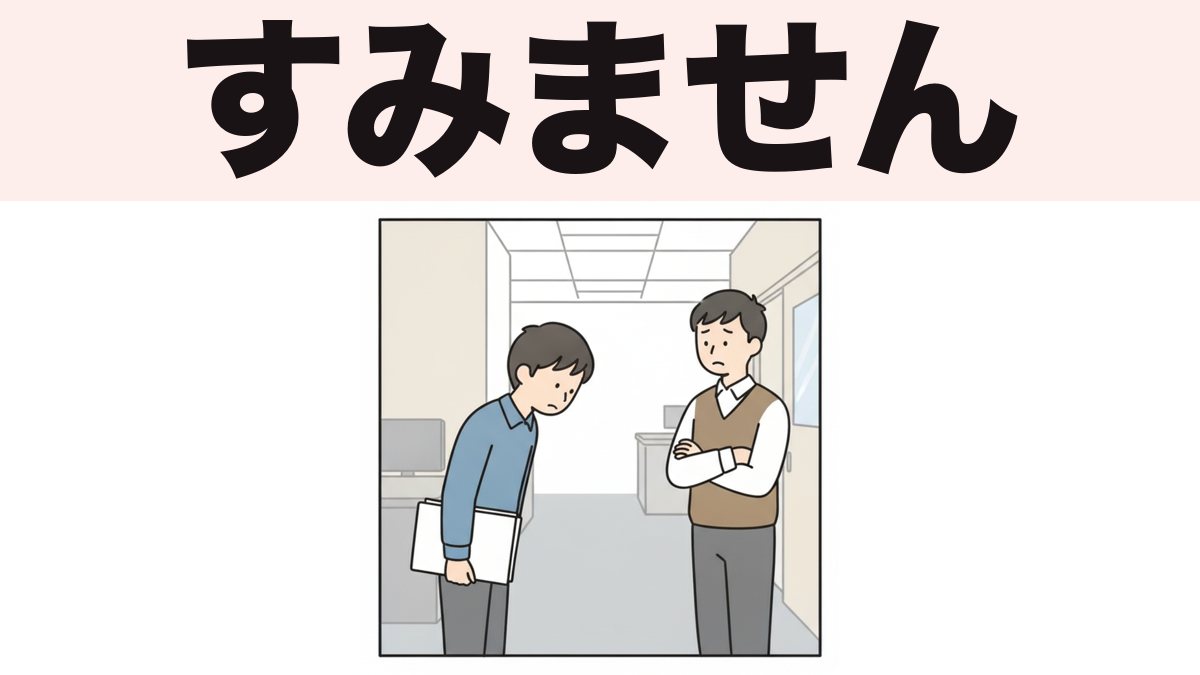
すみません is the apology you will use most, but it is one rung on a ladder: ごめん below it for friends, 申し訳ありません above it for real trouble, and 失礼します beside it for interrupting. Picking the wrong rung is much more noticeable than making a grammar mistake.
「すみません」はいちばんよく使いますが、はしごの まん中です。下に友だち用の「ごめん」、上に本当に困らせた時の「申し訳ありません」、そして横に「失礼します」があります。どこを使うかをまちがえると、文法のまちがいより目立ちます。
Apologising in Japanese is also doing a different job than in English. すみません is not primarily an admission of fault — it acknowledges that you have caused someone effort, which is why it works for bumping into a stranger, for getting a waiter's attention, and for being handed something.
The basics
The ladder
| Phrase | Reading | Use it for |
|---|---|---|
| ごめん | ごめん | Friends, family. Casual, small things. |
| ごめんなさい | ごめんなさい | Casual but sincere; a child to a parent, a real apology to a friend. |
| すみません | すみません | The everyday default. Strangers, staff, minor trouble. |
| 失礼します | しつれいします | Interrupting, entering, leaving. Not fault — just intrusion. |
| 申し訳ありません | もうしわけありません | Work, real inconvenience. Formal. |
| 申し訳ございません | もうしわけございません | The most formal. Service staff, serious apologies. |
すみません、遅れました。 — Sorry, I'm late. (polite, everyday) ごめん、忘れてた。 — Sorry, I forgot. (casual, to a friend) 申し訳ありません、私のミスです。 — I'm very sorry, it's my mistake. (formal, work)
If you learn only one, learn すみません. It is correct with anyone you are not close to, and the worst it can be is slightly too casual in a genuinely serious situation.
Why does すみません also mean "thank you"?
Because it acknowledges that the other person went to trouble for you — and in Japanese that acknowledgement can be gratitude or apology depending on context. When someone holds a door, picks up something you dropped, or brings you a menu, すみません means something close to "sorry to trouble you, and thanks".
すみません、ありがとうございます。 — Thank you (sorry for the trouble). (polite; both at once is extremely common)
Using すみません where English would use "thank you" is not a mistake — it is one of the most natural-sounding things a learner can do.
And it means "excuse me"
The third job: getting attention. すみません is how you call a waiter, stop a passer-by, or start a question.
すみません、お水をお願いします。 — Excuse me, could I have some water? (polite, restaurant)
Three functions, one word. This is why it is the single most useful word in the language, ahead of こんにちは.
Beyond the basics
What is 失礼します actually for?
Not fault — intrusion. It marks that you are crossing into someone's space or time: entering a room, leaving before others, taking a phone call, ending a conversation.
失礼します。 — Excuse me. (said on entering a room, and again on leaving) お先に失礼します。 — Excuse me for leaving first. (polite — the standard phrase for leaving work before your colleagues) 失礼しました。 — Sorry about that. (past tense — after the intrusion has happened)
お先に失礼します is worth memorising exactly as it is. In a Japanese workplace, leaving without saying it is more noticeable than leaving early.
申し訳ありません vs すみません
The difference is weight, not politeness level alone. すみません handles friction; 申し訳ありません handles harm. Using 申し訳ございません because you bumped someone on a train sounds theatrical; using すみません because you lost a client's document sounds careless.
ご迷惑をおかけして、申し訳ございません。 — I'm very sorry for the trouble I've caused. (formal; the set phrase for a real apology)
ご迷惑をおかけして ("having caused you trouble") is the standard opener for a serious apology, and it names the actual issue: 迷惑 (めいわく) — inconvenience caused to others — which is the concept the whole system is organised around. 申し訳ございません is also the form you will hear all day from shop and station staff, alongside the rest of service keigo.
How does apologising work differently from English?
Three differences that matter more than vocabulary:
- It is not an admission of liability. In English, "I'm sorry" can feel like accepting blame. In Japanese, apologising first is normal even when responsibility is shared or unclear — it is how you signal that the relationship matters more than the fault.
- It comes before the explanation, not after. English tends to explain and then apologise. Japanese apologises and then explains, if at all.
- It is often repeated. One apology can sound thin. In a real apology, the phrase appears at the start, in the middle, and at the end.
What about 大丈夫です as a response?
When someone apologises to you, the standard replies are short:
大丈夫です。 — It's fine. (polite) いえいえ。 — Not at all. (polite, warm — often with a small hand wave) 気にしないでください。 — Please don't worry about it. (polite)
大丈夫です is the safest. Note it also means "no thank you" when someone offers you something, which is worth knowing before a convenience store asks if you want a bag.
The casual end: 悪い and ごめんね
Among friends, apologies get very short:
悪い、待った? — Sorry, did you wait? (casual, mostly male) ごめんね。 — Sorry. (casual, softened with ね)
悪い (わるい) literally means "bad" and functions as a casual "my bad". It is close-range language, not something to use upward — the same register logic as plain vs polite forms.
Bowing
The apology and the bow are one gesture. You do not need to calibrate the angle — you need to actually do it, and to keep your hands at your sides rather than pressed together. A small nod goes with すみません; a deeper, slower bow goes with 申し訳ございません. A bow that ends before the sentence does reads as insincere, so let the sentence finish first.
Common mistakes
- Using ごめん with a stranger or someone senior. It is friends-and-family language. すみません is the public version.
- Reaching for 申し訳ございません for small things. It is for real inconvenience; overusing it sounds performative.
- Translating すみません as only "sorry". It is also "thank you" and "excuse me", and the thank-you use is very common.
- Explaining before apologising. In Japanese the apology comes first; the explanation is optional and second.
- Apologising once and moving on. For anything serious, repetition is part of the form.
- Saying 失礼します when you mean you did something wrong. 失礼 is about intrusion, not fault.
Practice
Say each answer out loud first. Questions 3 and 4 are a pair: same word, two different jobs.
1. You are late to meet a colleague. What do you say?
Show answer
すみません、遅れました — the everyday default. 申し訳ありません if it caused real disruption.
2. You forgot to reply to a friend's message. What do you say?
Show answer
ごめん、忘れてた — casual register with a friend. すみません would sound oddly distant.
3. Someone picks up something you dropped. What do you say?
Show answer
すみません — here it means "thank you, sorry for the trouble". Adding ありがとうございます is even better.
4. You want to order water in a restaurant. What do you say?
Show answer
すみません、お水をお願いします — the same word, now doing "excuse me". Three jobs, one word.
5. You are leaving the office before your colleagues. What do you say?
Show answer
お先に失礼します — a fixed phrase. Not apologising for a fault; marking that you are leaving first.
6. You made a real mistake at work that affected a client. What do you say?
Show answer
ご迷惑をおかけして、申し訳ございません — the formal apology, naming the trouble caused. すみません is too light here.
7. Someone apologises to you for something minor. What do you reply?
Show answer
大丈夫です — or いえいえ / 気にしないでください. Short replies are the norm.
8. What does 迷惑 mean, and why does it matter here?
Show answer
Inconvenience caused to others — it is the concept Japanese apologies are organised around, which is why apologies cover trouble caused rather than only fault.
9. Your friend says 悪い、待った? What register is that?
Show answer
Casual, close-range — 悪い literally means "bad" and works like "my bad". Not for use upward.
10. In what order do you apologise and explain?
Show answer
Apologise first, explain second (if at all) — the English habit of explaining first reads as excusing yourself.
FAQ
Is すみません enough for almost everything? Yes, for a visitor. It covers apology, gratitude and getting attention, and it is correct with anyone you are not close friends with. Add 申し訳ありません only when something has actually gone wrong.
What is the difference between ごめん and ごめんなさい? ごめん is shorter and lighter; ごめんなさい is the full form and sounds more sincere. Both are casual — neither belongs in a work email.
Do Japanese people really apologise that much? They use apology forms often, but many of those uses are not apologies in the English sense — they are acknowledgements of trouble caused or thanks. Counting them as apologies overstates it considerably.
Is it bad to apologise if it wasn't my fault? No. Apologising early is normal and does not assign blame the way it can in English. It signals that you care about the relationship and the other person's inconvenience.
How low should I bow? For everyday すみません, a nod. For a formal apology, a slow bow from the waist held for a beat. Far more important: finish the sentence before you straighten up.
What do I say when someone thanks me? どういたしまして exists but is less common than textbooks suggest. いえいえ, とんでもないです, or a simple はい with a nod are all more natural in everyday situations.
Vocabulary from this article
Tap the block to select all of it, then copy. In Anki: File → Import, note type Basic, separator Tab — the first column becomes the front, the second the back.
すみません	すみません — sorry; thank you; excuse me
ごめん	ごめん — sorry (casual)
ごめんなさい	ごめんなさい — sorry (casual, sincere)
申し訳ありません	もうしわけありません — I'm very sorry (formal)
失礼します	しつれいします — excuse me (entering, leaving)
迷惑	めいわく — trouble caused to others
謝る	あやまる — to apologise
遅れる	おくれる — to be late
大丈夫	だいじょうぶ — fine, okay
気にする	きにする — to worry about, mind
悪い	わるい — bad; "my bad" (casual)
忘れる	わすれる — to forget
間違い	まちがい — mistake
お先に	おさきに — ahead of you, before you
恐れ入ります	おそれいります — I'm much obliged (formal)
とんでもない	とんでもない — not at all
水	みず — water
仕事	しごと — work
I'm Yuuki, a Japanese teacher based in Tokyo. I've taught on italki as a Top 1% teacher and watched over 1,500 anime. すみません is the first word I give students and the last one they stop finding new uses for — most people are still discovering situations it covers a year in.
Sources: the author's own lessons and standard reference grammars.
日本語のあやまりは、英語の "sorry" とは仕事がちがいます。「すみません」は「私が悪い」というより、「あなたに手間をかけました」という意味です。だから、ぶつかった時にも、店の人を呼ぶ時にも、何かをもらった時にも使えます。
基本
はしご
| 言い方 | 読み方 | 使う場面 |
|---|---|---|
| ごめん | ごめん | 友だち・家ぞく。小さいこと |
| ごめんなさい | ごめんなさい | カジュアルだけど本気 |
| すみません | すみません | ふつう。知らない人・お店・小さいこと |
| 失礼します | しつれいします | 入る・出る・じゃまをする時(悪いことではない) |
| 申し訳ありません | もうしわけありません | 仕事・本当に困らせた時 |
| 申し訳ございません | もうしわけございません | いちばんていねい |
すみません、遅れました。 — Sorry, I'm late. (polite, everyday) ごめん、忘れてた。 — Sorry, I forgot. (casual, to a friend) 申し訳ありません、私のミスです。 — I'm very sorry, it's my mistake. (formal, work)
1つだけおぼえるなら「すみません」です。
なぜ「ありがとう」の意味にもなるの?
「あなたが手間をかけてくれた」という気持ちだからです。ドアを開けてもらった時、落とした物をひろってもらった時は、「すみません」で「ごめんね+ありがとう」になります。
すみません、ありがとうございます。 — Thank you (sorry for the trouble). (polite; both at once)
「すみません」=Excuse me
3つ目の仕事は「よぶ」ことです。
すみません、お水をお願いします。 — Excuse me, could I have some water? (polite, restaurant)
1つの言葉で3つの仕事。だから、日本語でいちばん役に立つ言葉です。
もう少し先へ
「失礼します」
悪いことをしたのではなく、じゃまをするという印です。
失礼します。 — Excuse me. (entering and leaving a room) お先に失礼します。 — Excuse me for leaving first. (leaving work before colleagues) 失礼しました。 — Sorry about that. (after the fact)
「お先に失礼します」は、そのままおぼえてください。日本の会社では、言わないで帰るほうが目立ちます。
「申し訳ありません」と「すみません」
ていねいさより、重さのちがいです。「すみません」は小さいこと、「申し訳ありません」は本当の めいわくです。
ご迷惑をおかけして、申し訳ございません。 — I'm very sorry for the trouble I've caused. (formal)
「迷惑(めいわく)」が、この形の中心にある考えです。お店の敬語でも、毎日聞きます。
英語とのちがい
- 「私が悪い」と認めることではありません。 先にあやまるのがふつうです。
- 説明より先にあやまります。 英語は説明が先になりがちです。
- くり返します。 大事なあやまりでは、最初・とちゅう・最後に出てきます。
言われた時の返事
大丈夫です。 — It's fine. (polite) いえいえ。 — Not at all. (polite, warm) 気にしないでください。 — Please don't worry about it. (polite)
「大丈夫です」は「いりません」の意味にもなります。
カジュアルな形
悪い、待った? — Sorry, did you wait? (casual) ごめんね。 — Sorry. (casual)
「悪い」は「my bad」に近い言い方です。目上の人には使いません(ていねい体とふつう体)。
おじぎ
あやまりとおじぎは1つの動きです。角度より、することが大事です。「すみません」は軽く、「申し訳ございません」は深く、ゆっくり。文が終わる前に頭を上げないでください。
よくあるまちがい
- 知らない人に「ごめん」と言う。 「すみません」です。
- 小さいことに「申し訳ございません」を使う。 大げさに聞こえます。
- 「すみません」を "sorry" だけだと思う。 「ありがとう」「すみません(呼びかけ)」にもなります。
- 説明を先にする。 あやまりが先です。
- 1回だけあやまって終わる。 大事な時はくり返します。
- 「失礼します」を「私が悪い」の意味で使う。 じゃまをする、という意味です。
練習
まず声に出してから、答えを見てください。3番と4番はペアです。
1. 同僚との待ち合わせにおくれました。
答えを見る
すみません、遅れました — 大きな迷惑なら「申し訳ありません」。
2. 友だちのメッセージに返事を忘れました。
答えを見る
ごめん、忘れてた — 友だちには「すみません」は遠く聞こえます。
3. 落とした物をひろってもらいました。
答えを見る
すみません — ここでは「ありがとう」の意味です。「ありがとうございます」も足すともっといいです。
4. レストランで水をたのみます。
答えを見る
すみません、お水をお願いします — 同じ言葉が「excuse me」になります。
5. 同僚より先に帰ります。
答えを見る
お先に失礼します — 決まった言い方です。
6. 仕事でお客さんに迷惑をかけました。
答えを見る
ご迷惑をおかけして、申し訳ございません — 「すみません」では軽すぎます。
7. 小さいことであやまられました。何と答えますか。
答えを見る
大丈夫です — 「いえいえ」「気にしないでください」もOKです。
8. 「迷惑」とはどんな意味ですか。
答えを見る
人にかける手間・こまらせること — 日本語のあやまりの中心にある考えです。
9. 友だちの「悪い、待った?」はどんな感じですか。
答えを見る
とてもカジュアル — 「悪い」は「my bad」に近いです。目上の人には使いません。
10. あやまりと説明、どちらが先ですか。
答えを見る
あやまりが先 — 説明が先だと、言いわけに聞こえます。
よくある質問
「すみません」だけで足りますか。 旅行なら足ります。あやまり・お礼・呼びかけの3つに使えます。
「ごめん」と「ごめんなさい」のちがいは? 「ごめんなさい」のほうが full な形で、まじめに聞こえます。どちらもカジュアルです。
日本人は本当によくあやまるのですか。 あやまりの形はよく使いますが、その多くは「ありがとう」や「手間をかけました」の意味です。
自分のせいじゃない時にあやまってもいいですか。 いいです。英語のように「私の責任です」とは受け取られません。
おじぎはどのくらい深くしますか。 ふつうは軽く。正式なあやまりは、ゆっくり深く。文が終わってから頭を上げます。
お礼を言われたら何と答えますか。 「どういたしまして」もありますが、「いえいえ」「とんでもないです」のほうがよく使います。
この記事に出た単語
下のブロックをタップして全部えらび、コピーしてください。Anki では ファイル → 読み込み、ノートの種類は 基本、区切りは タブ です。
すみません	すみません — sorry; thank you; excuse me
ごめん	ごめん — sorry (casual)
ごめんなさい	ごめんなさい — sorry (casual, sincere)
申し訳ありません	もうしわけありません — I'm very sorry (formal)
失礼します	しつれいします — excuse me (entering, leaving)
迷惑	めいわく — trouble caused to others
謝る	あやまる — to apologise
遅れる	おくれる — to be late
大丈夫	だいじょうぶ — fine, okay
気にする	きにする — to worry about, mind
悪い	わるい — bad; "my bad" (casual)
忘れる	わすれる — to forget
間違い	まちがい — mistake
お先に	おさきに — ahead of you, before you
恐れ入ります	おそれいります — I'm much obliged (formal)
とんでもない	とんでもない — not at all
水	みず — water
仕事	しごと — work
私はユウキです。東京で日本語を教えています。 italki の Top 1% の先生で、アニメは1,500本以上見ました。「すみません」は、最初に教える言葉で、最後まで新しい使い方が見つかる言葉です。1年たっても、まだ新しい場面が出てきます。
More drills like the ones above, plus a timed JLPT-style mock test: Practice · N5上のような練習問題と、時間つきのJLPT形式のもぎ試験: 練習ページ · N5
Want to try this in a real conversation?
本当の会話で、ためしてみませんか?
30-minute trial lesson, $13. Times shown in your own timezone.
30分の体験レッスン、$13。時間はあなたのタイムゾーンで表示されます。
Book a trial lesson · $13