How to say "or" in Japanese: か, それとも, または and the one that is not "or" at all日本語の「or」: か・それとも・または、そして「それと」のわな
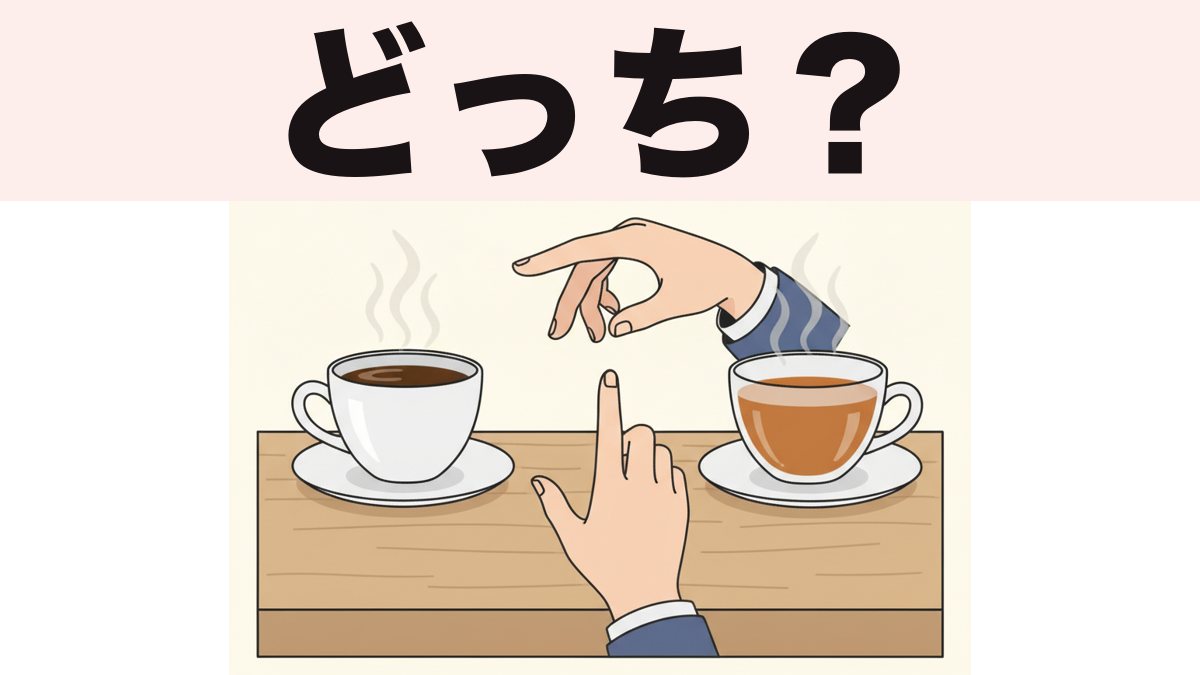
There is no single Japanese word for "or." Use か between nouns (コーヒーか紅茶), それとも between two whole questions (行きますか、それとも行きませんか), and または in writing. The word that catches learners out is それと — it looks like それとも but means "and."
日本語には「or」にあたる言葉が1つだけ、というわけではありません。名詞と名詞の間は「か」(コーヒーか紅茶)。質問と質問の間は「それとも」。書く時は「または」。気をつけるのは「それと」です。形は似ていますが、意味は「and」です。
English gets away with one word doing every job. Japanese splits that job across at least four words, and picking the wrong one usually does not produce a sentence that is merely awkward — it produces a sentence that means something else.
The basics
か: the everyday "or" between nouns
か goes between the two options, directly, with no particles in between. This is the version you will use most.
コーヒーか紅茶をください。 — Coffee or tea, please. (polite, at a café) 土曜日か日曜日に行きましょう。 — Let's go on Saturday or Sunday. (polite, making plans)
Note where the particle goes: it lands after the whole か group, not after each item. コーヒーか紅茶をください, not コーヒーをか紅茶をください. The か bundle behaves like a single noun.
You can also put か after both items — コーヒーか紅茶か — which makes the list feel slightly more open-ended, as though there might be a third option you have not named.
それとも: "or" between two complete questions
When you are offering someone a choice between two full alternatives and you want them to pick one, それとも goes between the two questions.
行きますか、それとも行きませんか。 — Are you going, or not? (polite, forcing a decision) 飲みますか、それともやめておきますか。 — Will you drink, or will you pass? (polite, offering a real choice)
The giveaway is that それとも needs a question on both sides. If you are not asking, it does not belong. This is why 犬それとも猫が好きです is wrong — there is no question there, so it should be 犬か猫が好きです.
または: the written one
または is the "or" of forms, signs, manuals and contracts. It is not wrong in speech, but it sounds like you are reading aloud from a document.
ペンまたは鉛筆で書いてください。 — Please write with a pen or a pencil. (formal, written instructions)
If you are filling out a Japanese form or reading a sign, this is the word you will see. If you are talking to a friend, use か.
Beyond the basics
それと is not それとも
This is the pair that causes real damage, because they differ by one syllable and mean opposite things.
- それとも — or (offering an alternative)
- それと — and (adding one more item)
コーヒー、それとコーヒーゼリーもください。 — Coffee, and also coffee jelly, please. (polite, adding to an order) コーヒーですか、それとも紅茶ですか。 — Coffee, or tea? (polite, asking which one)
Say the wrong one at a counter and you will either get two drinks you did not want or be asked to choose between things you wanted both of. When in doubt, ask yourself whether you are adding or choosing. Adding is それと; choosing is それとも.
あるいは and もしくは: the formal shelves
Both mean "or," both are more formal than か, and both are more common in writing than in speech.
- あるいは — slightly literary, common in essays and analysis
- もしくは — legal and administrative register, often paired with または in documents to mark nested choices
電話、あるいはメールでご連絡ください。 — Please contact us by phone or email. (formal, business)
As a learner you need to recognize these, not produce them. か and それとも will carry you through every conversation you actually have.
〜とか: "or something like that"
〜とか attaches to each item and makes the whole list feel like examples rather than a closed set. English handles this with "or something."
お茶とかコーヒーとか、何か飲む? — Tea, coffee, something like that — want a drink? (casual, friends) 土曜とか、どう? — Saturday or something, how about it? (casual, floating an idea)
This is close cousin to 〜たり〜たり, which does the same "and other things like that" job for verbs. とか is enormously common in casual speech and softens a suggestion by implying you are not fixed on the specific thing you named.
〜か〜か: when both options are verbs or clauses
For a choice between two actions, put か after each plain-form clause.
行くか行かないか、まだ決めていません。 — I haven't decided yet whether I'll go or not. (polite, reporting indecision)
This shape is also how Japanese expresses embedded "whether": 〜かどうか. 行くかどうか分かりません means "I don't know whether I'm going." The どうか is a stand-in for the unstated negative half.
The "or" that appears in negative questions
When someone asks 行きませんか, they are not asking "or not." That is an invitation — "won't you come?" — and the polite answer is usually not a flat yes or no. Mixing this up with the それとも construction is common, because both involve a negative verb in a question.
一緒に行きませんか。 — Won't you come along? (polite invitation) 行きますか、行きませんか。 — Are you coming or not? (polite, but blunt — this really is a choice)
The first is warm; the second is the kind of thing a doctor's receptionist says when a queue is forming behind you. See ましょう and ませんか for the full invitation ladder.
Common mistakes
- Using そして or それから for "or." Both mean "and then." そして紅茶 does not offer tea as an alternative; it adds tea to what came before.
- Repeating the particle inside a か group. コーヒーをか紅茶を is wrong. The particle goes once, at the end: コーヒーか紅茶を.
- Using それとも with statements. それとも requires a question on both sides. In a statement, use か.
- Saying それと when you mean それとも. The one-syllable difference flips "and" into "or." This is the single most consequential error on this page.
- Using または in casual speech. It is grammatical, but it sounds like a printed form is talking.
- Assuming か always means "or." Sentence-final か is the question marker — 行きますか is "are you going?", not "going or…". Position decides the job.
Which "or" do I use?
| Situation | Word | Example |
|---|---|---|
| Between two nouns, speaking | か | コーヒーか紅茶 |
| Between two full questions | それとも | 行きますか、それとも行きませんか |
| In writing, forms, signs | または | ペンまたは鉛筆 |
| Formal speech or essays | あるいは / もしくは | 電話あるいはメール |
| Casual, "or something like that" | 〜とか | お茶とかコーヒーとか |
| Between two verb clauses | 〜か〜か | 行くか行かないか |
| Adding, not choosing | それと | コーヒー、それとケーキ |
Practice
Questions 4 and 5 are the pair to get right — one syllable separates them, and the meaning flips.
1. Order coffee or tea, politely.
Show answer
コーヒーか紅茶をください。 — か goes between the nouns, and を goes once, after the whole group.
2. Say "let's go on Saturday or Sunday."
Show answer
土曜日か日曜日に行きましょう。 — Again, に attaches after the か group, not to each day.
3. Ask politely: "are you going, or not?"
Show answer
行きますか、それとも行きませんか。 — それとも needs a complete question on both sides.
4. At a café: "coffee, and also cake, please."
Show answer
コーヒー、それとケーキもください。 — それと adds. If you said それとも here you would be asking the staff to choose for you.
5. At a café: "coffee, or tea?"
Show answer
コーヒーですか、それとも紅茶ですか。 — それとも offers a choice. Same café, one syllable of difference.
6. Write a form instruction: "please write in pen or pencil."
Show answer
ペンまたは鉛筆で書いてください。 — または is the written register. In speech you would say ペンか鉛筆.
7. Say casually: "tea, coffee, something like that — want a drink?"
Show answer
お茶とかコーヒーとか、何か飲む? — とか attaches to each item and keeps the list open.
8. Say: "I haven't decided whether I'm going or not."
Show answer
行くか行かないか、まだ決めていません。 — か after each plain-form clause. 行くかどうか also works.
9. Fix this sentence: 犬それとも猫が好きです。
Show answer
犬か猫が好きです。 — There is no question here, so それとも cannot be used. Between nouns in a statement, use か.
10. Fix this sentence: コーヒーをか紅茶をください。
Show answer
コーヒーか紅茶をください。 — The か group takes one particle, at the end. It behaves like a single noun.
FAQ
Is それとも ever used without a question? Rarely, and it sounds incomplete. If you find it in a statement, the question is usually implied by context — someone trailing off with 〜それとも… is inviting you to supply the other half.
Can I use か between three or more nouns? Yes: コーヒーか紅茶かジュース. With three or more, putting か after every item including the last (…かジュースか) reads as a slightly more casual, open list.
What is the difference between 〜かどうか and 〜か〜ないか? They mean the same thing. 〜かどうか is shorter and more common; 〜か〜ないか spells out both halves and therefore feels a little more deliberate, often used when the choice itself is the point.
Does 〜とか always mean "or"? Not exactly. It means "things like X," which covers both "and" and "or" depending on context. お茶とかコーヒーとか飲みました means you drank several of them; お茶とかコーヒーとか飲む? offers a choice. The listener decides from context.
Why does か mean both "or" and the question marker? They are the same particle doing the same underlying job: marking uncertainty. A question is uncertainty about the whole sentence; か between nouns is uncertainty about which noun. Seeing it that way makes both uses feel like one rule instead of two.
Is もしくは worth learning? Only for reading. It appears in contracts and official notices, often nested inside a または clause to mark a sub-choice. You will never need to say it.
Vocabulary from this article
Tap the block to select all of it, then copy. In Anki: File → Import, note type Basic, separator Tab — the first column becomes the front, the second the back.
それとも	それとも — or (between two questions)
それと	それと — and, also
または	または — or (written)
あるいは	あるいは — or (formal, literary)
もしくは	もしくは — or (legal, administrative)
紅茶	こうちゃ — black tea
お茶	おちゃ — tea, green tea
鉛筆	えんぴつ — pencil
土曜日	どようび — Saturday
日曜日	にちようび — Sunday
決める	きめる — to decide
連絡	れんらく — contact, getting in touch
一緒に	いっしょに — together
犬	いぬ — dog
猫	ねこ — cat
書く	かく — to write
飲む	のむ — to drink
そして	そして — and then
I'm Yuuki, a Japanese teacher based in Tokyo. I've taught on italki as a Top 1% teacher and watched over 1,500 anime. それと and それとも is the mix-up I correct most often in ordering practice — students who have the grammar perfectly clear still reach for the wrong one under time pressure at an imaginary counter.
Sources: the author's own lessons and standard reference grammars.
英語は1つの言葉で全部できます。日本語は4つ以上に分かれています。選びまちがえると、少し変な文になるのではなく、ちがう意味の文になります。
基本
「か」: ふだん使う「or」
名詞と名詞の間に、そのまま入れます。いちばんよく使います。
コーヒーか紅茶をください。 — Coffee or tea, please. (polite, at a café) 土曜日か日曜日に行きましょう。 — Let's go on Saturday or Sunday. (polite, making plans)
助詞の場所に気をつけてください。「か」のまとまり全部の後ろに、1回だけつけます。「コーヒーをか紅茶をください」とは言いません。「か」のまとまりは、1つの名詞のようにあつかいます。
「それとも」: 質問と質問の間
2つの質問を出して、どちらかを選んでもらう時に使います。
行きますか、それとも行きませんか。 — Are you going, or not? (polite, forcing a decision) 飲みますか、それともやめておきますか。 — Will you drink, or will you pass? (polite, offering a real choice)
前にも後ろにも、質問が必要です。質問でない時は使えません。だから「犬それとも猫が好きです」は間違いで、「犬か猫が好きです」が正しいです。
「または」: 書く時の言葉
紙の書類、看板、説明書で使います。話す時に使っても間違いではありませんが、書類を読んでいるように聞こえます。
ペンまたは鉛筆で書いてください。 — Please write with a pen or a pencil. (formal, written instructions)
もう少し先へ
「それと」と「それとも」はちがいます
1文字ちがうだけで、意味が反対になります。
- それとも — or(どちらかを選ぶ)
- それと — and(もう1つ足す)
コーヒー、それとコーヒーゼリーもください。 — Coffee, and also coffee jelly, please. (polite, adding to an order) コーヒーですか、それとも紅茶ですか。 — Coffee, or tea? (polite, asking which one)
お店でまちがえると、いらないものが2つ来るか、両方ほしいのに選ばされます。「足す」なら「それと」、「選ぶ」なら「それとも」です。
「あるいは」「もしくは」
どちらも「or」です。「か」よりかたい言葉で、書く時に多いです。
電話、あるいはメールでご連絡ください。 — Please contact us by phone or email. (formal, business)
読んで分かればいいです。自分で使わなくても大丈夫です。
「〜とか」: 「〜とか、そういうもの」
1つ1つの後ろにつけます。「これだけ」ではなく「例えば」という感じになります。
お茶とかコーヒーとか、何か飲む? — Tea, coffee, something like that — want a drink? (casual, friends) 土曜とか、どう? — Saturday or something, how about it? (casual, floating an idea)
話す時にとてもよく使います。やわらかくなります。
「〜か〜か」: 動詞の時
行くか行かないか、まだ決めていません。 — I haven't decided yet whether I'll go or not. (polite, reporting indecision)
「〜かどうか」も同じ意味です。「行くかどうか分かりません」。
「行きませんか」は「or」ではありません
これはさそう言い方です。「or not」ではありません。
一緒に行きませんか。 — Won't you come along? (polite invitation) 行きますか、行きませんか。 — Are you coming or not? (polite, but blunt — this really is a choice)
上はやさしい言い方、下は少しきつい言い方です。
よくある間違い
- 「そして」「それから」を「or」に使う。 どちらも「and then」です。
- 「か」のまとまりの中で助詞をくり返す。 「コーヒーをか紅茶を」は間違いです。
- 質問でないのに「それとも」を使う。 質問が2つ必要です。
- 「それとも」と「それと」をまちがえる。 これがいちばん大きな間違いです。
- 話す時に「または」を使う。 かたすぎます。
- 「か」を全部「or」だと思う。 文の最後の「か」は質問の印です。
どの「or」を使うか
| 場面 | 言葉 | 例 |
|---|---|---|
| 名詞と名詞、話す時 | か | コーヒーか紅茶 |
| 質問と質問 | それとも | 行きますか、それとも行きませんか |
| 書類・看板 | または | ペンまたは鉛筆 |
| かたい話し方・文章 | あるいは / もしくは | 電話あるいはメール |
| ふつうの会話「〜とか」 | 〜とか | お茶とかコーヒーとか |
| 動詞と動詞 | 〜か〜か | 行くか行かないか |
| 足す時(選ばない) | それと | コーヒー、それとケーキ |
練習
4番と5番が大事です。1文字で意味が反対になります。
1. 「コーヒーか紅茶をください」と、ていねいに言ってください。
答えを見る
コーヒーか紅茶をください。 — 「か」は名詞の間に、「を」は全部の後ろに1回だけです。
2. 「土曜日か日曜日に行きましょう」と言ってください。
答えを見る
土曜日か日曜日に行きましょう。 — 「に」も、まとまりの後ろに1回だけです。
3. 「行きますか、行きませんか」を、ていねいに聞いてください。
答えを見る
行きますか、それとも行きませんか。 — 前も後ろも質問の形にします。
4. お店で「コーヒーと、ケーキもください」と言ってください。
答えを見る
コーヒー、それとケーキもください。 — 足す時は「それと」です。
5. お店で「コーヒーですか、紅茶ですか」と聞いてください。
答えを見る
コーヒーですか、それとも紅茶ですか。 — 選ぶ時は「それとも」です。
6. 書類に「ペンか鉛筆で書いてください」と書いてください。
答えを見る
ペンまたは鉛筆で書いてください。 — 書く時は「または」です。
7. 友だちに「お茶とかコーヒーとか、何か飲む?」と言ってください。
答えを見る
お茶とかコーヒーとか、何か飲む? — 「とか」は1つ1つの後ろにつけます。
8. 「行くかどうか、まだ決めていない」と言ってください。
答えを見る
行くか行かないか、まだ決めていません。 — 「行くかどうか」も同じ意味です。
9. 直してください: 犬それとも猫が好きです。
答えを見る
犬か猫が好きです。 — 質問ではないので「それとも」は使えません。
10. 直してください: コーヒーをか紅茶をください。
答えを見る
コーヒーか紅茶をください。 — 助詞は最後に1回だけです。
よくある質問
質問でない文で「それとも」を使えますか。 ほとんど使いません。使う時は、質問が言わなくても分かる場面です。
「か」は3つ以上の名詞にも使えますか。 使えます。「コーヒーか紅茶かジュース」。最後にも「か」をつけると、もっとゆるい感じになります。
「〜かどうか」と「〜か〜ないか」はちがいますか。 意味は同じです。「〜かどうか」のほうが短くて、よく使います。
「〜とか」はいつも「or」ですか。 いいえ。「〜のようなもの」という意味です。場面によって「and」にも「or」にもなります。
どうして「か」は質問の印でもあるのですか。 どちらも「はっきりしない」を表すからです。文全体がはっきりしないのが質問、どちらの名詞かがはっきりしないのが「or」です。
「もしくは」は覚えたほうがいいですか。 読めればいいです。契約書やお知らせに出てきます。
この記事に出た単語
このブロックを長く押して全部選び、コピーしてください。Ankiでは ファイル → 読み込み、ノートタイプは 基本、区切りは タブ にします。左が表、右が裏になります。
それとも	それとも — or (between two questions)
それと	それと — and, also
または	または — or (written)
あるいは	あるいは — or (formal, literary)
もしくは	もしくは — or (legal, administrative)
紅茶	こうちゃ — black tea
お茶	おちゃ — tea, green tea
鉛筆	えんぴつ — pencil
土曜日	どようび — Saturday
日曜日	にちようび — Sunday
決める	きめる — to decide
連絡	れんらく — contact, getting in touch
一緒に	いっしょに — together
犬	いぬ — dog
猫	ねこ — cat
書く	かく — to write
飲む	のむ — to drink
そして	そして — and then
日本語教師のユウキです。東京にいます。 italkiで Top 1% の教師をしています。アニメは1,500本以上見ました。「それと」と「それとも」は、注文の練習でいちばん直す間違いです。文法は分かっていても、いざ言う時にまちがえます。
More drills like the ones above, plus a timed JLPT-style mock test: Practice · N4上のような練習問題と、時間つきのJLPT形式のもぎ試験: 練習ページ · N4
Want to try this in a real conversation?
本当の会話で、ためしてみませんか?
30-minute trial lesson, $13. Times shown in your own timezone.
30分の体験レッスン、$13。時間はあなたのタイムゾーンで表示されます。
Book a trial lesson · $13