How to say hello in Japanese: こんにちは is not the default you think it isあいさつ: 「こんにちは」は、思っているほど「ふつう」ではありません
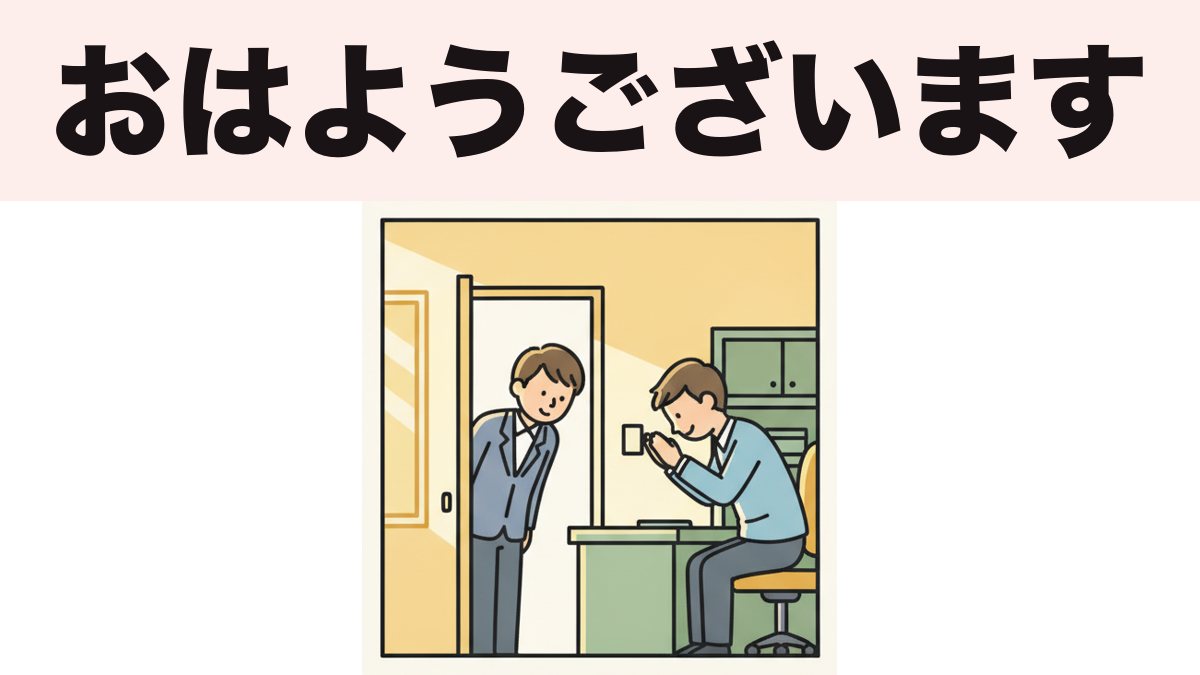
こんにちは is real, but it is a daytime greeting for people you are not close to — which means it is not what colleagues say to each other, not what you say to family, and not what you say at 8am. Japanese picks a greeting by time of day and relationship, and several of the most-used ones have no English equivalent at all.
「こんにちは」はありますが、これは「昼に、あまり近くない人に」使うあいさつです。だから、同僚には使いません。家族にも使いません。朝8時にも使いません。日本語のあいさつは、時間と関係で決まります。そして、英語にないあいさつがいくつもあります。
The greeting set is small and fixed. Learning it properly is unusually high-value, because greetings are the one part of the language you will use every single day, and getting them right makes you sound situated rather than translated.
The basics
The three time-of-day greetings
| Greeting | Reading | When |
|---|---|---|
| おはようございます | おはようございます | Morning, until roughly 10–11am |
| こんにちは | こんにちは | Daytime |
| こんばんは | こんばんは | Evening |
おはようございます。 — Good morning. (polite; the workplace default, whatever the hour) おはよう。 — Morning. (casual, friends and family)
おはようございます has a quirk worth knowing: in many workplaces — broadcasting, restaurants, entertainment — it is said at the start of your shift regardless of the actual time, because it means "you have arrived", not "it is morning".
Why don't colleagues say こんにちは to each other?
Because こんにちは carries a small distance. It is the greeting for someone outside your immediate circle: a neighbour, a shop you are entering, someone you are meeting for the first time that day in a non-work setting.
Inside a workplace or a group, the greeting is お疲れ様です — which has no English equivalent at all.
お疲れ様です。 — (acknowledges shared effort; the all-purpose workplace greeting) お疲れ様でした。 — (the same, at the end — said when leaving or when something finishes)
It works as "hello", "goodbye", "thanks", and "good work" depending on where it lands. In a Japanese office you will hear it dozens of times a day. Saying こんにちは instead marks you as an outsider more clearly than any grammar mistake.
The home set
Greetings at a door are fixed pairs, and both halves are expected:
いってきます。 — I'm off. (said by the person leaving) いってらっしゃい。 — See you, come back safely. (said by the person staying) ただいま。 — I'm home. (said on returning) おかえりなさい。 — Welcome back. (said by whoever is there)
These are used at home, and also in offices when someone leaves for and returns from an errand. They are not optional politeness — leaving one out is noticeable in the way an unanswered "good morning" would be.
Beyond the basics
What about もしもし?
Phone only. もしもし is how you answer or open a phone call, and using it face to face is a joke rather than a greeting.
In a business call, you do not use it at all — you give your company and name instead, which is where the service keigo forms come in.
いらっしゃいませ — the one you never answer
Shop staff will call いらっしゃいませ ("welcome") at everyone entering. It is broadcast, not directed, and it expects no reply. A small nod is more than enough, and most Japanese customers say nothing at all.
Answering it with こんにちは is a small, very common learner tell. It is harmless — but the silence is correct.
Greetings with no English equivalent
Three of the most-used greetings do not translate, and that is exactly why they are worth learning as whole units rather than as vocabulary:
- お疲れ様です — acknowledges that the other person has been working.
- よろしくお願いします — "please treat me well", used when starting anything together. Covered in self-introductions.
- お世話になっております — "thank you for your continued support", the standard opening in business email and calls.
If you learn these three as fixed phrases and stop trying to translate them, a large part of everyday Japanese suddenly has a shape.
Meeting again, and meeting after a long time
お久しぶりです。 — It's been a while. (polite) 久しぶり! — Long time no see! (casual)
久しぶり is one of the most common openers after any gap, and it frequently replaces こんにちは entirely.
Within the same day, Japanese generally does not repeat the greeting. Passing a colleague for the second time, a nod or a light お疲れ様です is the pattern — repeating おはようございます would sound like you had forgotten the first one.
Casual greetings
- やあ / おっす — casual, mostly male, fairly anime-flavoured.
- どうも — light and flexible; can be hello or thanks.
- 元気? — "how are you?", but not as an automatic opener the way English uses it.
That last point matters: お元気ですか is not a greeting the way "how are you?" is. It is a genuine question, used when you have not seen someone for a while. Asking it every time you meet someone reads as odd, or as though you are worried about them.
Common mistakes
- Using こんにちは with colleagues. お疲れ様です is the in-group greeting.
- Asking お元気ですか every time. It is a real question for a real gap, not an automatic opener.
- Replying to いらっしゃいませ. A nod is the whole response.
- Using もしもし in person. Phone only.
- Skipping ただいま / おかえり. They come in pairs, and the missing half is noticed.
- Saying おはよう to a boss. The ございます is what makes it polite; the short form is for friends and family.
The greeting map
| Situation | What to say |
|---|---|
| Arriving at work, any hour | おはようございます |
| Passing a colleague during the day | お疲れ様です |
| Entering a shop | (nothing — they greet you) |
| Meeting a neighbour in the afternoon | こんにちは |
| Leaving the house | いってきます |
| Coming home | ただいま |
| Leaving work | お先に失礼します |
| Seeing someone after months | お久しぶりです |
| Answering the phone | もしもし |
| Starting a business call or email | お世話になっております |
Practice
Say each answer out loud first. Questions 2 and 3 are a pair: the same time of day, two different relationships.
1. You arrive at work at 3pm for an evening shift. What do you say?
Show answer
おはようございます — it marks arrival, not the hour. Common in workplaces with shifts.
2. You pass a colleague in the corridor at 2pm. What do you say?
Show answer
お疲れ様です — the in-group greeting. こんにちは would sound distant.
3. You pass a neighbour on the street at 2pm. What do you say?
Show answer
こんにちは — outside your group, daytime. Same hour, different relationship, different word.
4. A shop assistant says いらっしゃいませ. What do you say?
Show answer
Nothing — a small nod — it is broadcast at everyone entering and expects no reply.
5. You are leaving the house. What do you say, and what do they say back?
Show answer
いってきます → いってらっしゃい — a fixed pair. Both halves are expected.
6. You get home. What do you say, and what do they say back?
Show answer
ただいま → おかえりなさい — the returning pair.
7. What does お疲れ様です actually mean?
Show answer
It acknowledges the other person's effort — and functions as hello, goodbye, thanks and "good work" depending on context. No English equivalent.
8. Why shouldn't you ask お元気ですか every time you meet someone?
Show answer
It is a genuine question, not a greeting formula — it belongs after a real gap, not as an automatic opener.
9. You are leaving the office before your colleagues. What do you say?
Show answer
お先に失礼します — "excuse me for going first". They will answer お疲れ様でした.
10. You bump into an old friend you have not seen in a year. What do you say?
Show answer
久しぶり! (casual) or お久しぶりです (polite) — this usually replaces こんにちは entirely.
FAQ
Is こんにちは ever wrong? Not wrong, but often not the natural choice. It is correct with strangers and acquaintances during the day, and slightly distant with people you work alongside.
When exactly does おはよう become こんにちは? Roughly 10 or 11am in everyday life, though nobody enforces it. At work, おはようございます attaches to your arrival rather than to the clock.
Do I need to bow when greeting? A small nod, yes. Full bows are for formal introductions and apologies; everyday greetings come with a nod that is more like a head-dip than a bow.
What do I say when I answer the phone for a business? Your company name plus でございます, not もしもし. もしもし is for personal calls and for checking whether the line is still connected.
Is おっす or やあ safe to use? Between close friends of similar age, yes. Both are casual and slightly performative, and neither belongs anywhere polite.
What do I say when leaving a conversation? 失礼します is the safe general one. じゃあ、また ("see you") is the casual version, and お疲れ様でした works when leaving a work setting.
Vocabulary from this article
Tap the block to select all of it, then copy. In Anki: File → Import, note type Basic, separator Tab — the first column becomes the front, the second the back.
おはようございます	おはようございます — good morning (polite)
こんにちは	こんにちは — hello (daytime)
こんばんは	こんばんは — good evening
お疲れ様	おつかれさま — thanks for your effort (workplace greeting)
いってきます	いってきます — I'm off
いってらっしゃい	いってらっしゃい — see you, take care
ただいま	ただいま — I'm home
おかえりなさい	おかえりなさい — welcome back
いらっしゃいませ	いらっしゃいませ — welcome (to a shop)
もしもし	もしもし — hello (phone only)
久しぶり	ひさしぶり — it's been a while
元気	げんき — well, energetic
失礼します	しつれいします — excuse me (leaving, entering)
挨拶	あいさつ — greeting
近所	きんじょ — neighbourhood
同僚	どうりょう — colleague
帰る	かえる — to go home
会う	あう — to meet
I'm Yuuki, a Japanese teacher based in Tokyo. I've taught on italki as a Top 1% teacher and watched over 1,500 anime. Greetings are the fastest win in the language: a student who switches from こんにちは to お疲れ様です in the right room sounds like they have been here, and it takes one lesson to learn.
Sources: the author's own lessons and standard reference grammars.
あいさつの数は多くありません。でも、毎日使います。だから、ここを正しくおぼえると、いちばん早く「日本にいる人」の話し方になります。
基本
時間のあいさつ
| あいさつ | 読み方 | いつ |
|---|---|---|
| おはようございます | — | 朝〜10時・11時ごろ |
| こんにちは | — | 昼 |
| こんばんは | — | 夜 |
おはようございます。 — Good morning. (polite; the workplace default) おはよう。 — Morning. (casual, friends and family)
「おはようございます」には、おもしろいところがあります。テレビ・飲食店などでは、出勤した時に言います。時間ではなく「来ました」という意味だからです。
なぜ同僚に「こんにちは」と言わないの?
「こんにちは」には、少しきょりがあるからです。近所の人、初めて会う人、お店に入る時のあいさつです。
会社やグループの中では、「お疲れ様です」を使います。英語にはありません。
お疲れ様です。 — (acknowledges shared effort; the all-purpose workplace greeting) お疲れ様でした。 — (at the end — leaving, or when something finishes)
「こんにちは」「さようなら」「ありがとう」「よくやったね」の全部になります。会社では1日に何回も聞きます。
家のあいさつ
ドアのあいさつは、2つで1つです。
いってきます。 — I'm off. (the person leaving) いってらっしゃい。 — See you, come back safely. (the person staying) ただいま。 — I'm home. (on returning) おかえりなさい。 — Welcome back. (whoever is there)
会社でも、外に出る時・帰ってきた時に使います。片方だけだと、すぐに分かります。
もう少し先へ
「もしもし」
電話だけです。会って言うと、じょうだんになります。仕事の電話では使わず、会社名と名前を言います(お店の敬語)。
「いらっしゃいませ」に返事はいりません
お店の人が、入る人みんなに言います。返事はいりません。軽く会しゃくで十分です。「こんにちは」と返すのは、学習者によくある小さいくせです。
英語にないあいさつ
- お疲れ様です — 相手がはたらいたことを認めます。
- よろしくお願いします — 何かを一緒に始める時(自己紹介)。
- お世話になっております — 仕事のメールや電話の最初。
この3つは、訳さないで、かたまりでおぼえてください。
ひさしぶりに会う時
お久しぶりです。 — It's been a while. (polite) 久しぶり! — Long time no see! (casual)
「こんにちは」の代わりになります。
同じ日に2回目に会った時は、あいさつをくり返しません。会しゃくか、軽い「お疲れ様です」です。
カジュアルなあいさつ
- やあ/おっす — カジュアル。アニメっぽい感じもあります。
- どうも — 軽い。「こんにちは」にも「ありがとう」にもなります。
- 元気? — 英語の "how are you?" とはちがいます。
ここが大事です。「お元気ですか」はあいさつではありません。しばらく会っていない人に聞く、本当の質問です。毎回聞くと、変に聞こえます。
よくあるまちがい
- 同僚に「こんにちは」。 「お疲れ様です」です。
- 毎回「お元気ですか」。 本当の質問です。
- 「いらっしゃいませ」に返事をする。 会しゃくで十分です。
- 会って「もしもし」。 電話だけです。
- 「ただいま」「おかえり」を言わない。 2つで1つです。
- 上司に「おはよう」。 「ございます」をつけます。
あいさつの地図
| 場面 | 言うこと |
|---|---|
| 出勤した時(何時でも) | おはようございます |
| 昼に同僚とすれちがう | お疲れ様です |
| お店に入る | (何も言わない) |
| 昼に近所の人に会う | こんにちは |
| 家を出る | いってきます |
| 家に帰る | ただいま |
| 会社を出る | お先に失礼します |
| 何か月ぶりかに会う | お久しぶりです |
| 電話に出る | もしもし |
| 仕事の電話・メールの最初 | お世話になっております |
練習
まず声に出してから、答えを見てください。2番と3番はペアです。
1. 午後3時に、夜のシフトで出勤しました。
答えを見る
おはようございます — 時間ではなく「来ました」という意味です。
2. 午後2時に、会社のろうかで同僚に会いました。
答えを見る
お疲れ様です — グループの中のあいさつです。
3. 午後2時に、道で近所の人に会いました。
答えを見る
こんにちは — 同じ時間でも、関係がちがうと言葉が変わります。
4. 店員さんが「いらっしゃいませ」と言いました。
答えを見る
何も言わなくていい(会しゃく) — 入る人みんなへの言葉です。
5. 家を出ます。何と言いますか。相手は?
答えを見る
いってきます → いってらっしゃい — 2つで1つです。
6. 家に帰りました。何と言いますか。相手は?
答えを見る
ただいま → おかえりなさい
7. 「お疲れ様です」の意味は?
答えを見る
相手がはたらいたことを認める言葉 — こんにちは・さようなら・ありがとうの全部になります。
8. なぜ毎回「お元気ですか」と聞かないのですか。
答えを見る
本当の質問だから — ひさしぶりの人に聞く言葉です。
9. 同僚より先に帰ります。
答えを見る
お先に失礼します — 相手は「お疲れ様でした」と言います。
10. 1年ぶりに友だちに会いました。
答えを見る
久しぶり!(お久しぶりです) — 「こんにちは」の代わりになります。
よくある質問
「こんにちは」はまちがいですか。 まちがいではありません。知らない人や近所の人には正しいです。一緒に働く人には、少しきょりがあります。
「おはよう」は何時までですか。 だいたい10時〜11時です。会社では「来た時」に言います。
あいさつでおじぎをしますか。 軽く会しゃくします。深いおじぎは、正式なしょうかいやあやまりの時です。
仕事の電話に出る時は? 会社名+「でございます」。「もしもし」は使いません。
「おっす」「やあ」は使えますか。 同じくらいの年の友だちだけです。
帰る時は何と言いますか。 「失礼します」が安全です。カジュアルなら「じゃあ、また」、会社なら「お疲れ様でした」。
この記事に出た単語
下のブロックをタップして全部えらび、コピーしてください。Anki では ファイル → 読み込み、ノートの種類は 基本、区切りは タブ です。
おはようございます	おはようございます — good morning (polite)
こんにちは	こんにちは — hello (daytime)
こんばんは	こんばんは — good evening
お疲れ様	おつかれさま — thanks for your effort (workplace greeting)
いってきます	いってきます — I'm off
いってらっしゃい	いってらっしゃい — see you, take care
ただいま	ただいま — I'm home
おかえりなさい	おかえりなさい — welcome back
いらっしゃいませ	いらっしゃいませ — welcome (to a shop)
もしもし	もしもし — hello (phone only)
久しぶり	ひさしぶり — it's been a while
元気	げんき — well, energetic
失礼します	しつれいします — excuse me (leaving, entering)
挨拶	あいさつ — greeting
近所	きんじょ — neighbourhood
同僚	どうりょう — colleague
帰る	かえる — to go home
会う	あう — to meet
私はユウキです。東京で日本語を教えています。 italki の Top 1% の先生で、アニメは1,500本以上見ました。あいさつは、いちばん早く効く所です。正しい場面で「こんにちは」から「お疲れ様です」に変えられる人は、もうここにいる人の話し方になります。1回のレッスンでおぼえられます。
More drills like the ones above, plus a timed JLPT-style mock test: Practice · N5上のような練習問題と、時間つきのJLPT形式のもぎ試験: 練習ページ · N5
Want to try this in a real conversation?
本当の会話で、ためしてみませんか?
30-minute trial lesson, $13. Times shown in your own timezone.
30分の体験レッスン、$13。時間はあなたのタイムゾーンで表示されます。
Book a trial lesson · $13