How to say "a lot" in Japanese: たくさん, いっぱい — and the one that cannot touch a noun「たくさん」の言い方: 名詞の前に立てない「多い」
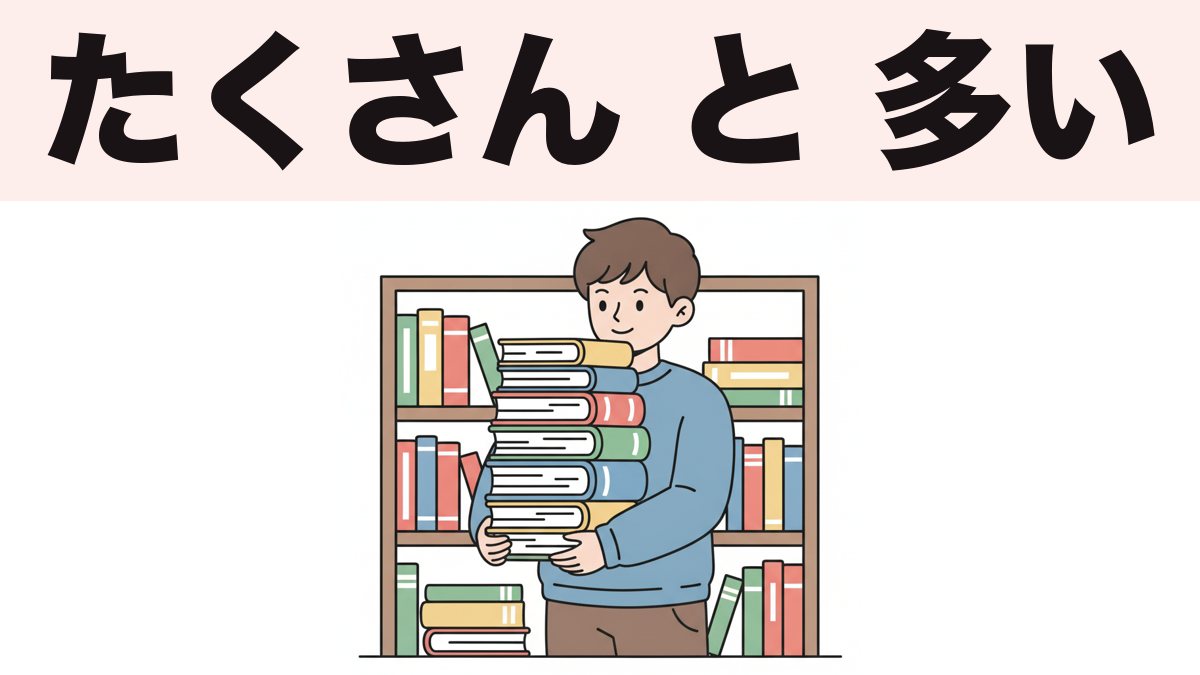
たくさん and いっぱい both mean "a lot" and both go before the verb. 多い also means "a lot," but it is an adjective that cannot sit in front of a noun: 多い人 is wrong, and 人が多い is right. That restriction catches every learner at least once, because English has no equivalent of it.
「たくさん」も「いっぱい」も「a lot」で、動詞の前に置きます。「多い」も「a lot」ですが、名詞の前には置けません。「多い人」は間違いで、「人が多い」が正しいです。英語にはないルールなので、みんな1度はまちがえます。
Quantity is one of the first things you want to express and one of the first places Japanese refuses to behave like English. The words are easy; the rule about where 多い can stand is the part worth five minutes.
The basics
たくさん: the standard "a lot"
たくさん食べました。 — I ate a lot. (polite) 本がたくさんあります。 — There are a lot of books. (polite)
たくさん is an adverb, so it goes before the verb. To attach it to a noun directly, you need の: たくさんの本 ("a lot of books"). Both たくさんの本があります and 本がたくさんあります are correct, and the second is more common in speech.
いっぱい: the same, but warmer
いっぱい means the same thing and sounds more casual and more physical — it comes from 一杯, "one cupful."
今日はいっぱい歩きました。 — I walked a lot today. (casual-polite) お腹いっぱいです。 — I'm full. (polite — the set phrase, literally "stomach full")
お腹いっぱいです is the phrase to have ready after a meal in Japan, and it is a compliment rather than a complaint.
多い: the adjective that cannot go in front
Here is the rule that matters.
人が多いです。 — There are a lot of people. (polite — correct) 多い人がいます。 — (wrong as "many people" — this reads as "a person who is many")
多い describes a quantity as a state, so it works as a predicate at the end of a sentence but not as a modifier before a noun. If you need to modify a noun, you have three options:
- 人が多い店 — a shop where the people are many (relative clause)
- たくさんの人 — a lot of people (たくさん + の)
- 多くの人 — many people (the special form 多く + の)
多くの is the one to memorize, because it is the fix for exactly this situation and it is very common in writing.
Beyond the basics
少ない has the same restriction
The opposite of 多い behaves identically.
お客さんが少ないです。 — There are few customers. (polite — correct) 少ない人 — (does not mean "few people")
The pattern to remember: 多い and 少ない are about how many there are, not about which ones. Adjectives that describe quantity in Japanese live at the end of the sentence. 高い, 新しい and 大きい have no such restriction — 高い本 is perfectly fine — which is why this feels arbitrary until you see that it is specifically the quantity adjectives.
とても, すごく, かなり: degree, not quantity
These modify how much, not how many, and they attach to adjectives rather than counting things.
とても高いです。 — It's very expensive. (polite, neutral) すごく高いです。 — It's really expensive. (casual-polite, more emphatic) かなり高いです。 — It's fairly expensive. (polite — less than すごく, more than a little)
とても is the neutral default and the one to use in writing. すごく is spoken and more emotional. かなり sits between "fairly" and "quite" and is useful precisely because it is honest about being a middling amount.
The small end: 少し, ちょっと, 少しだけ
少し話せます。 — I can speak a little. (polite, neutral) ちょっと待ってください。 — Please wait a moment. (polite — the most-used word in Japanese)
少し and ちょっと mean the same thing; 少し is slightly more formal. ちょっと also does an enormous amount of social work as a softener — ちょっと高いですね ("it's a bit expensive") and ちょっと… as a refusal are both ちょっと doing something other than measuring quantity.
Counting instead of quantifying
Often the natural Japanese is a number and a counter rather than a quantity word.
本を三冊買いました。 — I bought three books. (polite)
Japanese reaches for exact counts more readily than English does, and the counter goes after the noun with no particle. If counters are still shaky, the six you actually need is the short version.
ばかり and だらけ: too much of one thing
Two words that mean "a lot" with an attitude attached.
- 〜ばかり — nothing but, only this
- 〜だらけ — covered in, full of (almost always negative)
漫画ばかり読んでいます。 — I do nothing but read manga. (casual-polite, mild self-criticism) 間違いだらけです。 — It's full of mistakes. (polite — definitely negative)
だらけ is strongly negative and attaches directly to a noun: 泥だらけ (covered in mud), 傷だらけ (covered in scratches). ばかり has its own set of uses, covered in 〜ばかり.
Common mistakes
- Putting 多い in front of a noun. 多い人 is not "many people." Use 多くの人 or restructure as 人が多い.
- Putting 少ない in front of a noun. Same rule. Use 少しの or restructure.
- Forgetting the の after たくさん. たくさん本 is not standard; it is たくさんの本, or move it to たくさんあります.
- Using とても with a verb. とても食べました is odd. For verbs you want たくさん食べました.
- Treating いっぱい as always casual. お腹いっぱいです is perfectly polite. The word is casual in register, not impolite.
- Using だらけ for something positive. 花だらけ sounds like an infestation. For a pleasant abundance, use いっぱい.
The quantity toolkit
| What you mean | Word | Where it goes |
|---|---|---|
| A lot (with a verb) | たくさん / いっぱい | Before the verb |
| A lot of + noun | たくさんの / 多くの | Before the noun |
| There are many | 多い | End of the sentence |
| There are few | 少ない | End of the sentence |
| Very (with an adjective) | とても / すごく / かなり | Before the adjective |
| A little | 少し / ちょっと | Before the verb or adjective |
| An exact amount | number + counter | After the noun |
| Nothing but | 〜ばかり | After the noun or te-form |
| Covered in (negative) | 〜だらけ | After the noun |
Practice
Questions 1 and 2 are the pair: the same meaning, and only one word order works.
1. Say "there are a lot of people," politely.
Show answer
人が多いです。 — 多い goes at the end. It describes the quantity as a state.
2. Now say "many people" as a noun phrase, inside a longer sentence.
Show answer
多くの人 — 多い cannot modify a noun directly, so the special form 多く plus の does the job. たくさんの人 also works.
3. Say "I ate a lot," politely.
Show answer
たくさん食べました。 — たくさん is an adverb, so it goes before the verb with no particle.
4. Say "I'm full" after a meal.
Show answer
お腹いっぱいです。 — A set phrase, and a compliment rather than a complaint.
5. Say "it's very expensive," neutrally and politely.
Show answer
とても高いです。 — とても for degree with an adjective. すごく would be more emotional and more spoken.
6. Say "I can speak a little," politely.
Show answer
少し話せます。 — ちょっと話せます also works and sounds slightly more casual.
7. Say "I bought three books."
Show answer
本を三冊買いました。 — The counter goes after the noun and its particle, with nothing in between.
8. Say "it's full of mistakes," politely.
Show answer
間違いだらけです。 — だらけ attaches straight to the noun and is always negative.
9. Fix this: 多い人がいます。(meaning "there are many people")
Show answer
人が多いです。 — Or 多くの人がいます. 多い cannot stand in front of a noun.
10. Fix this: とても食べました。
Show answer
たくさん食べました。 — とても modifies adjectives. For "a lot" with a verb you need たくさん or いっぱい.
FAQ
Why can 高い go in front of a noun but 多い cannot? Because 多い describes the size of a set rather than a property of an individual. 高い本 picks out a book that is expensive; 多い本 would have to pick out a book that is numerous, which is not a thing a single book can be.
Is 多くの only for writing? It leans written and formal, but it is perfectly usable in speech. In casual conversation たくさんの or a restructured 〜が多い is more common.
What is the difference between たくさん and いっぱい? Meaning, none. Register: いっぱい is warmer and more casual, with a physical "filled up" feeling. たくさん is the neutral default and safer in writing.
Can I say とてもたくさん? Yes, though it is emphatic and slightly heavy. すごくたくさん is the more natural spoken version of the same idea.
Is ちょっと ever not about quantity? Constantly. ちょっと待って ("hang on"), ちょっといいですか ("got a second?") and a trailing ちょっと… as a soft refusal are all social moves rather than measurements.
How do I say "too much"? 〜すぎる attached to the verb or adjective stem: 食べすぎました ("I ate too much"), 高すぎます ("it's too expensive"). See 〜すぎる for the い you have to drop.
Vocabulary from this article
Tap the block to select all of it, then copy. In Anki: File → Import, note type Basic, separator Tab — the first column becomes the front, the second the back.
たくさん	たくさん — a lot
いっぱい	いっぱい — a lot, full
多い	おおい — many, numerous
多く	おおく — many (before の)
少ない	すくない — few
少し	すこし — a little
ちょっと	ちょっと — a little, a moment
とても	とても — very
すごく	すごく — really
かなり	かなり — fairly, quite
だらけ	だらけ — covered in (negative)
お腹	おなか — stomach
冊	さつ — counter for books
間違い	まちがい — mistake
泥	どろ — mud
漫画	まんが — manga
お客さん	おきゃくさん — customer, guest
歩く	あるく — to walk
I'm Yuuki, a Japanese teacher based in Tokyo. I've taught on italki as a Top 1% teacher and watched over 1,500 anime. 多い人 is a mistake almost everyone makes exactly once, usually while trying to describe a crowded train — and the fix, 人が多い, is a sentence you then use every day.
Sources: the author's own lessons and standard reference grammars.
数の多さは、早く言いたくなることの1つです。そして、日本語が英語と同じにならないところでもあります。ことばは簡単です。「多い」がどこに立てるか、それだけが大事です。
基本
「たくさん」
たくさん食べました。 — I ate a lot. (polite) 本がたくさんあります。 — There are a lot of books. (polite)
「たくさん」は副詞なので、動詞の前です。名詞につける時は「の」がいります。「たくさんの本」です。「本がたくさんあります」のほうが、話す時はよく使います。
「いっぱい」
意味は同じです。もっとくだけていて、体で感じる感じがあります。もとは「一杯」です。
今日はいっぱい歩きました。 — I walked a lot today. (casual-polite) お腹いっぱいです。 — I'm full. (polite — the set phrase, literally "stomach full")
「お腹いっぱいです」は、食事のあとに言います。文句ではなく、ほめことばです。
「多い」は名詞の前に立てません
ここが大事です。
人が多いです。 — There are a lot of people. (polite — correct) 多い人がいます。 — (「たくさんの人」の意味にはなりません)
「多い」は「数が多いという状態」を言います。だから文の終わりでは使えますが、名詞の前では使えません。名詞につけたい時は、3つの方法があります。
- 人が多い店 — 人が多い、という説明をつける
- たくさんの人 — たくさん+の
- 多くの人 — 「多く」という特別な形+の
「多くの」を覚えてください。この場面のための形で、文章によく出ます。
もう少し先へ
「少ない」も同じです
お客さんが少ないです。 — There are few customers. (polite — correct) 少ない人 — (「少しの人」の意味にはなりません)
「多い」「少ない」は「いくつあるか」のことばです。「どれか」のことばではありません。「高い本」「新しい本」は大丈夫です。数のことばだけが特別です。
「とても」「すごく」「かなり」
これは「数」ではなく「どのくらい」です。形容詞につきます。
とても高いです。 — It's very expensive. (polite, neutral) すごく高いです。 — It's really expensive. (casual-polite, more emphatic) かなり高いです。 — It's fairly expensive. (polite)
書く時は「とても」が安全です。「すごく」は話しことばで、気持ちが強く出ます。
少ない時: 「少し」「ちょっと」
少し話せます。 — I can speak a little. (polite, neutral) ちょっと待ってください。 — Please wait a moment. (polite)
意味は同じで、「少し」のほうが少しかたいです。「ちょっと」は、数と関係ない使い方もたくさんあります。「ちょっと高いですね」「ちょっと…」(断る時)などです。
数えたほうが自然な時
本を三冊買いました。 — I bought three books. (polite)
日本語は、英語より数を言うことが多いです。助数詞は名詞と助詞のあとに、そのまま置きます。
「ばかり」と「だらけ」
どちらも「多い」ですが、気持ちが入ります。
- 〜ばかり — それだけ
- 〜だらけ — 〜でいっぱい(ほとんど悪い意味)
漫画ばかり読んでいます。 — I do nothing but read manga. (casual-polite, mild self-criticism) 間違いだらけです。 — It's full of mistakes. (polite — definitely negative)
「だらけ」は名詞にそのままつきます。「泥だらけ」「傷だらけ」です。
よくある間違い
- 「多い」を名詞の前に置く。 「多くの人」か「人が多い」です。
- 「少ない」を名詞の前に置く。 同じルールです。
- 「たくさん」の「の」を忘れる。 「たくさんの本」です。
- 動詞に「とても」を使う。 「たくさん食べました」です。
- 「いっぱい」は失礼だと思う。 「お腹いっぱいです」はていねいです。
- いいことに「だらけ」を使う。 「花だらけ」は困っているように聞こえます。
まとめ
| 言いたいこと | ことば | 場所 |
|---|---|---|
| たくさん(動詞と) | たくさん / いっぱい | 動詞の前 |
| たくさんの+名詞 | たくさんの / 多くの | 名詞の前 |
| 数が多い | 多い | 文の終わり |
| 数が少ない | 少ない | 文の終わり |
| とても(形容詞と) | とても / すごく / かなり | 形容詞の前 |
| 少し | 少し / ちょっと | 動詞・形容詞の前 |
| ちょうどの数 | 数字+助数詞 | 名詞のあと |
| 〜ばかり | 〜ばかり | 名詞・て形のあと |
| 〜だらけ(悪い) | 〜だらけ | 名詞のあと |
練習
1番と2番が組です。同じ意味でも、形がちがいます。
1. 「人が多いです」と言ってください。
答えを見る
人が多いです。 — 「多い」は文の終わりです。
2. 「たくさんの人」を、別の言い方で言ってください。
答えを見る
多くの人 — 「多い」は名詞の前に立てないので、「多く」+「の」です。
3. 「たくさん食べました」と言ってください。
答えを見る
たくさん食べました。 — 副詞なので、動詞の前にそのまま置きます。
4. 食事のあとに「お腹いっぱいです」と言ってください。
答えを見る
お腹いっぱいです。 — 決まった言い方で、ほめことばです。
5. 「とても高いです」と言ってください。
答えを見る
とても高いです。 — 形容詞には「とても」です。
6. 「少し話せます」と言ってください。
答えを見る
少し話せます。 — 「ちょっと話せます」も使えます。
7. 「本を三冊買いました」と言ってください。
答えを見る
本を三冊買いました。 — 助数詞は名詞と助詞のあとです。
8. 「間違いだらけです」と言ってください。
答えを見る
間違いだらけです。 — 名詞にそのままつきます。悪い意味です。
9. 直してください: 多い人がいます。
答えを見る
人が多いです。 — 「多くの人がいます」でも大丈夫です。
10. 直してください: とても食べました。
答えを見る
たくさん食べました。 — 動詞には「たくさん」です。
よくある質問
どうして「高い本」はよくて「多い本」はだめですか。 「高い」は1冊の本の性質です。「多い」は集まりの数です。1冊の本が「多い」ことはできません。
「多くの」は書く時だけですか。 少しかたいですが、話す時にも使えます。ふつうの会話では「たくさんの」や「〜が多い」が多いです。
「たくさん」と「いっぱい」はちがいますか。 意味は同じです。「いっぱい」のほうがくだけていて、あたたかい感じです。
「とてもたくさん」と言えますか。 言えます。強い言い方です。「すごくたくさん」のほうが話しことばらしいです。
「ちょっと」は数の話だけですか。 ちがいます。「ちょっと待って」「ちょっといいですか」「ちょっと…(断る)」も全部「ちょっと」です。
「〜しすぎる」は何ですか。 「多すぎる」という意味です。「食べすぎました」「高すぎます」です。
この記事に出た単語
このブロックを長く押して全部選び、コピーしてください。Ankiでは ファイル → 読み込み、ノートタイプは 基本、区切りは タブ にします。左が表、右が裏になります。
たくさん	たくさん — a lot
いっぱい	いっぱい — a lot, full
多い	おおい — many, numerous
多く	おおく — many (before の)
少ない	すくない — few
少し	すこし — a little
ちょっと	ちょっと — a little, a moment
とても	とても — very
すごく	すごく — really
かなり	かなり — fairly, quite
だらけ	だらけ — covered in (negative)
お腹	おなか — stomach
冊	さつ — counter for books
間違い	まちがい — mistake
泥	どろ — mud
漫画	まんが — manga
お客さん	おきゃくさん — customer, guest
歩く	あるく — to walk
日本語教師のユウキです。東京にいます。 italkiで Top 1% の教師をしています。アニメは1,500本以上見ました。「多い人」は、ほとんどの人がちょうど1回まちがえます。たいてい、混んだ電車の話をしようとした時です。直したあとの「人が多い」は、毎日使う文になります。
More drills like the ones above, plus a timed JLPT-style mock test: Practice · N5上のような練習問題と、時間つきのJLPT形式のもぎ試験: 練習ページ · N5
Want to try this in a real conversation?
本当の会話で、ためしてみませんか?
30-minute trial lesson, $13. Times shown in your own timezone.
30分の体験レッスン、$13。時間はあなたのタイムゾーンで表示されます。
Book a trial lesson · $13