How to ask someone to repeat themselves in Japanese — without saying え? every time聞き返し方: 「え?」だけで終わらせない
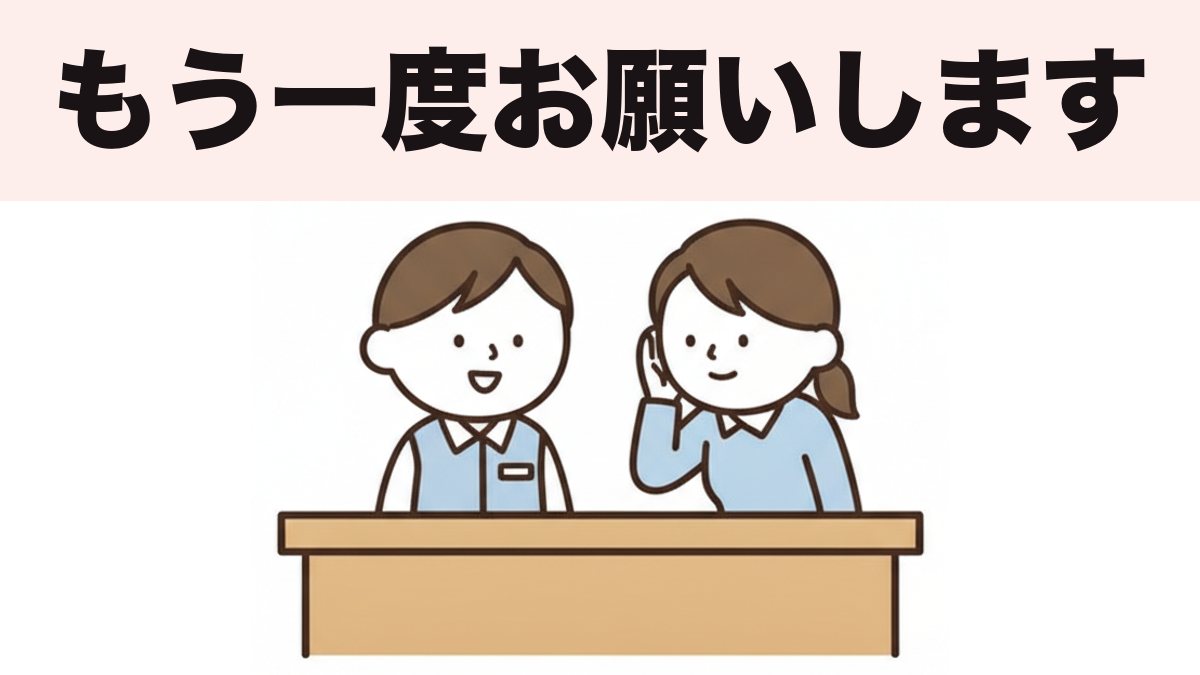
もう一度お願いします is the sentence to memorize first. The more useful skill is knowing which kind of repeat you actually need: slower (ゆっくりお願いします), simpler (やさしい日本語でお願いします), or just one word (〜って何ですか). Asking for "again" when you needed "slower" gets you the same wall of sound at the same speed.
まず「もう一度お願いします」を覚えてください。でも、もっと大事なのは「どの種類のお願いか」です。ゆっくり(ゆっくりお願いします)、やさしく(やさしい日本語でお願いします)、1語だけ(〜って何ですか)。「もう一度」と言うと、同じ速さで同じ文が返ってきます。
Almost every learner over-prepares the questions and under-prepares the recovery. This page is the recovery kit, and it is the part that decides whether a conversation continues or quietly ends.
The basics
The safe one
もう一度お願いします。 — Once more, please. (polite — works with anyone, anywhere) すみません、もう一度お願いします。 — Sorry, once more please. (polite — the すみません softens the interruption)
This is short, unambiguous and gets you a second attempt from almost anyone. It is the one to have ready before you land in Japan.
Asking for slower, not just again
ゆっくりお願いします。 — Slowly, please. (polite) もう少しゆっくり話していただけますか。 — Could you speak a little more slowly? (polite, more formal)
This is the request learners need most and ask for least. A repeat at the same speed rarely helps; a repeat at half speed usually does. ゆっくりお願いします is three words and solves more problems than もう一度 does.
え? and the problem with it
え? — Huh? (casual — fine with friends, abrupt with anyone else)
え? is what comes out automatically, and it is not wrong among friends. With a stranger, a shop assistant or a teacher it lands as blunt — it is closer to "what?" than to "sorry?" A quick すみません in front of it fixes it entirely.
Beyond the basics
Asking about one specific word
Often you got the whole sentence except one word. Say so — it is far more efficient than asking for the sentence again.
「最寄り」って何ですか。 — What does もより mean? (polite-casual — quoting the word back with って) すみません、最後の言葉をもう一度お願いします。 — Sorry, the last word once more please. (polite)
Quoting the word back with って is the fastest tool here, and it also proves you heard most of the sentence, which tells the other person to repeat only the missing piece. This is the same って covered in 〜という.
If you want the meaning rather than a repeat, that is 〜はどういう意味ですか.
Asking for simpler Japanese
やさしい日本語でお願いします。 — In simple Japanese, please. (polite) 簡単な言葉でお願いします。 — In easy words, please. (polite)
やさしい日本語 is a recognized term in Japan — it names a deliberately simplified register used in public announcements and disaster information. Asking for it is a clear, understood request, not an admission of failure.
Asking them to write it
書いてもらえますか。 — Could you write it down? (polite)
For an address, a name or a number, this is often faster than any amount of repetition. Japanese speakers reach for it with each other too, especially for names, because kanji readings are genuinely ambiguous.
Confirming instead of asking again
The most useful move is not asking for a repeat at all — it is repeating back what you did catch.
三時ですね。 — Three o'clock, yes? (polite — confirming with ね) まっすぐ行って、右ですね。 — Straight, then right — yes? (polite)
Repeating back with ね shows exactly which part you got, so the other person corrects only the missing piece. It is faster, it is more polite, and it keeps you in the conversation rather than restarting it.
When you genuinely did not catch anything
すみません、聞き取れませんでした。 — Sorry, I couldn't catch that. (polite — honest and completely acceptable) 日本語がまだ上手じゃないので、ゆっくりお願いします。 — My Japanese isn't good yet, so slowly please. (polite — sets expectations)
聞き取れませんでした is the potential form of 聞き取る ("to catch, to make out"), and it is a precise, adult way to say you did not hear rather than did not understand. Saying it once at the start of a conversation usually changes the other person's speed for the whole exchange.
Common mistakes
- Using え? with a stranger. It lands as "what?" Add すみません in front and it is fine.
- Asking もう一度 when you needed ゆっくり. The same sentence at the same speed is the same problem.
- Nodding when you did not understand. This is the real error. It ends the exchange without anyone knowing.
- Saying わかりません as a catch-all. わかりません means "I don't understand," which is about meaning. If you simply did not hear, 聞き取れませんでした is more accurate and gets a better response.
- Apologizing at length. One すみません is enough. A long apology takes more of everyone's time than the repeat would.
- Not repeating back. 〜ですね costs two syllables and saves an entire second round.
Which request do I need?
| What went wrong | What to say | Why |
|---|---|---|
| Missed it entirely | もう一度お願いします | Safe, universal |
| Too fast | ゆっくりお願いします | A repeat won't help; slower will |
| Too complex | やさしい日本語でお願いします | A recognized register in Japan |
| One word missing | 「〜」って何ですか | Repeat only the missing piece |
| A name, number or address | 書いてもらえますか | Faster than any repetition |
| You caught most of it | 〜ですね | Confirms and corrects in one move |
| You heard nothing at all | 聞き取れませんでした | Precise, and it slows them down |
| Among friends | え? / なんて? | Casual and completely normal |
Practice
Questions 2 and 3 are the pair: the same problem, two different requests, and only one of them helps.
1. Ask politely for a repeat, with a softening opener.
Show answer
すみません、もう一度お願いします。 — The safest sentence in this whole set. Memorize it first.
2. They spoke too fast. Ask for what you actually need.
Show answer
ゆっくりお願いします。 — A repeat at the same speed is the same problem again. Three words, and it solves it.
3. Why is もう一度お願いします the wrong request in question 2?
Show answer
同じ速さでくり返されるからです。 — "Again" gets you the identical sentence at the identical speed.
4. You caught everything except the word 最寄り. Ask about just that word.
Show answer
「最寄り」って何ですか。 — Quoting the word back with って tells them to repeat only the missing piece.
5. Ask for simpler Japanese, politely.
Show answer
やさしい日本語でお願いします。 — A recognized register in Japan, so this is a clear request rather than an apology.
6. Ask them to write it down.
Show answer
書いてもらえますか。 — For names, numbers and addresses this beats any amount of repetition.
7. You heard "three o'clock." Confirm it rather than asking again.
Show answer
三時ですね。 — Repeating back with ね corrects the one thing you got wrong, instead of restarting.
8. Say "sorry, I couldn't catch that," politely.
Show answer
すみません、聞き取れませんでした。 — This says you did not hear, not that you did not understand. It usually slows the other person down.
9. Fix this: え? (said to a shop assistant)
Show answer
すみません、もう一度お願いします。 — え? alone lands as "what?" Adding すみません in front would also be enough.
10. What is the one thing you should never do when you did not understand?
Show answer
だまってうなずくこと。 — Nodding ends the exchange without anyone knowing there was a problem. Any sentence on this page is better.
FAQ
Is え? actually rude? Not rude, just blunt — closer to "what?" than "sorry?" With friends it is completely normal. With anyone else, すみません in front of it makes it fine.
What is the difference between わかりません and 聞き取れませんでした? わかりません is about meaning: you heard it and it did not parse. 聞き取れませんでした is about hearing: the sounds did not resolve into words. Using the accurate one gets you the right kind of help.
Is it embarrassing to ask more than once? No, and asking twice is far better than nodding through. If you are worried about it, say 日本語がまだ上手じゃないので at the start — it resets expectations for the whole conversation.
How do I ask someone to speak louder? もう少し大きい声でお願いします. It is less commonly needed than ゆっくり, but useful on a phone or in a noisy shop.
What is やさしい日本語 exactly? A deliberately simplified register with short sentences, common words and no unnecessary kanji, used by local governments and broadcasters for non-native residents. Asking for it names something real rather than just asking for "easy Japanese."
Is なんて? okay to use? Among friends, yes — it is the casual "what was that?" With anyone else, もう一度お願いします.
Vocabulary from this article
Tap the block to select all of it, then copy. In Anki: File → Import, note type Basic, separator Tab — the first column becomes the front, the second the back.
もう一度	もういちど — once more
ゆっくり	ゆっくり — slowly
聞き取る	ききとる — to catch, to make out
簡単	かんたん — easy, simple
言葉	ことば — word
最後	さいご — the last
書く	かく — to write
声	こえ — voice
大きい	おおきい — big, loud
少し	すこし — a little
最寄り	もより — nearest
意味	いみ — meaning
上手	じょうず — good at
話す	はなす — to speak
分かる	わかる — to understand
確認	かくにん — confirmation
住所	じゅうしょ — address
名前	なまえ — name
I'm Yuuki, a Japanese teacher based in Tokyo. I've taught on italki as a Top 1% teacher and watched over 1,500 anime. Students spend hours rehearsing questions and none rehearsing what to do when the answer arrives too fast — which is a shame, because ゆっくりお願いします takes ten seconds to learn and rescues more conversations than any question ever has.
Sources: the author's own lessons and standard reference grammars.
みんな、質問はたくさん練習します。でも、聞き取れなかった時の言い方は練習しません。会話が続くか、そこで終わるかは、ここで決まります。
基本
安全なひとこと
もう一度お願いします。 — Once more, please. (polite — works with anyone, anywhere) すみません、もう一度お願いします。 — Sorry, once more please. (polite)
短くて、まちがえられません。日本に来る前に覚えておいてください。
「ゆっくり」をお願いする
ゆっくりお願いします。 — Slowly, please. (polite) もう少しゆっくり話していただけますか。 — Could you speak a little more slowly? (polite, more formal)
いちばん必要なのに、いちばん言われないお願いです。同じ速さでくり返されても、たいてい分かりません。ゆっくりなら分かります。
「え?」の問題
え? — Huh? (casual — fine with friends, abrupt with anyone else)
「え?」は勝手に口から出ます。友だちなら大丈夫です。でも、知らない人・店員さん・先生には強く聞こえます。前に「すみません」をつけるだけで直ります。
もう少し先へ
1語だけ聞く
文のほとんどは分かって、1語だけ分からないことがよくあります。そう言ってください。
「最寄り」って何ですか。 — What does もより mean? (polite-casual) すみません、最後の言葉をもう一度お願いします。 — Sorry, the last word once more please. (polite)
「って」でことばをくり返すのが、いちばん早いです。「ほとんど聞こえていた」ことも伝わるので、足りないところだけ言ってもらえます。
やさしい日本語をお願いする
やさしい日本語でお願いします。 — In simple Japanese, please. (polite) 簡単な言葉でお願いします。 — In easy words, please. (polite)
「やさしい日本語」は、日本で決まった言い方です。市役所やニュースが、日本語を勉強している人のために使う書き方・話し方のことです。だから、はっきり伝わるお願いです。
書いてもらう
書いてもらえますか。 — Could you write it down? (polite)
住所・名前・数字は、くり返してもらうより早いです。日本の人どうしでも、名前の漢字はよく書いて見せ合います。
聞き返さずに確かめる
いちばんいいのは、聞き返さないことです。分かったところをくり返します。
三時ですね。 — Three o'clock, yes? (polite) まっすぐ行って、右ですね。 — Straight, then right — yes? (polite)
「ね」でくり返すと、どこまで分かったかが伝わります。足りないところだけ直してもらえるので、早くてていねいです。
本当に何も分からなかった時
すみません、聞き取れませんでした。 — Sorry, I couldn't catch that. (polite) 日本語がまだ上手じゃないので、ゆっくりお願いします。 — My Japanese isn't good yet, so slowly please. (polite)
「聞き取れませんでした」は「音が分からなかった」という意味です。「意味が分からない」とはちがいます。最初に1回言っておくと、そのあとずっとゆっくり話してもらえます。
よくある間違い
- 知らない人に「え?」と言う。 前に「すみません」をつけます。
- 「ゆっくり」が必要なのに「もう一度」と言う。 同じ速さで返ってきます。
- 分からないのにうなずく。 これがいちばんよくありません。
- 何でも「わかりません」と言う。 音が分からなかった時は「聞き取れませんでした」です。
- 長くあやまる。 「すみません」1回で十分です。
- くり返して確かめない。 「〜ですね」だけで、もう1回分はぶけます。
どのお願いが必要か
| 困ったこと | 言うこと | 理由 |
|---|---|---|
| 全然聞こえなかった | もう一度お願いします | いつでも使える |
| 速すぎた | ゆっくりお願いします | くり返しでは直らない |
| むずかしかった | やさしい日本語でお願いします | 決まった言い方 |
| 1語だけ分からない | 「〜」って何ですか | そこだけ言ってもらえる |
| 名前・数字・住所 | 書いてもらえますか | いちばん早い |
| ほとんど分かった | 〜ですね | 確認と修正が一度に |
| 何も聞こえなかった | 聞き取れませんでした | 速さが変わる |
| 友だちと | え? / なんて? | ふつうです |
練習
2番と3番が組です。同じ場面で、片方だけが役に立ちます。
1. ていねいに、もう一度お願いしてください。
答えを見る
すみません、もう一度お願いします。 — まずこれを覚えてください。
2. 相手が早口でした。何とお願いしますか。
答えを見る
ゆっくりお願いします。 — 速さの問題なので、速さをお願いします。
3. 2番で「もう一度お願いします」だと、なぜだめですか。
答えを見る
同じ速さでくり返されるからです。 — 問題が変わりません。
4. 「最寄り」だけ分かりませんでした。そこだけ聞いてください。
答えを見る
「最寄り」って何ですか。 — 「って」でくり返すのがいちばん早いです。
5. やさしい日本語をお願いしてください。
答えを見る
やさしい日本語でお願いします。 — 日本で決まった言い方です。
6. 書いてもらってください。
答えを見る
書いてもらえますか。 — 名前や数字は、これがいちばん早いです。
7. 「三時」と聞こえました。聞き返さずに確かめてください。
答えを見る
三時ですね。 — ちがっていたら、そこだけ直してもらえます。
8. 「すみません、聞き取れませんでした」と言ってください。
答えを見る
すみません、聞き取れませんでした。 — 「音が分からなかった」という意味です。
9. 直してください: え?(店員さんに)
答えを見る
すみません、もう一度お願いします。 — 「すみません、え?」でも大丈夫です。
10. 分からない時に、いちばんしてはいけないことは何ですか。
答えを見る
だまってうなずくこと。 — 問題があったことが、だれにも伝わりません。
よくある質問
「え?」は失礼ですか。 失礼というより、強いです。友だちならふつうです。ほかの人には「すみません」をつけてください。
「わかりません」と「聞き取れませんでした」はちがいますか。 ちがいます。「わかりません」は意味、「聞き取れませんでした」は音です。正しいほうを言うと、正しい助けがもらえます。
何回も聞くのは、はずかしいですか。 いいえ。だまってうなずくよりずっといいです。最初に「日本語がまだ上手じゃないので」と言っておくと楽になります。
「大きい声で」は何と言いますか。 「もう少し大きい声でお願いします」です。電話やうるさいお店で使います。
「やさしい日本語」は何ですか。 短い文・よく使うことば・むずかしい漢字なし、で話す書き方です。市役所やニュースが使います。
「なんて?」は使えますか。 友だちには使えます。ほかの人には「もう一度お願いします」です。
この記事に出た単語
このブロックを長く押して全部選び、コピーしてください。Ankiでは ファイル → 読み込み、ノートタイプは 基本、区切りは タブ にします。左が表、右が裏になります。
もう一度	もういちど — once more
ゆっくり	ゆっくり — slowly
聞き取る	ききとる — to catch, to make out
簡単	かんたん — easy, simple
言葉	ことば — word
最後	さいご — the last
書く	かく — to write
声	こえ — voice
大きい	おおきい — big, loud
少し	すこし — a little
最寄り	もより — nearest
意味	いみ — meaning
上手	じょうず — good at
話す	はなす — to speak
分かる	わかる — to understand
確認	かくにん — confirmation
住所	じゅうしょ — address
名前	なまえ — name
日本語教師のユウキです。東京にいます。 italkiで Top 1% の教師をしています。アニメは1,500本以上見ました。みんな質問は何時間も練習するのに、答えが早口で返ってきた時の練習はしません。「ゆっくりお願いします」は10秒で覚えられて、どんな質問より多くの会話を助けてくれます。
More drills like the ones above, plus a timed JLPT-style mock test: Practice · N5上のような練習問題と、時間つきのJLPT形式のもぎ試験: 練習ページ · N5
Want to try this in a real conversation?
本当の会話で、ためしてみませんか?
30-minute trial lesson, $13. Times shown in your own timezone.
30分の体験レッスン、$13。時間はあなたのタイムゾーンで表示されます。
Book a trial lesson · $13