How do you say "how do you say...?" in Japanese?「〜は日本語で何と言いますか」: ほかの全部が手に入る1文
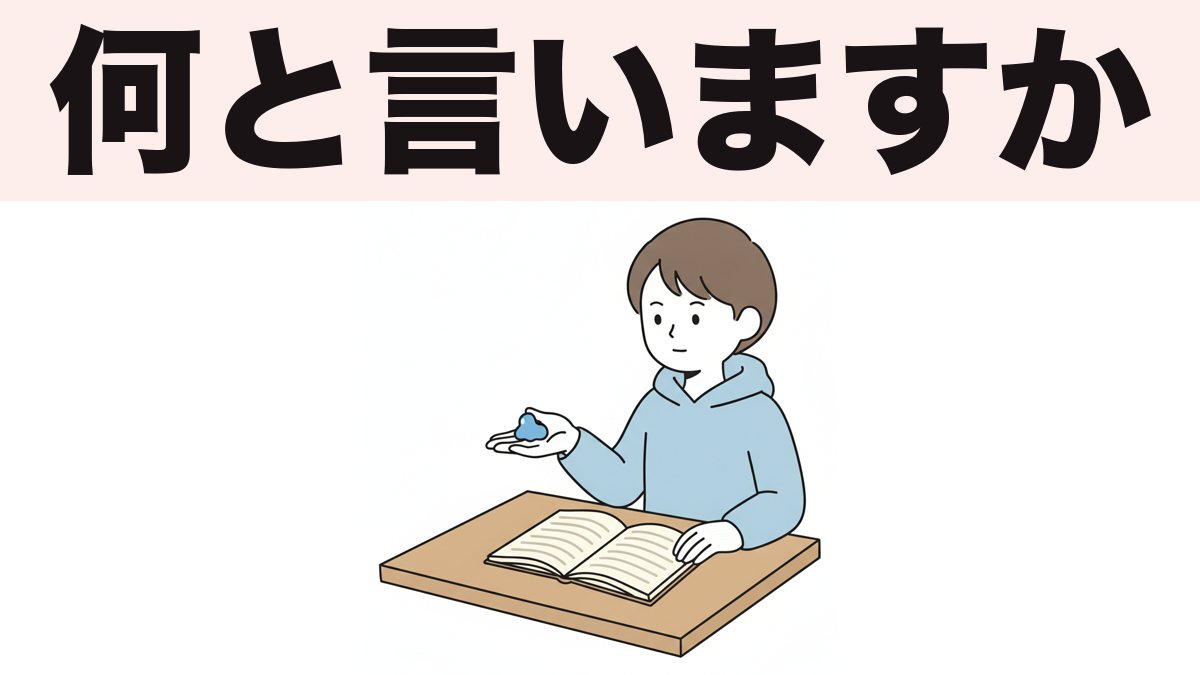
〜は日本語で何と言いますか — "what do you say for ~ in Japanese?" That single sentence is the most valuable thing a beginner can memorize, because it is the sentence that gets you every other sentence for free.
「〜は日本語で何と言いますか」。初めのうちに覚えると、いちばん得をする文です。この1文があれば、ほかの文を全部、その場でもらえるからです。
Most beginner phrasebooks are lists of things to say. This is different: it is a tool for extracting new Japanese from the person in front of you, in Japanese, without breaking into English. Learners who own it improve noticeably faster than learners who do not, because every conversation becomes a source of vocabulary instead of a test of it.
The basics
The full sentence
「water」は日本語で何と言いますか。 — How do you say "water" in Japanese? (polite, the complete form) これは日本語で何と言いますか。 — What do you call this in Japanese? (polite, while pointing at something)
The parts:
- 〜は — the topic: the thing you want a word for
- 日本語で — "in Japanese," with で marking the language as the means
- 何と — "as what," where と is the quotation particle
- 言いますか — "do you say?"
The と is the interesting piece. It is the same quotation と in 〜と思います, and it is doing the same job: marking the content of speech. You are literally asking "as what do people say it."
The shorter version everyone actually uses
In real conversation, 何と言いますか usually compresses to 何ですか.
これは日本語で何ですか。 — What is this in Japanese? (polite, the everyday version) 「library」は日本語で何ですか。 — What's "library" in Japanese? (polite)
This is shorter, completely natural, and slightly less precise — 何ですか asks what something is, and context supplies that you mean its name. Nobody will misunderstand you. Use the long version when you want to be unambiguous, the short one the rest of the time.
The casual version
Drop ですか and add って, the casual quotation particle.
これ、日本語で何て言うの? — What's this called in Japanese? (casual, friends) これ何? — What's this? (very casual — the minimum viable question)
何て言うの is the form you will hear constantly in anime and in ordinary conversation. 何て is a contraction of 何と, and の softens the question into curiosity rather than interrogation.
Beyond the basics
The opposite question: asking what a word means
This sentence has a twin pointing the other way. If you heard a Japanese word and want its meaning rather than a word for something you can see, you need 〜はどういう意味ですか.
「もったいない」はどういう意味ですか。 — What does もったいない mean? (polite — you heard the word, you want the meaning) 「wasteful」は日本語で何と言いますか。 — How do you say "wasteful" in Japanese? (polite — you have the meaning, you want the word)
Learners mix these up constantly, and the mix-up is visible: asking どういう意味ですか about an English word makes it sound as though you do not know your own language. Check which direction you are travelling before you open your mouth.
When you do not know the English word either
This is the situation phrasebooks never cover and real life produces weekly. You can point, or you can describe.
これは何ですか。 — What is this? (polite, pointing — the simplest escape hatch in the language) えっと、髪を切るところです。 — Um, it's the place where you get your hair cut. (polite, describing your way toward the word)
Describing is a skill worth practising on purpose. 〜ところ ("the place where"), 〜もの ("the thing that") and 〜人 ("the person who") let you build a definition out of words you already have, and the other person supplies the noun. That exchange is how vocabulary actually enters your head — attached to a moment, not to a list.
言いますか vs 言えばいいですか
A slightly more advanced version asks not what the word is, but what you should say — useful when the issue is politeness rather than vocabulary.
こういう時、何と言えばいいですか。 — What should I say in a situation like this? (polite — asking about register, not words)
This is the question to use when you know the words but not whether they are appropriate. It is also the question that gets you the most useful answers from a native speaker, because it invites them to correct your whole sentence rather than hand you a noun.
Asking about a specific written word
If the word is in front of you on a page or a screen, swap 日本語で for a pointer.
この漢字は何と読みますか。 — How do you read this kanji? (polite — asking for the pronunciation, not the meaning) これは何と書いてありますか。 — What does this say? (polite, about a sign or notice)
読みますか is the one to have ready in Japan. Kanji you cannot read are a daily problem, and 何と読みますか gets you a reading from anyone standing nearby without any awkwardness at all.
Softening it when you interrupt
If you are cutting into a conversation to ask, a short preamble makes it land better.
すみません、ちょっと聞いてもいいですか。 — Excuse me, can I ask something? (polite — the standard opener)
That pairs naturally with 〜てもいいですか, and the two together make a complete, polite interruption that works with strangers, teachers and colleagues alike.
Common mistakes
- Using どういう意味ですか for an English word. That asks what the English means. For an English word you want 日本語で何と言いますか.
- Saying 日本語に instead of 日本語で. で marks the means or medium. に would point at Japanese as a destination.
- Dropping the と. 日本語で何言いますか is missing the quotation particle. It is 何と言いますか.
- Using this to ask for a translation of a whole sentence. For a sentence, 〜は日本語でどう言いますか ("how do you say ~") fits better than 何と言いますか, which expects a word.
- Forgetting you can just point. これは何ですか solves most real situations and costs four words.
- Only asking in English. The whole value of this sentence is that it keeps the conversation in Japanese. Asking "how do you say water?" in English gets you the same word and none of the practice.
The question-asking toolkit
| What you want | Sentence | When |
|---|---|---|
| A Japanese word for a thing you can name | 〜は日本語で何と言いますか | You know the English |
| A Japanese word for a thing you can see | これは日本語で何と言いますか | You can point |
| The meaning of a Japanese word | 〜はどういう意味ですか | You heard it |
| The reading of a kanji | この漢字は何と読みますか | You can see it written |
| What is written on something | これは何と書いてありますか | A sign or notice |
| The appropriate thing to say | こういう時、何と言えばいいですか | You want register, not vocabulary |
| Permission to interrupt and ask | ちょっと聞いてもいいですか | Before any of the above |
Practice
Questions 1 and 2 are the pair that matters most: two questions that look similar and point in opposite directions.
1. You want the Japanese word for "wasteful." Ask politely.
Show answer
「wasteful」は日本語で何と言いますか。 — You have the meaning and want the word, so this is the direction to travel.
2. You heard もったいない and want to know what it means. Ask politely.
Show answer
「もったいない」はどういう意味ですか。 — You have the word and want the meaning. Using 何と言いますか here would make no sense.
3. You are pointing at an object you cannot name in any language. Ask politely.
Show answer
これは何ですか。 — Four words, solves most real situations. Pointing is allowed.
4. Ask the same thing casually, to a friend.
Show answer
これ、日本語で何て言うの? — 何て is the casual contraction of 何と, and の softens it into curiosity.
5. You can see a kanji but cannot read it. Ask politely.
Show answer
この漢字は何と読みますか。 — 読む for the pronunciation. This is the most useful version of the question inside Japan.
6. You know the words but not whether they are polite enough. Ask.
Show answer
こういう時、何と言えばいいですか。 — This asks about register rather than vocabulary, and it gets far better answers.
7. Ask permission to interrupt with a question.
Show answer
すみません、ちょっと聞いてもいいですか。 — The standard opener. Pairs with any question on this page.
8. Describe a barber shop without knowing the word, so the other person supplies it.
Show answer
髪を切るところです。 — 〜ところ lets you define your way to a noun using words you already have. This is the single most useful improvisation skill at N5.
9. Fix this: 「water」は日本語に何と言いますか。
Show answer
「water」は日本語で何と言いますか。 — で marks the medium. に would treat Japanese as a destination.
10. Fix this: これは日本語で何言いますか。
Show answer
これは日本語で何と言いますか。 — The quotation particle と is not optional here.
FAQ
Is 何と言いますか or 何ですか more correct? Both are correct. 何と言いますか is more precise and slightly more formal; 何ですか is shorter and far more common in speech. Neither will confuse anyone.
Can I use this with a teacher mid-lesson? Yes, and you should. It is the single best habit a beginner can build, because it keeps you inside the language instead of stepping outside it every time you hit a gap.
What if they answer with a word I do not know either? Ask again about the new word: それはどういう意味ですか. Two rounds of this usually lands on something you know, and the detour is where the learning happens.
How do I ask for a whole sentence rather than a word? 〜は日本語でどう言いますか. どう ("how") fits a sentence; 何と ("as what") expects a noun.
Is 何て言うの rude? No, just casual. It is the plain form, so it belongs with friends, family and people your own age. With a stranger or a teacher, use 何と言いますか.
What does the と in 何と actually do? It marks quoted content — the same と in 〜と思います and 〜と言いました. You are asking "as what do you say it", which is why the particle is there at all.
Vocabulary from this article
Tap the block to select all of it, then copy. In Anki: File → Import, note type Basic, separator Tab — the first column becomes the front, the second the back.
日本語	にほんご — Japanese (language)
何	なに — what
言う	いう — to say
読む	よむ — to read
書く	かく — to write
意味	いみ — meaning
漢字	かんじ — kanji
聞く	きく — to ask; to listen
時	とき — time, occasion
ところ	ところ — place
もの	もの — thing
髪	かみ — hair
切る	きる — to cut
水	みず — water
図書館	としょかん — library
こういう	こういう — this kind of
すみません	すみません — excuse me; sorry
ちょっと	ちょっと — a little, just a moment
I'm Yuuki, a Japanese teacher based in Tokyo. I've taught on italki as a Top 1% teacher and watched over 1,500 anime. I can usually tell in the first ten minutes of a trial lesson whether someone will get fast: the ones who do are the ones who ask this question instead of switching to English.
Sources: the author's own lessons and standard reference grammars.
たいていの本は「言う文」を並べています。これはちがいます。目の前の人から、日本語のまま、新しい日本語を引き出す道具です。この文を持っている人は、持っていない人より、はっきり早く上手になります。
基本
全部の形
「water」は日本語で何と言いますか。 — How do you say "water" in Japanese? (polite, the complete form) これは日本語で何と言いますか。 — What do you call this in Japanese? (polite, while pointing at something)
部品はこうです。
- 〜は — ことばがほしいもの
- 日本語で — 「日本語という方法で」。「で」です
- 何と — 「何として」。この「と」は引用の「と」です
- 言いますか — 言いますか
この「と」は、「〜と思います」の「と」と同じです。「何として言いますか」という形です。
短い形(みんなこれを使います)
話す時は「何と言いますか」が「何ですか」になります。
これは日本語で何ですか。 — What is this in Japanese? (polite, the everyday version) 「library」は日本語で何ですか。 — What's "library" in Japanese? (polite)
短くて、自然です。意味は少しあいまいですが、だれも困りません。
ふつうの話し方
「ですか」を取って、「って」を使います。
これ、日本語で何て言うの? — What's this called in Japanese? (casual, friends) これ何? — What's this? (very casual — the minimum viable question)
「何て」は「何と」の話しことばです。アニメでよく聞きます。
もう少し先へ
反対の質問
この文には、反対向きの兄弟がいます。日本語のことばを聞いて、意味が知りたい時は「どういう意味ですか」です。
「もったいない」はどういう意味ですか。 — What does もったいない mean? (polite — you heard the word, you want the meaning) 「wasteful」は日本語で何と言いますか。 — How do you say "wasteful" in Japanese? (polite — you have the meaning, you want the word)
この2つをまちがえる人がとても多いです。英語のことばに「どういう意味ですか」と聞くと、自分の国のことばを知らないように聞こえます。
英語のことばも分からない時
本には書いてありませんが、実際によくあります。指をさすか、説明します。
これは何ですか。 — What is this? (polite, pointing — the simplest escape hatch in the language) えっと、髪を切るところです。 — Um, it's the place where you get your hair cut. (polite, describing your way toward the word)
説明する練習は、わざとやる価値があります。「〜ところ」「〜もの」「〜人」を使えば、知っていることばだけで説明できます。そして相手がことばを教えてくれます。
「言いますか」と「言えばいいですか」
ことばではなく「言い方」を聞きたい時の形です。
こういう時、何と言えばいいですか。 — What should I say in a situation like this? (polite — asking about register, not words)
ことばは知っているけれど、ていねいかどうか分からない時に使います。いちばんいい答えがもらえる質問です。
書いてあるものを聞く
この漢字は何と読みますか。 — How do you read this kanji? (polite — asking for the pronunciation, not the meaning) これは何と書いてありますか。 — What does this say? (polite, about a sign or notice)
日本にいるなら「何と読みますか」を用意しておいてください。読めない漢字は毎日出てきます。
話に入る時
すみません、ちょっと聞いてもいいですか。 — Excuse me, can I ask something? (polite — the standard opener)
この形と上の質問を合わせれば、だれにでも使えます。
よくある間違い
- 英語のことばに「どういう意味ですか」と聞く。 それは英語の意味を聞く形です。
- 「日本語に」と言う。 「で」です。「に」は行き先になります。
- 「と」を落とす。 「何と言いますか」です。
- 文全体の訳を「何と」で聞く。 文なら「どう言いますか」です。
- 指をさすのを忘れる。 「これは何ですか」で、ほとんど解決します。
- 英語で聞いてしまう。 それでは練習になりません。
質問の道具箱
| 知りたいこと | 文 | いつ |
|---|---|---|
| 言えるものの日本語 | 〜は日本語で何と言いますか | 英語が分かる時 |
| 見えるものの日本語 | これは日本語で何と言いますか | 指をさせる時 |
| 日本語のことばの意味 | 〜はどういう意味ですか | 聞いた時 |
| 漢字の読み方 | この漢字は何と読みますか | 書いてある時 |
| 書いてある内容 | これは何と書いてありますか | 看板・お知らせ |
| ふさわしい言い方 | こういう時、何と言えばいいですか | 言い方を知りたい時 |
| 聞いていいか | ちょっと聞いてもいいですか | 上の全部の前に |
練習
1番と2番が大事です。似ていますが、向きが反対です。
1. 「wasteful」の日本語を、ていねいに聞いてください。
答えを見る
「wasteful」は日本語で何と言いますか。 — 意味が分かっていて、ことばがほしい時の形です。
2. 「もったいない」の意味を、ていねいに聞いてください。
答えを見る
「もったいない」はどういう意味ですか。 — ことばが分かっていて、意味がほしい時の形です。
3. 名前が分からないものを指さして、ていねいに聞いてください。
答えを見る
これは何ですか。 — 短いですが、ほとんどの場面で足ります。
4. 同じことを、友だちに聞いてください。
答えを見る
これ、日本語で何て言うの? — 「何て」は話しことばの形です。
5. 読めない漢字を、ていねいに聞いてください。
答えを見る
この漢字は何と読みますか。 — 日本で、いちばん役に立つ形です。
6. ことばではなく、言い方を聞いてください。
答えを見る
こういう時、何と言えばいいですか。 — いちばんいい答えがもらえる質問です。
7. 話に入る前のひとことを言ってください。
答えを見る
すみません、ちょっと聞いてもいいですか。 — どの質問の前にも使えます。
8. 「床屋」ということばを知らないまま、説明してください。
答えを見る
髪を切るところです。 — 「〜ところ」で、知っていることばだけで説明できます。
9. 直してください: 「water」は日本語に何と言いますか。
答えを見る
「water」は日本語で何と言いますか。 — 方法の「で」です。
10. 直してください: これは日本語で何言いますか。
答えを見る
これは日本語で何と言いますか。 — 「と」は落とせません。
よくある質問
「何と言いますか」と「何ですか」はどちらが正しいですか。 どちらも正しいです。上のほうが少しかたく、下のほうが話しことばです。
先生にレッスン中に使ってもいいですか。 ぜひ使ってください。日本語のまま続けられるので、いちばんいい習慣です。
知らないことばで答えられたら、どうしますか。 「それはどういう意味ですか」ともう一度聞きます。2回くらいで、知っていることばに着きます。
文全体を聞きたい時は何と言いますか。 「〜は日本語でどう言いますか」です。「どう」は文に合います。
「何て言うの」は失礼ですか。 いいえ、ふつうの話し方です。友だちや家族に使います。
「何と」の「と」は何ですか。 引用の「と」です。「〜と思います」「〜と言いました」と同じです。
この記事に出た単語
このブロックを長く押して全部選び、コピーしてください。Ankiでは ファイル → 読み込み、ノートタイプは 基本、区切りは タブ にします。左が表、右が裏になります。
日本語	にほんご — Japanese (language)
何	なに — what
言う	いう — to say
読む	よむ — to read
書く	かく — to write
意味	いみ — meaning
漢字	かんじ — kanji
聞く	きく — to ask; to listen
時	とき — time, occasion
ところ	ところ — place
もの	もの — thing
髪	かみ — hair
切る	きる — to cut
水	みず — water
図書館	としょかん — library
こういう	こういう — this kind of
すみません	すみません — excuse me; sorry
ちょっと	ちょっと — a little, just a moment
日本語教師のユウキです。東京にいます。 italkiで Top 1% の教師をしています。アニメは1,500本以上見ました。体験レッスンの最初の10分で、早く上手になる人はだいたい分かります。英語に切りかえずに、この質問をする人です。
More drills like the ones above, plus a timed JLPT-style mock test: Practice · N5上のような練習問題と、時間つきのJLPT形式のもぎ試験: 練習ページ · N5
Want to try this in a real conversation?
本当の会話で、ためしてみませんか?
30-minute trial lesson, $13. Times shown in your own timezone.
30分の体験レッスン、$13。時間はあなたのタイムゾーンで表示されます。
Book a trial lesson · $13