中 as じゅう and ちゅう: "all day" versus "in the middle of「中」の読み方: 一日中(じゅう)と 会議中(ちゅう)
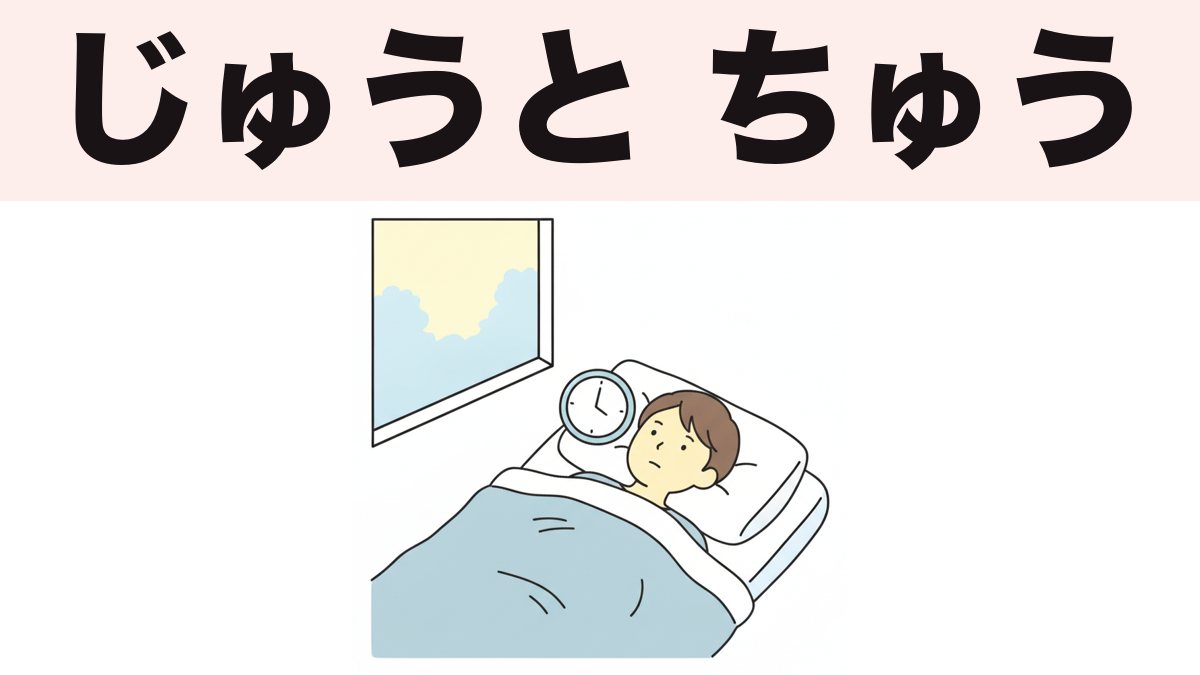
中 read as じゅう means "throughout the whole of it"; read as ちゅう it means "currently in the middle of it" — and picking the wrong reading changes what you said, not just how it sounds.
「中」を「じゅう」と読むと「その全部にわたって」、「ちゅう」と読むと「今そのとちゅう」です。読み方をまちがえると、音ではなく意味が変わります。
This is one of the cheapest wins in Japanese. Two readings, one clear rule, and a pile of everyday words that stop being separate vocabulary items the moment you see the pattern.
The basics
じゅう: the whole extent of something
Attach じゅう to a complete stretch of time or space, and it means "all of it, throughout."
一日中寝ていました。 — I slept all day. (polite; いちにちじゅう) 世界中で人気があります。 — It's popular all over the world. (polite; せかいじゅう) 体中が痛い。 — My whole body aches. (plain; からだじゅう)
The bases are things with a full extent already built in: 一日, 一年, 一晩, 世界, 町, 部屋, 体, 家. You are saying "every part of it."
ちゅう: currently in the middle of it
Attach ちゅう to an activity, and it means the activity is happening right now.
会議中です。 — He's in a meeting. (polite; かいぎちゅう) ただいま準備中です。 — We're getting ready at the moment. (polite; the sign on a restaurant door before opening) 工事中のため通れません。 — You can't get through — construction in progress. (written; road sign)
The bases here are nouns that describe an action, usually the kind that take する: 勉強, 会議, 工事, 準備, 使用, 通話, 営業, 作業.
The rule in one line
| Base is | Reading | Meaning | Example |
|---|---|---|---|
| A period or a space | じゅう | Throughout all of it | 一日中, 世界中 |
| An activity | ちゅう | Currently doing it | 会議中, 準備中 |
一日ちゅう and 会議じゅう are both wrong, and Japanese speakers will hear them as mistakes rather than accents. The good news is that the base tells you the reading almost every time.
Beyond the basics
午前中 is the exception everyone meets
午前中 is ごぜんちゅう — "during the morning" — even though 午前 is a period of time, not an activity.
午前中に電話します。 — I'll call sometime during the morning. (polite)
It works because 午前中 means "within the morning," not "throughout the morning." The whole-extent reading would be 午前中ずっと. There is no 午後中 in common use; for the afternoon people say 午後 or 午後のうちに.
今週中, 今月中: a deadline, not a duration
This is the second ちゅう family, and it is the useful one at work. A time word plus ちゅう plus に means "by the end of."
今週中に終わらせます。 — I'll finish it by the end of this week. (polite; こんしゅうちゅう) 今月中にお返事します。 — I'll reply by the end of this month. (polite)
Note the に. Without it you are describing a stretch; with it you are naming a deadline, which is the same に that turns まで into までに — see から and まで.
Confusingly, 今日中 is きょうじゅう, not きょうちゅう. 今日中に終わらせます is "I'll finish it by the end of today," and it keeps the じゅう reading while doing a ちゅう job. It is worth memorising as its own item.
〜中 vs 〜ている
Both can describe something in progress, and they are not interchangeable.
勉強中です。 — I'm in the middle of studying. (polite; noun-like, slightly formal, common on a status message) 勉強しています。 — I'm studying. (polite; the ordinary verb form)
〜中 is compact and slightly official. It belongs on signs, status indicators and short replies — 外出中 (out of the office), 使用中 (occupied), 営業中 (open for business). In flowing speech, the 〜ている form is normal. The difference is register more than meaning, which is the wider point made in 書き言葉 and 話し言葉.
ずっと does a similar job
For emphasis, じゅう often pairs with ずっと, or ずっと replaces it entirely.
一日中ずっと雨だった。 — It rained all day, the whole time. (plain; the pair adds weight) ずっと待っていました。 — I've been waiting the whole time. (polite; no 中 needed)
ずっと can attach to anything and stresses continuity. じゅう needs a bounded period to fill.
The signs you will actually see in Japan
These are worth recognising before you land:
営業中 — Open for business. (shop sign) 準備中 — Getting ready, not open yet. (the one that catches tourists out) 使用中 — Occupied. (toilet door) 工事中 — Under construction. 調理中 — Being cooked. (on an order screen)
準備中 on a restaurant door does not mean closed forever — it usually means they are between lunch and dinner service.
Common mistakes
- Reading 一日中 as いちにちちゅう. A period takes じゅう.
- Reading 会議中 as かいぎじゅう. An activity takes ちゅう.
- Assuming 今日中 follows the deadline pattern's reading. It is きょうじゅう, and it still means "by the end of today."
- Dropping the に in 今週中に. Without it you describe a stretch of time; with it you name a deadline.
- Using 〜中 in flowing conversation. 勉強中です is fine as a short reply and stilted in the middle of a story. Use 勉強しています.
- Reading 準備中 as "closed." It means "not yet open," which for a restaurant usually means "come back at five."
Practice
Answers are hidden — say yours first, then open. Questions 1 and 2 are a pair: the same kanji, the two readings.
1. Read and translate: 一日中寝ていました。
Show answer
いちにちじゅう — "I slept all day." — 一日 is a period, so 中 is じゅう and means "throughout."
2. Read and translate: 会議中です。
Show answer
かいぎちゅう — "He's in a meeting." — 会議 is an activity, so 中 is ちゅう and means "currently."
3. Say: "It's popular all over the world."
Show answer
世界中で人気があります。 — せかいじゅう. A space with a full extent takes じゅう.
4. Say: "I'll finish it by the end of this week."
Show answer
今週中に終わらせます。 — こんしゅうちゅうに. The に is what turns the stretch into a deadline.
5. How is 今日中 read, and what does it mean?
Show answer
きょうじゅう — "by the end of today." — It keeps the じゅう reading while doing the deadline job. Memorise it as its own item.
6. You see 準備中 on a restaurant door at 3pm. What does it mean?
Show answer
They are not open yet. — Usually between lunch and dinner service, not closed for good. 営業中 is the open sign.
7. Rewrite 勉強中です for the middle of a spoken story.
Show answer
勉強しています。 — 〜中 is compact and slightly official, right for signs and short replies. Flowing speech wants the 〜ている form.
8. Say: "I'll call sometime during the morning."
Show answer
午前中に電話します。 — ごぜんちゅう, the exception. It means "within the morning," not "throughout it."
9. What does dropping the に change in 今月中に返事します?
Show answer
It stops being a deadline. — With に, "by the end of this month." Without it, you are describing a stretch of time instead of promising anything.
10. Say: "My whole body aches."
Show answer
体中が痛い。 — からだじゅう. A body has a full extent, so じゅう.
FAQ
Is there a reliable way to guess the reading? Yes, and it works nearly always: if the base is a period or a place, it is じゅう; if the base is an activity, it is ちゅう. The handful of exceptions (午前中, 今日中) are common enough that you will meet them early and remember them.
Why does 今日中 use じゅう when 今週中 uses ちゅう? There is no satisfying reason — it is a fixed reading. Both mean "by the end of," and both take に for the deadline.
Can I say 午後中? It is not standard. For "during the afternoon," say 午後に or 午後のうちに.
What is 〜中 on a phone status? 通話中 is "on a call," 充電中 is "charging," 送信中 is "sending." All ちゅう, all activities in progress.
Is 一晩中 a word? Yes — ひとばんじゅう, "all night long." 一年中 (いちねんじゅう, all year round) is the other one worth having.
Does 中 ever just mean "inside"? Yes, read なか, as a standalone noun: 箱の中 ("inside the box"). That is the everyday spatial word, and it is covered in Japanese position words.
Vocabulary from this article
Tap the block to select all of it, then copy. In Anki: File → Import, note type Basic, separator Tab — the first column becomes the front, the second the back.
一日中	いちにちじゅう — all day long
一晩中	ひとばんじゅう — all night long
一年中	いちねんじゅう — all year round
世界中	せかいじゅう — all over the world
体中	からだじゅう — all over one's body
今日中	きょうじゅう — by the end of today
今週中	こんしゅうちゅう — by the end of this week
午前中	ごぜんちゅう — during the morning
会議中	かいぎちゅう — in a meeting
準備中	じゅんびちゅう — getting ready, not open yet
営業中	えいぎょうちゅう — open for business
使用中	しようちゅう — occupied, in use
工事中	こうじちゅう — under construction
外出中	がいしゅつちゅう — out of the office
通話中	つうわちゅう — on a call
ずっと	ずっと — the whole time, continuously
I'm Yuuki, a Japanese teacher based in Tokyo. I've taught on italki as a Top 1% teacher and watched over 1,500 anime. Students usually learn 一日中 and 準備中 months apart as unrelated vocabulary, and are mildly annoyed to discover they are the same kanji doing two jobs.
Sources: the author's own lessons and standard reference grammars.
これは日本語の中でも「覚えるのが安くて、よく効く」ところです。読み方は2つ、ルールは1つ、そして毎日見ることばがたくさん、同じ仲間になります。
基本
じゅう: 全部にわたって
時間や場所の「まとまり」につくと、「その全部」という意味になります。
一日中寝ていました。 — I slept all day. (いちにちじゅう) 世界中で人気があります。 — It's popular all over the world. (せかいじゅう) 体中が痛い。 — My whole body aches. (からだじゅう)
前につくのは、はじめから「全体」があるものです。一日、一年、一晩、世界、町、部屋、体、家。「そのどこもかしこも」という意味です。
ちゅう: 今そのとちゅう
動作につくと、「今それをしている」という意味になります。
会議中です。 — He's in a meeting. (かいぎちゅう) ただいま準備中です。 — We're getting ready at the moment. (店のドアのふだ) 工事中のため通れません。 — You can't get through — construction in progress. (道路の表示)
前につくのは、動作を表す名詞です。だいたい「する」がつくものです。勉強、会議、工事、準備、使用、通話、営業、作業。
ルールは1行
| 前につくもの | 読み方 | 意味 | 例 |
|---|---|---|---|
| 期間・場所 | じゅう | その全部にわたって | 一日中、世界中 |
| 動作 | ちゅう | 今している | 会議中、準備中 |
「一日ちゅう」も「会議じゅう」もまちがいです。方言ではなく、まちがいとして聞こえます。でも、前のことばを見れば読み方はほぼ分かります。
もう少し先へ
「午前中」は、みんなが出会う例外
「午前中」は「ごぜんちゅう」です。「午前」は動作ではなく時間なのに、「ちゅう」と読みます。
午前中に電話します。 — I'll call sometime during the morning.
これは「午前のうちに」という意味だからです。「午前じゅうずっと」なら「午前中ずっと」と言います。「午後中」は使いません。午後は「午後に」「午後のうちに」です。
「今週中」「今月中」は、しめきり
もう一つの「ちゅう」の仲間で、仕事で役に立ちます。時間のことば+「ちゅう」+「に」で、「〜の終わりまでに」です。
今週中に終わらせます。 — I'll finish it by the end of this week. (こんしゅうちゅう) 今月中にお返事します。 — I'll reply by the end of this month.
「に」に注目してください。「に」がないと期間の説明、「に」があるとしめきりです。これは「まで」を「までに」に変える「に」と同じです。から と まで を見てください。
ややこしいのは「今日中」です。これは「きょうじゅう」で、「きょうちゅう」ではありません。「今日中に終わらせます」」今日の終わりまでに、です。読みは「じゅう」なのに仕事は「ちゅう」なので、1つの単語として覚えてください。
「〜中」と「〜ている」
どちらも「今している」ですが、同じではありません。
勉強中です。 — I'm in the middle of studying. (名詞っぽい。少しかたい。ステータス表示によく合う) 勉強しています。 — I'm studying. (ふつうの動詞の形)
「〜中」は短くて、少し公式です。ふだ・表示・短い返事に合います(外出中、使用中、営業中)。話の流れの中では「〜ている」が自然です。意味よりも「場所」のちがいで、これは 書き言葉と話し言葉 と同じ話です。
「ずっと」も似た仕事をする
強めたい時、「じゅう」は「ずっと」と組みます。「ずっと」だけでも言えます。
一日中ずっと雨だった。 — It rained all day, the whole time. ずっと待っていました。 — I've been waiting the whole time. (「中」は要らない)
「ずっと」は何にでもつき、「続いている」を強めます。「じゅう」は、はしとはしのある期間が必要です。
日本で実際に見るふだ
行く前に知っておくと便利です。
営業中 — Open for business. 準備中 — Getting ready, not open yet. (旅行者がいちばんまちがえる) 使用中 — Occupied. (トイレのドア) 工事中 — Under construction. 調理中 — Being cooked. (注文の画面)
レストランのドアの「準備中」は「もう閉店」ではありません。だいたい、昼と夜の間です。
よくあるまちがい
- 「一日中」を「いちにちちゅう」と読む。 期間は「じゅう」です。
- 「会議中」を「かいぎじゅう」と読む。 動作は「ちゅう」です。
- 「今日中」を「きょうちゅう」と読む。 「きょうじゅう」で、意味は「今日の終わりまでに」です。
- 「今週中に」の「に」を落とす。 「に」がないと期間、あるとしめきりです。
- 会話の流れで「〜中」を使う。 短い返事ならいいですが、話のとちゅうではかたいです。「勉強しています」に。
- 「準備中」を「閉店」と読む。 「まだ開いていない」です。だいたい「5時にまた来て」という意味です。
練習
答えはかくしてあります。先に言ってから開けてください。1と2は同じ漢字の、2つの読みです。
1. 読んで訳してください: 一日中寝ていました。
答えを見る
いちにちじゅう —「一日ずっと寝ていた」。 — 「一日」は期間なので「じゅう」、意味は「全部にわたって」です。
2. 読んで訳してください: 会議中です。
答えを見る
かいぎちゅう —「今、会議をしています」。 — 「会議」は動作なので「ちゅう」、意味は「今している」です。
3. 「世界のどこでも人気です」を「中」で。
答えを見る
世界中で人気があります。 — せかいじゅう。全体のある場所は「じゅう」です。
4. 「今週の終わりまでに終わらせます」を言ってください。
答えを見る
今週中に終わらせます。 — こんしゅうちゅうに。「に」がしめきりにします。
5. 「今日中」の読みと意味は?
答えを見る
きょうじゅう —「今日の終わりまでに」。 — 読みは「じゅう」、仕事は「ちゅう」。1つの単語として覚えます。
6. 午後3時に店のドアに「準備中」。どういう意味ですか。
答えを見る
まだ開いていません。 — たいてい昼と夜の間です。開いている時は「営業中」。
7. 話のとちゅうで言うなら、「勉強中です」をどう言いますか。
答えを見る
勉強しています。 — 「〜中」は短くて少し公式で、ふだや短い返事に合います。
8. 「午前のうちに電話します」を言ってください。
答えを見る
午前中に電話します。 — ごぜんちゅう。例外です。「午前じゅうずっと」ではありません。
9. 「今月中に返事します」から「に」を取ると、何が変わりますか。
答えを見る
しめきりでなくなります。 — 「に」があると「今月の終わりまでに」。ないと期間の説明になり、約束になりません。
10. 「体のあちこちが痛い」を「中」で。
答えを見る
体中が痛い。 — からだじゅう。体は全体があるので「じゅう」です。
よくある質問
読み方を当てる方法はありますか。 あります。ほぼ当たります。前が期間か場所なら「じゅう」、動作なら「ちゅう」。例外(午前中・今日中)は数が少なく、早く出会うので覚えられます。
「今日中」が「じゅう」で「今週中」が「ちゅう」なのはなぜですか。 決まった読みで、すっきりした理由はありません。どちらも「〜の終わりまでに」で、しめきりにするには「に」が要ります。
「午後中」は言えますか。 標準ではありません。「午後に」「午後のうちに」を使います。
スマホの「〜中」は? 「通話中」」on a call、「充電中」」charging、「送信中」」sending。全部「ちゅう」で、動作のとちゅうです。
「一晩中」は単語ですか。 はい。「ひとばんじゅう」」all night long。「一年中(いちねんじゅう)」も覚えておくと便利です。
「中」が「なか」になることは? あります。名詞として使う時です(「箱の中」)。これは場所のことばで、位置のことば にあります。
この記事に出た単語
このブロックをタップして全部えらんでから、コピーしてください。Ankiでは File → Import、ノートタイプは Basic、区切りは Tab。左が表、右が裏になります。
一日中	いちにちじゅう — all day long
一晩中	ひとばんじゅう — all night long
一年中	いちねんじゅう — all year round
世界中	せかいじゅう — all over the world
体中	からだじゅう — all over one's body
今日中	きょうじゅう — by the end of today
今週中	こんしゅうちゅう — by the end of this week
午前中	ごぜんちゅう — during the morning
会議中	かいぎちゅう — in a meeting
準備中	じゅんびちゅう — getting ready, not open yet
営業中	えいぎょうちゅう — open for business
使用中	しようちゅう — occupied, in use
工事中	こうじちゅう — under construction
外出中	がいしゅつちゅう — out of the office
通話中	つうわちゅう — on a call
ずっと	ずっと — the whole time, continuously
ユウキです。東京で日本語を教えています。 italki の Top 1% 講師で、アニメは1,500本以上見ました。生徒は「一日中」と「準備中」を何か月もはなれて覚えて、あとで同じ漢字だと知って、少しくやしそうな顔をします。
More drills like the ones above, plus a timed JLPT-style mock test: Practice · N4上のような練習問題と、時間つきのJLPT形式のもぎ試験: 練習ページ · N4
Want to try this in a real conversation?
本当の会話で、ためしてみませんか?
30-minute trial lesson, $13. Times shown in your own timezone.
30分の体験レッスン、$13。時間はあなたのタイムゾーンで表示されます。
Book a trial lesson · $13