Is the soba really 100% buckwheat?
It is jūwari — buckwheat flour and water, no wheat binder — and the dough is made in the shop, with the noodles cut and boiled to order. That is the whole reason the shop exists.
Part of: Where to Eat in Akihabara: 11 Shops Compared
Browse more: Maid Cafés, Collab Cafés & Where to Eat
中村麺兵衛 池袋東口店(豊島区東池袋)/2024年11月8日の昼の記録
I ate here on 8 November 2024 and photographed my tray. The hours, address and menu structure below are re-checked against the shop's official site in November 2026 — and the prices get their own honest warning, because this shop has raised them more than once.
One minute from Ikebukuro's East Exit, a ticket machine sells you 100% buckwheat soba that was dough in the same building that morning. Nakamura Menbei is a small chain with a fast-food floor plan and a slow-food claim: the soba is jūwari — buckwheat flour and water, nothing else — mixed in the shop, cut when you order, and boiled straight after. The signature tray pairs it with a katsudon whose cutlet is thick enough to be the point of the dish. It is the Ikebukuro lunch I reach for when the afternoon has anime shops in it and lunch has twenty minutes.
A jūwari soba specialist run like a fast counter — ticket machine at the door, counter seats, food in minutes — that makes its noodles properly. The Ikebukuro Higashiguchi shop opened in February 2023 as the brand's second Tokyo shop after Shibuya, run by the local operator Wood Boy. The kitchen mixes buckwheat flour and water into dough in the shop every day and works to the old three-freshnesses rule — freshly milled, freshly made, freshly boiled — which is why the noodles are cut to order instead of waiting in a pile. The broth leans the other way from the usual Tokyo style: several kinds of dried flakes, blended for depth of dashi rather than a soy-sauce punch.
Half the menu is rice bowls, and the star is built into the shop's name for itself: the atsumi katsudon, a thick-cut pork cutlet under a glossy layer of egg. Note that Ikebukuro has two Menbei shops — this article is about the Higashiguchi (east exit) one; the Rakuen-ten across on the south side is a different room.
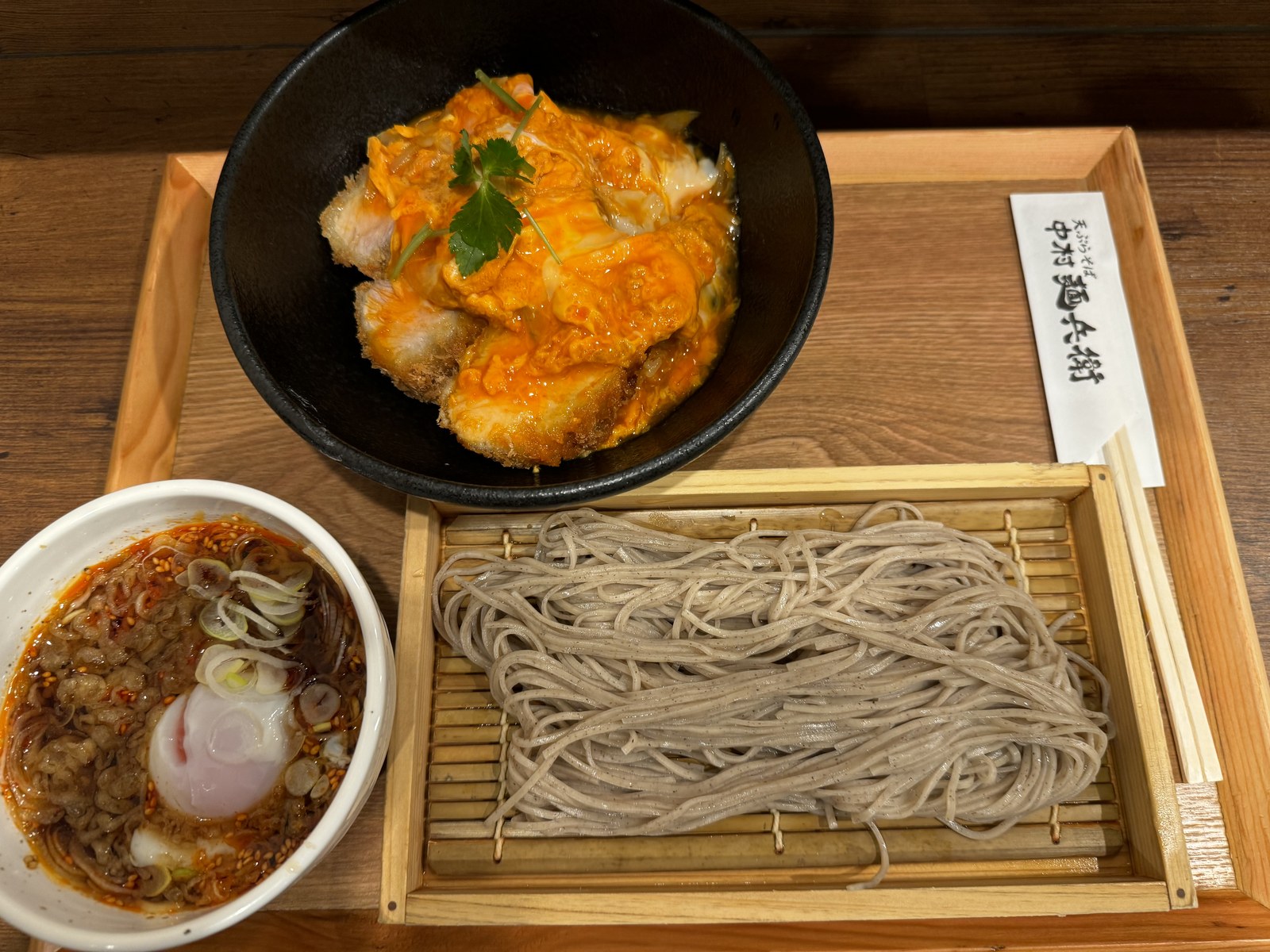
The tray from my visit in November 2024: the thick-cut katsudon and the chilled soba. The shop's name card sits on the tray
The signature set: thick-cut katsudon with soba (厚みかつ丼とそば) — the tray in my photograph. The katsudon is not the usual egg-bound style: the cutlet is genuinely thick, and the rich egg goes over the top rather than sealing it in, so the crust keeps its crunch at the edges. The soba beside it — mine was the chilled version — is the honest test of the kitchen: plain jūwari noodles with a dashi-forward dipping broth, plus a little grated yuzu peel among the condiments, which the regulars notice.
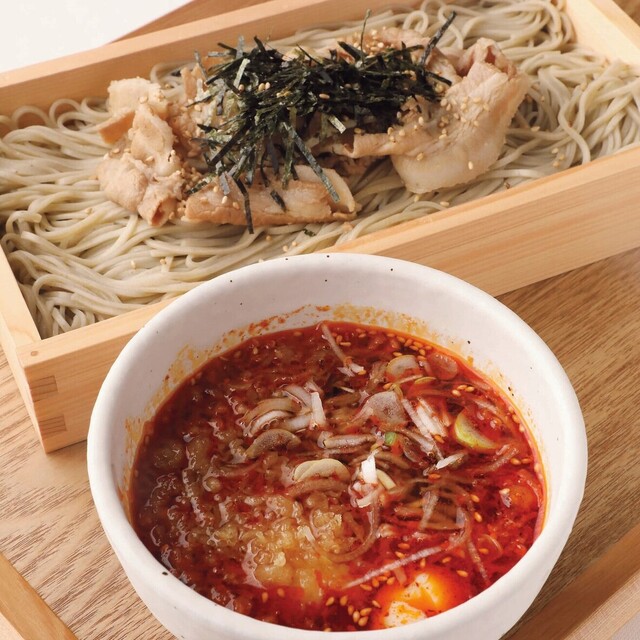
The shop's other signature is the spicy one: pirikara onsen-tamago tsuke soba, cold noodles dipped in a spicy broth with a soft egg, built on the house's own chilli oil. If your group splits both ways, order one of each and trade halfway — that is what the menu is quietly designed for.
Read this table as the menu's shape, then check the ticket machine for today's number. The prices below are transcribed from the shop's published menu. The signature set launched at ¥979–990 when this shop opened in 2023, and diners since have reported paying ¥1,090 and, in April 2026, ¥1,190 for it — the shop revises prices upward in small steps and its own site warns that items and prices differ by branch. The structure has stayed stable even as the numbers moved: soba from ¥500, sets around the ¥1,000 line, rice bowls in the ¥800s.
| Sets — a rice bowl with soba (chilled or hot) | Menu price |
|---|---|
| Thick-cut katsudon & soba (the signature) | ¥980 |
| Thick-cut katsudon & spicy onsen-egg soba | ¥1,080 |
| Rich-egg oyakodon & soba | ¥980 |
| Prawn tendon & soba | ¥980 |
| Maguro tataki don & soba | ¥980 |
| The Beef Curry & soba | ¥980 |
| The Beef Katsu Curry & soba | ¥1,080 |
| Soba on its own | Menu price |
|---|---|
| Mori soba (chilled) | ¥500 |
| Nimai-mori soba (double tray, chilled) | ¥720 |
| Dashi soba (hot) | ¥500 |
| Spicy onsen-egg tsuke soba | ¥680 |
| Spicy onsen-egg meat tsuke soba | ¥880 |
| Curry nanban soba (hot) | ¥780 |
| Daikon-oroshi soba | ¥600 |
| Toriten dashi soba (chicken tempura, hot) | ¥600 |
| Ebi-ten dashi soba (prawn tempura, hot) | ¥720 |
| Rice bowls on their own | Menu price |
|---|---|
| Thick-cut katsudon, rich egg | ¥820 |
| Oyakodon, rich egg | ¥820 |
| Prawn tendon, matured sauce | ¥820 |
| Maguro tataki don | ¥820 |
| White tororo katsudon | ¥880 |
Even at the higher recent prices, the arithmetic holds: a hand-made jūwari set beside a main station for roughly the cost of a coffee-shop lunch is why this place is full of locals at noon.
Ticket machine first, then hand the ticket over and wait at the counter — the whole system is built for speed. There are two machines by the entrance. Water is self-service from the corner station, where you will also find soba-yu (the hot water the noodles were boiled in, for thinning your dipping broth at the end) and paper aprons. One small kindness worth copying from the regulars: the larger of the two machines takes ¥10,000 notes, which saves the usual ticket-machine dance with a wallet full of big bills.
The price in any article — including this one — is a snapshot, and this shop moves its prices. Treat the table above as the menu's structure and confirm the set's price on the ticket machine; if it reads ¥1,190, that is the current truth, not a rip-off. The second catch is payment: my sources flatly disagree (one 2026 visit report says cash only; a listings site says cards and e-money are accepted), so I am not going to settle it from my desk — carry cash.
Beyond that: the official site lists irregular closing days (不定休), so a closure is possible on any given day; and this is a working lunch room — counter seats, quick turnover, no lingering over coffee. That is a feature at 12:15 with a train at 13:00, and a mismatch if you wanted a long, quiet lunch.
Any day, 10:30–23:00, last order 22:30 — those are the official site's hours for this shop, with irregular holidays. The early opening is the useful detail: an 11:00 lunch here beats the noon rush entirely, and the late close makes it a real dinner option after an Ikebukuro afternoon rather than a lunch-only stop.
1-3-3 Higashi-Ikebukuro, Toshima-ku (Iryu Building 1F) — out of Ikebukuro Station's East Exit on the Parco side, about a minute's walk; Tabelog measures it at 217 metres from the station. If you reach the Sunshine-dōri arcade, you are already there.
| Style | Jūwari (100% buckwheat) soba, made in-house and cut to order; rice-bowl sets |
| Budget | Soba from ¥500; sets around ¥980–1,190 (prices rise in steps — check the machine) |
| First-timer order | Thick-cut katsudon & soba set — the signature tray |
| Hours | 10:30–23:00 (LO 22:30), irregular holidays (official site) |
| Address | 1-3-3 Higashi-Ikebukuro, Toshima-ku (Iryu Bldg 1F) |
| Nearest station | Ikebukuro, East Exit, ~1 min |
| Payment | Not confirmed — sources conflict; bring cash |
| English | Tabelog lists a multilingual (English) menu for this shop |
| Visited | 8 November 2024 (Friday) |
It is jūwari — buckwheat flour and water, no wheat binder — and the dough is made in the shop, with the noodles cut and boiled to order. That is the whole reason the shop exists.
Ikebukuro Station, East Exit (Parco side), about one minute on foot — 217 metres by Tabelog's measure. Careful: there are two Menbei shops in Ikebukuro. This article covers the Higashiguchi (east exit) shop at 1-3-3 Higashi-Ikebukuro, not the Rakuen-ten on the south side.
Buy a ticket, hand it over, eat — I walked in at lunch. The system is built for people between trains, and the food follows within minutes.
According to Tabelog's listing for this shop, a multilingual menu including English is available. I did not photograph it on my visit, so that is the listing's word rather than my photograph — between it and the table in this article, ordering holds no puzzles either way.
I did not confirm it, and my sources disagree with each other — a 2026 visit report says cash only, a listings site says cards and e-money are fine. Carry cash and treat anything else as a bonus.
On a private, tailor-made day. Ikebukuro is one of my regular patches, and a fast, filling lunch like this is what keeps an afternoon of anime shops on schedule — mention Menbei when you book.
I visited on 8 November 2024; the tray photograph is from that visit — the shop's own name card sits on the tray in the frame — and what I ate (the thick-cut katsudon with chilled soba) is described from the photograph and my visit record.
Opening hours, the address, the telephone number and the irregular-holidays note are from the shop's official site (nakamura-menbei.com), re-checked on 11 November 2026; the official site itself warns that menu items and prices differ by branch. The menu structure and the menu prices in the table are transcribed from the shop's published menu as reproduced by Toshima Life. Prices are the weak point and I have written them that way in the article: the signature set was ¥979–990 at this shop's 2023 opening (Ikebukuro Keizai's opening report), and later diners report ¥1,090 (Tabelog review) and ¥1,190 (a visit in April 2026) — expect the ticket machine to be the final authority. The in-house dough-making, the cut-to-order noodles and the flake-blend broth are from Ikebukuro Keizai's opening report and the operator's own descriptions; the two ticket machines, the self-service corner and the ¥10,000-note detail are from Ikebukuro Times' visit report. The English-menu point is Tabelog's listing, not something I photographed.
I did not confirm payment methods — published sources conflict, and the article says so rather than picking one. I have not printed a Google rating for this shop; I did not verify one for this draft.
No affiliate links. This is a lunch I have repeated on Ikebukuro days; it earns its place by being fast without being careless.
About the author. I am Yuuki, a local guide based in Akihabara. I run private tours in English, tailor-made for one group at a time, and I find places like this one by walking the neighbourhoods myself — this article is one of the finds. I have also watched over 1,500 anime series, which is either a qualification or a warning depending on your point of view.
See the private Akihabara tour →
Sources
A private half-day with a local otaku guide, planned around your fandom. Three to four hours in English, never mixed with other travelers, rated 4.96 by 171 Airbnb guests. Booking here goes straight into my calendar.
Book the private Akihabara anime tour direct See Yuuki's Japan Kit