だ or です: the one decision that changes how you sound「だ」か「です」か: 話し方が変わる、たった1つの決めごと
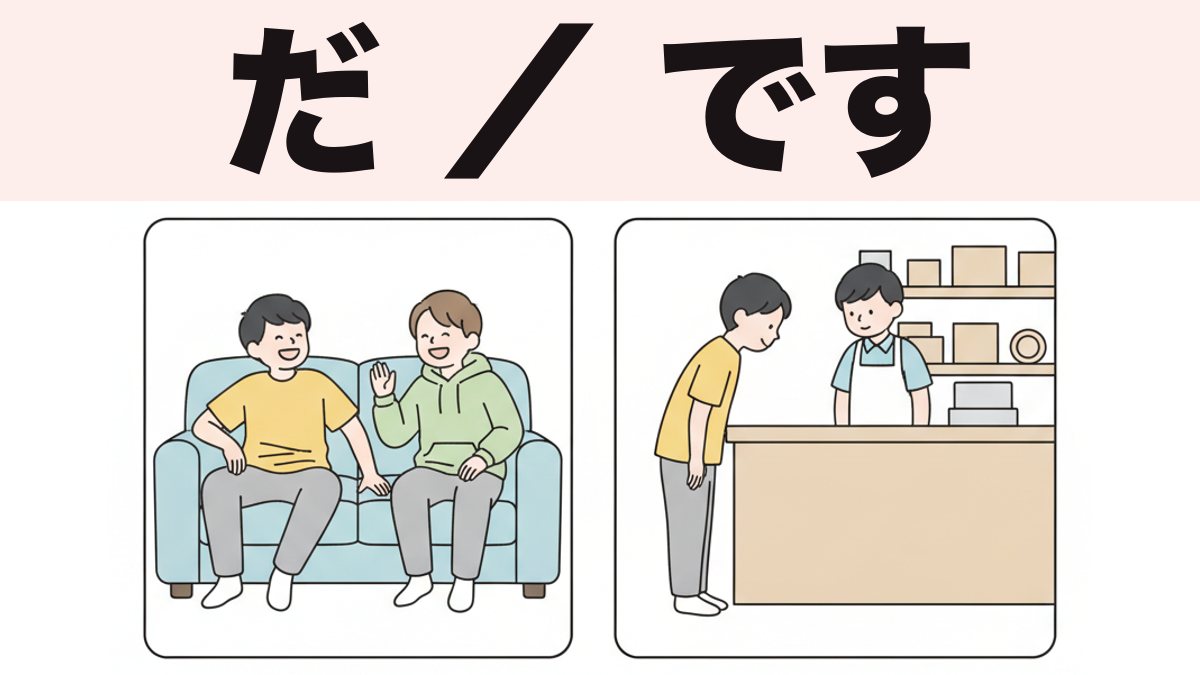
English carries politeness in word choice. Japanese carries it in the last two syllables.
英語は「ことばの選び方」でていねいさを出します。日本語は「文の最後の2文字」で出します。
That is genuinely good news. It means you do not need a second vocabulary to be polite — you need one switch, thrown at the right moment.
The switch
学生だ。 — I'm a student. (plain) 学生です。 — I'm a student. (polite)
行く。 — I'll go. (plain) 行きます。 — I'll go. (polite)
Same information. Same words. Different relationship.
Which to use
です/ます — the safe default. Anyone you did not go to school with. Shops, work, teachers, strangers, anyone older, anyone you just met. If you are unsure, this is the answer, always.
Plain form — close range. Friends, family, people clearly junior to you, and your own head. Also every book, article and subtitle you will ever read, because writing uses plain form by default.
Beginners are told "use です" and left there, which produces a learner who sounds like a form letter with their friends. Both forms are necessary. です is just the one to be defaulted to.
The mistake that actually matters
Not "too plain." Inconsistency.
❌ 昨日 映画を 見た。とても 面白かったです。
Half casual, half polite, in two sentences. To a Japanese ear this is more jarring than being uniformly casual, because it sounds like the speaker is switching how they feel about you mid-thought.
Pick one register per conversation and stay there. If you must change, change at a clear boundary — a new topic, a new person joining.
The two exceptions worth knowing early
1. Questions to yourself stay plain. Even in the most polite conversation, thinking out loud uses plain form.
えーと、何だっけ… — er, what was it again…
2. Relative clauses are always plain. The polite form only ever lives at the end of a sentence. Inside, everything goes plain, no matter how formal you are being.
昨日 見た 映画は 面白かったです。 — The film I saw yesterday was interesting.
見た stays plain because it is describing 映画, not ending the sentence. Learners who try to be polite all the way through produce 見ました映画, which is wrong, and it is a very common wrong.
Softening without switching
Sometimes です feels too distant but plain feels too blunt. Japanese has a middle setting, and it is mostly small particles:
行くよ。 — I'll go, just so you know. (informative, warm) 行くね。 — I'll go, right? (seeking agreement) 行くけど… — I'll go, but… (leaves room)
These are how friends actually talk. Plain form with no particle at all is the flattest, coldest option — which is exactly why it works so well for anime characters who are supposed to be cold.
How to practise it
Take five sentences you already know in です form and say each one plain. Then reverse it. Two minutes, and it rewires the ending rather than the sentence, which is the whole point.
Then listen for it. Next time you watch something, ignore the words and track only the endings — who is using です with whom. You will see the entire social map of the show in about ten minutes.
In a lesson
I will move between the two on purpose during a lesson so you can hear the temperature change. Most students find that after one session they cannot un-hear it, and their Japanese starts landing where they meant it to.
これは、いいニュースです。ていねいに話すために、新しいことばをたくさん覚える必要はありません。スイッチを1つ、正しいタイミングで切りかえるだけです。
スイッチ
学生だ。 — I'm a student. (ふつう) 学生です。 — I'm a student. (ていねい) 行く。 — I'll go. (ふつう) 行きます。 — I'll go. (ていねい)
情報は同じ。ことばも同じ。ちがうのは「相手との関係」だけです。
どちらを使う?
です/ます — 安全なほう。 学校で一緒ではなかった人、お店の人、仕事の人、先生、知らない人、年上の人。まよったら、いつもこちらです。
ふつうの形 — 近い人に。 友だち、家族、自分よりはっきり下の人、そして自分の心の中。本、記事、字幕は、ぜんぶふつうの形で書かれています。
初心者は「ですを使いなさい」と言われて、そこで止まります。すると、友だちにも手紙のように話す人になります。両方が必要です。「です」は、まよったときの基本、というだけです。
本当に大事なまちがい
「ふつうすぎる」ことではありません。まぜることです。
❌ 昨日 映画を 見た。とても 面白かったです。
半分ふつう、半分ていねい。日本人の耳には、ずっとふつうで話すよりも変に聞こえます。話している途中で、相手への気持ちが変わったように聞こえるからです。
1つの会話では、1つの形を選んで、最後まで続けてください。変えるなら、はっきりした区切りで。新しい話題、新しい人が来たとき、などです。
早く知っておきたい2つの例外
1. 自分への質問は、ふつうの形。 どんなにていねいな会話でも、考えごとを声に出すときはふつうの形です。
えーと、何だっけ… — er, what was it again…
2. 文の中の文は、いつもふつうの形。 ていねいな形は、文の最後にだけあります。文の中では、どんなにていねいに話していても、ふつうの形です。
昨日 見た 映画は 面白かったです。 — The film I saw yesterday was interesting.
「見た」は「映画」を説明しているだけで、文を終わらせていません。だから、ふつうの形です。「見ました映画」と言う人がいますが、これはまちがいです。
スイッチを切りかえずに、やわらかくする
「です」は遠い、でもふつうの形は強すぎる。そう感じるときは、日本語には真ん中があります。小さなことばを足すだけです。
行くよ。 — I'll go, just so you know. (気軽で、あたたかい) 行くね。 — I'll go, right? (相手に確かめる) 行くけど… — I'll go, but… (ふくみをもたせる)
友だちは、こうやって話します。何も足さないふつうの形は、いちばん平らで、冷たい形です。だから、アニメの冷たいキャラクターによく合うのです。
練習のしかた
「です」の形で知っている文を5つ選んで、ふつうの形で言ってみてください。次に、その反対。2分で、文ではなく「最後」を切りかえる感覚がつきます。それが全部です。
そして、聞いてください。次にアニメを見るとき、ことばではなく「最後」を追いかけてみてください。だれが、だれに「です」を使っているか。10分で、その作品の人間関係が全部見えます。
レッスンでは
レッスンでは、わざと2つの形を行ったり来たりします。温度の変化を、耳で聞いてほしいからです。1回のレッスンで、もう「聞こえないふり」ができなくなります。そして、あなたの日本語が、ねらった場所に着地しはじめます。
More drills like the ones above, plus a timed JLPT-style mock test: Practice · N5上のような練習問題と、時間つきのJLPT形式のもぎ試験: 練習ページ · N5
Want to try this in a real conversation?
本当の会話で、ためしてみませんか?
30-minute trial lesson, $13. Times shown in your own timezone.
30分の体験レッスン、$13。時間はあなたのタイムゾーンで表示されます。
Book a trial lesson · $13