Shiritori: the rules of the Japanese word chain gameしりとりルールと負けないための考え方
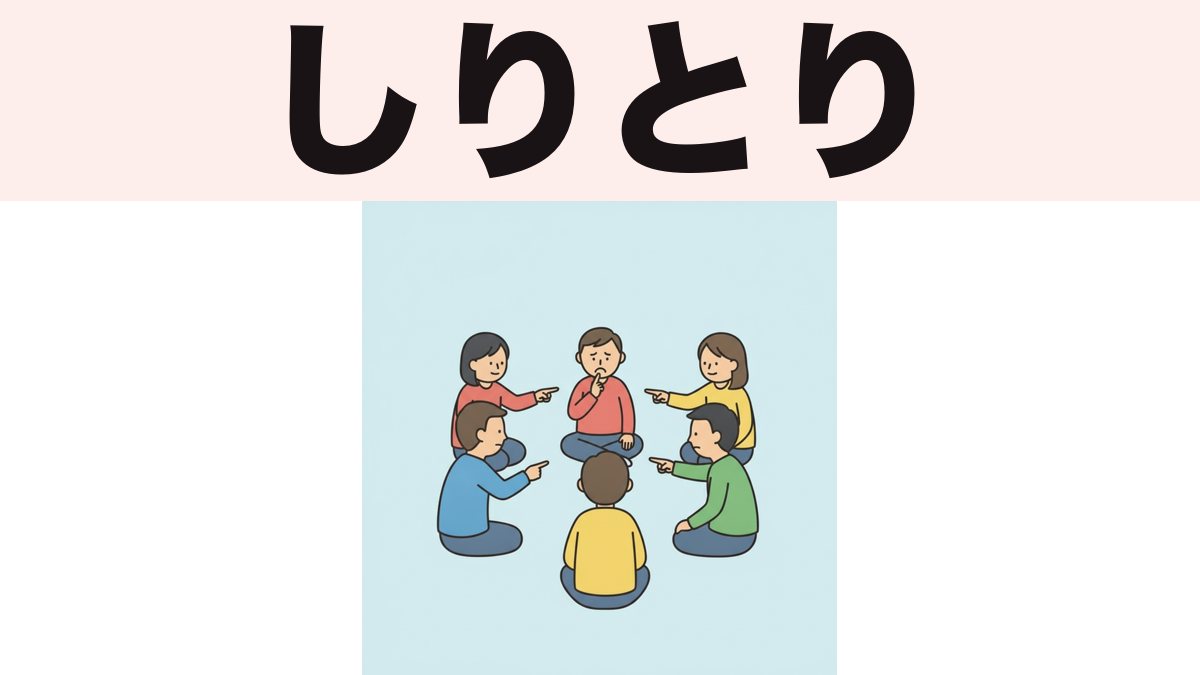
Shiritori (しりとり) is a word chain game. Someone says a word, the next person says a word that starts with the last sound of it, and you keep going around the circle. You lose if you cannot answer, if you repeat a word someone already said, or if you say a word ending in ん.
しりとりは、ことばをつなげるゲームです。だれかがことばを言います。次の人は、そのことばの最後の文字から始まることばを言います。答えられないとき、だれかと同じ答えをしたとき、「ん」で終わることばを言ったときに負けです。
This was the very first episode of my NihonGO podcast, recorded back in March 2019 for the free Discord lessons I was running at the time. I have rewritten and expanded it here, because shiritori is still the single easiest game to start playing on the day you learn hiragana.
How do you play shiritori?
Answer — One player says any noun. The next player says a noun beginning with the final character of that word. Repeat until someone gets stuck. The person who ends the chain loses.
The word itself explains the rules: 尻 (しり, "the rear") + 取り (とり, "taking"). You take the rear of the word.
さくら → らくだ → だいこん sakura (cherry blossom) → rakuda (camel) → daikon (radish)
だいこん ends in ん, so the person who said it just lost.
Three rules end a game:
| How it ends | What happened | Who loses |
|---|---|---|
| No answer | Nobody can think of a word starting with that sound | The person who cannot answer |
| Repeat | A word that has already been used comes up again | The person who repeated it |
| ん | A word ending in ん is played | The person who said it |
The ん rule exists for a simple reason: no Japanese word begins with ん. The chain physically cannot continue, so playing one is treated as giving up.
Why do so many beginners lose on ん?
Because a huge share of the vocabulary a beginner learns first ends in ん: みかん, ぱん, ラーメン, にほん, しんぶん, かばん, じかん. Beginner word lists are full of them, so the losing move is also the most available one. If you play without checking the last character of your own word, you will hand the game away inside three turns.
The fix is to practise the opposite habit: before you speak, look at the end of your own word. This sounds trivial, and it is exactly the skill that makes the game useful. You are being forced to hear a word as a sequence of characters rather than as a lump of sound, which is the thing that most learners are still not doing at the point where they can already hold a simple conversation.
What counts as a valid word?
The standard rules are:
- Nouns only. No verbs, no adjectives, no particles. 「たべる」 is out.
- No proper nouns, in the strict version. Casual games often allow place names and anime characters, which makes it far easier for beginners. Agree before you start.
- A word ending in ー hands over the vowel it extends. コーヒー → ひつじ. The ー is not a character you can pass on.
- Small characters (っ, ゃ, ゅ, ょ) usually count as their full-size version. きって → てがみ.
- が, ば, ぱ rows can start with the plain version. かばん → ばなな, or ばんごはん if you are trying to lose.
If you are playing with children, the only rules enforced are "no repeats" and "no ん". Everything else is negotiable, and that is the spirit of it.
Which sounds should you be afraid of?
Some endings are traps because very few words begin with them. る is the famous one: 「るすばん」「ルーレット」「ルビー」and then you are out of ideas. Experienced players deliberately hand る to the next person.
The dangerous handoffs, roughly in order:
- る — almost nothing starts with it
- ぬ — ぬいぐるみ, ぬの, and that is about it
- を, ん — ん is an instant loss; を never starts a word
- ゆ, よ, れ, ろ — thin, but survivable
Learning three or four words for each of those is the whole strategy. It also happens to be a genuinely useful vocabulary drill, which is why teachers keep using this game.
Is shiritori actually good Japanese practice?
Answer — Yes, for two specific skills: recall speed and character awareness. It is bad practice for grammar, because you never build a sentence. Use it as a five-minute warm-up, not as a lesson.
What it trains well:
- Retrieval under pressure. You know the word. The game asks whether you can produce it in two seconds, which is the gap between "I studied this" and "I can speak".
- Hearing the last character. Beginners routinely mishear ん at the end of a word, or miss that こうえん is four characters, not three.
- Vocabulary gaps. The moment you get stuck on ね, you have found a hole in your vocabulary, and it is a hole you now care about.
What it does not train: particles, conjugation, politeness level, or anything to do with putting words together. For that you need to actually talk, which is what my 1-on-1 lessons are for.
How do you play it on your own?
Write the chain down instead of speaking it, and give yourself a time limit per word. Or play the harder solo version: every word has to be from one category, and you still cannot end in ん. Ten words in a row from "food" is a real workout.
If you want a version of this with more structure, the Yamanote Line game is the category-based cousin of shiritori and it is the one Japanese people actually play at drinking parties.
Frequently asked questions
Can I use katakana words? Yes. ラーメン, テレビ, コンビニ are all fine. Remember that ー is not a character you can hand over: コーヒー ends in ヒー, so the next word starts with ひ.
What happens with words ending in a long vowel? Convention is you use the vowel. コーヒー → ひつじ (treating it as ひ) is the common house rule, though some groups say the next word must start with the vowel sound itself. Agree first.
Is there a version for kanji? Yes, and it is much harder: 四字熟語しりとり chains four-character compounds. Save it for later.
Do Japanese adults still play this? On long car journeys and with small children, constantly. At drinking parties they switch to the Yamanote Line game, because it is faster and louder.
Play it in your next lesson
If you can read hiragana, you can play shiritori today, and it will show you exactly which words you have and which ones you only think you have.
I am Yuuki, an online Japanese teacher and an Akihabara anime tour guide. I have been teaching Japanese through games, anime and normal conversation since the Discord days this podcast came from, and I still open lessons with a round of shiritori when a student needs to warm up.
Sources: this article is a rewrite of episode 1 of my NihonGO podcast (recorded 2019-03-12). House rules described here are the common Japanese conventions as I teach them; shiritori has no single governing rule set.
これは、僕の Podcast「NihonGO」の第1回です。2019年3月に、無料の Discord レッスンのために録音しました。ここでは、書き直して、もう少しくわしくしています。ひらがなを覚えた日からすぐに遊べるゲームなので、今でもいちばん最初にすすめます。
しりとりのルール
答え — まず、だれか 1人が、思いついたことばを言います。次の人は、前の人が言ったことばの最後の文字から始まることばを言います。同じルールで、順番につづけます。ゲームを終わらせた人が負けです。
「しりとり」という名前は、ルールの説明になっています。尻(しり・うしろ)を取る、ということです。
さくら→らくだ→だいこん
「だいこん」は「ん」で終わります。だから、これを言った人が負けです。
ゲームが終わる理由は 3つあります。
| 終わり方 | 何がおきたか | 負ける人 |
|---|---|---|
| 答えが出ない | だれもことばを思いつかない | 答えられなかった人 |
| 同じ答え | もう出たことばをもう一度言う | くり返した人 |
| 「ん」 | 「ん」で終わることばを言う | 言った人 |
「ん」のルールには、かんたんな理由があります。日本語には、「ん」から始まることばがありません。だから、つづけることができません。
どうしてみんな「ん」で負けるのか
最初に覚えることばには、「ん」で終わるものがとても多いからです。みかん、ぱん、ラーメン、にほん、しんぶん、かばん、じかん。初級のことばリストは「ん」でいっぱいです。自分のことばの最後を見ないで話すと、3回くらいで負けます。
直し方は、はんたいの習慣をつけることです。話す前に、自分のことばの最後を見る。かんたんに聞こえますが、これがこのゲームの役に立つところです。ことばを「音のかたまり」ではなく「文字のならび」として聞く練習になります。
使えることばは何か
ふつうのルールはこうです。
- 名詞だけ。 動詞や形容詞は使えません。「たべる」はだめです。
- 人の名前・地名は使わない(きびしいルール)。ゲームの前に決めておきましょう。
- 「ー」で終わることばは、のばしている母音をわたします。 コーヒー→「ひ」。「ー」はわたせません。
- 小さい「っ」「ゃ」「ゅ」「ょ」は、ふつうの大きさとして数えます。 きって→てがみ。
- 「が」「ば」「ぱ」は、「か」「は」「は」から始めてもいい ことが多いです。
子どもと遊ぶときは、「同じ答えはだめ」と「『ん』はだめ」の 2つだけ守ればじゅうぶんです。
こわい文字
つぎの人にわたすときびしい文字があります。「る」が有名です。「るすばん」「ルーレット」「ルビー」……そして、もう出てきません。じょうずな人は、わざと「る」をわたします。
あぶない文字は、だいたいこの順番です。
- る — 始まることばがほとんどない
- ぬ — ぬいぐるみ、ぬの、それくらい
- を・ん — 「ん」はすぐ負け。「を」から始まることばはない
- ゆ・よ・れ・ろ — 少ないけれど、まだだいじょうぶ
この文字ごとに 3つか 4つことばを覚えておく。これがぜんぶの作戦です。そして、これはそのままことばの練習になります。
しりとりは日本語の練習になるのか
答え — なります。ただし、2つの力だけです。「思い出す速さ」と「文字を聞く力」です。文を作らないので、文法の練習にはなりません。5分のウォーミングアップとして使ってください。
よく練習できること。
- 急いで思い出す力。 ことばは知っている。それを 2秒で言えるか。ここが「勉強した」と「話せる」のあいだです。
- 最後の文字を聞く力。 初級の人は、ことばの最後の「ん」を聞きのがします。「こうえん」が 4文字だと気づかない人もいます。
- 足りないことばが見つかる。 「ね」でつまったとき、自分のことばの穴が見つかります。
練習にならないこと。助詞、活用、ていねいさ、そして文を作ること。それには、実際に話す必要があります。それが 1対1のレッスン のしごとです。
1人で遊ぶ方法
声に出すのではなく、書いてつなげます。そして、1つのことばにかける時間を決めます。もっとむずかしいやり方もあります。ぜんぶのことばを 1つのテーマから選ぶ。それで「ん」もだめ。「食べもの」で 10個つづけるのは、かなりたいへんです。
もっときちんとしたルールで遊びたいときは、山手線ゲーム がしりとりの親せきです。日本人が飲み会で遊ぶのは、こちらのほうです。
よくある質問
カタカナのことばは使えますか。 使えます。ラーメン、テレビ、コンビニ、ぜんぶだいじょうぶです。「ー」はわたせないので、「コーヒー」の次は「ひ」から始めます。
のばす音で終わることばはどうしますか。 ふつうは、その母音を使います。コーヒー→「ひ」。ただし、グループによってちがうので、先に決めてください。
漢字のしりとりもありますか。 あります。四字熟語しりとり。ずっとむずかしいので、後で。
大人もまだ遊びますか。 長い車の移動と、小さい子どもといるときは、よく遊びます。飲み会では山手線ゲームになります。
レッスンで遊んでみる
ひらがなが読めれば、今日からしりとりができます。そして、自分が「持っていることば」と「持っているつもりのことば」がすぐにわかります。
僕はユウキです。オンラインの日本語教師で、秋葉原のアニメツアーガイドもしています。この Podcast のもとになった Discord のころから、ゲームとアニメとふつうの会話で日本語を教えています。今でも、生徒がかたくなっているときは、しりとりから始めます。
More drills like the ones above, plus a timed JLPT-style mock test: Practice上のような練習問題と、時間つきのJLPT形式のもぎ試験: 練習ページ
Want to try this in a real conversation?
本当の会話で、ためしてみませんか?
30-minute trial lesson, $13. Times shown in your own timezone.
30分の体験レッスン、$13。時間はあなたのタイムゾーンで表示されます。
Book a trial lesson · $13