〜んです: the ending that connects your sentence to the situation〜んです: 文と場面をつなぐことば
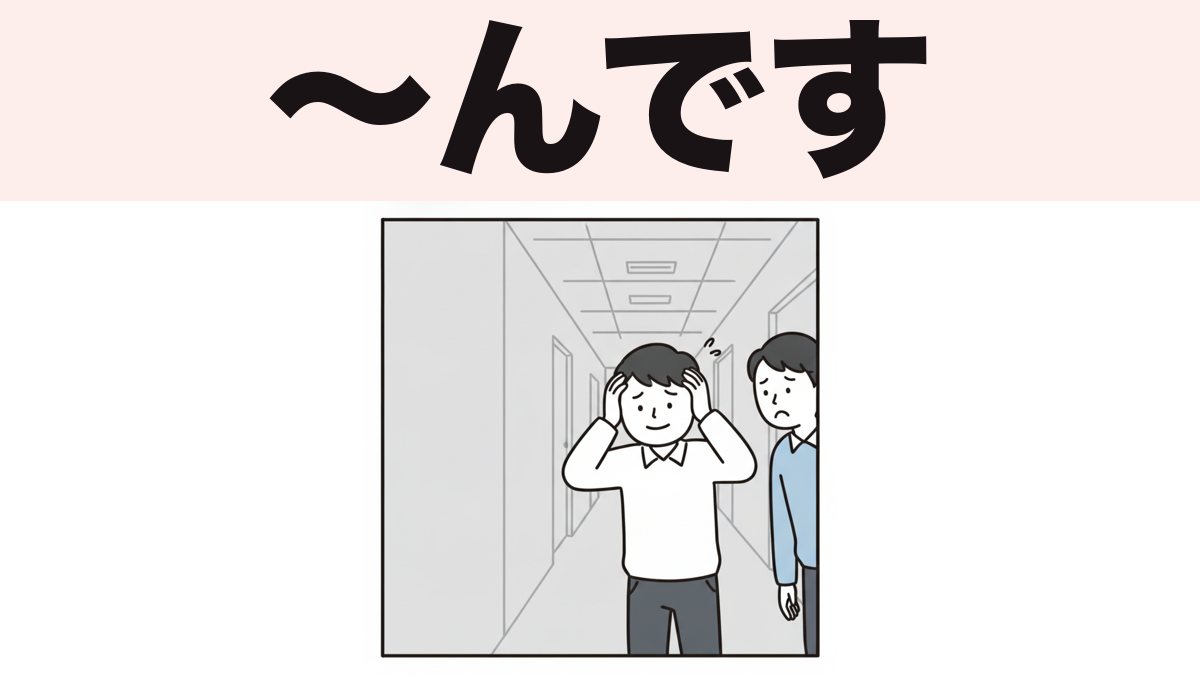
〜んです adds no new information to a sentence. What it adds is a connection: "this is the explanation for what you're seeing." That is why it is everywhere in real conversation and almost absent from beginner textbooks, and why leaving it out makes correct Japanese sound strangely disconnected.
「〜んです」は、文に新しい情報を足しません。足すのは「つながり」です。「これが、今のことのせつめいです」と言います。だから会話にはたくさん出て、初級の教科書にはあまり出ません。そして、これがないと、正しい日本語なのに、どこか切れて聞こえます。
The frustrating thing about 〜んです is that both versions of a sentence are grammatical. 頭が痛いです and 頭が痛いんです are both correct. They are used in different moments, and a learner who only has the first will spend years sounding subtly off without ever being corrected.
The basics
How do you build it?
Take the plain form and add んです. The only thing to watch is nouns and な-adjectives, which need な.
| Type | Plain | 〜んです |
|---|---|---|
| Verb | 行く | 行くんです |
| Verb, past | 行った | 行ったんです |
| い-adjective | 痛い | 痛いんです |
| な-adjective | 静かだ | 静かなんです |
| Noun | 学生だ | 学生なんです |
学生んです and 静かんです are the standard mistake, and the fix is one character — the same な that appears before ので. If you learned 学生なので, you already know this rule.
The full written form is 〜のです. In speech it contracts to 〜んです, and casually to 〜んだ or just 〜の.
What does it actually do?
It marks your sentence as relevant to something already in the room. Compare:
頭が痛いです。 — I have a headache. (a fact, announced from nowhere) 頭が痛いんです。 — I have a headache. (…which is why I'm leaving early / why I look like this)
The second one is an explanation. Something prompted it — a question, a look on someone's face, the situation itself — and んです is the thread tying your sentence back to that.
This is why it feels invisible in translation. English does the same job with intonation and with phrases like "the thing is" and "you see."
The three everyday jobs
1. Giving a reason for something visible:
すみません、電車が遅れたんです。 — Sorry — the train was delayed. (explaining why I'm late)
2. Asking for an explanation:
どうしたんですか。 — What's wrong? / What happened? (you noticed something) どうして来なかったんですか。 — Why didn't you come?
Why-questions are the clearest case: どうして来ませんでしたか is grammatical but sounds flat and almost interrogatory. Native speakers reach for んですか, because asking "why" is asking for an explanation, which is exactly what んです is for.
3. Setting up a request with 〜んですけど:
すみません、道が分からないんですけど… — Excuse me, I'm lost, but… (and then you stop)
This is one of the most useful sentence shapes in the language. You state your situation with んです, add けど, and trail off. The listener supplies the offer of help. Asking directly would be heavier; this gives them room to volunteer.
Beyond the basics
Too many んですか sounds like an interrogation
This is the failure mode nobody warns you about. Because 〜んですか asks for an explanation, stacking them turns friendly curiosity into a cross-examination.
日本に住んでるんですか。仕事は何なんですか。どうして日本に来たんですか。
Every sentence is grammatical and polite. Together they sound like a border check. The fix is to mix in plain questions and statements:
日本に住んでるんですか。 — Oh, you live in Japan? (one んですか, showing interest) いいですね。お仕事は? — Nice. And what do you do? (plain, light)
One んですか per topic is plenty. It signals "tell me more about that"; three in a row signals "explain yourself."
When you should not use it
んです wants there to be something to explain. With a plain, context-free statement it sounds like you are answering a question nobody asked.
○ はじめまして。田中です。学生です。 — Nice to meet you. I'm Tanaka. I'm a student. .△ はじめまして。学生なんです。 (sounds like it's explaining something — but what?)
Self-introductions, weather remarks, and simple announcements do not need it. The rule of thumb: if nothing prompted your sentence, drop the んです.
The casual forms
In casual speech it shrinks, and the shape differs slightly between statements and questions.
行くんだ。 — I'm going. (casual statement, explanatory) 行くの? — Are you going? (casual question — の alone, rising) どうしたの? — What's up? (the casual どうしたんですか)
Plain 〜の as a question is extremely common and worth having. Note that 〜の as a statement (行くの。) reads as softer and is used more by women and by children in speech; 〜んだ is the neutral casual statement form.
んです vs からです
Both relate to reasons, and they are not interchangeable.
どうして休んだんですか。 — Why did you take the day off? 熱があったからです。 — Because I had a fever. (a direct answer to "why") 熱があったんです。 — I had a fever. (offering the situation as the explanation)
からです answers a why-question head on. んです offers the circumstance and lets the listener draw the conclusion — softer, and more common in conversation. In an apology especially, んです lands better than からです, for the same reason ので beats から.
How does it sound in anime?
The casual forms carry enormous amounts of dialogue, usually as 〜んだ and 〜の.
そうなんだ。 — Oh, I see. (the single most common reaction line in Japanese) どういうことなんだ。 — What is going on? 知ってたんだ。 — So you knew.
そうなんだ deserves memorising on its own. It is the standard "ah, I see" when you receive new information, and its polite version そうなんですか is equally useful. Both mean "so that's the explanation" — which is んです doing precisely its job.
Common mistakes
- 学生んです / 静かんです. Nouns and な-adjectives need な: 学生なんです, 静かなんです.
- Stacking んですか. Three in a row is an interrogation. One per topic, mixed with lighter questions.
- Using it in a self-introduction. 学生です, not 学生なんです, unless you are explaining something specific.
- Leaving it out of why-questions. どうして来なかったんですか is what people say; どうして来ませんでしたか sounds cold and formal.
- Missing 〜んですけど for requests. Stating your problem and trailing off is the natural way to ask for help. A direct request is heavier.
- Thinking it makes a sentence more polite. It does not change politeness at all — です stays です. It changes whether the sentence is connected to the situation.
Practice
Answers are hidden — build yours first, then open. Questions 3 and 4 are a pair: the same information, and んです decides whether it explains anything.
1. Make 行く into the 〜んです form.
Show answer
行くんです — plain form plus んです. Verbs and い-adjectives attach directly, with nothing to change.
2. Something is wrong here: 学生んです。
Show answer
学生なんです — nouns and な-adjectives take な before んです. It is the same な that appears before ので.
3. What does 頭が痛いです mean, and when would you say it?
Show answer
"I have a headache" — announced as a bare fact — nothing connects it to the situation. Fine as an answer to "how are you feeling?"
4. What does 頭が痛いんです add?
Show answer
It explains something — the headache is the reason for whatever the other person just noticed: why you're leaving, why you look unwell. This is the pair to question 3: same fact, now connected.
5. Ask "why didn't you come?" the way a native speaker would.
Show answer
どうして来なかったんですか — why-questions want んですか, because asking why is asking for an explanation. どうして来ませんでしたか sounds flat and slightly cold.
6. You are lost and want help. Say your situation and stop.
Show answer
すみません、道が分からないんですけど… — state the situation with んです, add けど, trail off. The listener offers the help, which is lighter than asking outright.
7. Why does 日本に住んでるんですか。仕事は何なんですか。どうして来たんですか。sound wrong?
Show answer
Three んですか in a row is an interrogation — each one demands an explanation. One per topic, mixed with plain questions, sounds like interest instead.
8. Make 行くんですか casual.
Show answer
行くの? — casual questions use の alone with rising intonation. The casual statement form is 行くんだ.
9. What is the difference between 熱があったからです and 熱があったんです?
Show answer
Direct answer vs offered circumstance — からです answers "why" head on. んです puts the situation on the table and lets the listener conclude, which is softer and more common in conversation.
10. What does そうなんだ mean, and what is it doing?
Show answer
"Ah, I see" — receiving an explanation — literally "so that's how it is." The polite version is そうなんですか. It is んです doing exactly its job: marking something as the explanation.
FAQ
Does 〜んです make a sentence more polite? No. Politeness lives in です/ます, and んです does not touch it. What it changes is whether the sentence presents itself as connected to the situation.
Is 〜のです ever used in speech? Rarely, and it sounds formal or literary when it is — speeches, written explanations, textbooks. In conversation it is んです, and casually んだ.
How do I know when I need it? Ask whether anything prompted your sentence. A question, a visible situation, something the other person just said — those call for んです. A statement out of nowhere does not.
Is there a negative form? Yes, formed normally: 行かないんです ("the thing is, I'm not going"), 分からないんです ("I don't understand, you see"). The second is one of the most useful sentences a learner can carry.
What about 〜んですが? Same as 〜んですけど, one register up. が is the more formal version of けど, so すみません、お聞きしたいんですが… is the polite-business shape of the same trailing request.
Why do beginner textbooks skip it? Because it adds no translatable meaning, so it is hard to justify early and easy to postpone. The cost is that learners speak accurate, disconnected Japanese for a long time — which is why it is worth picking up as soon as you can hear the difference.
Vocabulary from this article
Tap the block to select all of it, then copy. In Anki: File → Import, note type Basic, separator Tab — the first column becomes the front, the second the back.
頭	あたま — head
痛い	いたい — painful
電車	でんしゃ — train
遅れる	おくれる — to be late, to be delayed
道	みち — road, way
分かる	わかる — to understand
学生	がくせい — student
静か	しずか — quiet
仕事	しごと — work, job
住む	すむ — to live, to reside
休む	やすむ — to take a day off, to rest
熱	ねつ — fever
聞く	きく — to ask, to listen
来る	くる — to come
行く	いく — to go
知る	しる — to know
I'm Yuuki, a Japanese teacher based in Tokyo. I've taught on italki as a Top 1% teacher and watched over 1,500 anime. This is the grammar point learners are least often corrected on, because leaving it out never produces a wrong sentence — it just produces a sentence that sounds like it arrived from nowhere, and most people are too polite to say so.
Sources: the author's own lessons and standard reference grammars.
やっかいなのは、どちらも正しいことです。「頭が痛いです」も「頭が痛いんです」も正しい文です。使う場面がちがうだけです。1つめしか持っていない人は、何年も少しずれたまま話します。だれも直してくれません。
基本
作り方
ふつうの形に「んです」をつけます。気をつけるのは名詞と「な形容詞」だけです。
| 種類 | ふつうの形 | 〜んです |
|---|---|---|
| 動詞 | 行く | 行くんです |
| 動詞・過去 | 行った | 行ったんです |
| い形容詞 | 痛い | 痛いんです |
| な形容詞 | 静かだ | 静かなんです |
| 名詞 | 学生だ | 学生なんです |
「学生んです」「静かんです」がよくある間ちがいです。直すのは1文字で、「ので」の前と同じ「な」です。「学生なので」を覚えているなら、もう知っています。
書きことばの形は「〜のです」です。話す時は「〜んです」、くだけると「〜んだ」や「〜の」になります。
何をしていますか?
「この文は、今ここにあることに関係があります」としるしています。くらべてください。
頭が痛いです。 — I have a headache. (とつぜんの事実) 頭が痛いんです。 — I have a headache. (だから早く帰ります/だからこんな顔です)
2つめはせつめいです。何かがあって言っています。質問、相手の顔、その場のじょうきょう。「んです」が、その何かと文をつなぐ糸です。
英語だと、声の高さや "the thing is" "you see" が同じ仕事をします。
毎日の3つの仕事
1. 見えていることの理由を言う:
すみません、電車が遅れたんです。 — Sorry — the train was delayed.
2. せつめいを聞く:
どうしたんですか。 — What's wrong? / What happened? どうして来なかったんですか。 — Why didn't you come?
「どうして」の質問がいちばん分かりやすいです。「どうして来ませんでしたか」も文法は正しいですが、平らで、取りしらべのように聞こえます。「どうして」はせつめいを聞くことばなので、「んですか」が自然です。
3. おねがいの前おきにする(〜んですけど):
すみません、道が分からないんですけど… — Excuse me, I'm lost, but…
これは日本語でいちばん役に立つ形の1つです。「んです」でじょうきょうを言い、「けど」をつけて、最後まで言いません。相手が「手つだいましょうか」と言ってくれます。まっすぐたのむより軽いです。
もう少し先へ
「んですか」が多いと取りしらべになります
これはだれも教えてくれない失ぱいです。「〜んですか」はせつめいを求める形なので、続けると、しつもんぜめになります。
日本に住んでるんですか。仕事は何なんですか。どうして日本に来たんですか。
1つ1つは正しくて、ていねいです。でも3つ続くと、入国しんさみたいです。直し方は、ふつうの質問をまぜることです。
日本に住んでるんですか。 — Oh, you live in Japan? (1つだけ。きょうみを表します) いいですね。お仕事は? — Nice. And what do you do? (軽い質問)
1つの話題に「んですか」は1回でじゅうぶんです。1回なら「もっと聞かせて」、3回なら「せつめいしてください」になります。
使わない方がいい時
「んです」は、せつめいする何かがほしいです。とつぜんの文につけると、だれも聞いていない質問に答えているように聞こえます。
○ はじめまして。田中です。学生です。 △ はじめまして。学生なんです。 (何をせつめいしている?)
自己しょうかい、天気の話、かんたんなお知らせには、いりません。目安は「何かがきっかけで言っているか」です。
くだけた形
話す時は短くなります。文と質問で、形が少しちがいます。
行くんだ。 — I'm going. (くだけた、せつめいの文) 行くの? — Are you going? (くだけた質問。「の」だけ、上げる声) どうしたの? — What's up?
「〜の?」の質問はとてもよく使います。「〜の。」の文の方は、女の人や子どもの話し方に多いです。中立のくだけた文は「〜んだ」です。
〜んです と 〜からです
どちらも理由に関係しますが、同じではありません。
どうして休んだんですか。 — Why did you take the day off? 熱があったからです。 — Because I had a fever. (まっすぐな答え) 熱があったんです。 — I had a fever. (じょうきょうを出して、あとは相手にまかせる)
「からです」は「どうして」にまっすぐ答えます。「んです」はじょうきょうを置いて、相手に考えてもらいます。やわらかくて、会話ではこちらが多いです。あやまる時は、とくに「んです」の方がいいです。
アニメではどう聞こえますか?
くだけた形が、せりふをたくさん運びます。「〜んだ」と「〜の」です。
そうなんだ。 — Oh, I see. どういうことなんだ。 — What is going on? 知ってたんだ。 — So you knew.
「そうなんだ」だけでも覚えてください。新しい話を聞いた時の、いちばんふつうの返事です。ていねいな形は「そうなんですか」です。どちらも「それがせつめいだったんですね」という意味で、「んです」の仕事そのものです。
よくある間違い
- 学生んです / 静かんです。 名詞と「な形容詞」は「な」が必要です。
- 「んですか」を続けること。 3つ続けると取りしらべです。1つの話題に1回です。
- 自己しょうかいで使うこと。 「学生です」です。何かをせつめいしている時だけ「学生なんです」です。
- 「どうして」の質問で使わないこと。 「どうして来なかったんですか」が自然です。
- おねがいで「〜んですけど」を使わないこと。 じょうきょうを言って止めるのが、自然なたのみ方です。
- ていねいになると思うこと。 ていねいさは変わりません。「です」は「です」のままです。変わるのは「つながっているか」です。
練習
答えはかくれています。まず自分の答えを作ってから開いてください。3番と4番は対になっています。
1. 「行く」を「〜んです」の形にしてください。
答えを見る
行くんです — ふつうの形+「んです」です。動詞と「い形容詞」はそのままつきます。
2. 直してください: 学生んです。
答えを見る
学生なんです — 名詞と「な形容詞」は「な」が入ります。「ので」の前と同じ「な」です。
3. 「頭が痛いです」はどんな時に言いますか。
答えを見る
事実をそのまま言う時 — 何ともつながっていません。「体ちょうはどうですか」の答えならぴったりです。
4. 「頭が痛いんです」は何を足しますか。
答えを見る
せつめいになります — 相手が気づいたこと(早く帰る・顔色が悪い)の理由になります。3番と同じ事実で、つながりが足されています。
5. 「どうして来ませんでしたか」を自然な形にしてください。
答えを見る
どうして来なかったんですか — 「どうして」はせつめいを聞くことばなので、「んですか」が合います。
6. 道にまよいました。じょうきょうを言って止めてください。
答えを見る
すみません、道が分からないんですけど… — 「んです」でじょうきょう、「けど」をつけて最後まで言いません。相手が手つだいを出してくれます。
7. 「日本に住んでるんですか。仕事は何なんですか。どうして来たんですか。」はなぜ変ですか。
答えを見る
「んですか」が3つ続くからです — 1つ1つがせつめいを求めます。1つの話題に1回にして、ふつうの質問をまぜます。
8. 「行くんですか」をくだけた形にしてください。
答えを見る
行くの? — くだけた質問は「の」だけで、声を上げます。くだけた文は「行くんだ」です。
9. 「熱があったからです」と「熱があったんです」はどうちがいますか。
答えを見る
まっすぐな答えか、じょうきょうを出すか — 「からです」は「どうして」に直接答えます。「んです」はじょうきょうを置いて、相手に考えてもらいます。やわらかいです。
10. 「そうなんだ」はどんな意味で、何をしていますか。
答えを見る
「へえ、そうなんですね」」せつめいを受け取っています — ていねいな形は「そうなんですか」です。「んです」の仕事そのものです。
よくある質問
「〜んです」を使うとていねいになりますか。 なりません。ていねいさは「です・ます」が決めます。「んです」が変えるのは、「その文が場面とつながっているか」だけです。
話す時に「〜のです」を使いますか。 ほとんど使いません。使うと、スピーチや書きことばのように聞こえます。会話は「んです」、くだけたら「んだ」です。
必要かどうか、どう分かりますか。 「何かがきっかけで言っているか」を聞いてください。質問、見えているじょうきょう、相手のことば。それがあれば「んです」です。
否定の形はありますか。 あります。「行かないんです」「分からないんです」。2つめは、初級でとても役に立つ文です。
「〜んですが」は何ですか。 「〜んですけど」のかたい形です。「が」は「けど」のていねいな形なので、「すみません、お聞きしたいんですが…」は仕事の場面の形です。
なぜ初級の教科書に出ないのですか。 訳せる意味を足さないので、早い時期に説明しにくいからです。でもそのせいで、正しいけれど切れて聞こえる日本語を長く話すことになります。
この記事に出た単語
ブロックをタップすると全部選べます。そのままコピーしてください。Anki では ファイル → 読み込み、ノートタイプ 基本、区切り タブ。1列目が表、2列目が裏になります。
頭	あたま — head
痛い	いたい — painful
電車	でんしゃ — train
遅れる	おくれる — to be late, to be delayed
道	みち — road, way
分かる	わかる — to understand
学生	がくせい — student
静か	しずか — quiet
仕事	しごと — work, job
住む	すむ — to live, to reside
休む	やすむ — to take a day off, to rest
熱	ねつ — fever
聞く	きく — to ask, to listen
来る	くる — to come
行く	いく — to go
知る	しる — to know
私はユウキです。東京で日本語を教えています。 italki の Top 1% の先生で、アニメは1,500本以上見ました。これは、いちばん直してもらえない文法です。なくても文はこわれないからです。ただ、どこからともなく出てきた文に聞こえます。そして、それをわざわざ言う人はいません。
More drills like the ones above, plus a timed JLPT-style mock test: Practice · N4上のような練習問題と、時間つきのJLPT形式のもぎ試験: 練習ページ · N4
Want to try this in a real conversation?
本当の会話で、ためしてみませんか?
30-minute trial lesson, $13. Times shown in your own timezone.
30分の体験レッスン、$13。時間はあなたのタイムゾーンで表示されます。
Book a trial lesson · $13