本音 and 建前: what they actually mean, and why it is not lying本音と建前: うそではありません
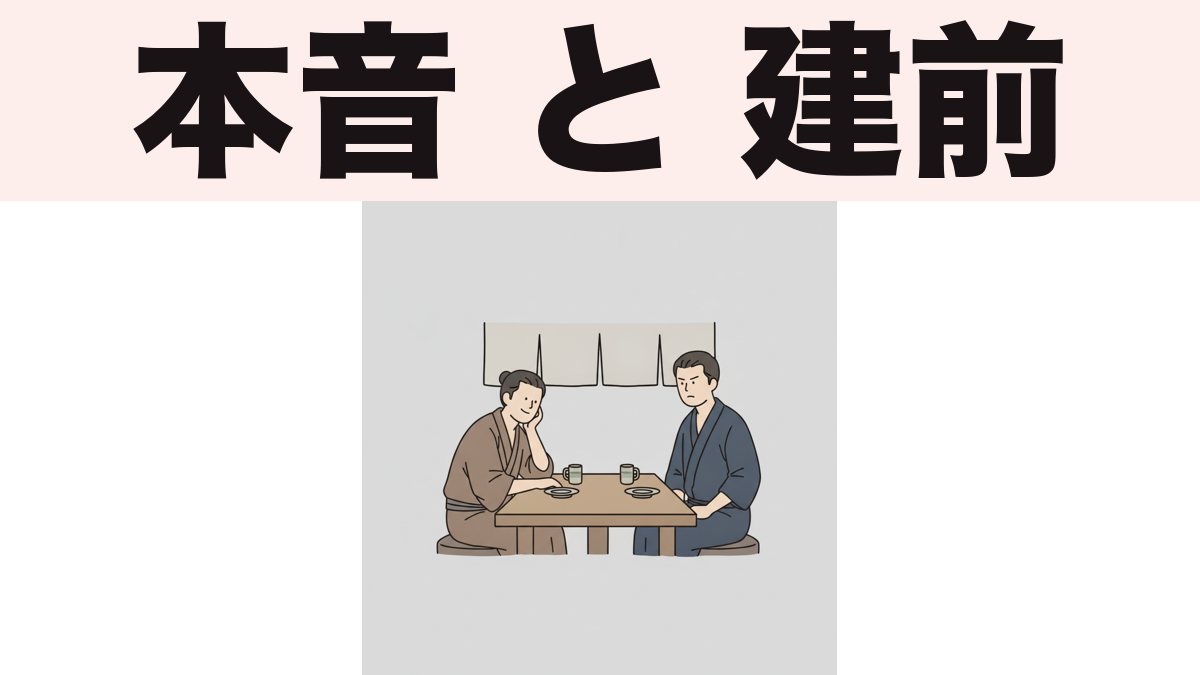
本音 (ほんね) is what you actually think. 建前 (たてまえ) is what the situation requires you to say. Japanese names the gap between them, which is unusual — most languages have the behaviour and no word for it — and the naming is the reason the pair gets described in English as though it were institutionalized dishonesty. It is not.
「本音(ほんね)」は、本当に思っていることです。「建前(たてまえ)」は、その場で言うべきことです。日本語はこの2つの間にあるものに名前をつけました。名前があるので、英語では「日本人はうそをつく」と説明されることがあります。でも、そうではありません。
This is one of the most misrepresented pieces of Japanese culture in English writing about Japan, and it is also genuinely useful to understand, because you will hear 建前 constantly and mistake it for a real answer if you do not know it exists.
The basics
What the words literally say
- 本音 — 本 (true, real) + 音 (sound). The true sound; what comes out when the filter is off.
- 建前 — 建 (build) + 前 (front). Originally the framework of a building: the structure you put up before the walls go on. The public-facing frame.
The metaphors are worth noticing. 本音 is a sound, something that escapes. 建前 is a structure, something you deliberately erect. Neither word implies deceit — one is involuntary, the other is construction work.
本音を言うと、行きたくないです。 — To tell the truth, I don't want to go. (polite — announcing you are dropping the filter) それは建前でしょう。 — That's just the official line, isn't it. (casual-polite — calling something out as 建前)
The most common 建前 you will actually meet
また今度。 — Some other time. (casual — very often means "no") 考えておきます。 — I'll think about it. (polite — in business, usually a refusal) ちょっと難しいですね。 — That's a little difficult. (polite — almost always "no")
None of these is a lie. Each one is a refusal delivered in a form that lets both people keep their dignity, and every Japanese speaker hears the refusal clearly. The information is transmitted; only the bluntness is removed.
If you take ちょっと難しいですね as "possible with effort," you have misheard a clear answer, not been deceived.
Beyond the basics
Why this is not dishonesty
English-language writing often frames 建前 as "the Japanese say one thing and mean another." The framing is wrong in two ways.
First, everyone does this. "We should grab coffee sometime" and "I'll let you know" do exactly the same work in English. Japanese differs in having a name for the practice, not in doing it more.
Second, 建前 is not intended to deceive. A deception succeeds when the other person believes the false thing. 建前 succeeds when both people understand the real message and neither has to say it. The signal is meant to be read.
The learner's actual problem is not moral, it is practical: you do not yet have the ear to read the signal.
How to hear it
A few reliable markers that you are receiving 建前 rather than an answer:
- The sentence trails off. ちょっと…, それはちょっと…, いや、それはね… — an unfinished sentence is a complete refusal.
- The answer is about difficulty rather than willingness. 難しい, 厳しい, 検討します — none of these says no, and all of them mean it.
- There is no follow-up. A genuine 考えておきます comes with a question or a date. A 建前 one closes the topic.
- The register jumps up. A sudden increase in politeness often marks distance being created.
For the broader mechanics of softening, ちょっと and the soft no covers the refusal vocabulary in detail.
Where 本音 comes out
There are recognized settings where the filter comes down, and they are somewhat institutionalized.
飲み会では本音が出ますね。 — People's real feelings come out at drinking parties, don't they. (polite-casual, an observation everyone agrees with)
飲み会 (drinking parties) function partly as a sanctioned space for 本音, which is why they matter more to Japanese working life than the alcohol alone would explain. The related phrase 無礼講 (ぶれいこう) declares a gathering temporarily rank-free, though how literally anyone takes that varies enormously.
建前 is not only about refusals
The word covers any publicly-required position, including institutional ones.
建前では平等ですが、実際は違います。 — Officially it's equal, but in practice it isn't. (polite — 建前 as "the official position")
Used this way, 建前 is close to English "officially" or "on paper," and 実際は ("in reality") is its natural partner. This use appears constantly in journalism and in serious conversation, and it is not about politeness at all.
The words around them
| Japanese | Reading | Meaning |
|---|---|---|
| 本音 | ほんね | true feelings |
| 建前 | たてまえ | the public position |
| 実際 | じっさい | in reality |
| 空気を読む | くうきをよむ | to read the room |
| 遠慮 | えんりょ | holding back out of consideration |
| 気を遣う | きをつかう | to be considerate, to take care |
| 社交辞令 | しゃこうじれい | a social pleasantry |
| 無礼講 | ぶれいこう | a no-rank gathering |
社交辞令 is worth knowing: it names a compliment or invitation offered as courtesy rather than intent. また遊びに来てください ("come and visit again") is often 社交辞令, and treating it as a firm invitation is a classic misstep.
Common mistakes
- Treating 建前 as lying. It is a delivery format, not a falsehood. Both parties know the content.
- Taking ちょっと難しい as "maybe". It is a no. Pushing after it makes the situation worse, not better.
- Assuming Japanese people never say 本音. They do, constantly, in the right settings and with the right people.
- Using 本音を言うと too often. It is a real signal. Prefacing every sentence with it makes the rest of your speech sound like 建前.
- Confusing 建前 with 遠慮. 遠慮 is holding yourself back out of consideration. 建前 is the position you present. They often appear together and they are not the same.
- Reading 建前 as たてまい. It is たてまえ.
How to respond when you hear 建前
| What you hear | What it means | What to do |
|---|---|---|
| ちょっと難しいですね | No | Accept it and move on |
| 考えておきます | Probably no | Do not follow up twice |
| また今度 | Not now, maybe never | Let them propose the next time |
| 前向きに検討します | Almost certainly no | Treat as closed |
| また遊びに来てください | Possibly 社交辞令 | Wait for a specific invitation |
| 本音を言うと… | The filter is coming off | Listen properly |
Practice
Questions 1 and 2 are the pair: the same situation, filter on and filter off.
1. Say "to tell the truth, I don't want to go," politely.
Show answer
本音を言うと、行きたくないです。 — 本音を言うと announces that you are dropping the filter. Use it sparingly and it carries weight.
2. Refuse the same invitation in 建前 form.
Show answer
ちょっと難しいですね。 — A clear refusal that names difficulty rather than unwillingness. Everyone hears the no.
3. What does 考えておきます usually mean in a business context?
Show answer
たいてい「いいえ」です。 — A genuine one comes with a question or a date. Without those, treat the topic as closed.
4. Someone's sentence trails off with それはちょっと…. What have they said?
Show answer
断っています。 — An unfinished sentence is a complete refusal. The silence is the message.
5. Say "that's just the official line, isn't it."
Show answer
それは建前でしょう。 — Naming 建前 out loud is direct, so this is said among people who are comfortable with each other.
6. Say "officially it's equal, but in practice it isn't."
Show answer
建前では平等ですが、実際は違います。 — Here 建前 means "on paper," and 実際は is its natural partner.
7. What is 社交辞令, and what is a typical example?
Show answer
礼儀として言うほめ言葉や誘い。「また遊びに来てください」など。 — Treating it as a firm invitation is a classic misstep.
8. Say "people's real feelings come out at drinking parties."
Show answer
飲み会では本音が出ますね。 — 飲み会 function partly as a sanctioned space for 本音, which is why they matter at work.
9. What is the difference between 建前 and 遠慮?
Show answer
建前建前外に見せる立場 / 遠慮遠慮相手を思って自分をおさえること — They often appear together, but one is a presented position and the other is self-restraint.
10. How do you read 建前?
Show answer
たてまえ — 建 is たて here, not けん. たてまい is a common misreading.
FAQ
Is 建前 unique to Japan? The behaviour is not; the word is. Every culture has socially required statements. Japanese happens to have named the category, which makes it visible and therefore easy to mistake for something distinctively Japanese.
Does this mean I can never trust what someone says? No. Most statements are straightforward. 建前 clusters around refusals, invitations and official positions — the places where a blunt answer would cost someone face.
How long does it take to hear the difference? Longer than the grammar takes, because it depends on register and context rather than vocabulary. The trailing-off marker is the easiest to learn and covers a lot of ground.
Should I use 建前 myself? Yes, and you probably already do in your own language. Using ちょっと難しいですね to decline is polite and completely appropriate for a learner.
Is it rude to say 本音を言うと? Not at all — it is a courtesy, because it warns the listener that what follows is direct. What makes it land badly is using it constantly.
What does 空気を読む have to do with this? It is the skill that makes the system work. Reading the room is how the listener extracts the real message from the 建前 version, which is why 空気が読めない is a genuine criticism.
Vocabulary from this article
Tap the block to select all of it, then copy. In Anki: File → Import, note type Basic, separator Tab — the first column becomes the front, the second the back.
本音	ほんね — true feelings
建前	たてまえ — the public position
実際	じっさい — in reality
社交辞令	しゃこうじれい — a social pleasantry
空気を読む	くうきをよむ — to read the room
遠慮	えんりょ — holding back out of consideration
気を遣う	きをつかう — to be considerate
無礼講	ぶれいこう — a no-rank gathering
飲み会	のみかい — drinking party
検討	けんとう — consideration, review
難しい	むずかしい — difficult
平等	びょうどう — equality
断る	ことわる — to refuse
誘い	さそい — an invitation
立場	たちば — position, standpoint
前向き	まえむき — positive, forward-looking
今度	こんど — next time
正直	しょうじき — honest
I'm Yuuki, a Japanese teacher based in Tokyo. I've taught on italki as a Top 1% teacher and watched over 1,500 anime. The thing worth taking from this one is that 建前 is meant to be understood, not believed — once you hear it that way, it stops feeling like a wall and starts feeling like a form of politeness you already use.
Sources: the author's own lessons and standard reference grammars.
日本の文化の中で、いちばん誤解されている話の1つです。そして、知っておくと本当に役に立ちます。「建前」を「本当の答え」だと思ってしまうことが多いからです。
基本
ことばの意味
- 本音 — 「本(ほんとう)」+「音(おと)」。フィルターを外した時に出る音
- 建前 — 「建てる」+「前」。もとは建物の骨組みのこと。外に見せる形
「本音」は音で、勝手に出るものです。「建前」は建てるもので、自分で立てるものです。どちらにも「だます」という意味はありません。
本音を言うと、行きたくないです。 — To tell the truth, I don't want to go. (polite — announcing you are dropping the filter) それは建前でしょう。 — That's just the official line, isn't it. (casual-polite)
よく出会う「建前」
また今度。 — Some other time. (casual — very often means "no") 考えておきます。 — I'll think about it. (polite — in business, usually a refusal) ちょっと難しいですね。 — That's a little difficult. (polite — almost always "no")
どれもうそではありません。断っているのですが、おたがいが気まずくならない形にしています。日本の人には、はっきり「いいえ」と聞こえています。情報は伝わっていて、きつさだけが取れているのです。
「ちょっと難しいですね」を「がんばればできる」と読んだら、それは聞きまちがえです。だまされたのではありません。
もう少し先へ
なぜ「うそ」ではないのか
英語の説明では「日本人は思っていることとちがうことを言う」と書かれます。でも、2つの点でちがいます。
1つ目。どの国の人もやっています。「またお茶しよう」「連絡するね」も同じはたらきです。日本語は、それに名前をつけただけです。
2つ目。「建前」は、だますためのものではありません。だますなら、相手が信じないといけません。「建前」は、おたがいが本当の意味を分かった上で、口に出さないですませる形です。読まれるために言っています。
学ぶ人の問題は、道徳ではなく、耳です。まだ聞き取れないだけです。
聞き分け方
- 文が途中で終わる。 「ちょっと…」「それはちょっと…」。終わっていない文は、はっきりした断りです。
- やりたいかどうかではなく、難しさの話をする。 「難しい」「厳しい」「検討します」。どれも「いいえ」と言っていません。でも、意味は「いいえ」です。
- 次の話がない。 本当の「考えておきます」には、質問か日にちがついてきます。
- 急にていねいになる。 きょりを取っている合図です。
「本音」が出る場所
フィルターが下がる場所が、ある程度決まっています。
飲み会では本音が出ますね。 — People's real feelings come out at drinking parties, don't they. (polite-casual)
「飲み会」は、本音を言ってもいい場として使われています。日本の仕事で飲み会が大事なのは、お酒のためだけではありません。「無礼講(ぶれいこう)」は「今日は上下なしで」という宣言ですが、どこまで本当かは場合によります。
「建前」は断りだけではありません
建前では平等ですが、実際は違います。 — Officially it's equal, but in practice it isn't. (polite)
この使い方の「建前」は「表向き」です。「実際は」とセットで使います。ニュースやまじめな話でよく出ます。
まわりのことば
| 日本語 | 読み方 | 意味 |
|---|---|---|
| 本音 | ほんね | 本当の気持ち |
| 建前 | たてまえ | 表向きの立場 |
| 実際 | じっさい | 本当のところ |
| 空気を読む | くうきをよむ | 場の気持ちを読む |
| 遠慮 | えんりょ | 相手を思ってひかえる |
| 気を遣う | きをつかう | 気をくばる |
| 社交辞令 | しゃこうじれい | 礼儀としてのことば |
| 無礼講 | ぶれいこう | 上下なしの会 |
「社交辞令」は覚えておくと便利です。「また遊びに来てください」は、多くの場合これです。本当のさそいだと思うと、こまります。
よくある間違い
- 「建前」をうそだと思う。 言い方であって、うそではありません。
- 「ちょっと難しい」を「たぶん大丈夫」と読む。 「いいえ」です。
- 日本人は本音を言わないと思う。 場所と相手がそろえば、よく言います。
- 「本音を言うと」を使いすぎる。 ほかの話が全部「建前」に聞こえます。
- 「建前」と「遠慮」を同じにする。 「遠慮」は自分をおさえること、「建前」は見せる立場です。
- 「建前」を「たてまい」と読む。 「たてまえ」です。
聞いた時どうするか
| 聞いたことば | 意味 | どうするか |
|---|---|---|
| ちょっと難しいですね | いいえ | 受け入れて、次へ |
| 考えておきます | たぶん いいえ | 2回追わない |
| また今度 | 今はちがう | 相手が言うのを待つ |
| 前向きに検討します | ほぼ いいえ | 終わったと考える |
| また遊びに来てください | 社交辞令かも | はっきりした誘いを待つ |
| 本音を言うと… | フィルターが外れる | ちゃんと聞く |
練習
1番と2番が組です。同じ場面で、フィルターのあるなしです。
1. 「本当は行きたくない」と、ていねいに言ってください。
答えを見る
本音を言うと、行きたくないです。 — 「今からまっすぐ言います」という合図です。
2. 同じさそいを、やわらかく断ってください。
答えを見る
ちょっと難しいですね。 — はっきりした断りです。みんなに伝わります。
3. 仕事の場の「考えておきます」は、たいてい何ですか。
答えを見る
たいてい「いいえ」です。 — 本当の時は、質問か日にちがついてきます。
4. 「それはちょっと…」で終わったら、相手は何と言いましたか。
答えを見る
断っています。 — 終わっていない文は、はっきりした断りです。
5. 「それは建前でしょう」と言ってください。
答えを見る
それは建前でしょう。 — まっすぐな言い方なので、仲のいい相手に使います。
6. 「表向きは平等ですが、実際はちがいます」と言ってください。
答えを見る
建前では平等ですが、実際は違います。 — この「建前」は「表向き」です。
7. 「社交辞令」は何ですか。例を1つ出してください。
答えを見る
礼儀として言うことば。「また遊びに来てください」など。 — 本当のさそいだと思うと、こまります。
8. 「飲み会では本音が出ますね」と言ってください。
答えを見る
飲み会では本音が出ますね。 — 飲み会は、本音を言ってもいい場として使われています。
9. 「建前」と「遠慮」のちがいは何ですか。
答えを見る
建前建前見せる立場 / 遠慮遠慮相手を思ってひかえること — いっしょに出ますが、別のものです。
10. 「建前」の読み方は何ですか。
答えを見る
たてまえ — 「たてまい」ではありません。
よくある質問
「建前」は日本だけですか。 ふるまいはどこにでもあります。名前があるのが日本語です。名前があるから、日本だけのことに見えてしまいます。
では、何も信じられないのですか。 そんなことはありません。ふつうの話はそのままです。「建前」は、断り・さそい・表向きの立場のまわりに集まります。
聞き分けられるまで、どのくらいかかりますか。 文法より時間がかかります。ことばではなく、場面と言い方で決まるからです。「途中で終わる文」は、いちばん早く覚えられます。
自分も使っていいですか。 使ってください。自分の国のことばでも、たぶん使っています。「ちょっと難しいですね」で断るのは、ていねいで自然です。
「本音を言うと」は失礼ですか。 ちがいます。「今からまっすぐ言います」と先に知らせる、やさしい形です。使いすぎるとよくありません。
「空気を読む」との関係は何ですか。 「空気を読む」は、建前から本当の意味を取り出す力です。だから「空気が読めない」は本当の批判になります。
この記事に出た単語
このブロックを長く押して全部選び、コピーしてください。Ankiでは ファイル → 読み込み、ノートタイプは 基本、区切りは タブ にします。左が表、右が裏になります。
本音	ほんね — true feelings
建前	たてまえ — the public position
実際	じっさい — in reality
社交辞令	しゃこうじれい — a social pleasantry
空気を読む	くうきをよむ — to read the room
遠慮	えんりょ — holding back out of consideration
気を遣う	きをつかう — to be considerate
無礼講	ぶれいこう — a no-rank gathering
飲み会	のみかい — drinking party
検討	けんとう — consideration, review
難しい	むずかしい — difficult
平等	びょうどう — equality
断る	ことわる — to refuse
誘い	さそい — an invitation
立場	たちば — position, standpoint
前向き	まえむき — positive, forward-looking
今度	こんど — next time
正直	しょうじき — honest
日本語教師のユウキです。東京にいます。 italkiで Top 1% の教師をしています。アニメは1,500本以上見ました。この記事でいちばん大事なのは、「建前」は信じるものではなく、読み取るものだということです。そう聞けるようになると、壁ではなく、自分もふだん使っているていねいさだと分かります。
More drills like the ones above, plus a timed JLPT-style mock test: Practice上のような練習問題と、時間つきのJLPT形式のもぎ試験: 練習ページ
Want to try this in a real conversation?
本当の会話で、ためしてみませんか?
30-minute trial lesson, $13. Times shown in your own timezone.
30分の体験レッスン、$13。時間はあなたのタイムゾーンで表示されます。
Book a trial lesson · $13