Is the JR Pass Worth It in 2026? The Prices, the Catch, and a Five-Minute Test
Only if your trip includes several long Shinkansen rides. The standard-car pass costs 50,000 yen for 7 days on the official website, so it pays off when the regular fares for your planned journeys add up to more than that. For a trip that stays mostly in Tokyo, it almost never does. And passes bought through overseas travel agencies have cost more since 1 October 2026: 53,000 yen for 7 days.
The JR Pass used to be an automatic purchase for first-time visitors. It no longer is: the fastest trains need an extra ticket, and prices through overseas agencies went up again on 1 October 2026. It is still a good deal for the right trip — the point of this page is to find out whether yours is one.
How much does the JR Pass cost in 2026?
On the official website: 50,000 yen for 7 days, 80,000 yen for 14 days and 100,000 yen for 21 days in a standard ("Ordinary") car. The Green Car version, first class, is 70,000, 110,000 and 140,000 yen. Children aged 6 to 11 pay half.
Duration
Standard car (adult)
Green Car (adult)
Standard car (child)
7 days
50,000 yen
70,000 yen
25,000 yen
14 days
80,000 yen
110,000 yen
40,000 yen
21 days
100,000 yen
140,000 yen
50,000 yen
These are the prices on the official site's online purchase table at the time of writing. The pass is paid in yen when bought online; when bought through a travel agency abroad, it is converted into local currency at the exchange rate on the day the voucher is issued.
For a Tokyo-only trip the pass rarely pays off — Akihabara is a few minutes from Tokyo Station on the Yamanote or Keihin-Tohoku line on a normal IC fare, which is how most guests reach my Akihabara anime tour.
What changed on 1 October 2026?
For passes bought through an overseas JR-designated travel agency, the official price table lists higher prices for purchases made from 1 October 2026: 53,000 yen for 7 days, 84,000 yen for 14 days and 105,000 yen for 21 days in a standard car. Green Car passes rise to 74,000, 116,000 and 147,000 yen.
Standard car, adult, via overseas agency
Until 30 Sep 2026
From 1 Oct 2026
7 days
50,000 yen
53,000 yen
14 days
80,000 yen
84,000 yen
21 days
100,000 yen
105,000 yen
The table on the official site states the date by local time where you buy. Buying online on the official site is now the cheaper route. Check the official price page on the day you pay — prices are marked as subject to change, and the price shown when you pay is the one that applies.
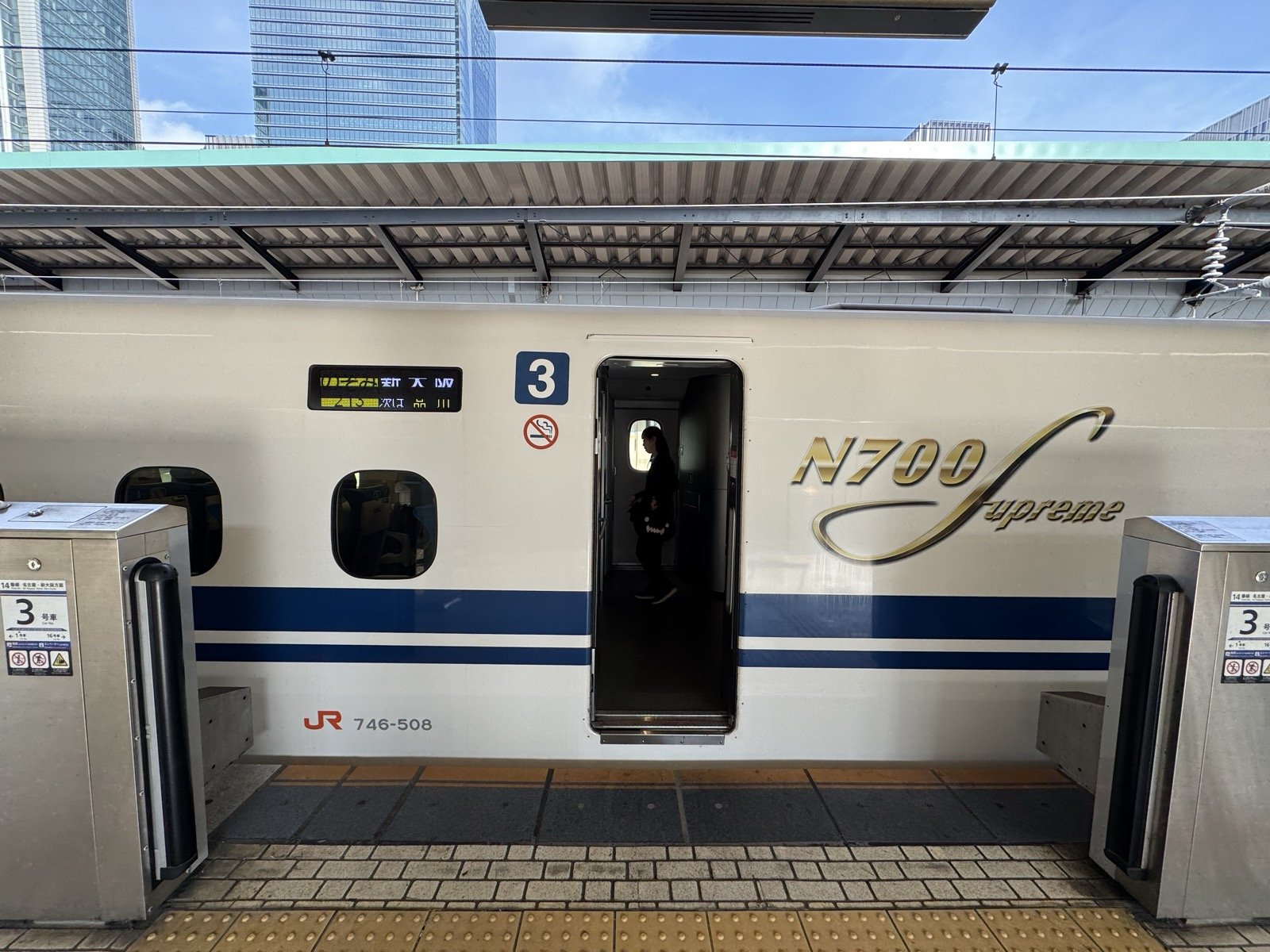
An N700S Supreme at the Tokyo Station platform, bound for Shin-Osaka (Feb 2026)
Can you ride the Nozomi with a JR Pass?
Not on the pass alone. The Nozomi and Mizuho, the fastest trains on the Tokaido, Sanyo and Kyushu Shinkansen, need an extra ticket that only pass holders can buy. It costs 4,960 yen from Tokyo to Kyoto or Shin-Osaka, per trip, per person. Without it, you ride the slightly slower Hikari and Kodama trains, which the pass covers.
Route (one way)
Extra Nozomi/Mizuho ticket
Tokyo – Nagoya
4,180 yen
Tokyo – Kyoto
4,960 yen
Tokyo – Shin-Osaka
4,960 yen
Tokyo – Hiroshima
6,500 yen
Shin-Osaka – Hakata
4,960 yen
Hakata – Kagoshima-Chuo
5,150 yen
You buy it at ticket machines or ticket offices, from one month before the day of travel, and you need a new one for every Nozomi ride. For most travellers the honest answer is: take the Hikari. It adds a little time between Tokyo and Kyoto and costs nothing extra on the pass.
How do you tell if the JR Pass is worth it for your trip?
Write down every JR train journey you are sure to make, look up the regular one-way fare for each on JR's official fare search or at a station, and add them up. If the total is clearly more than the pass price for the same number of days, buy the pass. If it is close or lower, buy individual tickets.
That is the whole calculator. A few rules make the result honest:
Count only journeys you will definitely make. "Maybe a day trip to Nikko" is not a saving until it is on the plan.
Count a return trip as two journeys. Tokyo to Kyoto and back is two fares.
Leave out city travel. Short hops inside Tokyo cost little, and a transit card handles them — Suica on your iPhone covers how.
Leave out non-JR lines. Subways and private railways are not covered, and in Tokyo many of the useful lines are exactly those.
Add the Nozomi ticket if you will not ride the Hikari. Otherwise the comparison is flattering the pass.
The fare search is worth five minutes before buying anything. Most people who do it find the answer is obvious either way.
Is there a JR Pass calculator?
Not an official one. The JR Pass site does not publish a tool that takes your itinerary and tells you whether it pays off — what passes for "the calculator" is the five-minute method above, done by hand with two numbers.
Trip side: add up the one-way fares, from JR's own fare search, for every journey you will definitely make. Add the Nozomi/Mizuho ticket price (4,180–6,500 yen per ride, from the table above) for any ride where you won't settle for the Hikari.
Pass side: take the price for your length of stay from the price table above — 50,000 / 80,000 / 100,000 yen online for 7 / 14 / 21 days, or 53,000 / 84,000 / 105,000 yen through an overseas agency from 1 October 2026.
Compare: if the trip side is higher, the pass pays off. If it's close or lower, buy individual tickets.
No app or official calculator does this for you because it depends on a route only you know. The two numbers above are the whole calculation.
When is the JR Pass usually worth it?
When a single trip packs in several long-distance Shinkansen rides inside 7, 14 or 21 days — typically a route that goes out from Tokyo to western Japan and on further, rather than out and back once. The longer the distances and the more of them fall inside the pass window, the more it pays.
When it usually is not worth it:
A Tokyo-only trip. City fares are small, and many Tokyo lines are not JR.
One out-and-back trip. Tokyo to Kyoto and back, on its own, needs checking carefully against the price.
A trip longer than the pass with the long rides spread out. Starting the pass on the first long ride and ending it on the last is fine, but if those rides are three weeks apart the window cannot cover both.
Regional passes cover a single area, and the official JR Pass site links to them for visitors who "will only be in Japan for a few days." What else to arrange before you fly is in what to book before your Tokyo trip.
What about luggage and seats?
You can reserve seats as a pass holder, and booking them online before you collect the pass is possible only when you buy it on the official website. Large suitcases are awkward on a busy Shinkansen, so it is often easier to send the case ahead.
Sending luggage between hotels by courier is the traveller's trick for Shinkansen days — luggage forwarding in Japan explains how. You then board with a small bag and any seat will do.
Common mistakes
Buying the pass by default without adding up the fares, forgetting the Nozomi ticket, and assuming it covers Tokyo's subways. All three make the pass look like better value than it is.
Mistake
Why it matters
Instead
Buying without checking fares
The pass may cost more than your tickets
Add up your fixed journeys first
Boarding a Nozomi on the pass alone
Not covered without the extra ticket
Buy the ticket or take the Hikari
Expecting subways to be included
Tokyo Metro and Toei are not JR
Use a transit card for city travel
Counting "maybe" trips
Inflates the saving
Count only certain journeys
Starting the pass on day one by habit
Wastes days of the window
Start it on your first long ride
Frequently asked questions
Q
Is the JR Pass worth it for Tokyo, Kyoto and Osaka?
Run the test. One trip from Tokyo to Kyoto, Kyoto to Osaka and Osaka back to Tokyo within a week needs to be priced against 50,000 yen. It can be close, which is exactly why looking up the real fares matters.
Q
Does the JR Pass cover the Yamanote Line in Tokyo?
YESThe Yamanote Line is JR. That includes Akihabara station, which is on it — getting to Akihabara station shows which exit to use. Tokyo Metro and Toei subway lines are not covered.
Q
Can children use a cheaper pass?
YESChildren aged 6 to 11 at the time of use pay half the adult price. Children who are 12 are charged as adults, with a small exception for the date of purchase explained on the official site.
Q
Is the Green Car pass worth it?
Only if comfort matters more than money. It costs 20,000 yen more than the standard pass for 7 days, and standard reserved seats on the Shinkansen are already comfortable.
Q
Is there a JR Pass calculator?
There is no official one that knows your plan. The practical calculator is the list of journeys above, priced with JR's own fare search.
Q
I'm only in Tokyo for a few days of anime and shopping. Do I need it?
Five minutes with the fare search replaces every rule of thumb about the JR Pass. If the total beats the pass price, buy it; if not, buy tickets, and spend the difference on the trip.
About the author. I am Yuuki, a Japanese teacher and Akihabara anime tour guide based in Tokyo. I run private anime tours in Akihabara, rated 4.96★ on Airbnb across 171 reviews, and "should I get the JR Pass?" is one of the first questions guests ask when they are planning the rest of their trip. I also teach Japanese one-on-one online as an italki Top 1% teacher, 5.0★ across 358 reviews.
A private half-day with a local otaku guide, planned around your fandom. Three to four hours in English, never mixed with other travelers, rated 4.96 by 171 Airbnb guests. Booking here goes straight into my calendar.