Talking about your job in Japanese — the one particle that trips everyone日本語で仕事について話す みんながつまずく1つの助詞
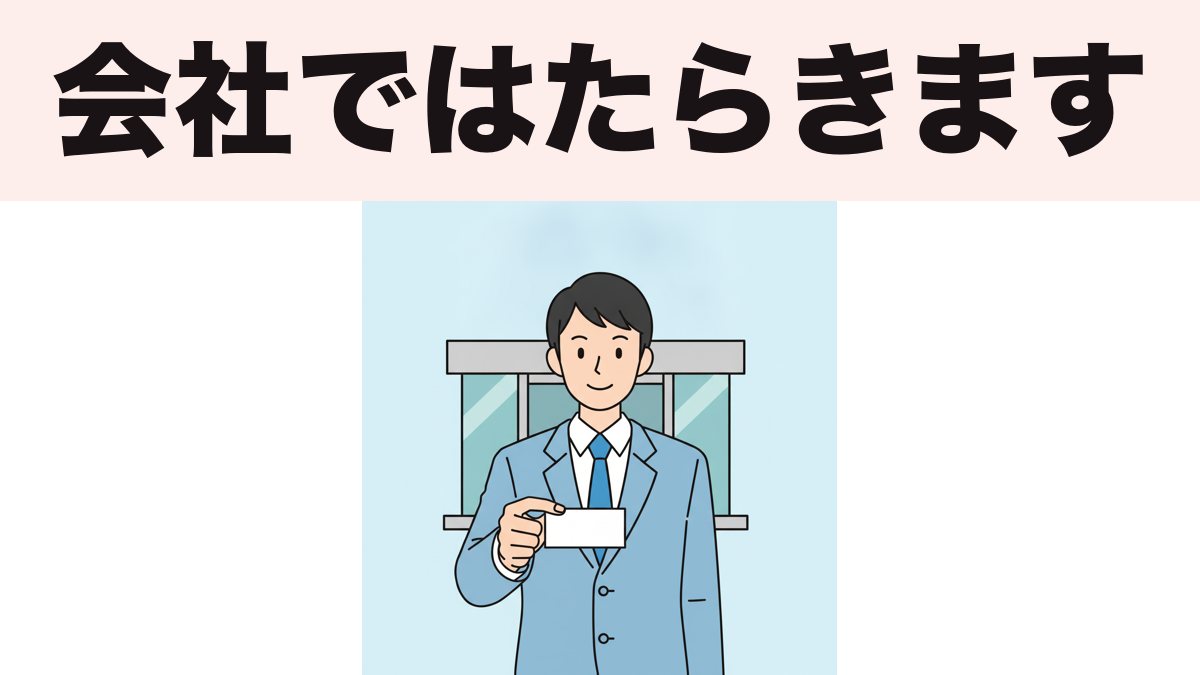
From a lesson with C., a student who works in sales. Details changed to keep it anonymous. He'd been studying about six months and could read hiragana and katakana, but hadn't said much out loud yet.
Short version: to say where you work, the particle you want is で — not に, not を.
わたしは かいしゃで はたらきます。 I work at my company.
Every learner I've taught gets this wrong at least once, and it's always the same wrong guess: に.
Why に feels right and isn't
に marks a destination — where something goes.
とうきょうに いきます。 — I go to Tokyo.
Working isn't going anywhere. で marks the place where an action happens.
スタジアムで サックスを えんそうしました。 — I played sax at the stadium. かいしゃで はたらきます。 — I work at my company.
Once you hear it as "the place the action happens" instead of "at", it stops being a rule you memorise.
The three questions that follow
In lessons, "what's your job" is never one question. It's three, and they come in this order every time:
| Japanese | English |
|---|---|
| しごとは なんですか? | What's your job? |
| なんの しごとですか? | What kind of work is it? |
| いそがしいですか? | Is it busy? |
C.'s answers, in order: かいしゃで はたらきます → セールス/えいぎょうです → すこし。
That last one — すこし, "a little" — is worth more than it looks. It's a complete, natural answer to a yes/no question, and it saves you from building a whole sentence when you're not ready to.
Words from this lesson
| 日本語 | English |
|---|---|
| しごと | job, work |
| はたらく/はたらきます | to work |
| 〜で はたらく | to work at 〜 |
| セールス/えいぎょう | sales |
| いそがしい | busy |
| たぶん | maybe |
| しゅみ | hobby |
Why this is the second thing we do
The first is introducing yourself. The second is your job — because it's the question every Japanese person will ask you within two minutes of meeting, and because it's yours. You already know the answer in English. All we're doing is moving it across.
Then we go straight to しゅみ (hobbies), which for most of my students means anime — and that's where the lesson actually starts.
Want your own version of this? The 30-minute trial is where we find out which questions you'll actually need.
ある生徒とのレッスンから書きました。営業の仕事をしている人です。特定されないように、内容は少し変えています。日本語の勉強を始めて半年くらいで、ひらがなとカタカナは読めましたが、声に出して話す機会はまだあまりありませんでした。
短く言うと、どこで働いているかを言うときに使う助詞は「で」です。「に」でも「を」でもありません。
わたしは かいしゃで はたらきます。 I work at my company.
わたしが教えたことがある生徒は、少なくとも一度はここでまちがえます。そして、いつも同じまちがい、「に」を選んでしまいます。
なぜ「に」が正しく感じるのに、そうではないのか
「に」は行き先、つまり「どこへ行くか」を表します。
とうきょうに いきます。 — I go to Tokyo.
働くことは、どこかへ行くことではありません。「で」は、行動が起きる場所 を表します。
スタジアムで サックスを えんそうしました。 — I played sax at the stadium. かいしゃで はたらきます。 — I work at my company.
「〜で」を「〜に」ではなく「その行動が起きる場所」として覚えると、丸暗記しなければいけないルールではなくなります。
続けて聞かれる3つの質問
レッスンでは、「仕事は何ですか」は1つの質問では終わりません。いつも3つの質問が、この順番で続きます。
| 日本語 | 英語 |
|---|---|
| しごとは なんですか? | What's your job? |
| なんの しごとですか? | What kind of work is it? |
| いそがしいですか? | Is it busy? |
その生徒の答えは、順番にこうでした。かいしゃで はたらきます → セールス/えいぎょうです → すこし。
最後の答え、すこし(少し)は、見た目より価値があります。はい・いいえで答える質問に対する、完成された、自然な答えだからです。まだ文を組み立てる準備ができていないときに、それを助けてくれます。
このレッスンで出てきたことば
| 日本語 | 英語 |
|---|---|
| しごと | job, work |
| はたらく/はたらきます | to work |
| 〜で はたらく | to work at 〜 |
| セールス/えいぎょう | sales |
| いそがしい | busy |
| たぶん | maybe |
| しゅみ | hobby |
なぜこれを2番目にやるのか
最初にやるのは自己紹介です。2番目が仕事についてです。理由は、日本人が初対面の2分以内にほぼ必ず聞いてくる質問だから、そして「自分自身のこと」だからです。英語での答えはもう知っているので、それを日本語に置きかえるだけです。
そのあとは、しゅみ(趣味)の話に進みます。わたしの生徒の多くにとって、それはアニメの話になり、そこからレッスンが本当に始まります。
同じようなレッスンを自分でも受けてみたいですか?30分の体験レッスンで、あなたに本当に必要な質問がどれか、いっしょに見つけます。
More drills like the ones above, plus a timed JLPT-style mock test: Practice · N5上のような練習問題と、時間つきのJLPT形式のもぎ試験: 練習ページ · N5
Want to try this in a real conversation?
本当の会話で、ためしてみませんか?
30-minute trial lesson, $13. Times shown in your own timezone.
30分の体験レッスン、$13。時間はあなたのタイムゾーンで表示されます。
Book a trial lesson · $13